
Guide
Does Gundry MD Total Restore work? What is in the capsule and what the trials say
Quick answer
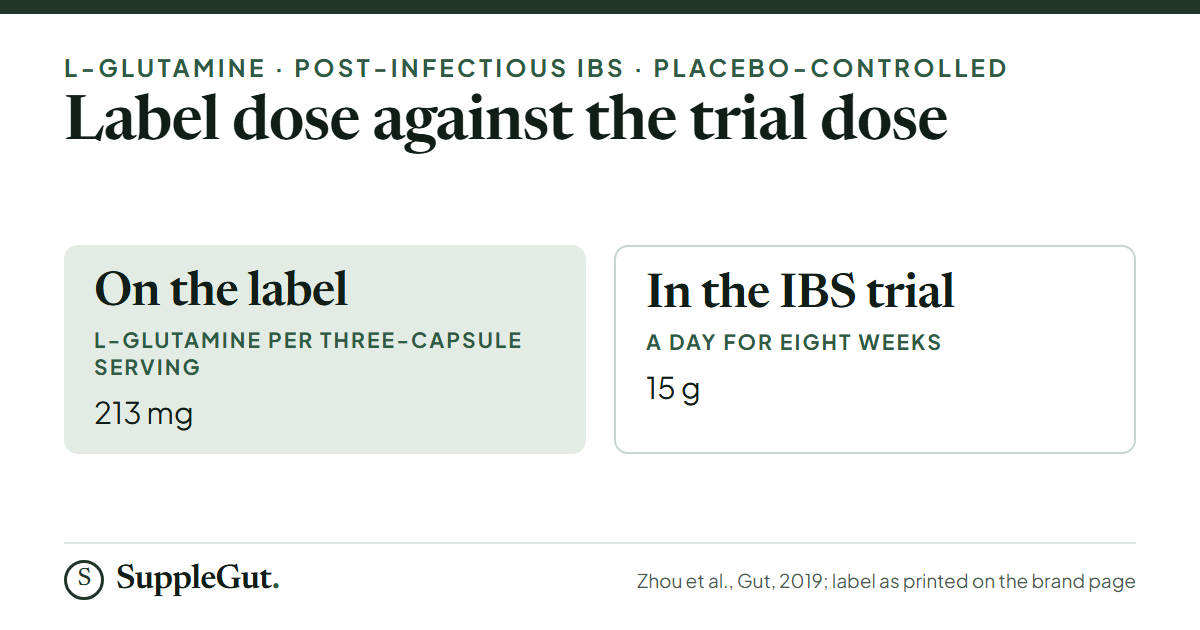
Does Total Restore work? No trial of the finished capsule was found. Its lead ingredient, L-glutamine, relieved post-infectious IBS in an eight-week placebo-controlled trial (79.6% responders against about 5.8%), but at 15 g a day; the label has 213 mg, about one-seventieth of that. Its zinc carnosine kept gut permeability from rising in a 10-person crossover study at 75 mg a day; the label has 10 mg. Amazon reviewers split: 62% give five stars and 11% give one.
Total Restore is Gundry MD’s three-capsule daily “gut lining” formula: an amino acid, a zinc and carnosine compound, and a long list of plant extracts, each printed with its own amount. What makes it different from the single-ingredient glutamine or zinc carnosine products is the length of the list, packed into about 0.8 g a serving, and what that means for each ingredient’s dose is the question this page works through.
What Total Restore is, and what it is not
A serving is three capsules and a bottle of 90 is 30 servings. Every ingredient has its own amount, so there is no proprietary blend:
| Ingredient | On the label (per 3 capsules) | Dose in the trial we found |
|---|---|---|
| L-glutamine | 213 mg | 15 g a day, 8 weeks (post-infectious IBS) |
| Zinc L-carnosine (PepZin GI) | 10 mg | 75 mg a day, 5 days (10 volunteers) |
| Berberine | 3 mg | 400 mg a day, 8 weeks (IBS-D) |
| N-acetyl-D-glucosamine, magnesium BHB, grape seed, licorice, wormwood, cinnamon, maitake, berries, cloves, black pepper, grapefruit seed, marshmallow root | 10 to 142 mg each | No gut-symptom trial at that dose looked up |
It is not a probiotic; the brand says so. It contains crab and shrimp shellfish, the source of the N-acetyl-D-glucosamine, so it is not vegan and not for anyone with a shellfish allergy. The wormwood is named Artemisia absinthium on a 2022 label record and Artemisia annua on today’s page; the brand does not say which is in the capsule.
The trial of the capsule itself
There isn’t one. We searched PubMed and ClinicalTrials.gov for the product and found no trial. The brand’s page cites a 12-week consumer perception study of 18 participants (94% smoother digestion, 89% fewer cravings, 83% more energy) and describes it as self-reported and subjective; we found no publication or control group for it.
The evidence for the ingredients
L-glutamine. In an eight-week placebo-controlled trial in adults with post-infectious diarrhea-predominant IBS and raised gut permeability, 5 g three times a day brought a fall of 50 points or more on the IBS severity score in 43 of 54 completers (79.6%) against about 5.8% on placebo, and permeability normalized in the glutamine group (Zhou et al., Gut, 2019). A six-week trial added 15 g a day to a low-FODMAP diet: 88% (22 of 25) improved by more than 45%, against 60% (15 of 25) on the diet alone (Rastgoo et al., Frontiers in Nutrition, 2021). Across ten trials in 352 people, glutamine had no significant overall effect on gut permeability; only the subgroup above 30 g a day did (Abbasi et al., Amino Acids, 2024).
Zinc carnosine. In 10 healthy volunteers given indomethacin, a drug that loosens the gut barrier, the permeability ratio rose from 0.35 to 0.88; with 37.5 mg of zinc carnosine twice a day (75 mg) it did not rise significantly (Mahmood et al., Gut, 2007). In eight volunteers, zinc carnosine or colostrum cut the rise in permeability after heavy exercise by 70% (Davison et al., American Journal of Clinical Nutrition, 2016). Both are permeability studies in healthy people under stress, not symptom trials.
Berberine. The one IBS-D trial found enrolled 132 patients on 400 mg of berberine hydrochloride a day, in two doses, for eight weeks, with fewer episodes of diarrhea (P = 0.032), abdominal pain (P < 0.01) and urgency (P < 0.01) than placebo (Chen et al., Phytotherapy Research, 2015). The label has 3 mg.
Read together: the zinc carnosine evidence is at 7.5 times the label dose, and the glutamine evidence on symptoms is at about 70 times. For the other plant ingredients we found no trial of a gut symptom at the label amount.
How to take Total Restore
The directions are three capsules a day with an 8 oz glass of water, ideally with a meal. The brand suggests taking all three with your biggest meal, or one with each meal if you prefer. The symptom trials of glutamine ran six to eight weeks, so that is the span the evidence covers.
Side effects and who should not take it
The label says to talk to a doctor before any new supplement if you have a medical condition or take medication, to stop if allergic to an ingredient, and to keep it from children; the brand page adds that it is not a substitute for medication and asks for a provider’s advice before giving supplements to anyone under 18. We found no pregnancy or nursing statement. Shellfish is declared. The panel prints “Licorice Roots and Rhizomes Powder 54 mg” without saying whether the glycyrrhizin has been removed; NIH’s NCCIH says glycyrrhizin can cause serious effects, such as irregular heartbeat, especially in large or long-term amounts, with higher risk in people with high blood pressure, heart or kidney disease, and reports of an interaction with corticosteroids. The label gives no glycyrrhizin amount.
What the reviews say
The independent product pool is Amazon, 4.1 from 9,333 ratings (62% five-star, 5% two-star, 11% one-star). Trustpilot (3.5 from 7,366) and the Better Business Bureau (A+, 4.05 from 1,284 reviews, 185 complaints in three years) cover every Gundry MD product, and the brand’s “41,000+ verified 5-star reviews” also spans all products.
The praise is less bloating, easier digestion and quick relief for some, and refunds given when it did nothing. The complaints are no effect, the price, early diarrhea, feeling worse, and neck and shoulder pain after taking it; the subscription reports are below.
The subscription and refund terms
The brand’s terms are a 90-day money-back guarantee and cancel-anytime subscriptions at $41.95 a bottle. A brand reply on Trustpilot says products must be returned for a full refund and that return shipping is not included. Reviewers who name Total Restore report auto-refills they did not expect, a three-bottle shipment of $107.82 that cost $25.52 to send back, a guarantee described as expired for six sealed bottles, and one claim of a $21.95 cancellation charge that has no brand reply and that the page’s cancel-anytime line contradicts. These are reviewer accounts. A single bottle can be bought one-time on the brand site ($69.95) or on Amazon, and the brand says third-party listings elsewhere are not guaranteed authentic.
Who Total Restore is for
- Someone who wants a many-ingredient formula with every amount printed and no probiotic.
- A person with no shellfish allergy who is comfortable with 0.8 g of mixed extracts.
- Someone who will give it a trial period and use the 90-day guarantee, returning the product if it does nothing.
If the interest is one ingredient at a studied dose, the catalog has single-ingredient products: NOW Foods L-Glutamine Powder, Thorne L-Glutamine Powder and Doctor’s Best PepZin GI. Thorne Berberine is the berberine product. The page for this one is Gundry MD Total Restore.
Cost
One bottle is $69.95 on the brand site, which is $2.33 a day; $49.95 with a free account ($1.67 a day); and $41.95 on a monthly subscription ($1.40 a day). Six bottles at once cost $353.70 ($1.97 a day). Amazon lists $69.95 for one bottle and $157.95 for three ($1.76 a day).
The products in this catalog
Common questions
Does Total Restore work?
No trial of the finished capsule was found. Glutamine helped IBS symptoms in two trials that used 15 g a day, and the label has 213 mg. Zinc carnosine kept gut permeability from rising in a 10-person crossover study at 75 mg a day, and the label has 10 mg. Amazon reviewers split: 62% give five stars and 11% give one star.
What are the ingredients in Total Restore?
Each ingredient has its own amount on the label and there is no proprietary blend. Per three capsules: L-glutamine 213 mg, N-acetyl-D-glucosamine 142 mg, magnesium beta-hydroxybutyrate 86 mg, grape seed extract 58 mg, licorice root 54 mg, wormwood 50 mg, cinnamon 50 mg, maitake 34 mg, a six-berry blend 22 mg, cloves, black pepper and grapefruit seed 17 mg each, marshmallow root 10 mg, zinc L-carnosine 10 mg and berberine 3 mg. It contains crab and shrimp shellfish and no probiotic.
What are Total Restore side effects?
The label lists none beyond advice to talk to a doctor if you have a medical condition or take medication, and it states that it contains shellfish. Reviewers report diarrhea in the first days, nausea, feeling worse, and neck and shoulder pain; others report none. The licorice is not described as deglycyrrhizinated, and NIH notes that glycyrrhizin in licorice can cause serious effects, such as irregular heartbeat, in large or long-term amounts.
How do you take Total Restore?
Three capsules a day with 8 ounces of water, ideally with a meal. The brand suggests all three with your biggest meal, or one with each meal. The glutamine trials that measured symptoms ran six to eight weeks.
How much does Total Restore cost?
On the Gundry MD site one bottle is $69.95, $49.95 with a free account, or $41.95 on a monthly subscription. A bottle is 30 servings, so $69.95 is $2.33 a day. Amazon lists $69.95 for one bottle and $157.95 for three.
What do the subscription and refund terms say?
The brand states a 90-day money-back guarantee and “cancel anytime” on subscriptions. A brand reply to a reviewer says products must be returned for a full refund and return shipping costs are not included. Trustpilot reviewers who bought Total Restore report unexpected auto-refills, shipments charged before they could return them, and paying return postage.
Total Restore vs Bio Complete 3?
Both are Gundry MD capsules at a $69.95 list price. Total Restore is three capsules a day of glutamine, zinc carnosine, N-acetyl-D-glucosamine and plant extracts, with no probiotic, and it contains shellfish. Bio Complete 3 is two capsules a day of a prebiotic fiber blend, tributyrin and two probiotic species; see its page.
Sources
- Zhou Q, Verne ML, Fields JZ, et al. "Randomised placebo-controlled trial of dietary glutamine supplements for postinfectious irritable bowel syndrome." Gut, 2019;68(6):996–1002. doi.org/10.1136/gutjnl-2017-315136
- Rastgoo S, Ebrahimi-Daryani N, Agah S, et al. "Glutamine Supplementation Enhances the Effects of a Low FODMAP Diet in Irritable Bowel Syndrome Management." Frontiers in Nutrition, 2021;8:746703. doi.org/10.3389/fnut.2021.746703
- Abbasi F, Haghighat Lari MM, Khosravi GR, et al. "A systematic review and meta-analysis of clinical trials on the effects of glutamine supplementation on gut permeability in adults." Amino Acids, 2024;56(1):60. doi.org/10.1007/s00726-024-03420-7
- Mahmood A, FitzGerald AJ, Marchbank T, et al. "Zinc carnosine, a health food supplement that stabilises small bowel integrity and stimulates gut repair processes." Gut, 2007;56(2):168–175. doi.org/10.1136/gut.2006.099929
- Davison G, Marchbank T, March DS, et al. "Zinc carnosine works with bovine colostrum in truncating heavy exercise-induced increase in gut permeability in healthy volunteers." American Journal of Clinical Nutrition, 2016;104(2):526–536. doi.org/10.3945/ajcn.116.134403
- Chen C, Tao C, Liu Z, et al. "A Randomized Clinical Trial of Berberine Hydrochloride in Patients with Diarrhea-Predominant Irritable Bowel Syndrome." Phytotherapy Research, 2015;29(11):1822–1827. doi.org/10.1002/ptr.5475
- NIH National Center for Complementary and Integrative Health. "Licorice Root." nccih.nih.gov/health/licorice-root
- NIH Dietary Supplement Label Database, Total Restore label record: directions, warnings and ingredients. dsld.od.nih.gov/label/210836
- Brand page: label, directions, price, guarantee and subscription options. gundrymd.com/p/total-restore
- Amazon listing: price and ratings. amazon.com/dp/B07G6624KR
Not sure which product fits your situation?
This guide covers the mechanics. The quiz takes your specific symptoms, routine and preferences and matches you to one product from the catalog.
Take the quiz →