
Guide
Does Snap Gut Health work? Three blends, an H. pylori strain with no printed amount, and what its trials measured
Quick answer
Does Snap Gut Health work? We could find no trial of Snap Gut Health. Its Pylopass L. reuteri was tested in seven human studies of people with H. pylori; in the four trials that added it to antibiotics, two found higher eradication (91.1% against 68.9%, and 96.7% against 86.0%) and two found none. The label prints three proprietary blends (850, 200 and 325 mg) with no amount for any ingredient, no cell count and no statement whether the L. reuteri is live. A bottle costs about $1.32 a day on the brand site.
Snap Gut Health is a two-capsule-a-day product from Snap Supplements, sold mostly on Amazon and built around three proprietary blends. Its distinguishing ingredient is Pylopass, a trademarked Lactobacillus reuteri strain tested in people with H. pylori infection. This page sets out what the label prints and leaves out, what the trials measured, and what it costs.
What Snap Gut Health is, and what the label leaves out
The panel lists zinc at 15 mg and then three proprietary blends. Inside each blend the ingredients are named but no individual amount is printed.
| Blend | Total | Named inside | Left out |
|---|---|---|---|
| Mucosal Lining and Cell Support | 850 mg | Turmeric root, barberry root bark extract, zinc complex, turkey rhubarb root, aloe leaf extract, Ceylon cinnamon, fulvic acid | Every amount |
| Digestive Blend | 200 mg | Protease, amylase, cellulase, lactase, lipase, chicory root inulin, FOS | Enzyme activity units, inulin and FOS split |
| H. pylori Relief Blend | 325 mg | Pylopass L. reuteri, peppermint leaf, fennel seed, deglycyrrhizinated licorice extract, Bacillus clausii, Bacillus subtilis | Every amount, and any CFU or cell count |
The L. reuteri is printed as “Pylopass”, the name of one strain, but the strain number (DSM 17648) is not on the panel; it is identified through the trial papers. The label does not say whether those cells are live or non-viable, and every Pylopass trial used non-viable cells. B. clausii and B. subtilis carry no strain code and no count. The panel image prints no serving size; Vitacost’s text gives two capsules and 25 servings in a 50-capsule bottle.
The listing states third-party testing and a GMP-certified facility but names no laboratory and no manufacturer. The brand does not test for H. pylori, so nothing about the product shows whether the infection is present.
The trial of the product itself
We could find none. The brand page says “every component is backed by research” and links no study, and a PubMed search for the product and its ingredients together returned nothing. Whatever the trials below show applies to the strain, not to this capsule.
The evidence for Pylopass
Pylopass has seven human studies, all in people who had tested positive for H. pylori. None enrolled people chosen for bloating or irregularity.
Without antibiotics, three small single-blind studies measured change in a breath test for the infection. A 14-day pilot in 27 infected adults found a change of −4.9 against −0.6 on placebo (p = 0.026). A 14-day crossover in 22 adults found Pylopass against placebo at p = 0.084, a trend. A 56-day study in 24 adults with mild dyspepsia found symptom scores fell, but Pylopass against placebo was p = 0.200, and its breath-test change was not significant. The strain’s supplier or manufacturer supported all three.
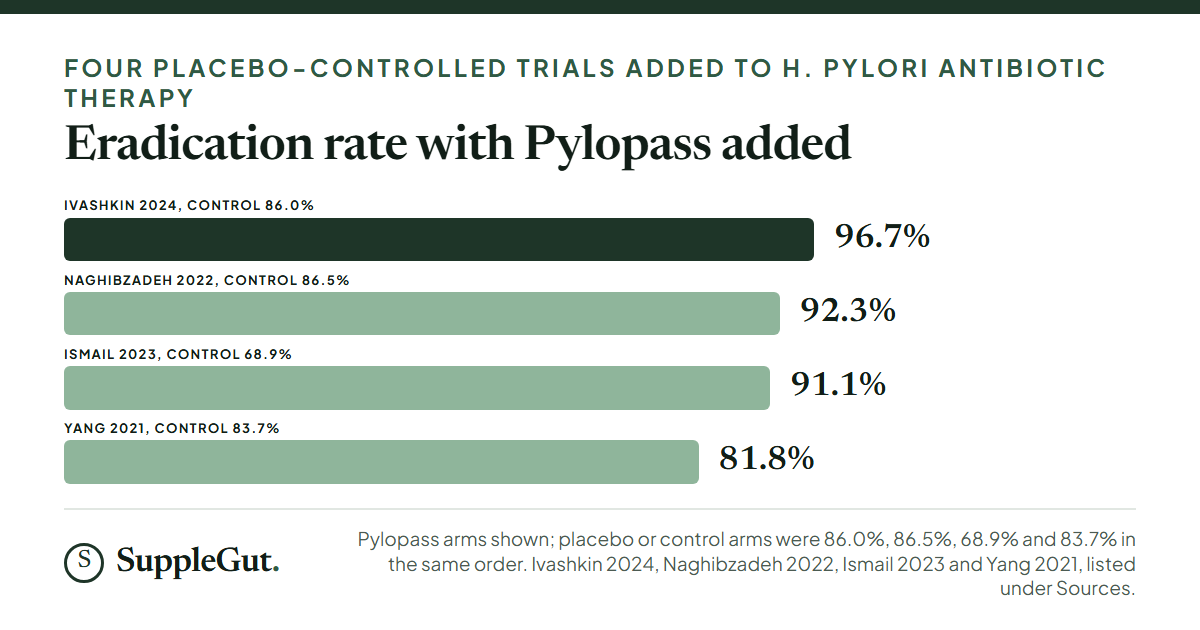
As an add-on to antibiotics, four randomized placebo-controlled trials split two and two:
- 90 patients (triple therapy, then 4 weeks of Pylopass): eradication 91.1% against 68.9% (p = 0.007),.
- 129 patients with functional dyspepsia and H. pylori (117 analyzed): 96.7% against 86.0% per protocol (p = 0.039), sponsored by Novozymes and Parusin.
- 200 patients: 81.8% against 83.7% (p = 0.730), no eradication benefit.
- 156 patients on quadruple therapy: 92.3% against 86.5% with no difference between arms.
Read together, the strain has mixed results on eradication and small pilots without antibiotics.
The trial doses and the label do not line up. The studies gave 200 to 400 mg of Pylopass a day (two 100 mg tablets in one, 200 mg twice a day in another); the two earliest gave four 250 mg tablets, with the Pylopass mass per tablet not stated. Snap prints 325 mg for the whole H. pylori Relief Blend, which holds six ingredients, and does not say how much of it is Pylopass.
The evidence for the other ingredients
Enzymes. A narrative review of multi-enzyme products for after-meal IBS-like symptoms reports a long run of mostly positive trials and notes that none was designed to show which component does what. Our digestive enzymes guide covers where enzyme trials are strongest.
Turmeric. In 132 patients with functional dyspepsia, four weeks of Curcuma longa lowered pain score by 16.98 points against 10.53 on placebo (p < 0.001), with no difference from omeprazole. The turmeric here shares an 850 mg blend with six other ingredients.
Chicory inulin. A trial of 12 g a day for four weeks raised stool frequency from 3.0 to 4.0 a week in 44 adults with constipation. Snap’s whole Digestive Blend is 200 mg for enzymes, inulin and FOS together, so the inulin is at most about 1.7% of the trial dose. Inulin and FOS are fermentable fibers, which can themselves cause gas.
Aloe. A 110-patient IBS crossover trial (47 completed) found an aloe vera drink no better than placebo for quality of life; that was 60 mL twice a day, not a leaf extract in a capsule. Peppermint, fennel, licorice, cinnamon, barberry and fulvic acid have no printed amounts, and we did not evaluate them separately.
How to take it, and the 7-day break
The dose is two capsules a day, and the instructions conflict by channel. The brand page says on an empty stomach; Amazon says to take it with food; Vitacost says with or without. The cycle is also described two ways. The brand’s How To Use section names a 5-day reset, while its FAQ and Amazon describe a bottle of 25 days followed by a 7-day break. The brand shows a “30-day supply” beside the price although 50 capsules at two a day lasts 25 days; with the break, one bottle covers 32 calendar days.
Side effects and who should check first
The brand’s FAQ lists loose bowel movements, mild headaches and slight cramping and says to stop and consult a healthcare professional if symptoms last beyond a few days. Its page tells anyone who is pregnant or nursing, under 18, taking medication or with a medical condition to consult a doctor. The formula includes turkey rhubarb root, aloe leaf extract and barberry root bark with no amounts, and the text we read carries no warning specific to any of them. For bacterial products in general, see the probiotic side effects guide.
What the reviews say
- Amazon, single 50-capsule bottle: 4.5 from 410 ratings, an independent pool, with the listing ranked first in Amazon’s lipase supplement category.
- Brand page: 4.8 from 79 reviews, self-hosted, with no review text in the page we read.
- Trustpilot: 4.7 from 110 reviews, with 78% five-star and 3% one-star, for the whole brand, not this product.
- Vitacost: 14 reviews, no average shown.
The recurring praise, read at brand level, is capsules that are easy to take with no aftertaste and some reports of better digestion and energy. The complaints are few. One 1-star reviewer says they were put into a subscription without knowing and spent about 20 minutes on the phone to cancel; the brand’s home page says cancelling takes one click. Another reports half an order arriving and a refund only after an initial denial.
Price, subscriptions and the refund terms
| Route | Price | Per day (25-day bottle) |
|---|---|---|
| Brand site, one time | $32.95 | $1.32 ($1.03 per calendar day with the 7-day break) |
| Brand site, subscription | $28.01 a month | $1.12 |
| Amazon, single bottle | from $29.95 | $1.20 |
| Amazon, Subscribe & Save | $23.96 | $0.96 |
| Vitacost | $39.95 | $1.60 |
Single bottles can be bought one time at all three, so a subscription is not required. The brand’s home page says subscriptions save “up to 10%”, while the product page shows $4.94 off, about 15%.
The refund terms appear in two versions. The home-page FAQ states a 90-day money-back guarantee for one-time and subscription orders. The refund-policy page says refunds are issued “only under special circumstances”, requires the product back unused in original packaging with the invoice, excludes shipping and prints no number of days.
Who Snap Gut Health is for
- Someone who wants the Pylopass strain and accepts that the label does not say how much is in a capsule, or whether it is live.
- Someone a clinician has told has H. pylori and who is asking about an add-on to the antibiotics the trials used, not a replacement for them.
Other approaches: Heliclear IgY is an egg-yolk antibody product with small H. pylori trials behind the ingredient class; Jarrow mastic gum is Chios mastic resin with one placebo-controlled trial behind the ingredient; and Physician’s CHOICE Multi Enzymes is a 16-enzyme blend with no individual amounts. The quiz starts from symptoms instead.
The products in this catalog
Common questions
Does Snap Gut Health work?
No trial of Snap Gut Health was found. Its L. reuteri, Pylopass, was tested as non-viable cells in people with H. pylori: two of four antibiotic add-on trials found higher eradication (91.1% against 68.9% in 90 patients, and 96.7% against 86.0% in 117 analyzed) and two found none. The label does not print the Pylopass amount.
What is in Snap Gut Health, and what does the label not say?
Zinc at 15 mg and three proprietary blends of 850 mg, 200 mg and 325 mg that hold turmeric, aloe, turkey rhubarb, five enzymes, inulin, FOS, Pylopass L. reuteri and two Bacillus species. No amount is printed for any ingredient inside a blend, no enzyme units, no CFU or cell count, and the label does not say whether the L. reuteri is live.
Is Snap Gut Health an H. pylori treatment, and does it test for it?
No. It is a dietary supplement, and the brand does not test for H. pylori. In the trials Pylopass was an add-on to antibiotics or a short pilot, and the label’s 325 mg “H. pylori Relief Blend” holds it with five other ingredients, at an amount that is not printed.
Should Snap Gut Health be taken on an empty stomach or with food?
The directions conflict. The brand page says on an empty stomach, Amazon says with food and Vitacost says with or without. The brand also describes a 7-day break after each 25-day bottle, and its How To Use section names a 5-day reset.
What are the side effects of Snap Gut Health?
The brand lists loose bowel movements, mild headaches and slight cramping, and says to stop and consult a healthcare professional if symptoms last more than a few days. It advises talking to a doctor first if pregnant, nursing, under 18, on medication or with a medical condition. Turkey rhubarb root and aloe leaf extract are in the formula with no amounts printed.
How much does Snap Gut Health cost, and can single bottles be bought?
A 50-capsule bottle lasts 25 days. The brand charges $32.95 one time ($1.32 a day, or $1.03 per calendar day counting the 7-day break) and $28.01 a month on subscription. Amazon shows $23.96 with Subscribe & Save ($0.96 a day) and Vitacost $39.95, and single bottles can be bought at all three.
What is the Snap Supplements refund policy?
The home page states a 90-day money-back guarantee for one-time and subscription orders. The refund-policy page says refunds are issued only under special circumstances, requires unused product in original packaging and prints no number of days. One 1-star Trustpilot reviewer says they were put into a subscription without knowing and had to phone to cancel, while the brand says cancelling takes one click.
Sources
- Holz C, et al. Non-viable L. reuteri DSM 17648 in H. pylori-positive adults: single-blind placebo crossover pilot. Probiotics and Antimicrobial Proteins, 2015. PMID 25481036
- Mehling H, Busjahn A. Non-viable Lactobacillus reuteri DSMZ 17648 (Pylopass) and H. pylori: placebo crossover pilot in 22 adults. Nutrients, 2013. PMID 23917169
- Buckley M, et al. L. reuteri DSM 17648 in H. pylori infection with mild dyspepsia. BMC Nutrition, 2018. PMID 32153909
- Ismail NI, et al. L. reuteri DSM 17648 as an adjunct to triple therapy: randomized double-blind placebo trial in 90 patients. Helicobacter, 2023. PMID 37614081
- Ivashkin V, et al. Inactivated DSM 17648 with triple therapy in functional dyspepsia with H. pylori. Clinical and Translational Gastroenterology, 2024. PMID 39023173
- Yang C, et al. Non-viable L. reuteri with triple therapy: randomized double-blind placebo trial in 200 patients. Helicobacter, 2021. PMID 34628695
- Naghibzadeh N, et al. Quadruple therapy with S. boulardii or L. reuteri DSMZ 17648. BMC Gastroenterology, 2022. PMID 35255819
- Graham DY, et al. Enzyme therapy for post-prandial distress: narrative review. Journal of Digestive Diseases, 2018. PMID 30101562
- Yongwatana K, et al. Curcuma longa against omeprazole and placebo in functional dyspepsia. Journal of Gastroenterology and Hepatology, 2021. PMID 34652861
- Micka A, et al. Chicory inulin 12 g a day in adults with constipation. 2017. PMID 27492975
- Hutchings HA, et al. Aloe vera in irritable bowel syndrome: crossover trial. ISRN Gastroenterology, 2011. PMID 21991499
- Brand page: label, directions, price and refund policy. snapsupplements.com/products/gut_health; snapsupplements.com/policies/refund-policy
- Amazon listing (rating, price, directions) and Vitacost listing (label text, price, reviews). amazon.com/dp/B0B1GCMM9Y; vitacost.com/snap-supplements-gut-health; Trustpilot profile for snapsupplements.com.
Not sure which product fits your situation?
This guide covers the mechanics. The quiz takes your specific symptoms, routine and preferences and matches you to one product from the catalog.
Take the quiz →