
Guide
Probiotic side effects: what the trials report, brand by brand
Quick answer
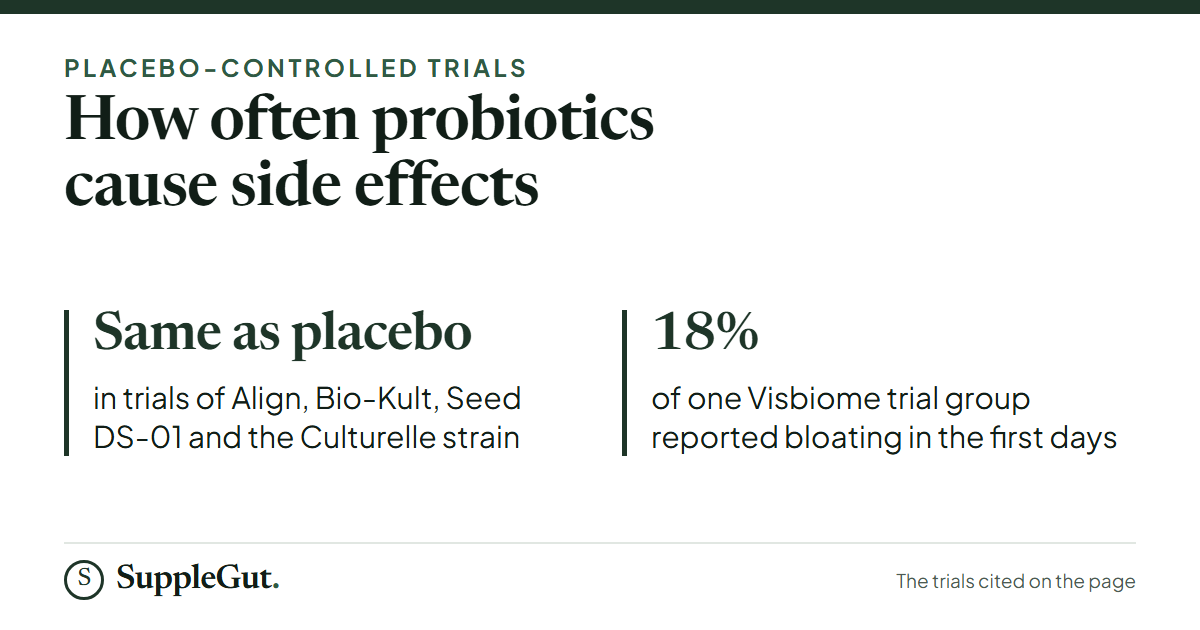
What side effects do probiotics cause? Gas, bloating and mild stomach discomfort in the first days are the ones people report, and in the placebo-controlled trials of Align, Bio-Kult, Seed DS-01 and the Culturelle strain, side effects were no more common than on placebo. The De Simone formulation sold as Visbiome is the exception with a measured rate: 18% of one trial group reported bloating and discomfort in the first days. The serious risks are infections, and they are concentrated in premature infants, people who are critically ill or immune-suppressed, and people with a central venous line.
"Side effects" in a probiotic trial means whatever participants reported, in the probiotic group and in the placebo group. Both groups report things, because people who track their own digestion for weeks notice it. The useful number is the difference between the two, and that is what this page pulls out, brand by brand, along with what each label discloses about allergens.
Brand by brand
| Product | Largest placebo-controlled trial | What it recorded about side effects | Label allergens |
|---|---|---|---|
| Align Bifidobacterium longum 35624 | 362 women with IBS, 4 weeks | No significant adverse events recorded. The maker’s own FAQ says some people report gas and bloating in the first few days. | Contains milk (sodium caseinate). Tested gluten-free. Soy not guaranteed absent. |
| Culturelle Lactobacillus rhamnosus GG | 12 trials in 1,499 people for antibiotic-associated diarrhea, pooled | Strain reviewed as well tolerated; rare bloodstream infections reported, almost all in seriously ill patients. | Label states free of dairy, lactose, milk, yeast, wheat, eggs, tree nuts, peanuts, gluten and soy. |
| Florastor Saccharomyces boulardii CNCM I-745 | 21 trials in 4,780 people for antibiotic-associated diarrhea, pooled | Well tolerated in trials. Documented cases of yeast in the blood, nearly all in hospital patients with a central line or suppressed immunity. | Contains lactose and may contain trace milk protein. Not for anyone with a yeast allergy. |
| Bio-Kult 14 strains | 400 adults with diarrhea-predominant IBS, 16 weeks | No adverse events reported in either group. | May contain milk and soy from the growth media. |
| Seed DS-01 24 strains plus a prebiotic | 350 adults with bloating, 6 weeks | No serious adverse events; no significant difference from placebo on total adverse events, nausea or other gut symptoms. | See the product page for the current label. |
| Visbiome De Simone formulation, 8 strains | 147 adults with ulcerative colitis, 12 weeks | 18.2% of the probiotic group reported bloating and discomfort in the first days; 11.2% reported mild side effects in a second trial. | See the product page for the current label. |
Align
The strain in Align, Bifidobacterium longum 35624 (formerly B. infantis), was tested in a randomized, placebo-controlled trial of 362 women with IBS in primary care. At 100 million CFU a day it beat placebo on abdominal pain and on a composite symptom score over four weeks, and no significant adverse events were recorded (Whorwell et al., American Journal of Gastroenterology, 2006). The maker’s FAQ states that "in the first few days of taking Align, some consumers have reported experiencing some gas and bloating," and describes it as temporary while the system adjusts (Align FAQ).
On the label: Align contains milk and sodium caseinate, a milk protein, so it is not suitable for a milk allergy. It has been tested gluten-free. The maker does not add soy but cannot guarantee it is soy-free. Each capsule contains 1 billion CFU at manufacture, declining to 10 million CFU by the best-by date, and it does not need refrigeration.
Culturelle
Lactobacillus rhamnosus GG is the most-trialed probiotic strain there is. For preventing antibiotic-associated diarrhea, a meta-analysis of 12 randomized trials in 1,499 people found it cut the rate from 22.4% to 12.3% and reported the strain as well tolerated (Szajewska & Kolodziej, Alimentary Pharmacology & Therapeutics, 2015). Gas and bloating in the first days are the usual reports, as with any live-bacteria product.
The serious question with a Lactobacillus is whether it can get into the blood. Finnish surveillance during a period when LGG consumption rose sharply found lactobacilli in 0.02% of all blood cultures and no increase in Lactobacillus bacteremia over the period (Salminen et al., Clinical Infectious Diseases, 2002). Case reports of LGG bacteremia exist, and they are concentrated in people with serious underlying illness, central lines or suppressed immunity. The Culturelle Digestive Daily label states the capsules are free of dairy, lactose, milk, yeast, wheat, eggs, tree nuts, peanuts, gluten and soy, with one wheat-sourced ingredient that meets the FDA gluten-free threshold (Culturelle product page).
Florastor
Florastor is a yeast, Saccharomyces boulardii CNCM I-745, not a bacterium. Its antibiotic-diarrhea evidence is the largest of any single probiotic: a meta-analysis of 21 trials in 4,780 people found it cut the rate from 18.7% to 8.5% (Szajewska & Kolodziej, Alimentary Pharmacology & Therapeutics, 2015).
The risk that matters is fungemia, the yeast reaching the bloodstream. A ten-year registry study across five Finnish university hospitals found 46 patients with Saccharomyces in their blood between 2009 and 2018. At least 20 of them had been taking an S. boulardii probiotic, 16 of those 20 received it in hospital, 72% had taken antibiotics in the previous four weeks, and 37% had died by day 28. Set against control patients with other bloodstream infections, the odds ratio for probiotic use was 14 (Rannikko et al., Emerging Infectious Diseases, 2021). That is a hospital-patient risk, and the maker’s own guidance follows it: do not use Florastor with a central venous catheter, with a yeast allergy, or when severely immunocompromised, including AIDS, lymphoma, long-term corticosteroid treatment and bone marrow transplant (Florastor FAQ). The capsules contain lactose and may contain trace milk protein.
Bio-Kult
Bio-Kult’s 14-strain formulation was tested in a randomized, placebo-controlled trial of 400 adults with diarrhea-predominant IBS over 16 weeks, at a higher dose than one capsule provides. Abdominal pain severity fell 69% on the probiotic against 47% on placebo, and no adverse events were reported for either group (Ishaque et al., BMC Gastroenterology, 2018). The label lists 2 billion CFU per capsule and states the product may contain milk and soy, which are used in the growth media for the strains (Bio-Kult product page).
Seed DS-01
The finished DS-01 capsule was tested against placebo in 350 adults with bloating for six weeks. The authors report that the synbiotic "was well-tolerated, with no serious adverse events reported," and that there were no significant differences between the groups on total adverse events or on dizziness, drowsiness, dry mouth, headache, insomnia, nausea, numbness or tingling, or other gut symptoms (Allegretti et al., Nutrients, 2026). Seed funded the trial and an outside research firm ran it; our guide to that trial covers what it did and did not show, and Align vs Seed DS-01 sets it against the single-strain product with the longer IBS record.
Visbiome
The De Simone formulation, sold as Visbiome and formerly as VSL#3, is the one product here with a measured early side-effect rate. In a 12-week trial in 147 adults with mild-to-moderately active ulcerative colitis, 14 of the 77 on the probiotic (18.2%) reported abdominal bloating and discomfort for the first few days, and seven of those also reported an unpleasant taste; no major adverse event occurred in either group (Sood et al., Clinical Gastroenterology and Hepatology, 2009). In a second trial of 144 adults with relapsing colitis, 8 of 71 on the probiotic (11.2%) reported mild side effects, six of them bloating and discomfort at the start, one dizziness and one a flu-like syndrome (Tursi et al., American Journal of Gastroenterology, 2010). Both trials used doses far above one capsule a day.
The serious risks, and who they apply to
The National Center for Complementary and Integrative Health summarizes the position: probiotics usually have few side effects, the data on long-term safety are limited, and the risk of serious harm is greater in people with underlying health conditions. The harms it lists are infections, harmful substances produced by the organisms, and transfer of antibiotic-resistance genes to other gut bacteria (NCCIH, Probiotics: Usefulness and Safety).
- Premature infants. In 2023 the FDA warned health care providers that premature infants given probiotics are at risk of severe, potentially fatal infections from the organisms in the products (FDA warning letter, 2023).
- Critically ill, post-surgical and immune-suppressed patients, and anyone with a central venous line. This is where the documented bloodstream infections from S. boulardii and Lactobacillus cluster.
- People with a milk, soy or yeast allergy. Align contains milk protein; Florastor contains lactose and is a yeast; Bio-Kult may contain milk and soy. The label decides, not the strain.
- Pregnancy. NCCIH lists pregnant women among the groups for whom probiotic safety data are thinner; the product pages here flag it where a maker does.
What to expect when you start
- Gas, bloating or a change in stool for a few days. This is the common report across brands, and the Align FAQ describes it as temporary. If it is still there after two weeks, the product is not settling and there is no evidence that pushing on changes that.
- Nothing at all is also normal. Most trial participants report no side effects, and the placebo groups report the same things the probiotic groups do.
- Fever, chills or feeling unwell is not a probiotic adjustment. Stop and see a doctor, and mention the product, because it is what a bloodstream infection looks like at the start.
The products in this catalog
How many bacteria a capsule needs to hold is a separate question with a separate answer; how many CFU do you need goes through the dose-response evidence.
Common questions
What are the most common side effects of probiotics?
Gas, bloating and mild stomach discomfort in the first days. In the placebo-controlled trials of Align, Bio-Kult and Seed DS-01, side effects were no more common on the probiotic than on placebo. The NCCIH summary is that probiotics usually have few side effects, with the serious risks concentrated in people with underlying health conditions.
Does Align cause side effects?
In the 362-patient placebo-controlled trial of its strain, no significant adverse events were recorded. The maker’s FAQ says some people report gas and bloating in the first few days and describes it as temporary. Align contains milk protein (sodium caseinate), so it is not suitable for a milk allergy.
Does Culturelle cause gas and bloating?
Gas and bloating in the first days are the usual reports for any live-bacteria product. In pooled trials of its strain in 1,499 people it was reported as well tolerated. The label states the capsules are free of dairy, lactose, milk, yeast, wheat, eggs, tree nuts, peanuts, gluten and soy.
Who should not take Florastor?
The maker says not to use it with a central venous catheter, with a yeast allergy, or when severely immunocompromised. A ten-year Finnish hospital registry found 46 patients with the yeast in their blood, at least 20 of whom had taken an S. boulardii probiotic, 16 of them in hospital. It also contains lactose and may contain trace milk protein.
Does Bio-Kult have side effects?
In the 400-patient, 16-week placebo-controlled trial of the formulation in diarrhea-predominant IBS, no adverse events were reported in either group. The label says the capsules may contain milk and soy from the growth media.
Does Seed DS-01 have side effects?
In the 350-person, six-week placebo-controlled trial, there were no serious adverse events and no significant difference from placebo on total adverse events, nausea or other gut symptoms.
Does Visbiome cause bloating?
It is the one product here with a measured early rate: in a 147-patient ulcerative colitis trial, 18.2% of the probiotic group reported bloating and discomfort for the first few days, and 11.2% reported mild side effects in a second trial. Both trials used doses far above one capsule a day.
Who should not take probiotics without asking a doctor?
Premature infants (the FDA issued a warning in 2023), people who are critically ill, recovering from surgery or immune-suppressed, anyone with a central venous line, and anyone with a milk, soy or yeast allergy, depending on the label.
Sources
- Whorwell PJ, et al. "Efficacy of an Encapsulated Probiotic Bifidobacterium infantis 35624 in Women with Irritable Bowel Syndrome." American Journal of Gastroenterology, 2006;101(7):1581–1590. journals.lww.com/ajg
- Align Probiotics. Frequently asked questions (side effects, allergens, CFU). alignprobiotics.com/en-us/faq
- Szajewska H, Kolodziej M. "Systematic review with meta-analysis: Lactobacillus rhamnosus GG in the prevention of antibiotic-associated diarrhoea in children and adults." Alimentary Pharmacology & Therapeutics, 2015;42(10):1149–1157. pubmed.ncbi.nlm.nih.gov/26365389
- Salminen MK, et al. "Lactobacillus Bacteremia during a Rapid Increase in Probiotic Use of Lactobacillus rhamnosus GG in Finland." Clinical Infectious Diseases, 2002;35(10):1155–1160. academic.oup.com/cid
- Culturelle. Digestive Daily Probiotic capsules, product and label information. culturelle.com
- Szajewska H, Kolodziej M. "Systematic review with meta-analysis: Saccharomyces boulardii in the prevention of antibiotic-associated diarrhoea." Alimentary Pharmacology & Therapeutics, 2015;42(7):793–801. pubmed.ncbi.nlm.nih.gov/26216624
- Rannikko J, et al. "Fungemia and Other Fungal Infections Associated with Use of Saccharomyces boulardii Probiotic Supplements." Emerging Infectious Diseases, 2021;27(8). wwwnc.cdc.gov/eid/article/27/8/21-0018_article
- Florastor. Frequently asked questions (contraindications, lactose). florastor.com/a/faq
- Ishaque SM, et al. "A randomized placebo-controlled clinical trial of a multi-strain probiotic formulation (Bio-Kult) in the management of diarrhea-predominant irritable bowel syndrome." BMC Gastroenterology, 2018;18:71. bmcgastroenterol.biomedcentral.com
- Bio-Kult. Everyday Gut (Advanced Multi-Strain) capsules, ingredients and allergen statement. bio-kult.com
- Allegretti JR, et al. "A Randomized, Placebo-Controlled Trial Evaluating Multi-Species Synbiotic Supplementation for Bloating, Gas, and Abdominal Discomfort." Nutrients, 2026;18(2):255. pmc.ncbi.nlm.nih.gov/articles/PMC12845427
- Sood A, et al. "The Probiotic Preparation, VSL#3 Induces Remission in Patients With Mild-to-Moderately Active Ulcerative Colitis." Clinical Gastroenterology and Hepatology, 2009;7(11):1202–1209. pubmed.ncbi.nlm.nih.gov/19631292
- Tursi A, et al. "Treatment of Relapsing Mild-to-Moderate Ulcerative Colitis With the Probiotic VSL#3 as Adjunctive to a Standard Pharmaceutical Treatment." American Journal of Gastroenterology, 2010;105(10):2218–2227. pubmed.ncbi.nlm.nih.gov/20517305
- National Center for Complementary and Integrative Health. "Probiotics: Usefulness and Safety." nccih.nih.gov/health/probiotics-usefulness-and-safety
- U.S. Food and Drug Administration. "Warning Regarding Use of Probiotics in Preterm Infants," 2023. fda.gov/media/172606/download
Not sure which product fits your situation?
This guide covers the mechanics. The quiz takes your specific symptoms, routine and preferences and matches you to one product from the catalog.
Take the quiz →