Guide
Does wholier Peppermint Stomach Soother work? Five oils in two blends, and what the trials do and do not cover
Quick answer
Does wholier Peppermint Stomach Soother work? No study of this capsule turned up. Its main ingredient, peppermint oil, beat placebo for IBS symptoms in a 2022 meta-analysis of 10 trials in 1,030 people, with more side effects and very low quality evidence. The label gives a 185 mg mint blend and a 200 mg herbal blend, so no oil can be matched to a trial dose. Amazon shows 4.2 from 135 ratings.
wholier Peppermint Stomach Soother is a vegan capsule that combines peppermint, spearmint, fennel, ginger and black cumin seed oils, which the brand describes as a capsule-in-capsule with the mint oils in an inner coated capsule. Peppermint oil has a body of IBS research behind it; this particular five-oil blend does not. The sections below cover the panel, the research that applies, how the brand says to take it, the reviews, the price and how it sits next to IBgard.
Two blends, five oils, and three versions of one number
The brand’s Supplement Facts panel lists a serving as one vegan capsule, with 60 capsules in a glass bottle. It shows two proprietary blends and no other actives. The Herbal Blend is 200 mg and contains fennel seed oil (Foeniculum vulgare), organic ginger root oil (Zingiber officinale) and organic black cumin seed oil (Nigella sativa). The Mint Blend is 185 mg and contains organic peppermint leaf oil (Mentha piperita) and organic spearmint herb oil (Mentha spicata). That makes 385 mg a capsule on the brand’s panel. The daily value column reads “not established.” The other ingredients are vegetable cellulose for the capsule, MCT oil from coconut and soy-free mixed tocopherols, and Amazon’s text adds a natural lemon mint flavor in a small essence pack that ships in the bottle.
The label lists no laxative herbs and no sweeteners, and it does not frame any ingredient as antimicrobial. The brand states the capsule is vegan, gluten-free, non-GMO, soy-free and corn-free. It prints no milk, egg, tree nut, fish or sesame statement, so those allergens are not addressed either way.
The sources disagree on the mint blend. The brand’s newest panel image shows 185 mg. Amazon’s ingredient text gives 140 mg, and one Amazon bullet says “145mg mint blend.” The Herbal Blend is 200 mg in all three. The brand’s page also calls the third herbal oil “cumin seed oil,” while the panel says black cumin (Nigella sativa), a different plant. This page uses the panel image, which is the newest document. Amazon also calls the capsule once-daily in one bullet, while the directions say twice.
What the research covers, and what it does not
A search of PubMed for the brand name and for combinations of the five oils turned up no published study of this capsule. The brand says the formula was developed by a naturopathic doctor and a certified nutrition specialist and refers to “hundreds of clinical studies” on its page without naming one. None of the five oils is a branded, separately studied ingredient, so there is no ingredient-level trial to borrow either. What exists is research on peppermint oil as a class, mostly in people with irritable bowel syndrome (IBS).
Three pooled analyses are the main body of that work:
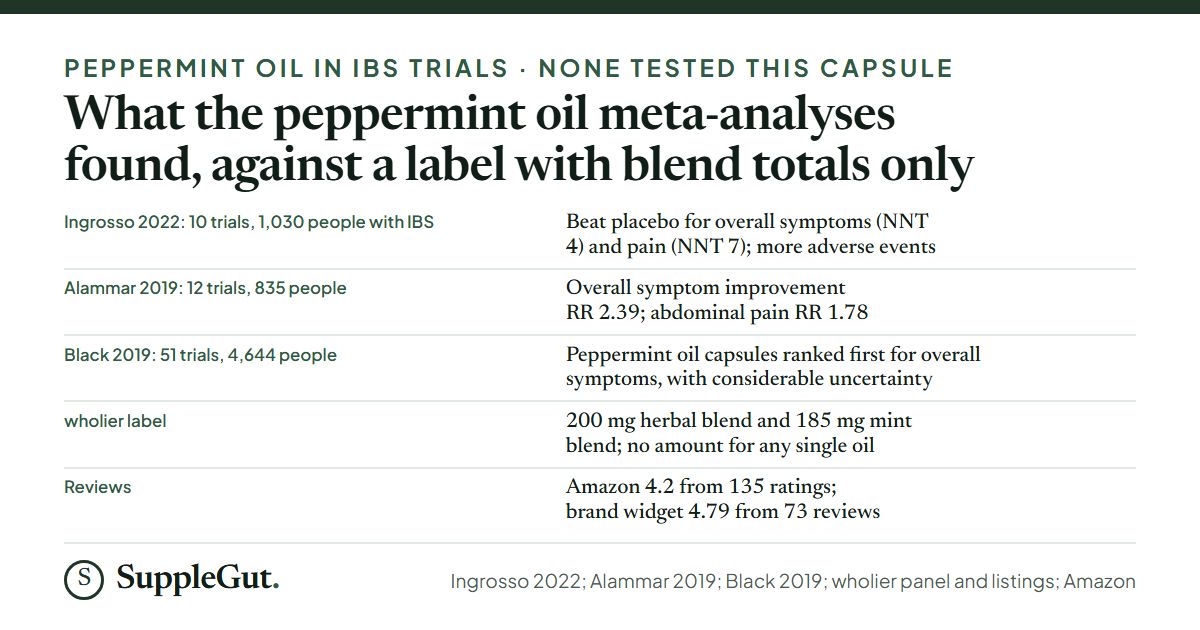
- 10 randomized trials, 1,030 people with IBS. Peppermint oil beat placebo for overall symptoms (relative risk of not improving 0.65, 95% CI 0.43 to 0.98) and for abdominal pain (0.76, 0.62 to 0.93). The number needed to treat, meaning how many people take it for one extra person to improve, was 4 for overall symptoms and 7 for pain. Adverse events were more frequent on peppermint oil (relative risk 1.57, 1.04 to 2.37), and the authors rated the quality of the evidence very low (Ingrosso et al., Alimentary Pharmacology & Therapeutics, 2022).
- 12 randomized trials, 835 people. Overall symptom improvement came out at a relative risk of 2.39 (1.93 to 2.97) and abdominal pain improvement at 1.78 (1.43 to 2.20). Adverse events were 9.3% on peppermint oil and 6.1% on placebo, a difference that was not statistically significant (Alammar et al., BMC Complementary and Alternative Medicine, 2019).
- A network meta-analysis of 51 trials in 4,644 people comparing fiber, antispasmodic drugs, peppermint oil and gut-brain neuromodulators. Peppermint oil capsules ranked first for overall IBS symptoms (relative risk of not improving 0.63, 0.48 to 0.83). Only 13 of the 51 trials were at low risk of bias, and the authors describe considerable uncertainty around the ranking (Black et al., The Lancet Gastroenterology & Hepatology, 2019).
Those results are for people with a diagnosed condition, taking peppermint oil for weeks. The wholier page speaks of bloating, gas and nausea in general, and no analysis above tested that.
Why the doses cannot be compared. The abstracts of these analyses do not give a per-capsule oil dose, and the wholier panel does not give one either. The 185 mg figure is a total for two mint oils, with the split between peppermint and spearmint unprinted, taken up to twice a day. Because the peppermint share is unknown, the amount of peppermint oil in a capsule cannot be lined up against any trial.
The brand also makes the claim “More Effective Than Probiotics” and says peppermint oil outperforms probiotics for IBS, without naming a study. The network meta-analysis above did not include probiotics in its comparison.
The other four oils, and the capsule they come in
Beyond peppermint, the other four oils sit at unstated amounts inside blend totals, so the panel supports only the peppermint-oil research above. Fennel, black cumin seed oil and spearmint oil were not searched individually for this page. Ginger has a literature, though for nausea in other settings. A 2024 meta-analysis of 35 randomized trials found that ginger capsules taken with standard antiemetic drugs reduced severe nausea and vomiting in people having chemotherapy (Lin et al., Cancer Nursing, 2024). A 2023 meta-analysis of complementary treatments for nausea in pregnancy reported that ginger beat placebo on some measures, with low-quality evidence (Tan et al., Frontiers in Public Health, 2023). Neither studied this blend, and neither involved the gut-comfort or medication-related nausea the brand’s testimonials describe, including reviews from people using GLP-1 drugs.
The brand describes a vegan capsule-in-capsule. The outer capsule holds the ginger, fennel and black cumin oils, and an inner enteric-coated capsule holds the peppermint and spearmint oils. Enteric coating is meant to keep a capsule intact in the stomach and open it further along the gut, and the brand presents spearmint as a gentler mint. The panel itself shows none of this: the coating is the brand’s description, and a Supplement Facts panel cannot show how much oil reaches the intestine. Enteric-coated capsules are the format used in most peppermint oil trials, though the abstracts above do not detail the capsule designs. The brand also states that every batch is third-party tested for heavy metals and label accuracy to GMP standards, and does not name the laboratory.
Directions on the label
The directions on the brand page say to take one capsule, and “for best results” two times per day, before or with meals or at the onset of discomfort. At two a day a bottle lasts 30 days. The Amazon listing describes the product as a once-daily capsule in one bullet, so the instruction is not identical everywhere. The label directions do not give a minimum trial period. The network meta-analysis above included trials of 4 to 12 weeks of treatment, which gives a sense of the time frame the research covers.
Side effects, including reflux
The brand page shows no warning text beyond a storage line. Amazon’s safety section says not to use the product if the safety seal is broken or missing, and to consult a healthcare provider before taking any supplement, especially if you are pregnant, nursing, taking a medication or have a medical condition.
The 2022 meta-analysis found adverse events more frequent on peppermint oil than on placebo and tracked gastroesophageal reflux as a safety outcome. Reviewers of this product describe what that can look like: one Amazon reviewer wrote that all it did was “give me acid reflux,” a brand-page reviewer found it “too strong” and irritating, another reported the fennel was strong and caused belching, and a few mention peppermint burps. Others describe no aftertaste or burping.
Reading the customer reviews
Amazon shows 4.2 out of 5 from 135 ratings: 69% five-star, 12% four, 2% three, 2% two and 15% one. The listing is sold by wholier and shipped by Amazon. Amazon’s own summary of the review text says customers report help with bloating, digestion and gas, and like the taste. Three themes recur in reviewers’ own words: less bloating and gas after meals, a quick calming effect on an upset stomach (including nausea in some GLP-1 users), and a pleasant mint taste with few burps.
The complaints are the mirror image. Some reviewers report no change in bloating, some report reflux or an irritated stomach, and some find the fennel or peppermint too strong. The one-star share on Amazon, 15%, is much larger than on the brand’s own widget.
The brand’s page carries a Junip review widget showing 4.79 out of 5 from 73 reviews: 63 five-star, 7 four-star, 1 three-star, 2 two-star and none at one star. This is a review feed the brand hosts. 54 of the 73 carry the widget’s “rewarded” flag, which marks reviews for which a reward was given, and 61 have a brand reply. Star rating and text do not always agree: the feed holds a five-star review whose text reads “Terrible does not work.” We found no Trustpilot, Walmart, Target or iHerb listing for the product, so there is no third independent score.
Price, the subscription and the refund terms
A 60-capsule bottle is a 30-day supply at two capsules a day. On the brand site, one bottle bought once is $39.99 plus $4.99 shipping, or $1.33 a day; shipping is free from $45. The brand’s selling plans give 10% off on a 30 or 45 day schedule ($35.99, $1.20 a day), 15% off every 60 days ($33.99) and 20% off every 90 days ($31.99). Two bottles are $75.98 and three are $107.97. The page also advertises 25% off a first subscription order and a free travel tin, a figure that does not match the selling plans. Amazon lists the bottle at $35.99, $1.20 a day.
The brand’s refund policy: you have 30 days from delivery to try one full-sized unit and ask for a refund, “no questions asked.” It covers the cost of the product, sales tax and the original shipping. Return shipping is the customer’s cost, the unit is to be mailed back within 7 days of the brand’s reply, and the refund follows within 72 hours of receipt. Additional units, samples and purchases through Amazon or other retailers are not covered, and Amazon purchases follow Amazon’s returns. For subscriptions, an upcoming order must be cancelled or skipped before the renewal date, and renewal orders are not eligible for refund once they have shipped. Two of the 73 widget reviews mention a subscription, and none mention an unwanted charge or a refund.
wholier next to IBgard
IBgard is a peppermint oil capsule with a trial of the finished product, and the two differ in what is printed and what has been tested. IBgard lists one ingredient, 90 mg of ultra-purified peppermint oil per capsule, in coated beads. It has a four-week placebo-controlled trial of the finished capsule in 72 adults with IBS, taken three times a day, in which the total symptom score fell 40% against 24% on placebo. wholier prints two blend totals covering five oils and has no trial of its own. The directions differ too: IBgard’s label has two capsules up to three times a day, 30 to 90 minutes before a meal, while wholier’s has one capsule, twice a day, before or with meals. IBgard is sold as a medical food for the dietary management of IBS; wholier’s page speaks of bloating, gas, nausea and digestive comfort. The IBgard guide sets out that trial and its label in full, and the IBgard page has the catalog entry.
Who wholier Peppermint Stomach Soother is for
- Someone whose complaint is bloating, gas or an uncomfortable stomach around meals, the symptoms reviewers most often praise it for.
- Someone who wants a mint-forward capsule with ginger and fennel included, and accepts that the label shows blend totals instead of per-oil amounts.
- Someone willing to take a capsule twice a day and check the result after several weeks.
- Someone who knows peppermint tends to trigger their reflux should read the side effects section first and ask a healthcare provider.
For a single-ingredient peppermint capsule with a printed dose and a trial of its own, see IBgard. Traditional Medicinals Organic Peppermint Tea is a plain peppermint leaf tea, and Atrantil is a polyphenol blend aimed at bloating from gas-producing gut bacteria. If you are starting from the symptom rather than the product, the bloating guide and the quiz begin there.
The entries this page refers to
Common questions
What evidence is there behind wholier Peppermint Stomach Soother?
The capsule itself has no published study that we found. The evidence is for peppermint oil as a class: a 2022 meta-analysis of 10 randomized trials (1,030 people with IBS) found it beat placebo for overall symptoms and abdominal pain, with more adverse events and very low quality evidence. The brand cites “hundreds of clinical studies” without naming any.
Which oils are in each capsule, and in what amounts?
The brand’s panel lists a 200 mg herbal blend (fennel seed oil, organic ginger root oil, organic black cumin seed oil) and a 185 mg mint blend (organic peppermint leaf oil, organic spearmint herb oil). No single oil has its own amount. Amazon’s ingredient text gives the mint blend as 140 mg and an Amazon bullet says 145 mg.
Is the black cumin in this capsule the same as cumin?
No. The panel names Nigella sativa, which is black cumin seed oil. The brand page headline calls it “cumin seed oil,” which is a different plant, while the Amazon title says black cumin. The panel is the document to go by.
Do I take the capsule once or twice a day?
The directions on the brand page and Amazon say one capsule, and “for best results” two times per day, before or with meals or at the onset of discomfort. An Amazon bullet calls it a once-daily capsule. At two a day, a 60-capsule bottle lasts 30 days.
Can peppermint capsules cause acid reflux?
They can in some people. The 2022 peppermint oil meta-analysis counted gastroesophageal reflux as a safety outcome, and an Amazon reviewer of this capsule wrote that it caused acid reflux. The brand page prints no reflux warning; the Amazon safety text advises asking a healthcare provider first if you are pregnant, nursing, on medication or have a medical condition.
What does a bottle cost per day, and how does the refund work?
A 60-capsule bottle is $39.99 on the brand site plus $4.99 shipping under $45, about $1.33 a day at two capsules. Subscriptions take 10% to 20% off and Amazon lists $35.99 ($1.20 a day). The brand refunds one full-sized unit within 30 days of delivery; subscription renewals are not refundable once shipped, and Amazon orders follow Amazon’s returns.
Why do the brand’s reviews and Amazon’s differ?
Amazon shows 4.2 from 135 ratings, 15% of them one star. The brand’s own review widget shows 4.79 from 73 reviews and no one-star ratings, and 54 of those 73 carry the widget’s “rewarded” flag, meaning a reward was given for the review. The two pools are different sizes and are collected differently.
How does wholier differ from IBgard?
IBgard prints one ingredient, 90 mg of peppermint oil per capsule, and has a four-week placebo-controlled trial of the finished capsule in 72 adults with IBS. wholier prints two blend totals covering five oils and has no trial of its own. The IBgard guide has the details.
Sources
- Ingrosso MR, Ianiro G, Nee J, et al. “Systematic review and meta-analysis: efficacy of peppermint oil in irritable bowel syndrome.” Alimentary Pharmacology & Therapeutics, 2022;56(6):932–941. PubMed 35942669
- Alammar N, Wang L, Saberi B, et al. “The impact of peppermint oil on the irritable bowel syndrome: a meta-analysis of the pooled clinical data.” BMC Complementary and Alternative Medicine, 2019;19(1):21. PubMed 30654773
- Black CJ, Yuan Y, Selinger CP, et al. “Efficacy of soluble fibre, antispasmodic drugs, and gut-brain neuromodulators in irritable bowel syndrome: a systematic review and network meta-analysis.” The Lancet Gastroenterology & Hepatology, 2019;5(2):117–131. PubMed 31859183
- Lin CY, Huang SH, Tam KW, et al. “Efficacy and Safety of Ginger on Chemotherapy-Induced Nausea and Vomiting: A Systematic Review and Meta-analysis of Randomized Controlled Trials.” Cancer Nursing, 2024;48(6):455–466. PubMed 38625733
- Tan MY, Shu SH, Liu RL, Zhao Q. “The efficacy and safety of complementary and alternative medicine in the treatment of nausea and vomiting during pregnancy: A systematic review and meta-analysis.” Frontiers in Public Health, 2023;11:1108756. PubMed 36969661
- wholier Peppermint Stomach Soother: product page, Supplement Facts panel image, directions, review widget and selling plans. livewholier.com
- wholier refund policy. livewholier.com
- Amazon listing for wholier Peppermint Stomach Soother (ASIN B0DW1FVNY2): ingredient field, safety information, price, ratings and review summary. amazon.com
Which of these fits you?
Three minutes with the quiz turns this background into one named product, with the reasons shown.
Take the quiz →