
Guide
Does IBgard work? The trial, the ingredients and how to take it
Quick answer
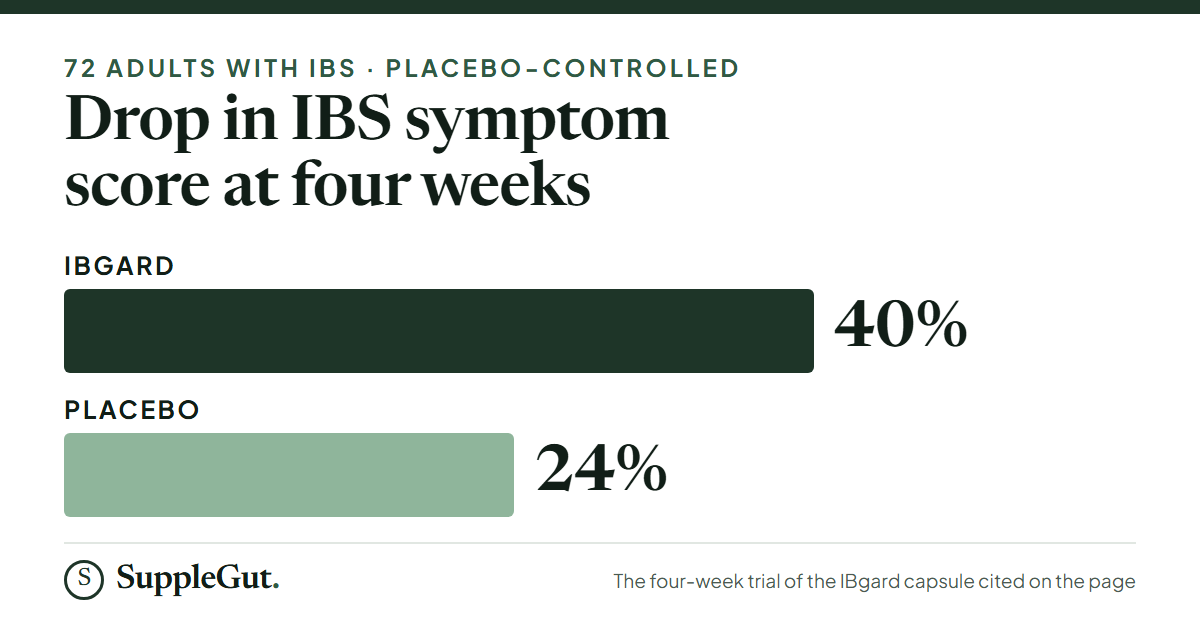
Does IBgard work? For IBS-type cramping, urgency and pain, it has better evidence than almost anything else sold without a prescription. A four-week placebo-controlled trial of this exact capsule in 72 adults with IBS cut the total symptom score by 40% against 24% on placebo, with the gap showing inside 24 hours, and its ingredient, peppermint oil, has a meta-analysis of 12 trials in 835 patients and a 2021 gastroenterology guideline recommendation behind it. It does nothing for a share of the people who try it, and the directions decide which group you land in.
IBgard is peppermint oil. What makes it different from the peppermint capsules on the next shelf is the delivery: the oil sits in triple-coated beads built to pass through the stomach and release in the small intestine, where the muscle it relaxes is. This page sets out what is in it, what the trial of the capsule found, what the label says about taking it, and where the reviews split.
What IBgard is, and what it is not
Each capsule holds 90 mg of ultra-purified peppermint oil (the brand calls the extract Ultramen), so the two-capsule serving on the label is 180 mg. The other ingredients are microcrystalline cellulose, gelatin, hypromellose, methylcellulose, methacrylic acid copolymer and under 1% of triethyl citrate and polysorbate 80: the coating system, not actives. There are no bacteria in it. IBgard is not a probiotic, not a fiber and not an antispasmodic drug; it is an herbal oil in a targeted-release capsule, sold as a medical food for the dietary management of IBS.
Peppermint oil works on the gut wall. Its main component, L-menthol, relaxes intestinal smooth muscle, which is why it eases cramping and urgency and why plain peppermint can also relax the valve at the top of the stomach and cause heartburn. The coating exists to get the oil past that valve.
The trial of the capsule itself
Most gut supplements borrow their evidence from trials of an ingredient. IBgard has a trial of the finished product. In IBSREST, 72 adults with mixed or diarrhea-type IBS took the capsule or an identical placebo three times a day for four weeks. At four weeks the total IBS symptom score had fallen 40% on IBgard against 24.3% on placebo; at 24 hours the drop was already 19.6% against 10.3%, and both differences were statistically significant. People on the capsule also reported more improvement in individual symptoms and in the ones they rated severe or unbearable, and the trial reported few adverse events (Cash et al., Digestive Diseases and Sciences, 2016). The label’s line that it was “clinically studied at 6 capsules per day” refers to this trial.
Two limits worth knowing. Seventy-two people is a small trial, and it ran for four weeks, so nothing is known from it about month three or beyond. And a 16-point gap on a symptom score is a real, measurable benefit rather than a cure: a quarter of the placebo group improved too.
The evidence for the ingredient
Behind the capsule sits a larger record for peppermint oil in IBS. A 2019 meta-analysis pooled 12 randomized trials in 835 patients. Across the seven trials that measured overall symptoms, people on peppermint oil were 2.4 times as likely to improve as people on placebo; across the six that measured abdominal pain, 1.8 times. Side effects were no more common than on placebo (9.3% against 6.1%, not significant), and the number needed to treat was three for overall symptoms and four for pain (Alammar et al., BMC Complementary and Alternative Medicine, 2019). The 2021 American College of Gastroenterology guideline on IBS recommends peppermint oil for overall symptoms, graded as a weak recommendation with low certainty, which is the honest grade for a field of small trials and still more than most supplements can point to.
The guideline recommendation is for peppermint oil, not for IBgard specifically. Enteric-coated peppermint capsules from other brands have trials of their own at a fraction of the price. What they do not have is a placebo-controlled trial of their own formulation, which IBgard does.
How to take IBgard
The label directions on the retail listings we read: adults take two capsules, up to three times a day, as needed or as directed by a healthcare provider, 30 to 90 minutes before a meal, with water. If the pre-meal dose is missed, the label says it can be taken with or after a meal. Capsules are swallowed whole, never chewed or crushed, because breaking the coating releases the oil in the stomach, which is what the coating is there to prevent. Some listings print a ceiling of eight capsules a day; the trial dose was six.
The timing is the whole difference between the two camps in the reviews. The people who call it the only thing that worked took it before meals, every day, for weeks. The people who say it did nothing are, again and again, the ones who took it after eating or only when a cramp had already started. Peppermint oil cannot relax muscle it has not reached.
How long it takes: in the trial the difference from placebo appeared within 24 hours and grew over four weeks. A fair test is a month at the full label dose.
Side effects and who should not take it
Nausea, vomiting and heartburn are the listed common effects; headache, flushing, mouth irritation and severe abdominal pain are the ones the drug reference lists as reasons to stop and seek care. Heartburn is the peppermint problem the coating is designed to reduce, and the guideline notes coated formulations may do so, but it does not remove it in everyone. The reference advises against use in children under eight, and tells anyone with reflux disease, stomach or intestinal ulcers, liver disease, gallbladder disease or a blocked bile duct to check with a doctor first. The label adds the usual line for pregnancy, nursing and anyone on medication or with a medical condition: consult a healthcare provider before use.
What the reviews say
They split hard. The recurring praise is dramatic relief for IBS-type cramping and urgency, often after years of trying other things. The recurring complaint is no effect at all, and the directions are the usual explanation. A smaller group report heartburn or a peppermint aftertaste. The rating pool and the figures are on the product page below; the polarized pattern is the thing to take from them, because it matches what the trial would predict for a product that works on a specific mechanism in a condition with several.
Who IBgard is for
- Cramping or pain that eases after a bowel movement, with urgency or a bowel habit that changes: the IBS picture the trial enrolled.
- Bloating that comes with those bowel changes rather than bloating on its own.
- Someone who can take a capsule before meals and keep doing it for a month.
It is the wrong tool for fullness, early satiety and queasiness under the ribs, which is the upper-gut picture. That is where IBgard vs Iberogast draws the line, and where the brand’s sibling product FDgard, a caraway-oil and menthol capsule for indigestion, sits. If gas and bloating after particular foods are the main complaint, the bloating guide starts from the cause instead of the product.
Cost
At the catalog price IBgard costs about $0.57 a day at a two-capsule serving, and three times that at the six-capsule trial dose. Plain enteric-coated peppermint oil runs a fraction of either figure; the premium buys the coated formulation the trial used.
The products in this catalog
Common questions
Does IBgard work for IBS?
It has a placebo-controlled trial of the exact capsule: 72 adults with IBS took it three times a day for four weeks and their total symptom score fell 40% against 24% on placebo, with the difference showing inside 24 hours. Its ingredient, peppermint oil, has a meta-analysis of 12 trials in 835 patients behind it and a 2021 American College of Gastroenterology recommendation for overall IBS symptoms. It still did nothing for a share of the people who reviewed it, most often the ones who did not take it before meals.
What are the ingredients in IBgard?
Ultra-purified peppermint oil, 90 mg per capsule and 180 mg in the two-capsule serving, in triple-coated beads designed to release in the small intestine. The other ingredients are the coating and capsule: microcrystalline cellulose, gelatin, hypromellose, methylcellulose, methacrylic acid copolymer and under 1% of triethyl citrate and polysorbate 80. No bacteria, no fiber.
How do you take IBgard, and how many capsules a day?
The label says two capsules, up to three times a day, 30 to 90 minutes before a meal with water, swallowed whole and never chewed. If the pre-meal dose is missed it can be taken with or after a meal. The trial used six capsules a day, and some listings print a ceiling of eight.
Is IBgard a probiotic?
No. It contains no bacteria. It is peppermint oil in a targeted-release capsule, sold as a medical food for the dietary management of IBS, and it works on the muscle of the gut wall rather than on the microbiome.
What are the side effects of IBgard?
Nausea, vomiting and heartburn are the listed common ones; headache, flushing, mouth irritation and severe abdominal pain are reasons to stop and seek care. The coating is designed to reduce the heartburn plain peppermint oil can cause. The drug reference advises against use in children under eight and tells anyone with reflux disease, ulcers, liver or gallbladder disease to check with a doctor first.
How long does IBgard take to work?
In the trial the difference from placebo appeared within 24 hours and grew over four weeks. Reviewers who saw a benefit mostly describe it within the first week. A fair test is a month at the full label dose, taken before meals.
Sources
- Cash BD, Epstein MS, Shah SM. "A Novel Delivery System of Peppermint Oil Is an Effective Therapy for Irritable Bowel Syndrome Symptoms." Digestive Diseases and Sciences, 2016;61(2):560–571. doi.org/10.1007/s10620-015-3858-7
- Alammar N, Wang L, Saberi B, et al. "The impact of peppermint oil on the irritable bowel syndrome: a meta-analysis of the pooled clinical data." BMC Complementary and Alternative Medicine, 2019;19(1):21. doi.org/10.1186/s12906-018-2409-0
- Lacy BE, Pimentel M, Brenner DM, et al. "ACG Clinical Guideline: Management of Irritable Bowel Syndrome." American Journal of Gastroenterology, 2021;116(1):17–44. journals.lww.com
- IBgard capsules: label directions, other ingredients and warnings as printed on the Wegmans product listing. wegmans.com
- Kaiser Permanente drug encyclopedia. "IBgard 90 mg capsule, delayed, extended release": strength, how to take, side effects and precautions. healthy.kaiserpermanente.org
- IBgard price and rating as listed at the retailer named on the product page above.
Not sure which product fits your situation?
This guide covers the mechanics. The quiz takes your specific symptoms, routine and preferences and matches you to one product from the catalog.
Take the quiz →