
Guide
What’s the best supplement for bloating and gas?
Quick answer
What is the best supplement for bloating and gas? It depends on what drives the bloating, and the trials sort by that. For bloating that comes with IBS-type pain and cramping, enteric-coated peppermint oil has the largest trial base (nine randomized trials, 726 people). For most-days bloating without a food pattern, two probiotics have placebo-controlled bloating results: Bifidobacterium longum 35624 and Seed's DS-01. For gas after beans and vegetables, alpha-galactosidase; after dairy, lactase. For fullness and nausea after meals, the six-plant Iberogast formulation.
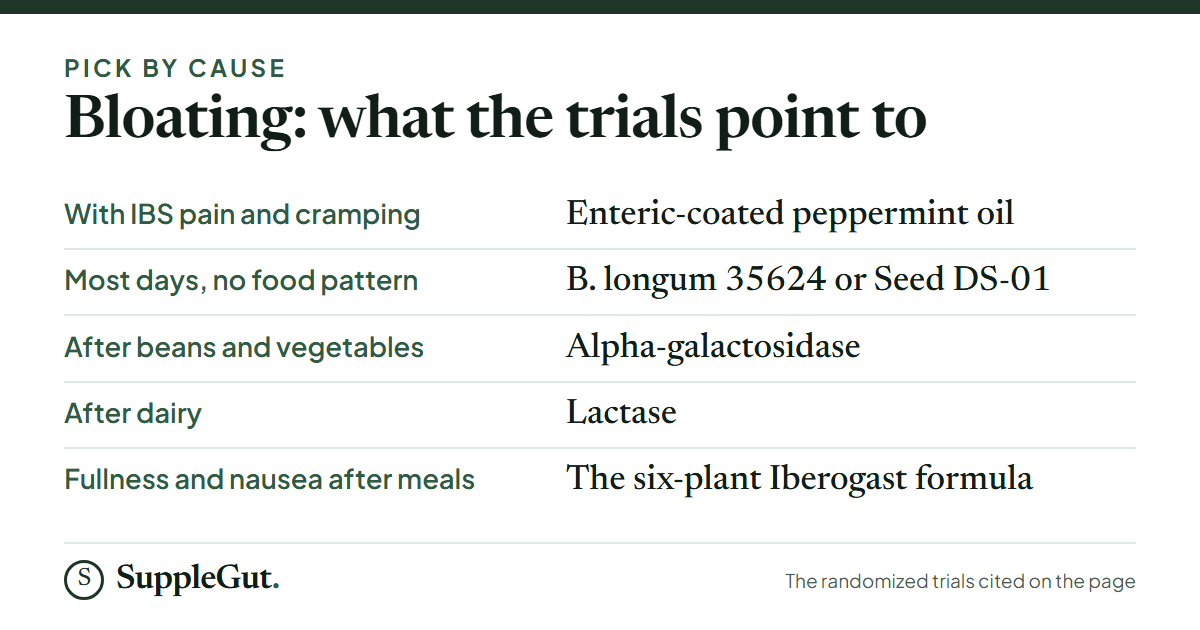
Bloating is one word for several complaints, and the trials below were each run in a different one: IBS with pain and cramping, most-days bloating, gas after particular foods, and fullness after meals. No supplement has been shown to help all of them. This guide ranks the options by the trials behind them and says which kind of bloating each trial measured.
How the evidence ranks
| Supplement | Best trial | What it showed | Suits |
|---|---|---|---|
| Enteric-coated peppermint oil | Meta-analysis, 9 RCTs, 726 IBS patients | Global symptoms RR 2.23; abdominal pain RR 2.14 | Bloating with cramping, urgency or pain |
| B. longum 35624 (Align) | RCT, 362 women with IBS, 4 weeks | 108 CFU beat placebo on pain and bloating; 106 and 1010 did not | Most-days bloating with an IBS pattern |
| Seed DS-01 | RCT, 350 adults with bloating, 6 weeks | 72% rarely or never bloated vs 56% on placebo | Most-days bloating without a food pattern |
| Alpha-galactosidase (Beano) | RCT, 52 children, 2 weeks; meal challenges in adults | Fewer bloating days and less flatulence; 1,200 GalU cut breath hydrogen | Gas after beans, lentils, cruciferous vegetables |
| Lactase (Lactaid) | Crossover RCT, 47 adults with lactose intolerance | Symptoms improved; breath hydrogen down 55% | Bloating after milk, ice cream, soft cheese |
| Iberogast (STW 5-II, six plants) | RCT, 120 people with functional dyspepsia, 8 weeks | Complete relief 43% vs 3% on placebo | Fullness, early satiety, nausea after meals |
| Partially hydrolyzed guar gum | Open randomized trial, 188 people with IBS, 12 weeks | 60% success vs 40% on wheat bran | IBS with bloating that fiber usually makes worse |
Peppermint oil: the biggest trial base, for the cramping kind
The 2014 meta-analysis pooled nine randomized controlled trials in 726 people with IBS and found enteric-coated peppermint oil more than doubled the chance of global symptom improvement (relative risk 2.23, 95% CI 1.78 to 2.81, five trials) and of abdominal pain improvement (relative risk 2.14, five trials), over a minimum of two weeks. Side effects were more common on peppermint than placebo but mild and transient, and heartburn was the commonest (Khanna, MacDonald & Levesque, Journal of Clinical Gastroenterology, 2014). The trials used enteric-coated capsules, so an uncoated oil is not what was tested. They measured IBS symptoms and pain rather than bloating on its own, so this is the pick when bloating comes with cramping or urgency.
Two probiotics with a bloating result of their own
Bifidobacterium longum 35624, the strain in Align, was tested in 362 women with IBS at three doses for four weeks. The middle dose, 108 CFU a day, beat placebo on abdominal pain (p<0.02), on bloating and on global symptoms by more than 20 points; the lower dose did nothing and the higher dose failed because of a formulation problem, so more was not better (Whorwell et al., American Journal of Gastroenterology, 2006). No significant adverse events were recorded.
Seed DS-01 is the one multi-strain product with a placebo-controlled trial of the finished capsule aimed at bloating: 350 adults, six weeks, 72.3% rarely or never bloated by week six against 55.9% on placebo (p<0.001), with smaller gains on abdominal discomfort and regularity and no difference in adverse events. The groups separated by weeks three to four; Seed funded the trial and an outside firm ran it (Allegretti et al., Nutrients, 2026). Our guide to that trial sets out its limits.
A smaller crossover in 23 people with lactose intolerance whose symptoms persisted on a lactose-free diet found 30 days of B. longum BB536 with L. rhamnosus HN001 reduced bloating against placebo (p=0.028) (Vitellio et al., Nutrients, 2019). BB536 is sold on its own in this catalog.
The multi-strain VSL#3 formulation, sold in the US as Visbiome, was tested in 48 people with IBS and significant bloating: it reduced flatulence scores against placebo (29.7 against 39.5, p=0.011) and slowed colonic transit, but the share reporting satisfactory bloating relief did not differ from placebo (Kim et al., Neurogastroenterology & Motility, 2005). Less gas, then, without a bloating result of its own.
Enzymes: only when the meal matches
Alpha-galactosidase breaks down the sugars in beans, lentils and cruciferous vegetables before bacteria ferment them. In a two-week randomized, double-blind trial of 52 children with recurrent gas symptoms it reduced the number of moderate-to-severe bloating days (p=0.03) and the share of days with flatulence (p=0.02), with no adverse events (Di Nardo et al., BMC Gastroenterology, 2013). In meal challenges in adults, 1,200 GalU with a bean meal cut breath hydrogen and flatulence severity in eight volunteers (Di Stefano et al., Digestive Diseases and Sciences, 2007), and eight drops with a test meal reduced flatulence events in 19 people without changing bloating or pain (Ganiats et al., Journal of Family Practice, 1994). Used daily for IBS rather than with a specific meal, it did less: a 12-week trial in 125 people with IBS found only a trend in symptom severity, and more people withdrew on the enzyme than on placebo, citing abdominal pain and diarrhea (Hillilä et al., Scandinavian Journal of Gastroenterology, 2016). It is a with-the-meal tool, not a daily treatment.
Lactase is the same idea for dairy. In a double-blind crossover of 47 adults with confirmed lactose intolerance, lactase tablets taken with a lactose challenge improved symptom scores and cut cumulative breath hydrogen by 55% against placebo (Baijal et al., JGH Open, 2020). If bloating follows milk, ice cream or soft cheese and not much else, this is the cheapest test there is. Broad multi-enzyme blends have no trial of this kind behind them; the guide to enzymes vs probiotics for bloating covers the difference.
Iberogast: for fullness and nausea rather than gas
The six-plant formulation sold in the US (STW 5-II) was tested against placebo in 120 people with functional dyspepsia over three four-week blocks: after eight weeks, 43.3% reported complete relief against 3.3% on placebo (p<0.001), and the symptom score had already separated by week four (Madisch et al., Digestion, 2004). The larger meta-analysis (three placebo-controlled trials, 138 against 135 people, odds ratio 0.22 for the most bothersome symptom, adverse events no different from placebo) is of the nine-plant STW 5, a close relative rather than the bottle on the shelf (Melzer et al., Alimentary Pharmacology & Therapeutics, 2004). Functional dyspepsia is upper-abdominal fullness, early satiety and nausea, so this is the pick when the bloating sits high and follows meals.
Fiber that does not make bloating worse
Most fibers add gas while the gut adjusts. Partially hydrolyzed guar gum is the exception with a trial: in an open randomized trial of 188 people with IBS, 5 g a day for 12 weeks gave a 60% success rate against 40% on wheat bran, and far more people switched from bran to PHGG than the other way, which the authors read as tolerability (Parisi et al., Digestive Diseases and Sciences, 2002). The trial was open-label, so the placebo effect is not separated out.
What has no bloating trial behind it
Activated charcoal, broad-spectrum enzyme blends sold for "digestion", apple cider vinegar and most "debloat" teas and gummies have no placebo-controlled bloating trial that a PubMed search for this guide could find. That is an absence of evidence rather than proof of failure, but it puts them behind every product in the table above. Simethicone is an over-the-counter drug rather than a supplement and is outside this catalog.
Broccoli sprout extract belongs in the same column, for a more specific reason. Its one good randomized trial gave 48 people with a confirmed Helicobacter pylori infection 70 g a day of fresh sprouts for eight weeks and measured colonization and stomach inflammation, not bloating, and the values went back to baseline two months after the sprouts stopped (Yanaka 2009). So there is real evidence behind the ingredient and none of it is about gas or bloating in people without an infection — the reasoning and the label problems are in our read of Sproutly’s capsules and in the gastritis guide.
Signs to stop comparing supplements and get checked
Bloating with unintended weight loss, blood in the stool, persistent vomiting, a swollen belly that does not go down overnight, or bloating that started after 50 with a change in bowel habit needs a clinician first. Bloating that follows wheat, dairy or a wide range of foods is worth testing for celiac disease and lactose intolerance before buying anything.
Products in this catalog with the trials above
Common questions
What is the best supplement for bloating?
For bloating with IBS-type cramping, enteric-coated peppermint oil: nine randomized trials in 726 people, more than double the chance of global improvement. For most-days bloating, Bifidobacterium longum 35624 (362-woman trial) and Seed DS-01 (350-adult trial) each beat placebo on bloating. When a meal is the trigger, alpha-galactosidase for beans and vegetables or lactase for dairy. For fullness and nausea after eating, the Iberogast formulation.
What is the best probiotic for bloating?
Two have a placebo-controlled bloating result: Bifidobacterium longum 35624 at 10^8 CFU a day improved bloating and pain in 362 women with IBS over four weeks, and Seed DS-01 left 72% of 350 adults rarely or never bloated after six weeks against 56% on placebo. A B. longum BB536 combination reduced bloating in 23 people with lactose intolerance. Higher doses were not better in the 35624 trial.
Do digestive enzymes help with bloating?
Only the enzyme that matches the meal. Alpha-galactosidase reduced bloating days and flatulence in a 52-child trial and cut breath hydrogen after a bean meal; lactase improved symptoms and cut breath hydrogen by 55% in 47 adults with lactose intolerance. Taken daily for IBS rather than with a trigger meal, alpha-galactosidase managed only a trend and more people stopped it. Broad enzyme blends have no bloating trial.
What are the side effects of peppermint oil capsules?
In the meta-analysis, people on peppermint oil had more side effects than on placebo, but they were mild and transient; heartburn was the most common. The trials used enteric-coated capsules.
How long does it take for a bloating supplement to work?
Enzymes act on the meal they are taken with. Peppermint oil trials ran at least two weeks. The probiotic trials separated from placebo by weeks three to four and were judged at four to six weeks. Iberogast’s symptom score separated by week four and complete relief was measured at eight.
Why am I bloated after eating dairy?
Undigested lactose is fermented in the colon, which makes the gas measured as breath hydrogen. In 47 adults with confirmed lactose intolerance, lactase tablets taken with lactose cut breath hydrogen by 55% and improved symptoms. If bloating follows dairy and little else, a lactose breath test or a lactase trial settles it.
Sources
- Khanna R, MacDonald JK, Levesque BG. "Peppermint oil for the treatment of irritable bowel syndrome: a systematic review and meta-analysis." Journal of Clinical Gastroenterology, 2014. pubmed.ncbi.nlm.nih.gov/24100754
- Whorwell PJ, et al. "Efficacy of an encapsulated probiotic Bifidobacterium infantis 35624 in women with irritable bowel syndrome." American Journal of Gastroenterology, 2006. pubmed.ncbi.nlm.nih.gov/16863564
- Allegretti JR, et al. "A Randomized, Placebo-Controlled Trial Evaluating Multi-Species Synbiotic Supplementation for Bloating, Gas, and Abdominal Discomfort." Nutrients, 2026;18(2):255. pmc.ncbi.nlm.nih.gov/articles/PMC12845427
- Kim HJ, et al. "A randomized controlled trial of a probiotic combination VSL# 3 and placebo in irritable bowel syndrome with bloating." Neurogastroenterology & Motility, 2005. pubmed.ncbi.nlm.nih.gov/16185307
- Vitellio P, et al. "Effects of Bifidobacterium longum and Lactobacillus rhamnosus on Gut Microbiota in Patients with Lactose Intolerance and Persisting Functional Gastrointestinal Symptoms." Nutrients, 2019. pubmed.ncbi.nlm.nih.gov/31010241
- Di Nardo G, et al. "Efficacy and tolerability of α-galactosidase in treating gas-related symptoms in children." BMC Gastroenterology, 2013. pubmed.ncbi.nlm.nih.gov/24063420
- Di Stefano M, et al. "The effect of oral alpha-galactosidase on intestinal gas production and gas-related symptoms." Digestive Diseases and Sciences, 2007. pubmed.ncbi.nlm.nih.gov/17151807
- Ganiats TG, et al. "Does Beano prevent gas? A double-blind crossover study of oral alpha-galactosidase." Journal of Family Practice, 1994. pubmed.ncbi.nlm.nih.gov/7964541
- Hillilä M, et al. "Does oral α-galactosidase relieve irritable bowel symptoms?" Scandinavian Journal of Gastroenterology, 2016. pubmed.ncbi.nlm.nih.gov/26133538
- Baijal R, Tandon RK. "Effect of lactase on symptoms and hydrogen breath levels in lactose intolerance: A crossover placebo-controlled study." JGH Open, 2020. pubmed.ncbi.nlm.nih.gov/33490624
- Madisch A, et al. "Treatment of functional dyspepsia with a herbal preparation. A double-blind, randomized, placebo-controlled, multicenter trial." Digestion, 2004. pubmed.ncbi.nlm.nih.gov/14755152
- Melzer J, et al. "Meta-analysis: phytotherapy of functional dyspepsia with the herbal drug preparation STW 5 (Iberogast)." Alimentary Pharmacology & Therapeutics, 2004. pubmed.ncbi.nlm.nih.gov/15606389
- Parisi GC, et al. "High-fiber diet supplementation in patients with irritable bowel syndrome (IBS): a multicenter, randomized, open trial comparison between wheat bran diet and partially hydrolyzed guar gum (PHGG)." Digestive Diseases and Sciences, 2002. pubmed.ncbi.nlm.nih.gov/12184518
Not sure which product fits your situation?
This guide covers the mechanics. The quiz takes your specific symptoms, routine and preferences and matches you to one product from the catalog.
Take the quiz →