
Guide
Gut supplement labels in numbers: strains, allergens, formats and cost
Quick answer
What do gut supplement labels disclose? Of the probiotics in the SuppleGut catalog, 72% name every organism down to the strain, 4% name some of them and 24% stop at the species. Across every product in the catalog, 21% carry a broad allergen-free statement, 14% name an allergen they contain and 65% say nothing or cover only part of the list. 62% are capsules, 61% are taken once a day, and the median probiotic costs $0.78 a day.
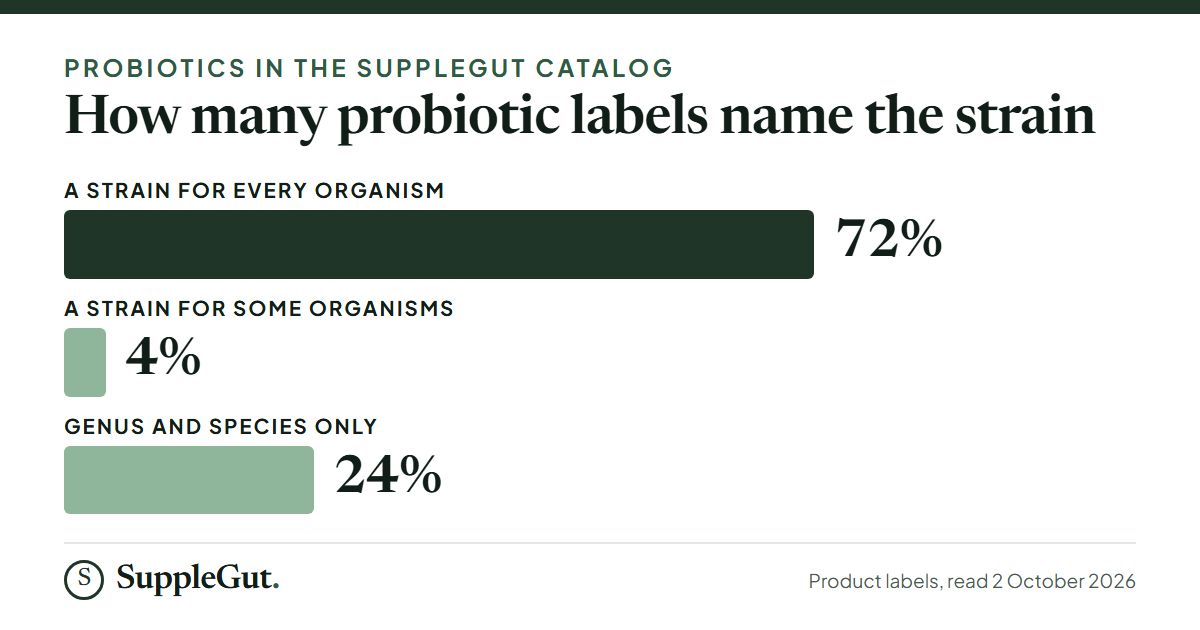
Every product page on this site is written from the product’s own label: what is in it, how much, what it says about allergens and how it is taken. This page adds those labels up. The figures are shares of the products in the catalog and are recalculated whenever a product is added or a label changes.
Probiotics: how many labels name the strain
Probiotic trials are run on single named strains, so the letters or numbers after the species are what tie a bottle to a trial. Lactobacillus rhamnosus is a species; Lactobacillus rhamnosus GG is the strain with the trials. Which probiotic to take goes through the strains that have them.
| What the label prints | Share of probiotics |
|---|---|
| A strain designation for every organism | 72% |
| A strain designation for some organisms, species only for the rest | 4% |
| Genus and species only | 24% |
A strain designation here means a strain code printed after the species, such as GG, 35624, DSM 17938 or HU58, or a trademarked name that belongs to one strain, such as LGG or BB-12.
Allergen statements
The quiz asks which allergens you avoid and removes any product whose label says it contains one. What it can do with the rest depends on what the label states.
| What the label states | Share of products |
|---|---|
| A broad free-from statement covering the major allergens | 21% |
| That it contains a named allergen | 14% |
| Nothing, or a statement that covers only part of the list | 65% |
Milk is the allergen named most often, on 8% of products. A label that says only “gluten-free” is counted in the third row: it rules out wheat and says nothing about milk, soy, egg, nuts, fish or sesame.
Diet claims
| Claim on the label | Share of products |
|---|---|
| Gluten-free | 79% |
| Dairy-free | 56% |
| Vegan | 44% |
Format and dosing
| Format | Share of products |
|---|---|
| Capsule | 62% |
| Powder | 16% |
| Liquid | 8% |
| Gummy | 5% |
| Tablet, chewable, softgel or tea | 9% |
61% of products are directed once a day. The rest are taken with meals, several times a day or as needed.
Cost per day
Cost at the label’s daily dose, from the retail listing each product page links to.
| Type | Median | Lowest | Highest |
|---|---|---|---|
| Probiotics | $0.78 | $0.07 | $2.21 |
| Fiber | $0.31 | $0.18 | $0.97 |
| Digestive enzymes | $0.39 | $0.13 | $1.06 |
| Herbal products | $0.69 | $0.14 | $3.30 |
Products sold by the dose, by the bottle or at a range of doses are left out of this table, because they have no single daily figure.
How these figures were made
- What was counted. Every product in the SuppleGut catalog: probiotics, fibers, digestive enzymes, herbal products and the other gut supplements the quiz can recommend.
- Where each fact comes from. The product’s Supplement Facts or Drug Facts panel and ingredient list, as printed by the brand, the retailer listing or the NIH Dietary Supplement Label Database.
- What the catalog is. A chosen list of products sold in the United States, not a random sample of the shelf. The shares describe this catalog.
- Rounding. Shares are rounded to the nearest whole percent.
How products are researched and scored covers the rest of what is read for each product.
Using these figures
The figures and the chart on this page are free to quote or reuse with a link to this page.
Common questions
What share of probiotics name their strains on the label?
Of the probiotics in the SuppleGut catalog, 72% print a strain designation for every organism, 4% print one for some organisms and 24% print genus and species only. The catalog is a chosen list of products sold in the United States, not a random sample of the shelf.
What counts as a strain designation?
A strain code printed after the species, such as GG, 35624, DSM 17938 or HU58, or a trademarked name that belongs to one strain, such as LGG or BB-12. A species name on its own, such as Lactobacillus acidophilus, is not a strain designation.
Why does the strain matter?
Probiotic trials are run on single named strains at set doses. The strain designation is what lets a label be matched to the trial that tested that organism.
Can I quote these figures?
Yes. The figures and the chart are free to quote or reuse with a link to the page.
Sources
- Product labels, read for each product page in the catalog.
- NIH Office of Dietary Supplements, Dietary Supplement Label Database. dsld.od.nih.gov
Not sure which product fits your situation?
This guide covers the mechanics. The quiz takes your specific symptoms, routine and preferences and matches you to one product from the catalog.
Take the quiz →