
Guide
Which probiotic should I take? Match the strain to the problem
Quick answer
Which probiotic should I take? The one whose strain has a trial for your problem, at the dose that trial used. For diarrhea during antibiotics that means Lactobacillus rhamnosus GG (Culturelle) or Saccharomyces boulardii (Florastor) at 5 billion CFU a day or more. For IBS-type bloating and pain, Bifidobacterium longum 35624 (Align), the Bio-Kult 14-strain formula, L. plantarum 299v or Seed DS-01, each with its own placebo-controlled trial. For everyday gut health there is no trial that picks a winner, so choose a named strain and ignore the CFU race.
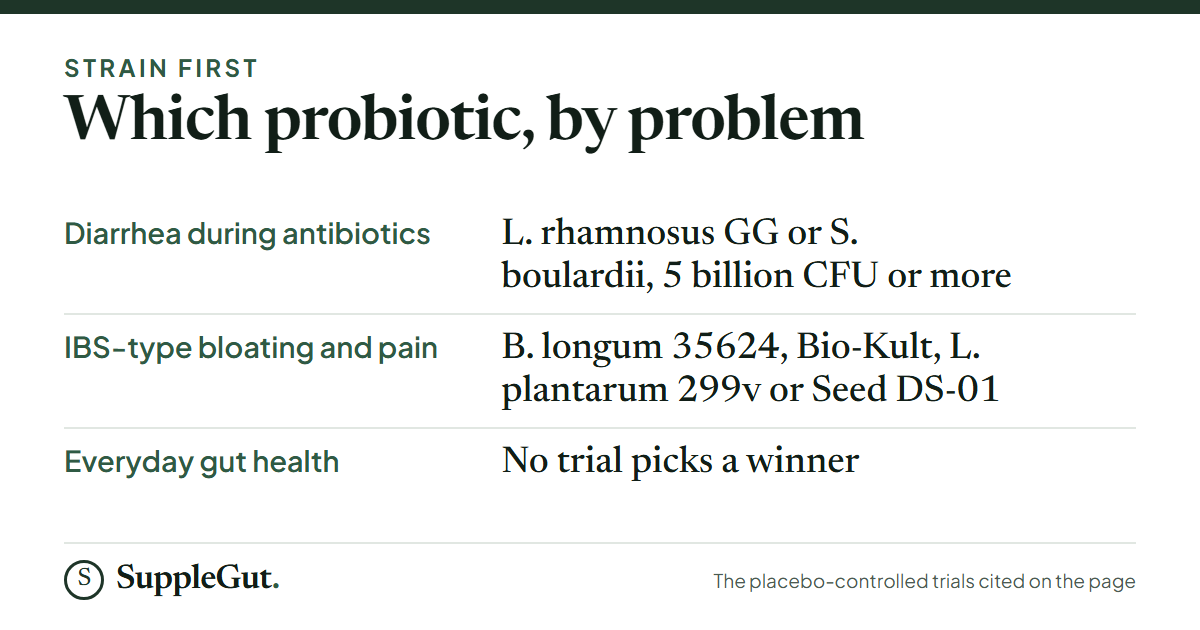
“Probiotic” is a category, not a product, and the trials are run on single named strains at set doses for set problems. A strain that shortened diarrhea in one trial has no claim on your bloating, and a bigger number on the label is not a bigger effect. This page matches the problems people actually have to the strains that have been tested for them, with the trial size and the dose each time, so the choice is a lookup rather than a guess.
The rule that sorts every probiotic
Three things have to line up: the strain (the letters after the species name, such as GG or 35624), the dose the trial used, and the outcome the trial measured. A label that says Lactobacillus rhamnosus without the GG is a different organism with different evidence. A label that says 50 billion CFU of a strain with no dose-finding trial tells you less than a label that says 1 billion of one that has. And a strain with a trial in antibiotic diarrhea has not been shown to do anything for bloating. Every recommendation below is one strain, one dose, one outcome.
Diarrhea during or after antibiotics
This is the best-evidenced use of any probiotic. A meta-analysis of 12 randomized trials in 1,499 people found L. rhamnosus GG cut the rate of antibiotic-associated diarrhea from 22.4% to 12.3% (Szajewska and Kołodziej, 2015). Saccharomyces boulardii has the largest record of any single probiotic: 21 trials in 4,780 people, with the yeast cutting the risk of antibiotic diarrhea, and because it is a yeast the antibiotic does not kill it, so it can be taken alongside rather than hours apart (McFarland, 2010). The doses in those trials were 5 billion CFU a day or more. Culturelle states LGG at 10 billion CFU; Florastor is S. boulardii CNCM I-745 at 250 mg a capsule. The Culturelle vs Florastor comparison sets the two side by side.
IBS-type bloating, cramping and urgency
Four options have a placebo-controlled trial of their own.
- Bifidobacterium longum 35624 (Align). In a trial of 362 women with IBS, 100 million CFU a day improved bloating and pain over four weeks, and a dose 100 times higher did not, which is the clearest demonstration anywhere that more is not better (Whorwell et al., 2006).
- The Bio-Kult 14-strain formula. The largest trial in diarrhea-predominant IBS: 400 adults over 16 weeks, pain severity down 69% against 47% on placebo, at a higher dose than one capsule of the retail product provides (Ishaque et al., 2018).
- L. plantarum 299v. A 214-person IBS trial with a pain result; Jarrow’s Ideal Bowel Support carries the strain at 10 billion CFU (Ducrotté et al., 2012).
- B. bifidum MIMBb75. Trials of the live strain in 122 people and of the heat-inactivated version in 443, both positive on IBS symptoms; the heat-inactivated form is what Kijimea sells (Guglielmetti et al., 2011; Andresen et al., 2020).
For bloating without the pain-and-bowel-habit pattern, Seed DS-01 has the one trial of a finished multi-strain capsule: 350 adults over six weeks, 72% rarely or never bloated by the end against 56% on placebo, funded by Seed and run by an outside firm (Allegretti et al.). The Seed trial guide goes through it. Peppermint oil, which is not a probiotic, has more IBS trials than any of these; the bloating guide weighs it against them.
Ulcerative colitis and pouchitis
The De Simone formulation sold as Visbiome has maintenance trials in ulcerative colitis and chronic pouchitis, in patients already on standard treatment (Tursi et al., 2010). That is a prescription-adjacent use with a clinician in the loop, not an everyday gut-health product, and it is the one probiotic on this site with a measured early side-effect rate: 18% of a trial group reported bloating and discomfort in the first days.
Everyday gut health, with no particular symptom
Here the honest answer is that no trial picks a winner. Published dose-response reviews found no relationship between CFU count and benefit for general gut health or bloating, and the NIH fact sheet says products with higher counts are not necessarily more effective (Ouwehand, 2017; NIH Office of Dietary Supplements). If you want one anyway, choose a strain with trials in something, at a stated CFU guaranteed through the best-by date rather than at manufacture, from a label that names the strain; how many labels do is counted on its own page. The CFU guide explains why the label number can differ from the real one by orders of magnitude.
What the label has to say before you buy
- The strain letters, not just the species. GG, 35624, 299v, CNCM I-745.
- CFU through the best-by date. A count “at time of manufacture” can be a hundred times the count in the capsule you swallow.
- Allergens. Align contains milk protein; Florastor contains lactose; Culturelle is dairy-free. The side-effects guide lists them brand by brand.
- Who should not take it. The serious risks, which are infections, sit with premature infants, people who are critically ill or immune-suppressed, and anyone with a central venous line (NCCIH). Gas and mild discomfort in the first days are the ordinary effects, and in the placebo-controlled trials above they were no more common than on placebo.
Not sure which of these is your picture?
The quiz asks where and when it hurts, what you take and what you have tried, then names the one product with the strongest case and shows the reasons. One to three minutes, no sign-up.
Take the quiz →The products in this catalog
Common questions
Which probiotic is best for bloating?
Two have a placebo-controlled bloating result: Bifidobacterium longum 35624 (Align) at 100 million CFU a day improved bloating and pain in 362 women with IBS over four weeks, and Seed DS-01 left 72% of 350 adults rarely or never bloated after six weeks against 56% on placebo. Peppermint oil, which is not a probiotic, has more bloating trials than either.
Which probiotic should I take with antibiotics?
Lactobacillus rhamnosus GG or Saccharomyces boulardii, at 5 billion CFU a day or more, which are the doses the trials used. Across 12 trials in 1,499 people LGG cut antibiotic-associated diarrhea from 22.4% to 12.3%; S. boulardii has 21 trials in 4,780 people and, being a yeast, is not killed by the antibiotic.
Does a higher CFU count mean a better probiotic?
No. The one trial that compared three doses of the same strain found 100 million CFU of B. infantis 35624 beat placebo while a dose 100 times higher did not, and dose-response reviews find no link between CFU and benefit for general gut health. The strain, the trial behind it and the count guaranteed through the best-by date matter more than the headline number.
Which probiotic is best for IBS with diarrhea?
The largest trial in diarrhea-predominant IBS tested the Bio-Kult 14-strain formula in 400 adults over 16 weeks, with pain severity down 69% against 47% on placebo. L. plantarum 299v (214 people) and B. bifidum MIMBb75 (122 live, 443 heat-inactivated) have IBS trials of their own.
Should I take a probiotic every day if nothing is wrong?
No trial shows a daily probiotic helps a healthy gut, and the NIH fact sheet says higher-count products are not necessarily more effective. If you take one anyway, choose a named strain with trials in something, at a CFU guaranteed through the best-by date.
Who should not take probiotics?
The serious risks are infections, and they are concentrated in premature infants, people who are critically ill or immune-suppressed, and anyone with a central venous line. For everyone else the ordinary effects are gas and mild discomfort in the first days, which in the placebo-controlled trials were no more common than on placebo.
Sources
- Szajewska H, Kołodziej M. "Systematic review with meta-analysis: Lactobacillus rhamnosus GG in the prevention of antibiotic-associated diarrhoea in children and adults." Alimentary Pharmacology & Therapeutics, 2015. pubmed.ncbi.nlm.nih.gov/26365389
- McFarland LV. "Systematic review and meta-analysis of Saccharomyces boulardii in adult patients." World Journal of Gastroenterology, 2010. pubmed.ncbi.nlm.nih.gov/20458757
- Whorwell PJ, et al. "Efficacy of an encapsulated probiotic Bifidobacterium infantis 35624 in women with irritable bowel syndrome." American Journal of Gastroenterology, 2006. pubmed.ncbi.nlm.nih.gov/16863564
- Ishaque SM, et al. "A randomized placebo-controlled clinical trial of a multi-strain probiotic formulation (Bio-Kult) in the management of diarrhea-predominant irritable bowel syndrome." BMC Gastroenterology, 2018. pubmed.ncbi.nlm.nih.gov/29801486
- Ducrotté P, et al. "Clinical trial: Lactobacillus plantarum 299v (DSM 9843) improves symptoms of irritable bowel syndrome." World Journal of Gastroenterology, 2012. pubmed.ncbi.nlm.nih.gov/22912552
- Guglielmetti S, et al. "Randomised clinical trial: Bifidobacterium bifidum MIMBb75 significantly alleviates irritable bowel syndrome and improves quality of life." Alimentary Pharmacology & Therapeutics, 2011. pubmed.ncbi.nlm.nih.gov/21418261
- Andresen V, et al. "Heat-inactivated Bifidobacterium bifidum MIMBb75 (SYN-HI-001) in the treatment of irritable bowel syndrome." Lancet Gastroenterology & Hepatology, 2020. pubmed.ncbi.nlm.nih.gov/32277872
- Allegretti JR, et al. "A Randomized, Placebo-Controlled Trial Evaluating Multi-Species Synbiotic Supplementation for Bloating, Gas, and Abdominal Discomfort." pmc.ncbi.nlm.nih.gov/articles/PMC12845427
- Tursi A, et al. "Treatment of relapsing mild-to-moderate ulcerative colitis with the probiotic VSL#3 as adjunctive to a standard pharmaceutical treatment." American Journal of Gastroenterology, 2010. pubmed.ncbi.nlm.nih.gov/20517305
- Ouwehand AC. "A review of dose-responses of probiotics in human studies." Beneficial Microbes, 2017. pubmed.ncbi.nlm.nih.gov/28008787
- National Institutes of Health, Office of Dietary Supplements. "Probiotics: Health Professional Fact Sheet." ods.od.nih.gov
- National Center for Complementary and Integrative Health. "Probiotics: Usefulness and Safety." nccih.nih.gov
Not sure which product fits your situation?
This guide covers the mechanics. The quiz takes your specific symptoms, routine and preferences and matches you to one product from the catalog.
Take the quiz →