
Daily gut routine
Foodology Coleology Diet Probiotics
A once-a-day capsule of three probiotic organisms (10.1 billion CFU) from a Korean diet brand, marketed for weight and gut balance.
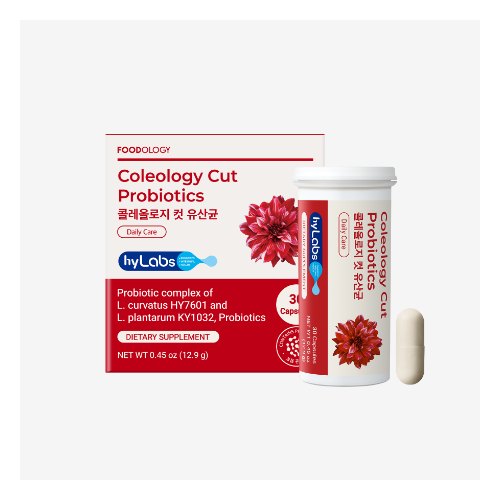
- Format
- Capsule, once a day
- Type
- Probiotic
- Cost
- $0.90 a day
- Customer rating
- 4.2 out of 5 from 155 ratings from Amazon
What customers consistently report
- Less bloating within the first week or two
- Easier bowel movements
- A capsule that is easy to swallow
Those are the themes that recur across the reviews. Moderate review confidence — Amazon shows an independent 4.2 from 155 ratings, the brand’s own page shows no rating, Trustpilot and the Better Business Bureau have no profile for the brand, and the Amazon review text was not readable.
Why it might work
The two named Lactobacillus strains were isolated from fermented foods and have mostly been studied for body weight, fat and blood-lipid effects, where trials report shifts in gut bacteria such as more Bifidobacteriaceae and Akkermansiaceae. The third organism, a Bifidobacterium, belongs to a species often studied for stool frequency and comfort, but no strain is named on the panel. Small amounts of fructooligosaccharide and chicory root extract are listed as prebiotics, with no weight given. The brand describes a delayed-release capsule that protects the cultures from stomach acid, yet the capsule listed on the panel is a plain hydroxypropyl methylcellulose capsule. Because only the blend total is printed, the label does not let you check how many of each organism you receive.
What the research supports
No trial of this capsule was found. Two of its three organisms, L. curvatus HY7601 and L. plantarum KY1032, were tested together in a 12-week placebo-controlled trial of 72 overweight adults at 10 billion CFU a day (5 billion each in a 250 mg capsule): the probiotic group lost 0.47 kg while the placebo group gained 0.93 kg, and the pair also has trials in adults with high triglycerides. Those trials did not measure bloating, gas or stool frequency, and most authors work for hy Co., Ltd., whose logo is on the box. The third organism has no strain code on the panel, and the label does not print per-strain counts, so the trial dose cannot be matched exactly. Reviews of probiotics for bloating and irritable bowel syndrome find benefit with low to very low certainty.
What the label discloses
The panel prints two strain codes, HY7601 and KY1032, but no code for B. animalis subsp. lactis and no count per strain, only 10.1 billion CFU for the 250 mg blend. The label states it contains milk, soy and wheat and is made in a facility that also handles egg, peanuts, fish, shellfish and tree nuts. No testing laboratory or certificate is named, and the Amazon title mentions enzymes and fiber that the panel does not list.
Who this tends to suit
We match this product to people reporting bloating and gas. It fits someone whose priority is a steady daily routine or day-to-day comfort. Whether it is the best fit for you depends on the rest of your answers — what you have already tried, what format you will take, and anything that has to be ruled out.
Where it may not fit
We hold no dietary claims on file for this product, so we do not assume any. A capsule only works if you will take it once a day, every day.
Side effects and what to be aware of
Most Amazon reviewers report less bloating or easier bowel movements, but some report more gas, bloating or stomach pain, and some report no effect after a week. The US panel and brand page print no pregnancy or medication warning, while a Korean-goods retailer listing of the same pack carries one and a California Proposition 65 notice. The label states milk, soy and wheat.
Common questions
Does Foodology Coleology Diet Probiotics work?
No trial of this capsule was found. Two of its strains, L. curvatus HY7601 and L. plantarum KY1032, lowered body weight, waist size and triglycerides in 12-week trials of overweight adults at about the label’s 10 billion CFU, but those trials did not measure bloating or regularity. Amazon’s summary of review text says customers report less bloating and easier bowel movements, with some reporting more bloating or stomach pain.
Is Coleology Diet Probiotics safe, and what are the side effects?
The US panel and brand page print no warning. A Korean-goods retailer listing of the same pack says children, pregnant women and nursing mothers should avoid it and to consult a doctor with liver, kidney or heart disease or medication, and it carries a California Proposition 65 lead and cadmium notice. Amazon reviewers mention bloating, gas and stomach pain from a minority of users, and the label states milk, soy and wheat.
What strains are in Coleology Diet Probiotics?
The panel lists Lactobacillus curvatus HY7601, Lactobacillus plantarum KY1032 and Bifidobacterium animalis subsp. lactis, with 10.1 billion CFU in total in a 250 mg blend. It does not print a count per strain or a code for the Bifidobacterium, although a brand graphic calls it KY8002. The first two codes belong to strains from the Korean company behind the hyLabs logo on the box.
How much does Coleology Diet Probiotics cost?
A 30-capsule bottle is $35 on the brand site, which is $1.17 a day, with free shipping at $59 and over. Amazon lists it at $27 ($0.90 a day) and $24.30 with Subscribe & Save. The brand site offers a 30-day refund on its own orders, while Amazon marks it non-returnable unless damaged.
Is Foodology sold in the US, and who makes it?
Foodology is a Korean brand (Adapt Inc., Seoul) that ships to the US from a California warehouse and sells on Amazon.com, where this capsule has a 4.2 rating from 155 ratings. No Trustpilot or Better Business Bureau profile exists for it, so no independent billing or delivery complaints could be checked. Its ads call it Korea’s number one edible GLP-1, which is a brand claim; it is a probiotic, not a drug.
Is this the right one for you?
The quiz works out which of the products we have researched fits your symptoms, your routine and what you have already tried — and tells you plainly if none of them do.
Take the quiz →Free. Private. Nothing to sign up for.
Others we researched for the same job
These sit in the same role as Foodology Coleology Diet Probiotics — daily gut routine — so they are the sensible things to weigh it against.
See all the products we have researched →
Related reading
Background on how this type of product works, read from the trial evidence.