
Daily gut routine
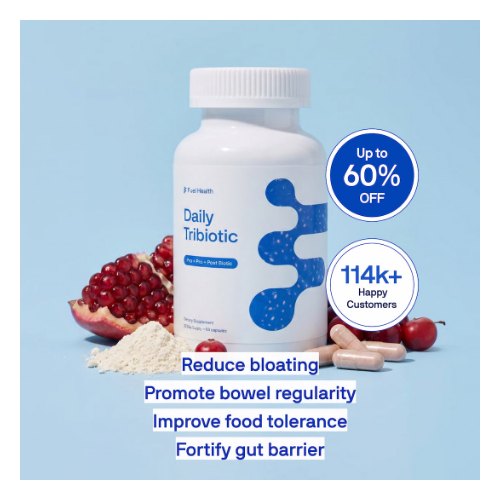
Fuel Health Daily Tribiotic
A once-a-day, two-capsule formula pairing 300 mg of tributyrin with fruit polyphenols and two small probiotic blends.
- Format
- Capsule, once a day
- Type
- Probiotic, prebiotic and postbiotic
- Cost
- $0.83 a day on Amazon; $1.30 to $1.93 a day on the brand site
- Customer rating
- 4 out of 5 from 18 ratings from Amazon
What the accounts we could find say
- Less bloating within a few weeks
- More regular bowel movements, including for people on GLP-1 medication
- An easy two-capsule morning routine
There is not enough independent feedback here to call those themes reliable. Low review confidence — the official Amazon listing shows 4.0 from 18 ratings, Trustpilot’s 4.2 rests on 49 reviews on a brand-wide profile that invites reviews, and the 4.88 from 326 on the brand’s own page includes 215 unverified entries filed under a bundle listing.
Why it might work
Tributyrin is three butyrate molecules bound to glycerol; digestive enzymes release butyrate along the gut, and butyrate is the main fuel for colon lining cells. The laboratory study found about 59% of the capsule dose reached the colon intact, and the brand’s idea is that this butyrate supports the gut lining and the bacteria that make it. Pomegranate pericarp and cranberry are polyphenol sources the brand calls prebiotics; a four-day study of a cranberry extract found more bifidobacteria, at a dose the label does not let you match. The Bifidobacterium and Bacillus subtilis rows are meant to add bacteria, and the B. subtilis is a spore former that survives stomach acid. The label does not print how many live cells are in the capsules, and no human trial shows the lining effect the brand describes.
What the research supports
No trial of this product was found, and the brand’s own science page says it has not been clinically tested as a finished formula. The main active, 300 mg of CoreBiome tributyrin, has a laboratory-model study (59% of a 300 mg capsule survived to the colon, with more butyrate in a gut simulator) and a registered 300 mg human study that was stopped for lack of funding after four participants and posted no results. The probiotics are listed by species and weight (10 mg each) with no strain designations or cell counts, so strain trials cannot be matched to them. Meta-analyses of probiotics for irritable bowel syndrome find low to very low certainty for bloating and pain.
What the label discloses
The panel prints a 10 mg three-species Bifidobacterium blend and 10 mg of Bacillus subtilis with no strain designation and no CFU. The brand states third-party testing and GMP manufacturing without naming a laboratory or manufacturer. Its homepage lists only a vegetable-cellulose capsule as other ingredients, while the panel lists five, including magnesium stearate and silicon dioxide.
Who this tends to suit
We match this product to people reporting bloating, gas, irregular bowel habits and general abdominal discomfort. It fits someone whose priority is day-to-day comfort, a steady daily routine or regularity. Whether it is the best fit for you depends on the rest of your answers — what you have already tried, what format you will take, and anything that has to be ruled out.
Where it may not fit
The label supports gluten-free and dairy-free. We flag this product for anyone pregnant or breastfeeding or taking prescription medication, and the quiz removes it rather than recommending it in those cases. That is a caution about who should be deciding, not a claim about the product. A capsule only works if you will take it once a day, every day.
Side effects and what to be aware of
Some reviewers report no change after one to two months, one reports two weeks of upset stomach, and two Trustpilot reviews describe unwanted recurring shipments or trouble cancelling while others describe an easy 90-day refund. The brand page pre-selects a monthly subscription, and the label itself carries no warnings; the homepage FAQ says to consult a provider if pregnant, nursing or taking medication.
Common questions
Does Fuel Health Daily Tribiotic work?
No trial of the finished product was found, and the brand’s science page says it has not been clinically tested as a formula. Its 300 mg tributyrin has a laboratory-model study and a human study that stopped with four participants and no results. On Trustpilot about four in five of 49 reviews are five-star and several say they noticed no difference after one to two months; the official Amazon listing shows 4.0 from 18 ratings.
Does Fuel Daily Tribiotic rebuild the gut lining in 48 hours, as the ads say?
That is a brand claim. The support on its science page is a cell-culture and gut-simulator study of tributyrin, not a study in people, and the page itself says the results come from laboratory models. No human measurement of gut lining repair at this dose was found.
Is Fuel Health Daily Tribiotic safe, and what are the side effects?
The panel prints no warnings; the homepage FAQ says to consult a healthcare provider if pregnant, nursing or taking medication. The brand says some people notice mild gas in the first week, and one reviewer reported about two weeks of upset stomach. A pilot of a different tributyrin product reported GI discomfort in under 10% of 24 participants.
How much does Fuel Health Daily Tribiotic cost?
The official Amazon listing was $24.99 for 60 capsules ($0.83 a day). On the brand site the variant price is $58 for a 30-day bottle ($1.93 a day) and the main page shows $39 ($1.30 a day) with a monthly subscription pre-selected; multi-bottle offers list $26 and $23.40 a bottle.
How do I cancel a Fuel Health subscription or get a refund?
The brand offers a 90-day money-back guarantee through a return portal, and a Trustpilot reviewer says a refund under it was easy. Two other Trustpilot reviewers say they could not cancel or received shipments they did not expect. Subscriptions can be changed or cancelled from the order-confirmation link or the account page, and the refund policy says sale items cannot be returned.
Before you take this. Speak to a doctor or pharmacist first if you are pregnant or breastfeeding, or taking prescription medication. Nothing on this page is medical advice, and no supplement diagnoses, treats, cures or prevents disease.
Is this the right one for you?
The quiz works out which of the products we have researched fits your symptoms, your routine and what you have already tried — and tells you plainly if none of them do.
Take the quiz →Free. Private. Nothing to sign up for.
Others we researched for the same job
These sit in the same role as Fuel Health Daily Tribiotic — daily gut routine — so they are the sensible things to weigh it against.
See all the products we have researched →
Related reading
Background on how this type of product works, read from the trial evidence.