
Guide
Does Coleology Diet Probiotics work? Two Korean weight-trial strains, one unnamed, and what the trial measured
Quick answer
Does Coleology Diet Probiotics work? We could find no trial of the capsule. Two of its three organisms, HY7601 and KY1032, lowered weight and waist in a 12-week trial of 72 adults at about the label’s 10 billion CFU, but that trial and the others measured weight and blood fats, not bloating. The label prints 10.1 billion CFU for the three together with no per-strain counts, and no code for the third organism. Amazon shows 4.2 from 155 ratings, with most reviewers reporting less bloating and a minority reporting more.
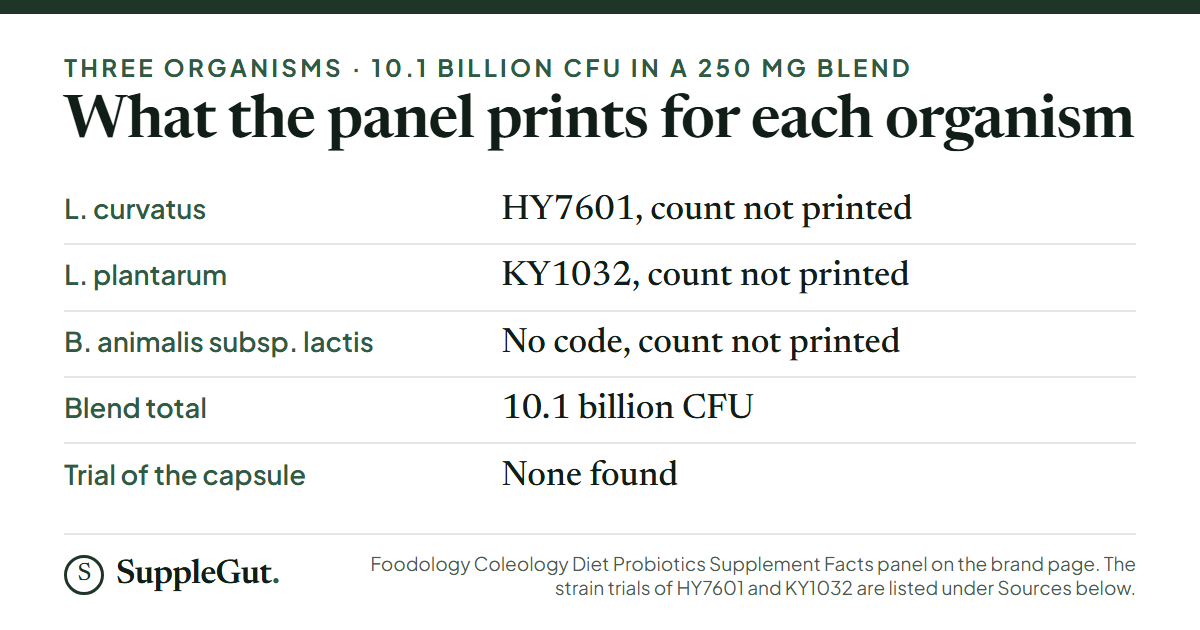
Foodology Coleology Diet Probiotics is a once-a-day capsule of three probiotic organisms, 10.1 billion CFU in total, from a Korean diet brand. It is sold in the US on the brand’s own store and on Amazon. What sets it apart from most small-brand probiotics is that two of its three organisms carry strain codes with human trials behind them; what those trials measured was body weight and blood fats, not bloating. This page sets out what the panel prints, what the strain trials found, what the reviews say, and what the price and refund terms are by route.
What Coleology is, and what it is not
The Supplement Facts panel lists one line: a Probiotic Blend of 250 mg with 10.1 billion CFU for the three organisms together. The panel prints no count for any single organism.
| Organism as printed | Strain code | Count |
|---|---|---|
| Lactobacillus curvatus | HY7601 | not printed |
| Lactobacillus plantarum | KY1032 | not printed |
| Bifidobacterium animalis subsp. lactis | none on the panel | not printed |
A brand graphic gives the third organism a code, KY8002, and writes the first as “KY7601”, which does not match the panel. We found no PubMed record under KY8002. The other ingredients are maltodextrin, corn starch and calcium carboxymethyl cellulose, then a list of lesser ingredients that includes isomalt, fructooligosaccharide, chicory root extract, a vegetable concentrate mix, aloe vera gel extract, cinnamon extract, fingerroot and hibiscus, each under 2% with no weight printed. The brand calls the capsule a synbiotic, but the only prebiotic-type ingredients are those under-2% lines. The Amazon title mentions fiber and digestive enzymes, and the panel lists neither.
The brand sells the same capsule under three names: Coleology Diet Probiotics on its store, Coleology Cut Probiotics on the box and panel, and a longer weight-management title on a hidden duplicate listing. The jellies and drink mixes in the brand’s range are different products.
The trial of the capsule itself
There is none. We found no record under the product or brand name on PubMed or ClinicalTrials.gov. The brand’s page refers to “3 clinically studied strains”, a claim that applies to at most two of them, and no trial of the third organism could be found. The brand’s own graphics promise “Feel Less Bloated” at one week, smoother digestion at two and stronger gut balance at three, and none of those was an outcome in the strain trials below.
The evidence for the two named strains
HY7601 and KY1032 have been tested together in humans five times that we could find, always as a pair. The closest match to the capsule is a 12-week, double-blind, placebo-controlled trial in overweight adults: 72 enrolled and 59 analyzed (30 on the probiotic, 29 on placebo). The capsule held 250 mg of the two strains at 5 billion CFU each, 10 billion in all. Body weight changed by −0.47 kg on the probiotic and +0.93 kg on placebo, and waist circumference by −0.41 cm against +1.31 cm. Visceral fat area and adiponectin were better than on placebo, and stool bacteria from the Bifidobacteriaceae and Akkermansiaceae families rose. There was no gut symptom outcome (Mo et al., Nutrients, 2022). The authors are from hy Co., Ltd., the company whose logo is on the Coleology box; the paper declares no conflict of interest.
A 2026 trial with authors from the same company enrolled 100 overweight adults with mildly high triglycerides and analyzed 80. Within the probiotic group, triglycerides fell from 158.61 to 139.54 mg/dL and LDL from 129.22 to 111.34 mg/dL, with no change in the placebo group (Kim et al., Nutrients, 2026). Two 2015 trials in adults with high triglycerides, of 128 and 92 people, used 2 g a day of a powder with both strains and reported lower triglycerides (Ahn et al., 2015). A 66-person trial in overweight adults linked weight loss to changes in medium chain acylcarnitines (Kim et al., Food & Function, 2017). All ran 12 weeks, and none measured bloating, gas or stool frequency. The same two strains also appear in our Vivvira Restore guide, where the trials are summarized next to a different product.
Does the label match the trial dose? The label’s 10.1 billion CFU is shared among three organisms and the split is not printed. An even three-way split would be about 3.4 billion each, below the 5 billion each used in the 72-adult trial, but the label does not say the split is even, so the match cannot be confirmed either way.
The wider evidence for probiotics, weight and bloating
A meta-analysis of 15 trials in 957 overweight or obese adults, lasting 3 to 12 weeks, found probiotics lowered body weight by 0.60 kg (95% confidence interval −1.19 to −0.01) and described the effect sizes as small (Borgeraas et al., Obesity Reviews, 2018). A 2025 meta-analysis of 8 trials in 412 people with obesity reported greater weight, waist and visceral fat reductions than control, with no significant change in BMI or LDL (Guo et al., Scientific Reports, 2025). For bloating, the largest review is of 82 trials in 10,332 adults with IBS; it rated the certainty of benefit for combination probiotics on bloating as very low, and for Bifidobacterium strains on abdominal pain as low (Goodoory et al., Gastroenterology, 2023). Those are IBS patients, not general users, and no strain in this capsule is singled out. For how CFU counts compare with trial doses, see how many CFU you need.
The “edible GLP-1” claim and the delayed-release claim
The brand’s ads on Meta describe the capsule as “Korea’s #1 edible GLP-1”, with “over 28 million sold” and the labels Fat Fighter, Burn Booster and Gut Guardian. These are the brand’s words. The product is a dietary supplement with a Supplement Facts panel, and the trials above measured weight and lipids. The “28M+ capsules sold” graphic carries a footnote that the total is cumulative sales in Korea since launch.
The brand’s graphics also call it a delayed-release capsule with a protective coating. The panel lists a hydroxypropyl methylcellulose capsule, with calcium carbonate, carrageenan, sorbitan monostearate, magnesium chloride, glycerin and potassium chloride, and no coating among the other ingredients. We found no testing laboratory, certificate or potency test named on the brand page or the Amazon listing.
How to take it
The brand page says one capsule a day with water, at any time, with no refrigeration needed. A Korean retailer’s text for the same pack says after a meal. Each capsule weighs about 430 mg, and a reviewer describes it as a little larger than a common pain-relief tablet but easy to swallow. The strain trials ran 12 weeks, so a fair test is longer than the first week or two that most reviewers describe.
Side effects and who should not take it
The US Supplement Facts panel and the brand’s page print no warning about pregnancy, medication, age or conditions. A Korean-goods retailer listing the same 30-capsule pack prints more: children, pregnant women and nursing mothers should avoid it; people with liver, kidney or heart disease, allergies, asthma or on medication should consult a specialist first; stop and see a doctor if stomach discomfort occurs; and a California Proposition 65 statement that the product can expose users to lead and cadmium. We could not tell whether the US box carries those lines, because the side panel in the product photo is too small to read. Amazon’s listing adds that some states prohibit sales of weight loss products to people under 18.
The panel states Contains Milk, Soy, Wheat, and that it is made in a facility that also processes egg, peanuts, wheat, fish (mackerel), crustacean shellfish (crab, shrimp) and tree nuts (walnut, pine nut). Amazon’s summary of reviews counts 9 mentions of side effects, 6 positive and 3 negative, and the negative ones describe more gas, bloating or stomach pain. Our guide to probiotic side effects covers the usual first-week effects.
What the reviews say
The only independent rating is on Amazon: 4.2 out of 5 from 155 ratings, split 68% five-star, 13% four, 6% three, 3% two and 10% one. The brand’s product page has no review widget, only static graphics headed “Real Reviews” with two five-star quotes and no count. We found no Trustpilot profile and no BBB profile for the brand, so no independent billing or delivery complaints could be checked there. One Korean-language review on a Korean-goods retailer says no effect had been noticed yet.
Amazon’s summary of review text lists 35 mentions of effectiveness, 29 positive and 6 negative. The recurring praise is less bloating, often within the first week or two, easier bowel movements, and a capsule that goes down easily. The recurring complaints are no change after about a week, more gas and bloating in a minority, and price: 5 of 7 value mentions are negative. Individual review text is behind a sign-in, so the excerpts we could read were limited to those Amazon shows in its summary.
Price, refunds and where it is sold
| Route | Price for 30 capsules | Per day |
|---|---|---|
| Brand site, one-time | $35.00 | $1.17 |
| Amazon, one-time | $27.00 | $0.90 |
| Amazon, Subscribe & Save | $24.30 | $0.81 |
The brand site offers no subscription for this product. US orders under $59 pay $5.99 shipping, and orders of $59 or more ship free. The brand states a 30-day refund for domestic orders on its own store, including a refund “guaranteed” for dissatisfaction with results; the customer pays return shipping, and the refund follows inspection of the returned product. Purchases from other platforms are excluded. Amazon lists the item as non-returnable for food safety reasons, with a refund or replacement if it arrives damaged or defective. Amazon describes Subscribe & Save as having no fees and cancelable at any time.
Who Coleology is for
- Someone who wants two strain codes on the label and is comfortable that the trials of those strains measured weight and blood fats.
- Someone who accepts a total CFU with no per-strain split and an unnamed third organism.
- Someone who can avoid milk, soy and wheat, and who will take the capsule daily for several weeks.
For a product that prints a code and a count for every strain, see Vivvira Restore Synbiotic. For a product with a much longer species list and no codes, see Slimbiosys and its guide. For a single named strain, see Culturelle Digestive Daily. The probiotic chooser and the quiz start from symptoms instead of products.
The products in this catalog
Common questions
Does Foodology Coleology Diet Probiotics work?
No trial of this capsule was found. Two of its strains, L. curvatus HY7601 and L. plantarum KY1032, were tested together in a 12-week trial of 72 overweight adults at 10 billion CFU, where the probiotic group lost 0.47 kg and the placebo group gained 0.93 kg. That trial and the others measured weight and blood fats, not bloating or regularity. Amazon’s summary of review text says customers report less bloating and easier bowel movements, with some reporting more bloating or stomach pain.
What strains are in Coleology Diet Probiotics?
The panel lists Lactobacillus curvatus HY7601, Lactobacillus plantarum KY1032 and Bifidobacterium animalis subsp. lactis, with 10.1 billion CFU in total in a 250 mg blend. It prints no count per strain and no code for the Bifidobacterium, although a brand graphic gives one. The box carries the logo of hy Co., Ltd., the company whose authors wrote the two most recent trials of the first two strains.
Is Foodology Coleology Probiotics safe, and what are the side effects?
The US panel and the brand page print no warning. A Korean-goods retailer listing of the same pack says children, pregnant women and nursing mothers should avoid it, to consult a doctor with liver, kidney or heart disease or on medication, and it carries a California Proposition 65 lead and cadmium notice. The label states milk, soy and wheat, and Amazon reviewers mention gas, bloating or stomach pain in a minority of cases.
Is Foodology sold in the US, and who makes it?
Foodology is a Korean brand, Adapt Inc. of Seoul, and it ships within the US from a warehouse in Compton, California. The capsule is also on Amazon.com, sold by Adapt Korea and shipped by Amazon, with a 4.2 rating from 155 ratings. We found no Trustpilot or BBB profile, so no independent billing or delivery complaints could be checked there. Its ads call the capsule “Korea’s #1 edible GLP-1”, which is the brand’s own wording.
How much does Coleology Diet Probiotics cost?
A 30-capsule bottle is $35 on the brand site, which is $1.17 a day, with free shipping at $59 and over. Amazon lists it at $27 ($0.90 a day) and $24.30 with Subscribe & Save ($0.81 a day).
Can you return Coleology Diet Probiotics?
The brand states a 30-day refund on orders placed on its own store, including for lack of results, with the customer paying return shipping and the refund issued after inspection. Purchases from other platforms are excluded. Amazon marks the item non-returnable unless it arrives damaged or defective.
Does the delayed-release capsule protect the probiotics?
The brand’s graphics describe a delayed-release capsule with a protective coating. The panel lists a plain hydroxypropyl methylcellulose capsule and names no coating, and we found no test of how many organisms reach the gut. Because only the blend total is printed, the label does not let a buyer check the count of each organism.
Sources
- Mo SJ, et al. Randomized trial of Lactobacillus curvatus HY7601 and Lactobacillus plantarum KY1032 in 72 overweight adults. Nutrients, 2022. PMID 35745214
- Kim EJ, et al. HY7601 and KY1032 in overweight adults with mild hypertriglyceridemia. Nutrients, 2026. PMID 42280356
- Ahn HY, et al. Probiotic pair and triglycerides, apo A-V and LDL particle size in 128 adults. Atherosclerosis, 2015. PMID 26117402
- Ahn HY, et al. Probiotic pair at 5 billion CFU each in 92 adults with hypertriglyceridemia. Nutrition, Metabolism and Cardiovascular Diseases, 2015. PMID 26044516
- Kim M, et al. Weight loss and medium chain acylcarnitines in overweight adults. Food & Function, 2017. PMID 28001147
- Borgeraas H, et al. Effects of probiotics on body weight, body mass index, fat mass and fat percentage: meta-analysis of 15 randomized trials. Obesity Reviews, 2018. PMID 29047207
- Guo M, et al. Probiotics, weight and visceral fat: meta-analysis of 8 randomized trials. Scientific Reports, 2025. PMID 39984625
- Goodoory VC, et al. Probiotics in irritable bowel syndrome: systematic review and meta-analysis of 82 randomized trials. Gastroenterology, 2023. PMID 37541528
- Brand pages: label, directions and price foodology-global.com/products/coleology-diet-probiotics; refund policy foodology-global.com/policies/refund-policy; shipping policy foodology-global.com/policies/shipping-policy
- Amazon listing: price, rating, review summary and legal disclaimer. amazon.com/dp/B0GVM369J4
- Korean-goods retailer listing of the same pack: warnings as printed. wooltariusa.com
Not sure which product fits your situation?
This guide covers the mechanics. The quiz takes your specific symptoms, routine and preferences and matches you to one product from the catalog.
Take the quiz →