
Guide
Does Fuel Daily Tribiotic work? Tributyrin, two unnamed probiotic blends and a lab-model claim
Quick answer
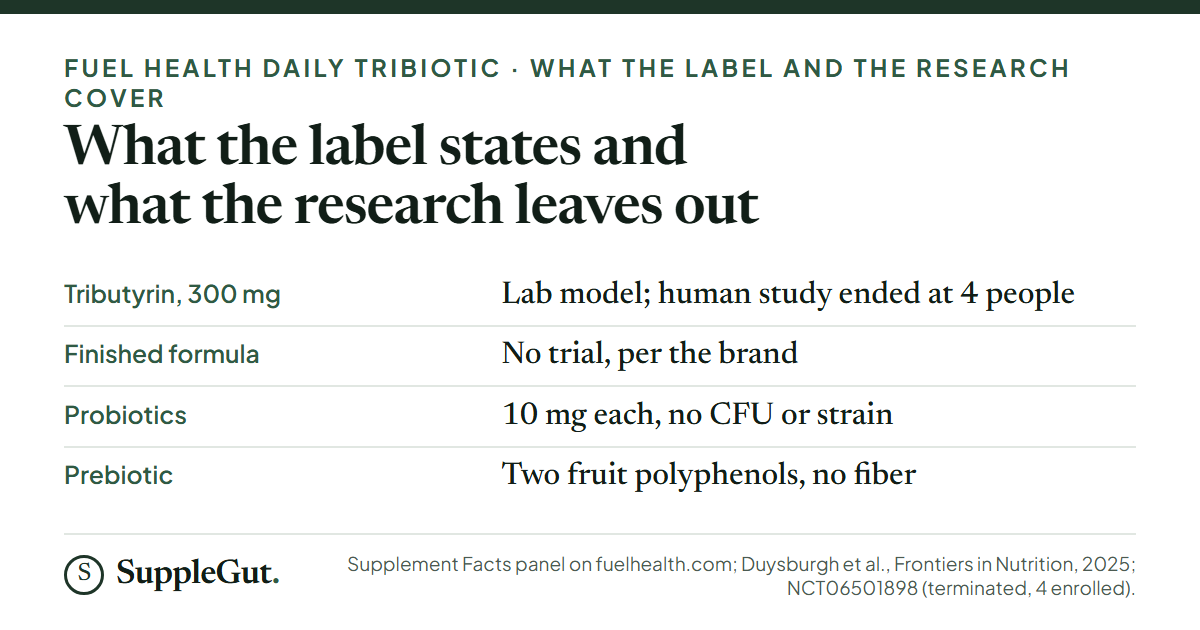
Does Fuel Daily Tribiotic work? We could find no trial of Daily Tribiotic, and the brand’s own science page says it has not been clinically tested as a finished formula. Its main ingredient, 300 mg of CoreBiome tributyrin, has a laboratory-model study (59% of a capsule reached the colon intact) and a 300 mg human study that was stopped with four people enrolled and no results. The probiotics are printed as 10 mg weights with no strain or CFU, and the “prebiotic” is two fruit polyphenols rather than a fiber. Ratings run from 4.0 from 18 on Amazon to 4.2 from 49 on Trustpilot and 4.88 from 326 on the brand’s own site.
Fuel Health Daily Tribiotic is a two-capsule, once-a-day formula that the brand describes as a prebiotic, probiotic and postbiotic in one. Its headline ingredient is 300 mg of CoreBiome tributyrin, a form of butyrate. This page sets out what the Supplement Facts panel prints, which studies exist for each ingredient and how they compare with the label dose, what the three review pools show, and what the brand’s published terms say about price, subscriptions and refunds.
What Daily Tribiotic is, and what it is not
Per serving of two capsules, the panel lists tributyrin (as CoreBiome) 300 mg; pomegranate pericarp 100 mg; cranberry fruit 100 mg; a three-strain probiotic blend of Bifidobacterium lactis, B. longum and B. breve at 10 mg in total; and Bacillus subtilis 10 mg. A bottle holds 60 capsules, which is 30 servings. The other ingredients are hypromellose cellulose, microcrystalline cellulose, magnesium stearate, silicon dioxide and calcium silicate. The panel is an image on the brand’s product page, and we read it at full size.
Three details of that panel shape how the product should be read. First, the probiotics are printed as weights, not cell counts: 10 mg of a three-species blend and 10 mg of B. subtilis, with no CFU and no strain designation on either row. Together they are 20 mg of the 520 mg of listed actives, about 4%. The brand’s own copy says “No Proprietary Blends”, while the panel prints the bifidobacteria as one blend with a single combined weight. Second, the “prebiotic” is two fruit polyphenol ingredients, not a fiber: no inulin, FOS or GOS is on the brand’s panel, although the Amazon listing’s bullet text says it is made with inulin. Third, the brand calls the tributyrin a postbiotic. Tributyrin is three butyrate molecules bound to glycerol, which digestive enzymes release along the gut; butyrate is the main fuel of colon lining cells.
The brand’s homepage and its panel differ on the other ingredients. The homepage lists a vegetable-cellulose capsule as the only other ingredient and says “No fillers”, while the panel lists five, including magnesium stearate and silicon dioxide.
The trial of the product itself
There is none. The brand’s science page answers its own question, “Has Daily Tribiotic been clinically tested?”, with “Not yet as a finished formula.” We searched PubMed and ClinicalTrials.gov under the product name and found no record. The homepage nonetheless lists “Published clinical research: Yes”; the research it points to concerns ingredients, set out below.
The evidence for tributyrin
The 300 mg figure on the label matches the dose in two studies, and neither shows an effect in people. The first is a laboratory study of CoreBiome. In an upper-gut simulation, 59.1% of a 300 mg capsule stayed intact to reach the colon and 40.9% was broken down to butyrate in the small intestine. Three weeks of daily tributyrin in a gut simulator raised butyrate and the counts of Bifidobacterium and Akkermansia, and in cell cultures it had a protective effect on a model of the gut barrier. It used no people, and it was sponsored by the ingredient’s supplier, Compound Solutions, and run by ProDigest (Duysburgh et al., Frontiers in Nutrition, 2025).
The second is a registered human study. A placebo-controlled trial of 300 mg of CoreBiome once daily for four weeks in sedentary adults, run at Florida State University, is listed as terminated for loss of funding with four people enrolled and no results posted (NCT06501898). It is the only registered human study of CoreBiome we found, and it produced no data.
For butyrate in a different form, a 12-week trial in 66 people with IBS added microencapsulated sodium butyrate to standard therapy. Pain during defecation fell at four weeks, and urgency and bowel habit improved by 12 weeks, but the reductions in abdominal pain, flatulence and disordered defecation were not statistically significant (Banasiewicz et al., Colorectal Disease, 2013). We found no human trial of tributyrin for bloating, regularity or the gut lining with results.
The gut-lining claim
The brand’s product page says Daily Tribiotic “rebuilds your protective gut barrier”, and the homepage says it “stops inflammation and rebuilds your protective gut lining in 48 hours”. These are the brand’s claims. The barrier evidence we could find is the cell-culture result in the laboratory study above, which tested cultured cells rather than people, and we found no human measurement of gut lining or intestinal permeability at 300 mg. The 48-hour figure has no source on the pages we read.
The evidence for the other ingredients
Cranberry. The brand cites a 28-adult study in which a named cranberry extract, two capsules a day for four days, gave a “strong bifidogenic effect” and more butyrate-producing bacteria. That extract supplied 109.3 mg of polyphenols plus 125 mg of oligosaccharides a day; the label prints only “Cranberry Fruit 100 mg”, with no extract type or polyphenol content, so the dose cannot be matched (Lessard-Lord et al., npj Biofilms and Microbiomes, 2024). Pomegranate pericarp. The brand’s page says pomegranate polyphenols “act as fuel for beneficial gut bacteria” and gives no reference; we found no human study at 100 mg.
The probiotics. With no strain and no CFU printed, no strain-level trial can be matched to the bifidobacteria row. For B. subtilis, one strain, BS50, was tested in 76 healthy adults for six weeks at 2 billion CFU a day. A composite score of bloating, burping and flatulence improved in 47.4% on the strain against 22.2% on placebo (odds ratio 3.2, 95% CI 1.1 to 8.7, p = 0.024), while bloating alone, at 31.6% against 13.9%, was not significant (p = 0.071). The strain’s maker funded it (Garvey et al., Gut Microbes, 2022). The Daily Tribiotic label gives no strain or CFU for its B. subtilis, so that trial is class evidence only. A meta-analysis of 82 trials in 10,332 adults with IBS rated the certainty of probiotic benefit as low for abdominal pain with Bifidobacterium strains and very low for bloating, and only 24 of the trials were at low risk of bias (Goodoory et al., Gastroenterology, 2023). Our CFU guide explains how CFU counts are read, which a weight in milligrams does not give.
A sentence that matches a different product. The brand’s FAQ says that in “a human pilot trial” fewer than 10% of participants reported GI discomfort. An abstract with the same wording and figure (2 of 29 healthy adults) belongs to a pilot of ButyraGen, a different tributyrin product. The brand does not say which study it means, and we found no human trial of CoreBiome with results.
How to take it
The brand says two capsules once a day with breakfast. Because CoreBiome is a triglyceride, a fat-based ingredient, the brand says taking it with food improves absorption. No refrigeration is needed. We found no stated length for a fair test; the brand’s own pages describe effects over days to weeks, and the only registered human study of the tributyrin dose was designed to run four weeks.
Side effects and who should not take it
The panel images carry no warnings. The homepage FAQ says that anyone who is pregnant, nursing or taking medication should consult a healthcare provider first, and the product-page FAQ says the product can be used alongside GLP-1 medication, adding that a new supplement should be mentioned to the prescribing physician. We found no age statement and no storage warning in the page text or images. The brand says some people notice mild, temporary gas in the first week; one reviewer on the brand’s site reported an upset stomach for about two weeks, while another wrote of “no die off”.
On allergens, the brand says the product is free from dairy, gluten and soy, with no artificial colors, flavors or preservatives, and made in GMP-certified facilities. It gives no “contains” statement and no shared-equipment statement, and it does not address egg, tree nuts, fish or sesame. The brand says all ingredients are third-party tested but names no laboratory or manufacturer, and we found no certificate of analysis.
What the reviews say
Three pools, read separately. Amazon, on the official listing sold by Fuel Health, shows 4.0 from 18 ratings (61% five-star, 20% four-star, 19% one-star). Trustpilot shows 4.2 from 49 reviews, all within a year, with 80% five-star and 12% one-star. The company has a paid Trustpilot subscription, asks customers to review, and some reviews are labeled “Invited”. The brand’s own site shows 4.88 from 326 reviews through a review widget, and the figures need reading closely: 109 of the 326 are flagged as verified buyers, 221 are filed under a bundle listing that pairs the capsule with a fiber powder, and 215 of those are not verified. Many of those describe a powder with a berry flavor, which is not the capsule. The 105 reviews filed under Daily Tribiotic itself average 4.82 and are almost all verified. The homepage separately cites “114,000+” customers and reviews; the widget behind its badge holds 326. There are also more than 20 other Amazon listings with “Daily Tribiotic” in the title, sold by other sellers, with their own ratings; we could not tell from the pages whether they are authorized resellers and did not count them.
The recurring praise is less bloating (30 of the 105 capsule-only brand reviews mention it, such as “less bloated”), more regular bowel movements (14 mention it, including three from people on GLP-1 medication), and a simple two-capsule morning routine. The recurring complaint is no noticeable effect, usually after one to two months of daily use; about seven of the 49 Trustpilot reviews are one- or two-star. A second complaint concerns billing, covered next.
Price, subscription and refund terms
The listed price of one 30-day bottle is $58.00, or $1.93 a day. The brand’s main product page pre-selects a monthly subscription at $39.00 ($1.30 a day), and its text says “By default, you will receive a 30 day supply every month.” The plan delivers every 28 days, two days sooner than a 30-serving bottle runs out. Multi-bottle offers list $26.00 a bottle for three and $23.40 for five. We did not add anything to a cart, so we could not confirm that the $58 price is selectable at checkout as a one-time purchase. On Amazon, the official 60-capsule listing was $24.99, or $0.83 a day at the label serving, and Amazon marks it non-returnable.
The brand states a 90-day money-back guarantee, “even if the bottle is empty”. Its refund policy says returns start in a return portal, that the additional bottles of a 60- or 90-day order must be unopened, that refunds follow within 10 business days of approval, and that “we cannot accept returns on sale items or gift cards”. The product is promoted with sale pricing, and the policy does not say how that line applies to the guarantee. The cancellation policy says a subscription can be changed or canceled at any time from the links in an order confirmation email. The terms of service contain an individual-arbitration clause.
Two of the 49 Trustpilot reviewers say they could not cancel or received shipments they had not expected; two others describe the 90-day refund being handled without trouble. One of the 105 capsule-only reviews on the brand’s own site mentions a subscription, and none mentions cancellation. We could not read Reddit or the text of Amazon reviews, so that is an absence of data rather than evidence either way.
Who Daily Tribiotic is for
- Someone who wants tributyrin in a capsule and accepts that the 300 mg dose has a laboratory-model study and no completed human trial.
- Someone who prefers a two-capsule, once-a-day routine and will track bloating or regularity over several weeks before deciding.
- Someone who will keep the order confirmation email and note the 90-day window and the cancellation route before the first bottle ships.
Where a trial of the finished product matters more, Seed DS-01 is a 24-strain capsule with a trial of the product itself. Adapt Naturals Biome Protect has the same 300 mg of CoreBiome with a single spore probiotic printed with a CFU count; our Biome Protect guide covers its panel and trials. Peak Performance CoreBiome Tributyrin is the tributyrin ingredient on its own. If bloating is the main complaint, the quiz starts from symptoms instead of ingredients.
Cost
At the label serving of two capsules a day, a bottle lasts 30 days: $1.93 a day at the $58 price, $1.30 on the subscription, and $0.83 on the official Amazon listing, whose specification line says 60 servings although the panel says 30. The five-bottle offer works out to about $0.78 a day. Tributyrin makes up 300 of the 520 mg of listed actives; the probiotics are the smallest part by weight.
The products in this catalog
Common questions
Does Fuel Health Daily Tribiotic work?
No trial of the finished product was found, and the brand’s science page says it has not been clinically tested as a formula. Its 300 mg of tributyrin has a laboratory-model study and a human study that stopped with four participants and no results. On Trustpilot about four in five of 49 reviews are five-star, and several reviewers say they noticed no difference after one to two months.
Does Fuel Daily Tribiotic really rebuild your gut lining in 48 hours?
That is a brand claim. The support is a cell-culture and gut-simulator study of tributyrin, which used no people. We found no human measurement of gut lining repair at this dose and no source for the 48-hour figure.
What is in Fuel Daily Tribiotic?
Per two capsules: 300 mg of tributyrin (CoreBiome), 100 mg each of pomegranate pericarp and cranberry fruit, a 10 mg blend of three Bifidobacterium species and 10 mg of Bacillus subtilis. The probiotics have no strain designation and no CFU count, and the “prebiotic” is the two fruit ingredients, not a fiber such as inulin.
Is Fuel Health Daily Tribiotic safe, and what are the side effects?
The panel prints no warnings; the homepage FAQ says to consult a healthcare provider if pregnant, nursing or taking medication. The brand says some people notice mild gas in the first week, and one reviewer reported about two weeks of upset stomach. The brand’s tolerability sentence, “less than 10%” with GI discomfort in a human pilot, matches a pilot of a different tributyrin product.
How much does Fuel Health Daily Tribiotic cost?
The listed price is $58 for a 30-day bottle ($1.93 a day), and the main page pre-selects a monthly subscription at $39 ($1.30 a day). Multi-bottle offers list $26 and $23.40 a bottle. The official Amazon listing was $24.99 for 60 capsules, which is $0.83 a day.
How do I cancel a Fuel Health subscription or get a refund?
The brand states a 90-day money-back guarantee through a return portal and says a subscription can be canceled from the link in the order confirmation email or in the account page. Its refund policy says sale items cannot be returned, and the Amazon listing is non-returnable. Two of 49 Trustpilot reviewers say they could not cancel or received unexpected shipments, and two describe a refund handled without trouble.
Fuel Daily Tribiotic or Biome Protect or Seed DS-01: which has the stronger evidence?
Seed DS-01 has a trial of the finished product, run by the brand; Daily Tribiotic has none. Biome Protect has the same 300 mg of CoreBiome and also has no trial of its own; see the Biome Protect guide for its strain trials. No study compares the three.
Sources
- Duysburgh C, Verstrepen L, Van Meulebroek L, et al. "Tributyrin (CoreBiome) enhances butyrate levels and modulates the gut microbiota, barrier function, and immune response in vitro." Frontiers in Nutrition, 2025;12:1712993. doi.org/10.3389/fnut.2025.1712993
- ClinicalTrials.gov. CoreBiome 300 mg once daily for four weeks in sedentary adults, Florida State University: status terminated, loss of funding, four enrolled. NCT06501898
- Lessard-Lord J, et al. Cranberry extract and the gut microbiota in 28 healthy adults. npj Biofilms and Microbiomes, 2024. PMID 38448452
- Garvey SM, et al. Bacillus subtilis BS50 and gastrointestinal symptoms in healthy adults: a randomized, double-blind, placebo-controlled trial. Gut Microbes, 2022. PMID 36269141
- Goodoory VC, et al. Probiotics in irritable bowel syndrome: systematic review and meta-analysis. Gastroenterology, 2023. PMID 37541528
- Banasiewicz T, Krokowicz Ł, Stojcev Z, et al. "Microencapsulated sodium butyrate reduces the frequency of abdominal pain in patients with irritable bowel syndrome." Colorectal Disease, 2013;15(2):204–209. doi.org/10.1111/j.1463-1318.2012.03152.x
- Pilot study of a different tributyrin product (ButyraGen) in 29 healthy adults. Nutrition and Healthy Aging, 2024. doi.org/10.3233/nha-240005 (NCT05601635)
- Brand pages: label, directions, price, science page, refund and cancellation policies. fuelhealth.com; science page; refund policy; cancellation policy
- Amazon listing: price and ratings. amazon.com/dp/B0HC2VVJG9
- Trustpilot: ratings and reviews for fuelhealth.com. trustpilot.com/review/fuelhealth.com
Not sure which product fits your situation?
This guide covers the mechanics. The quiz takes your specific symptoms, routine and preferences and matches you to one product from the catalog.
Take the quiz →