Daily gut routine
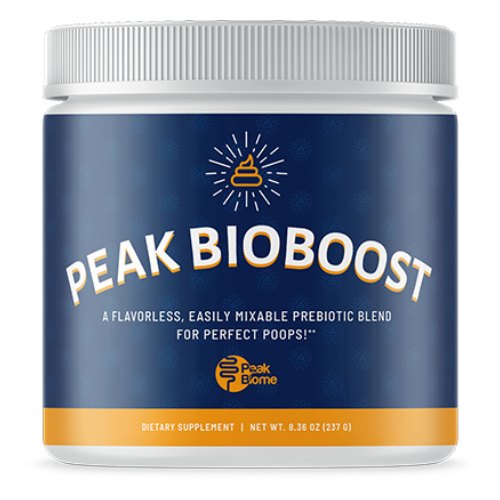
Peak Biome Peak BioBoost
A flavorless prebiotic fiber powder of inulin, FOS, acacia gum and XOS with a little magnesium, one scoop a day stirred into a warm drink.
- Format
- Powder, once a day
- Type
- Prebiotic and fiber
- Cost
- $1.67 a day
- Customer rating
- 4.5 out of 5 from 2,280 ratings from peakbiome.com
Not sure it suits your symptoms? The quiz matches one product to you in one to three minutes.
What customers consistently report
- Daily bowel movements after years of trying other products
- No taste when stirred into coffee or tea
- Less bloating and gas within a few weeks
Those are the themes that recur across the reviews. Low review confidence — the 4.5 from 2,280 is a Yotpo widget on the brand’s own store with no review below three stars and unverified early reviews, Trustpilot shows 2 reviews (both one star), and the Amazon listings could not be read.
The mechanism, as the brand describes it
Inulin, FOS and XOS are not digested in the small intestine; bacteria in the colon ferment them, which feeds bifidobacteria and makes short-chain fatty acids and gas. That fermentation adds bacterial mass and water to stool, which is how fructans soften it in trials, and the gas is why flatulence rises at higher doses. Acacia gum ferments more slowly along the colon. Magnesium draws water into the bowel, but the trials used around twenty times more than the 40 mg here. The label does not give each fiber’s amount, so only the 2 g ceiling on XOS can be checked against the trial doses.
What has actually been tested
No trial of Peak BioBoost was found, and the brand’s own press release says it did not run the studies it cites. Across 16 constipation trials, fiber helped most with psyllium or pectin and above 10 g a day, while one scoop gives 7 g, and inulin-type fructans did not change stool frequency. XOS improved constipation at 5 g a day in a small one-month trial, but it is listed last in this 8 g blend, so a scoop holds at most 2 g.
What the panel prints, and what it leaves out
The panel prints one 8 g prebiotic blend of inulin from Jerusalem artichoke, FOS, acacia gum and XOS without separate amounts, plus 7 g of dietary fiber and 40 mg of magnesium as citrate. No independent lab is named; the sales page says a GMP-certified manufacturer tests each batch. The brand’s own images show two blend versions and three net weights, so the label on a given jar may differ.
When it makes sense
The symptoms it is scored against are constipation, irregular bowel habits, a feeling of incomplete emptying, bloating and gas. It fits someone whose priority is regularity or day-to-day comfort. Which product the quiz lands on also turns on what you have already tried, the format you prefer, and any exclusions that apply to you.
Where it falls short of the brief
The dietary claims the label makes are gluten-free, dairy-free, vegan and no added sweeteners. One group does not see Peak BioBoost in their results: people pregnant or breastfeeding or taking prescription medication. The product is not the problem; the person who should decide is. It is a powder taken once a day, every day, and the quiz asks whether that is a routine you will keep.
Side effects and what to be aware of
Reviewers mostly describe regular bowel movements; the complaints that recur are diarrhea or extra gas at the start, a slow effect that led some to take more, and orders or refund requests that customer service could not trace. The label says to check with a doctor if pregnant, nursing, taking any medication or living with a medical condition, and to stop if any reaction occurs. The brand’s sales letter also makes fat-loss claims that its product page does not, and the product page opens with a monthly subscription selected.
Questions people ask
Does Peak BioBoost really work?
No trial of the powder exists. Fiber supplements help constipation in trials mainly with psyllium and above 10 g a day; a scoop gives 7 g of mostly inulin and FOS, which did not raise stool frequency in the pooled trials. Its XOS helped at 5 g a day in a one-month trial, and the label allows at most 2 g.
What are the ingredients in Peak BioBoost?
One scoop (about 8.25 g) holds an 8 g prebiotic blend of inulin from Jerusalem artichoke, FOS, acacia gum and XOS, plus magnesium 40 mg as magnesium citrate, with 7 g of dietary fiber and 30 calories. The blend has no per-ingredient amounts, and no sweetener or flavor is listed.
What are Peak BioBoost side effects?
Gas, bloating and loose stools are the usual effects of fermentable fiber, and pooled trials found more flatulence with inulin-type fibers. Both Trustpilot reviews report intolerance, one with diarrhea from the first day. The label says to consult a doctor if pregnant, nursing, on medication or with a medical condition, and to stop if a reaction occurs.
Where can I buy Peak BioBoost, and is it on Amazon?
The brand sells it at shop.peakbiome.com for $49.95 a jar, with a $44.95 monthly subscription selected when the page opens. Amazon shows listings under the Peak Biome name, which could not be read here. The brand forbids its affiliates from reselling it on Amazon or eBay.
How does the Peak BioBoost money-back guarantee work?
The store states a 3-month guarantee for unused, unopened packages, with return shipping paid by the customer; opened jars should not be sent back, and refunds on subscriptions are handled case by case. The sales letter mentions 3-month, 6-month and one-year guarantees on the same page.
Before you take this. Speak to a doctor or pharmacist first if you are pregnant or breastfeeding, or taking prescription medication. Peak BioBoost is a supplement, not a medicine, and this page is information rather than advice.
Would the quiz pick this for you?
Tell the quiz your symptoms, what you have tried and any medicines you take; it ranks Peak BioBoost against the rest and shows its reasons.
Take the quiz →Free. Private. Nothing to sign up for.
Its peers in the catalog
Daily gut routine: that is the job Peak Biome Peak BioBoost does, and these are the other entries doing it.
See all the products we have researched →
Further reading
The guides behind the category, written from the trials rather than the labels.