Guide
Does Peak BioBoost work? Four fibers in one 8 g blend, the doses the trials used, and no trial of the jar
Quick answer
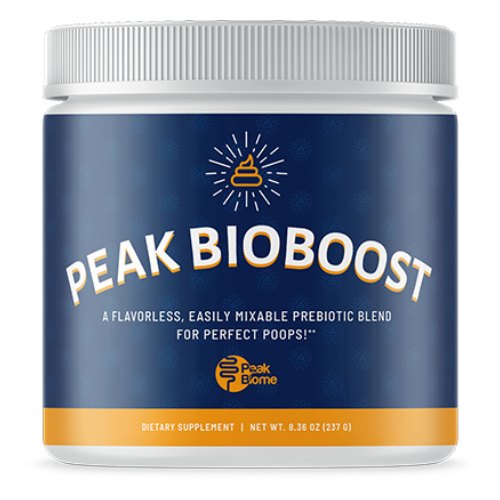
Does Peak BioBoost work? No trial of Peak BioBoost itself was found. Its fibers have trial support at higher doses: pooled constipation trials found a benefit above 10 g of fiber a day, mainly with psyllium, while a scoop gives 7 g, mostly inulin and FOS, a fiber family that did not raise stool frequency in those trials. XOS, the ingredient the brand leads with, helped at 5 g a day in a one-month trial; the label allows at most 2 g a scoop.
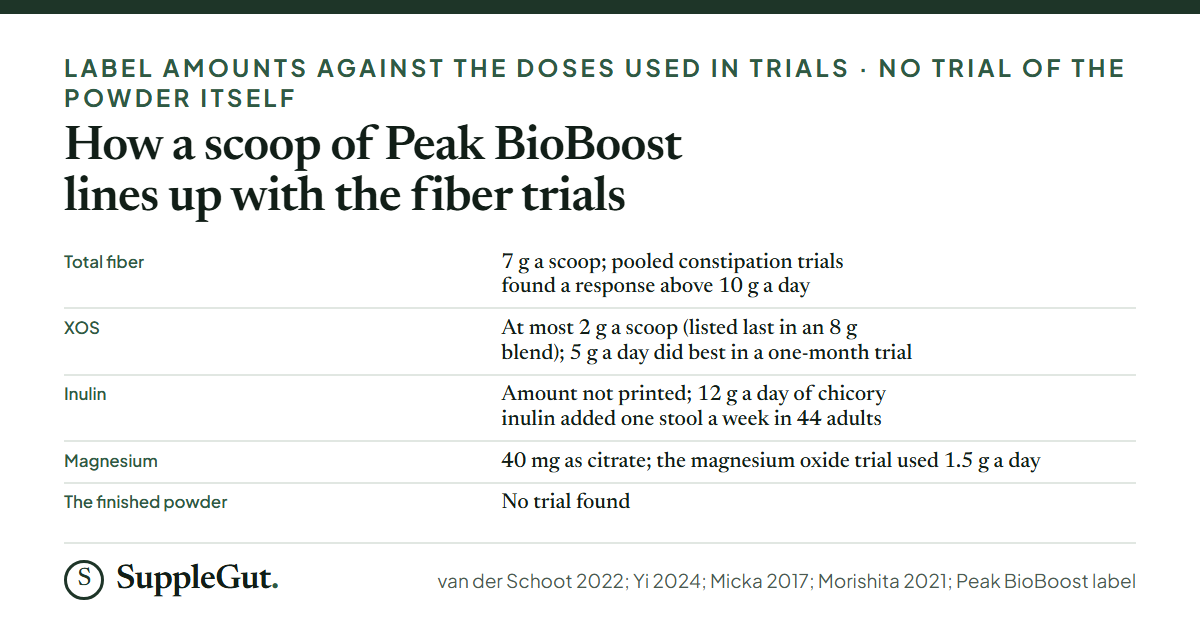
Peak BioBoost is an unflavored prebiotic fiber powder from Peak Biome, sold to be stirred into a morning coffee or tea for daily bowel movements and less bloating. Unlike psyllium it does not set into a gel: its four fibers dissolve, and the brand’s marketing leads with XOS (xylooligosaccharide), the fiber listed last on the panel. Below: what a scoop holds, what the fiber trials found and at what doses, the reviews and the guarantee in writing.
One scoop of Peak BioBoost, as the panel prints it
The Supplement Facts panel on the brand’s product page gives a serving as one scoop, about 8.25 g, with 30 servings in a jar:
| Panel line | Per scoop |
|---|---|
| Calories | 30 |
| Dietary fiber | 7 g (25% of the Daily Value) |
| Magnesium (as magnesium citrate) | 40 mg (10% of the Daily Value) |
| Prebiotic blend: inulin (from Jerusalem artichoke), FOS, acacia gum, XOS | 8 g |
The four fibers share one blend figure, so the label does not say how much of each a scoop holds. US labeling rules list blend ingredients from heaviest to lightest, and XOS is printed last, which caps it at a quarter of the blend: no more than 2 g a scoop. Inulin and FOS, printed first, make up at least half. No sweetener or flavor is listed, and the brand calls it vegan, gluten-free, dairy-free and soy-free; the panel has no allergen line.
The brand’s own images do not all match: an older jar render shows isomalto-oligosaccharide in the blend, and renders print net weights of 8.36, 8.75 and 8.78 oz. The jar shown now reads 8.36 oz (237 g).
No study has tested Peak BioBoost itself
Searches of PubMed and ClinicalTrials.gov found no trial of the powder. Peak Biome’s own press release says the company “did not conduct the referenced clinical studies,” and the product page’s numbered references point to studies of single ingredients. The brand’s lead image says 600 clinicians shared it with patients, which counts recommendations, not results. Its sales letter also says prebiotics help you “stay effortlessly lean”; no trial of this powder measured weight, and the trials below measured bowel habits.
What the fiber trials found, dose by dose
Fiber as a class. A meta-analysis of 16 randomized trials in 1,251 adults with chronic constipation found that 66% responded to fiber against 41% on control. The benefit was significant for psyllium and pectin, appeared only at more than 10 g of fiber a day, and showed in stool frequency only after four weeks or more. Inulin-type fructans, the family inulin and FOS belong to, did not change stool frequency, softened stools modestly and in two trials made flatulence worse (van der Schoot et al., American Journal of Clinical Nutrition, 2022). A scoop of Peak BioBoost gives 7 g of fiber.
XOS. The one placebo-controlled trial of XOS on its own in constipation that we found randomized 99 adults with functional constipation to XOS at 3, 5 or 10 g a day, FOS at 10 or 20 g a day, or a maltodextrin placebo for one month; 87 were analyzed, 13 to 17 per group. The 5 g XOS group improved most on stool form, a constipation score and quality of life, without diarrhea or flatulence, and 3 g a day did less (Yi et al., Food Science & Nutrition, 2024). By the labeling arithmetic above, a scoop holds at most 2 g.
Inulin. In a crossover trial, 44 constipated adults took 12 g a day of chicory inulin or maltodextrin for four weeks each; median stools rose from 3 to 4 a week (Micka et al., International Journal of Food Sciences and Nutrition, 2017, sponsored by the inulin maker). The inulin share of this blend is not printed, and it comes from Jerusalem artichoke rather than chicory.
Magnesium. At laxative doses magnesium draws water into the bowel. In a 90-person trial, magnesium oxide at 1.5 g a day improved constipation in 68.3% against 11.7% on placebo (Morishita et al., American Journal of Gastroenterology, 2021). That dose holds roughly 900 mg of magnesium; a scoop here has 40 mg.
Taken together: each fiber in the jar has some trial support, but at larger daily amounts than one scoop provides, and the ingredient the brand leads with, XOS, is the smallest part of the blend. Two scoops, the brand’s suggested start, would give 14 g of fiber and up to 4 g of XOS.
Taking it: one scoop in a warm drink
The label says to pour one scoop into 8 fl oz of a warm beverage; the product page suggests two scoops a day at first “for fast relief,” then one. The page says the ingredients let you take it without worrying about interactions with your medicines, while the jar asks anyone taking medication to check with a doctor first. In the pooled trials, stool frequency changed only after four weeks or more, so a month at a steady dose is the shortest fair test.
Gas, loose stools and the label’s warning
Inulin and FOS are fermented by colon bacteria, which makes gas; in the pooled trials flatulence was higher on fiber than on control, and in the XOS trial some people in the 20 g FOS group had more flatulence, diarrhea and less appetite. Both Trustpilot reviews of the brand describe intolerance: one reviewer’s gut “could not handle the fiber level,” and another reports diarrhea from the first day and an itchy rash by day seven. The jar’s warning asks anyone pregnant, nursing, taking any medication or with a medical condition to consult a doctor before use, and to stop if any reaction occurs; the brand’s other website adds people under 18.
Reading the 2,280 reviews
The product page runs a Yotpo review widget showing 4.5 from 2,280 reviews. We read it on the page, sorted both ways. None of the 2,280 is below three stars. The 44 lowest are three-star reviews, most of them glowing (“Miracle! It worked! I ordered 6 more”), and only 4 of the 44 carry a verified-buyer badge. The first 343 four-star reviews after them carry none and read like replies to the brand’s follow-up emails, some addressed to “Jeremy,” the name the sales letter is written in. From the average and those counts, the split works out to about 1,195 five-star, 1,040 four-star and 44 three-star.
The recurring praise is daily bowel movements after years of other products, no taste in coffee or tea, and less gas and bloating. The recurring complaints are gas or loose stools early on, a slow start that led some to take more, and delivery or service problems. Trustpilot has an unclaimed profile for the brand with two reviews, both one star.
Where Peak BioBoost is sold, what a day costs, and the guarantee in writing
| Purchase route at the brand’s store | Price | Per day at one scoop |
|---|---|---|
| 1 jar, one time | $49.95 | $1.67 |
| 1 jar, subscription every 30 days | $44.95 | $1.50 |
| 3 jars, one time | $119.85 | $1.33 |
| 6 jars, one time, free U.S. shipping | $179.70 | $1.00 |
The brand sells it at shop.peakbiome.com, where the product page opens with the subscription selected; at the two-scoop start a jar lasts 15 days. Amazon carries listings under the Peak Biome name and resellers list it on eBay. One reviewer on the brand’s widget says the jars she bought on Amazon did not work for her and that she now orders direct.
The store states a three-month, 100% money-back guarantee. Its shipping policy says return shipping is the customer’s cost and only unused, unopened packages may be sent back; the refund policy handles recurring orders case by case and allows a partial refund if the product is kept. The sales letter promises one year in one place, six months in another and three months on its order buttons; the store’s written policy is the three-month one.
Who Peak BioBoost suits
- Someone who wants a fiber they cannot taste in coffee or tea and dislikes the gel that psyllium forms.
- Someone who tolerates inulin and FOS, which make up most of the blend, without much gas.
- Someone ready to give it a month at a steady dose, buying one jar before the subscription.
For constipation, psyllium has the strongest fiber evidence: the constipation evidence guide sets out the options, and psyllium vs magnesium compares those two head to head. Among dissolving fibers, Sunfiber PHGG is partially hydrolyzed guar gum, a low-FODMAP fiber; Benefiber is a single-ingredient wheat dextrin; and LOAM Prebiotic Fiber Formula mixes six prebiotics at 10 g of fiber a scoop.
The products in this catalog
Common questions
Does Peak BioBoost really work for constipation?
No study has tested the powder. In 16 pooled constipation trials, fiber helped most with psyllium and above 10 g a day, and inulin-type fibers like the inulin and FOS that lead this blend did not raise stool frequency. Its XOS helped at 5 g a day in one small trial, and a scoop holds at most 2 g. Reviewers on the brand’s page describe daily bowel movements, often after a few weeks.
What are the ingredients in Peak BioBoost?
One scoop, about 8.25 g, holds an 8 g prebiotic blend of inulin from Jerusalem artichoke, FOS, acacia gum and XOS, plus 40 mg of magnesium as magnesium citrate. The panel lists 7 g of dietary fiber and 30 calories, with no sweetener, flavor or per-fiber amounts. It contains no psyllium.
What side effects can Peak BioBoost cause?
Gas, bloating and loose stools are the usual effects of fermentable fiber, and pooled trials found more flatulence with inulin-type fibers. Both Trustpilot reviews of the brand describe intolerance, one with diarrhea from the first day and an itchy rash by day seven. The label asks anyone pregnant, nursing, on medication or with a medical condition to consult a doctor first, and to stop if a reaction occurs.
Is Peak BioBoost sold on Amazon, and where else can you buy it?
The brand sells it at shop.peakbiome.com for $49.95 a jar, and Amazon carries listings under the Peak Biome name; resellers also list it on eBay. Walmart, Target and iHerb did not list it. One reviewer on the brand’s page says the jars she bought on Amazon did not work for her and that she now orders direct.
What complaints come up in Peak BioBoost reviews?
The recurring ones are extra gas or loose stools in the first weeks, a slow start that led some reviewers to take a second scoop, and delivery or customer service problems, including an order the company could not find. The brand’s review widget holds no review below three stars, so the complaints appear mostly inside three- and four-star reviews and on Trustpilot.
How does the Peak BioBoost guarantee work, and can I return an opened jar?
The store states a three-month, 100% money-back guarantee, with return shipping paid by the customer and only unused, unopened packages accepted back. Refunds on subscription orders are handled case by case, and the policy allows a partial refund if the product is kept. The product page opens with a $44.95 monthly subscription selected; the one-time jar is $49.95.
Sources
- van der Schoot A, Drysdale C, Whelan K, Dimidi E. “The Effect of Fiber Supplementation on Chronic Constipation in Adults: An Updated Systematic Review and Meta-Analysis of Randomized Controlled Trials.” American Journal of Clinical Nutrition, 2022;116(4):953–969. PubMed 35816465
- Yi W, Wang Q, Xue Y, et al. “Xylo-oligosaccharides improve functional constipation by targeted enrichment of Bifidobacterium.” Food Science & Nutrition, 2024;12(2):1119–1132. PubMed 38370040
- Micka A, Siepelmeyer A, Holz A, Theis S, Schön C. “Effect of consumption of chicory inulin on bowel function in healthy subjects with constipation: a randomized, double-blind, placebo-controlled trial.” International Journal of Food Sciences and Nutrition, 2017;68(1):82–89. PubMed 27492975
- Morishita D, Tomita T, Mori S, et al. “Senna Versus Magnesium Oxide for the Treatment of Chronic Constipation: A Randomized, Placebo-Controlled Trial.” American Journal of Gastroenterology, 2021;116(1):152–161. PubMed 32969946
- Peak Biome: product page, Supplement Facts panel image, directions and warning on the jar, and price. shop.peakbiome.com, panel image
- Peak Biome: refund, shipping and subscription policies. refund policy, shipping policy, subscription policy
- Peak Biome: sales letter, including its weight and guarantee claims. getpeakbiome.com
- Peak Biome press release on GlobeNewswire, including the statement that the company did not conduct the cited studies. globenewswire.com
- Trustpilot profile for peakbiome.com. trustpilot.com
- Yotpo review widget on the Peak BioBoost product page (rating, count and the reviews read).

From the general to your case
The trials above are the general case. The quiz applies them to yours: symptoms, medicines, routine, and what you have already tried.
Take the quiz →