Discomfort and cramping
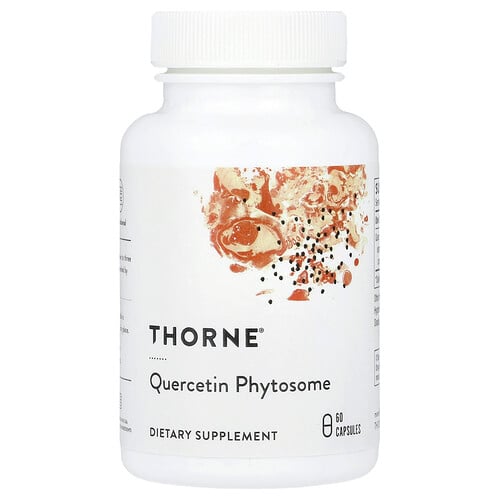
Thorne Quercetin Phytosome
An absorption-enhanced quercetin capsule with a large human trial behind it — one that came out null.
- Format
- Capsule
- Type
- Herbal
- Cost
- ~$2.30 a day at the full label dose, about $1.53 at two capsules
- Customer rating
- See the reviews on iHerb
Not sure it suits your symptoms? The quiz matches one product to you in one to three minutes.
The mechanism, as the brand describes it
Quercetin is a plant flavonoid, and this product's distinctive feature is its phytosome delivery: the 250 mg quercetin is complexed with sunflower phospholipids, a design intended to improve absorption rather than merely add another ingredient. That is a real mechanistic advantage over ordinary quercetin, and the label range of 500 to 750 mg a day sits within the dose studied in the large human trial. In cultured human mast cells, quercetin reduced histamine release, which offers a plausible route for studying food-related symptoms, but a dish result cannot tell us what happens in the gut of a person taking capsules. The large respiratory-illness trial found no significant overall benefit, despite using the relevant dose range, and no human gut trial was found. The phytosome may improve delivery; it does not establish an antiviral, immune, or digestive outcome. Drug-transport interactions also warrant attention. An informed possibility is still not proof of benefit when drug-transport interactions warrant attention.
Why this sits on a gut-health site
Quercetin is on a gut site for histamine rather than for viruses, and that is the strongest gut argument in this section — but it stops one step short of the evidence you would want. In cultured human mast cells, quercetin inhibited histamine release by 82 to 87 percent, slightly outperforming cromolyn, and only when it was added half an hour before the trigger rather than at the same time. Mast cells sit in the gut wall, and histamine is a plausible route to exactly the food-related symptoms people describe, which is why quercetin turns up in histamine-intolerance advice. What is missing is a trial. We could not find a single human study of quercetin in irritable bowel syndrome, functional dyspepsia, bloating, diagnosed histamine intolerance or measured intestinal permeability — not a negative result, an absence of anyone having looked. The related claim that quercetin supports DAO, the enzyme that breaks histamine down, has nothing behind it: the main study of what inhibits DAO did not test flavonoids at all. The human trials that do exist used the wrong organ — a histamine injection into the skin of 57 people, and eye symptoms in 20 people with pollen allergy, a trial in which no measured cytokine or antibody level shifted. A real mechanism in a dish, human evidence elsewhere in the body, and nothing yet in the gut.
What has actually been tested
This is the rare product here with a large, well-designed human trial. A randomized, double-blind, placebo-controlled study gave 1,002 people 500 or 1,000 mg of quercetin a day for 12 weeks and found no significant effect on upper-respiratory illness overall. Only a post-hoc subgroup — fitter participants aged 40 and over, 325 of them — showed reduced severity and fewer sick days, and post-hoc subgroups are hypotheses rather than findings. This product’s label dose of 500 to 750 mg a day sits inside the range that was tested. The primary outcome did not favor quercetin.
What the panel prints, and what it leaves out
Decent but not Thorne’s best. The panel is published through retailers: 250 mg of quercetin phytosome per capsule, complexed with sunflower phospholipids, with leucine, cellulose, a capsule shell and silicon dioxide alongside — no proprietary blend. The iHerb listing states third-party tested, but no certifier is named and this item does not carry the NSF Contents Certified mark that Thorne’s berberine does. As with the berberine, Thorne’s own page for this product was unreachable when we checked, so the label data comes from Walmart, Vitacost and iHerb.
When it makes sense
Its symptom profile covers general abdominal discomfort and symptoms that follow particular foods. It fits someone whose priority is a steady daily routine or handling meals. Which product the quiz lands on also turns on what you have already tried, the format you prefer, and any exclusions that apply to you.
Where it falls short of the brief
The dietary claims the label makes are gluten-free, dairy-free and minimal ingredient list. One group does not see Quercetin Phytosome in their results: people pregnant or breastfeeding or taking prescription medication. The product is not the problem; the person who should decide is. It is a capsule taken as often as the label directs, and the quiz asks whether that is a routine you will keep.
Side effects and what to be aware of
On safety, the label carries a pregnancy caution and no drug-interaction warning, and there is one interaction that has actually been demonstrated in people rather than inferred. In 12 healthy volunteers, quercetin at 500 mg three times a day for a week raised blood levels of the antihistamine fexofenadine by 55 percent and cut its clearance by 37 percent, consistent with quercetin blocking the P-glycoprotein pump that moves many drugs out of cells. That pump handles a long list of medicines, so this is a real reason for anyone on prescription medication to run it past a pharmacist. A separate and much weaker concern gets repeated more often — that quercetin inhibits the liver enzyme CYP3A4 — but that evidence is mostly cell culture and rats, and a high-dose human study found no inhibition at all.
One check first. Thorne sells a supplement, not a treatment, and if you are pregnant or breastfeeding, or taking prescription medication the decision belongs with a doctor or pharmacist, not with this page.
Would the quiz pick this for you?
Tell the quiz your symptoms, what you have tried and any medicines you take; it ranks Quercetin Phytosome against the rest and shows its reasons.
Take the quiz →Free. Private. Nothing to sign up for.
Its peers in the catalog
Discomfort and cramping: that is the job Thorne Quercetin Phytosome does, and these are the other entries doing it.
See all the products we have researched →
Further reading
The guides behind the category, written from the trials rather than the labels.