Guide
Does Mirica work? PEA and luteolin, the mast cell idea and what the trials actually measured
Quick answer
Does Mirica work? No trial has tested Mirica, or any PEA and luteolin product, in people with histamine intolerance or mast cell activation. The PEA in it (Levagen) has placebo-controlled trials at 300 to 600 mg a day for knee and nerve pain, and PEA paired with polydatin, not luteolin, reduced IBS abdominal pain in two 12-week trials.
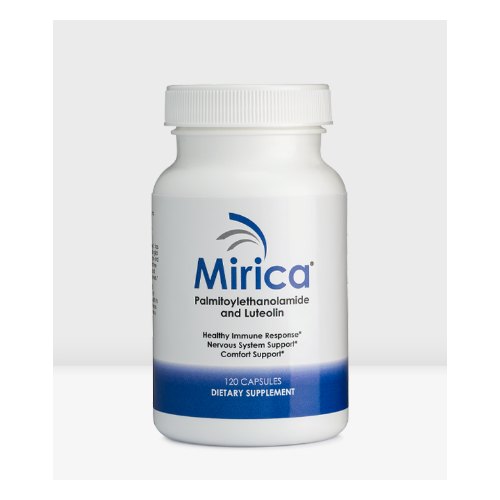
Mirica is a two-ingredient capsule from Young Nutraceuticals, a small Arkansas and Florida company, that pairs palmitoylethanolamide (PEA), a fatty acid amide the body makes itself, with the flavonoid luteolin. It is sold for nervous and immune system support and “everyday aches and pains,” and it has become the capsule people with mast cell activation and histamine problems ask about, because both compounds calm mast cells in the laboratory. What makes it different from the PEA bottle next to it is the luteolin, and the question this page answers is whether that pairing has been tested on anyone.
What Mirica is, and what the label prints
The Supplement Facts panel is short and complete. A serving is two capsules, 30 servings in the 60-capsule bottle and 60 in the 120.
| Line as printed | Per two capsules |
|---|---|
| Palmitoylethanolamide | 630 mg |
| Sunflower lecithin | 24 mg |
| Luteolin | 24 mg |
| Other ingredients | Vegetable cellulose capsule |
There is no proprietary blend and no other ingredient at all. The PEA is Gencor’s branded Levagen, which the panel calls “clinically-studied,” and the brand page says it comes from palm kernel oil, with the luteolin extracted from Sophora flower buds. The page does not say whether the PEA is micronized, which matters because PEA dissolves poorly and the trials below mostly used micronized, ultramicronized or dispersible forms. The bottle says it is made in a cGMP-registered, FDA-registered facility in Bentonville, Arkansas, while the site footer gives an Ormond Beach, Florida address; the brand says third-party tested but names no laboratory.
There is no trial of Mirica
No study of the capsule itself has been published, and the brand cites none. The evidence sits in three places: trials of the Levagen ingredient for pain, trials of PEA paired with a different compound in IBS, and trials of a different PEA-and-luteolin product for conditions that have nothing to do with the gut or histamine.
The evidence for PEA on its own
Gencor’s trials are the ones closest to this label. In 111 adults with mild to moderate knee osteoarthritis, 300 mg or 600 mg of PEA a day in divided doses for eight weeks lowered the total WOMAC score against placebo (p = 0.037 and p = 0.001), with the pain sub-score falling on both doses. In 70 people with diabetic nerve pain, 600 mg a day for eight weeks cut total pain and pain interference scores (P ≤ 0.001) and lowered interleukin-6 and C-reactive protein, with sleep and mood scores improving too. Acute-dose trials in migraine (600 mg) and menstrual pain (300 mg) found lower pain scores over the following hours. Most of these were funded by Gencor and run by one contract research company, and the trials used Levagen+, the dispersible form, while the bottle says Levagen.
The wider literature points the same way. A 2024 systematic review of 47 randomized trials of PEA found the strongest evidence in pain and general wellbeing, especially for micronized and dispersible formulations, with good tolerability. A 2016 pharmacology review was cooler: six randomized trials “of variable quality,” no head-to-head comparison of plain against micronized PEA, and safety data that rule out serious reactions at a rate of one in 200 for courses up to 49 days but not beyond 60. The brand quotes a 2016 pooled analysis as showing pain 2.7 points lower on PEA; that analysis pooled twelve studies of which only three were double-blind and placebo-controlled, and its abstract reports the result differently, as 81 percent of PEA patients reaching a pain score of three or under by day 60 against 41 percent of controls.
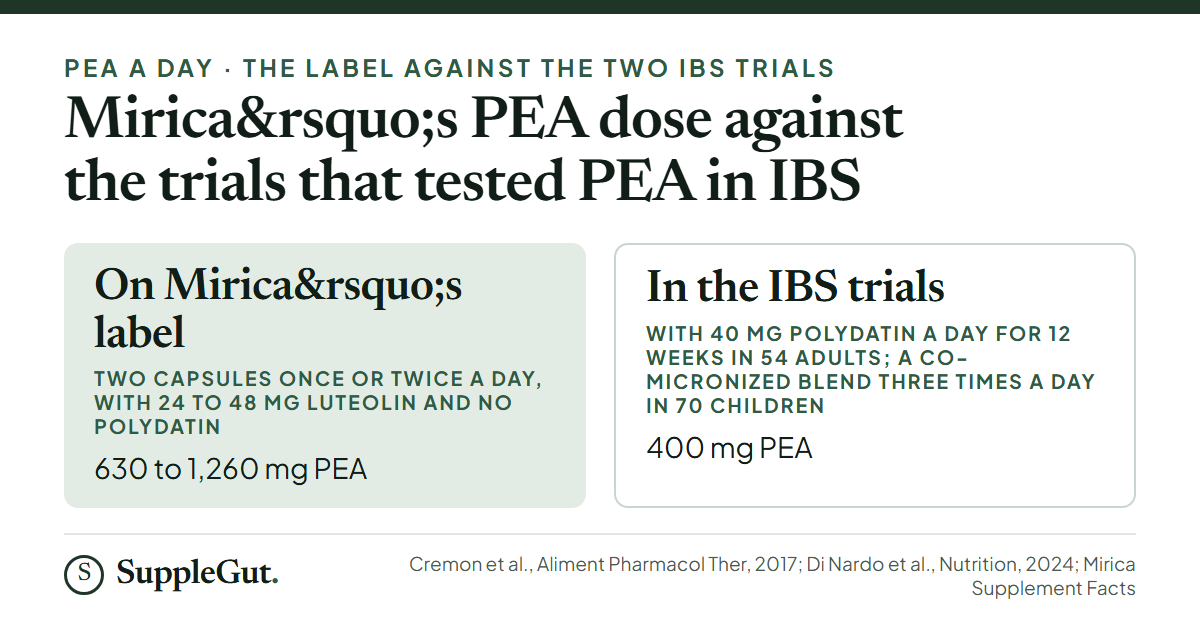
Mirica’s maintenance dose of 630 mg a day sits at the top of the pain-trial range, and the four-week starting dose doubles it. On dose, the label is not short.
The mast cell and histamine question
This is where the shelf and the science part company. The case for Mirica in histamine intolerance and mast cell activation rests on laboratory work: PEA damps mast cell and glial cell activity in cell and animal studies, luteolin blocks mast cell release in cell studies, and the brand cites a 2018 laboratory paper for the claim that the two together inhibit mast cells more than either alone. No randomized trial has tested PEA, luteolin or the pair in people with histamine intolerance, mast cell activation syndrome or chronic hives. A PubMed search for randomized trials of PEA with luteolin returns studies of post-COVID smell loss, frontotemporal dementia and stroke, all using an Italian ultramicronized product that gives 700 mg of PEA and 70 mg of luteolin a day. The largest, in 185 people with smell loss six months after COVID-19, found 92 percent improved on the supplement plus smell training against 42 percent on training alone. It says nothing about histamine, and its luteolin dose is three times Mirica’s maintenance dose.
The gut evidence is real but belongs to a different partner. Two placebo-controlled, 12-week trials gave PEA with polydatin, a resveratrol relative, on the theory that mucosal mast cells drive IBS pain. In 54 adults, 200 mg of PEA with 20 mg of polydatin twice a day “markedly improved abdominal pain severity” against placebo (P < 0.05), although it did not change the mast cell count in gut biopsies. In 70 children aged 10 to 17, a co-micronized blend three times a day produced more complete remissions (P = 0.015), most clearly in the diarrhea subtype, with no adverse events. Both trials involved the Italian maker of that product. Mirica has no polydatin; the brand’s Mirica Advanced does. And a 12-week trial of PEA alone in 58 overweight adults found no change in the overall gut microbiome.
Read the mast cell claim as a mechanism, not a result. Every human trial that comes close either used a different second ingredient (polydatin, in IBS) or a different condition (smell loss, dementia, stroke).
How to take it
The bottle’s directions are two capsules in the morning and two in the evening for four weeks, then one capsule twice a day. The Amazon listing prints a wider version, two to three capsules twice a day with food for at least four weeks, then one to two, and adds that “it can take up to 60 days to assess if Mirica is right for you.” Two months at the label dose is therefore the brand’s own definition of a fair test. The pain trials ran eight weeks; the IBS trials ran twelve.
Side effects and who should not take it
PEA has a mild record in trials: the 2016 review found no serious adverse reactions in courses up to 49 days and the IBS trial in children recorded none. Mirica’s own reviews are not quite that clean. On the brand site, one 2024 reviewer describes an upset stomach and swollen, reddened skin under the eyes that resolved on stopping, another could not continue because of sensitivity to the sunflower lecithin and to anything estrogenic, and a 2026 one-star review argues that luteolin’s effects on estrogen metabolism should be disclosed for anyone on hormone replacement; that is a reviewer’s claim, not a label statement. The label itself says the product is “not intended for use by women who are pregnant or breastfeeding” and carries no medication warning; the site adds the usual line about consulting a health professional before any supplement.
What the reviews say
The brand’s own Judge.me widgets show 4.81 from 124 reviews on the 60-count page and 4.59 from 95 on the 120, and they are self-hosted: 77 of the 124 date from 2017 to 2019, and only 28 carry a verified-buyer flag. Reading all 219, pain is the dominant word (nerve, back, arthritis, fibromyalgia), with a steady thread of people who bought it for mast cell problems: “Works as well as a mast cell stabilizer” and “a reduction in my chronic hives” (2019), “Calmed down my MCAS allowing me to eat things I love” (2024), “Have been able to tolerate more foods” (2024). The recurring complaints are no effect after a month at four capsules a day, the price at two to four capsules a day, and in 2026 two reports of orders that never arrived.
The subscription and refund terms
The brand site sells single bottles and a “Subscribe and save” option at 12 percent off, delivered weekly to every four months. Its refund policy accepts returns within 30 days only on unused, unopened bottles, deducts the cost of the return label, and offers no satisfaction guarantee. The subscription terms state that it renews automatically and “you may cancel after at least two recurring shipments are sent,” in the account settings or in writing at least five business days before the next shipment, with cancellation taking effect the following month. Single bottles are also on Amazon, sold by the brand, under Amazon’s own return rules.
Who Mirica is for, and when something else fits
- Someone whose main problem is nerve, joint or chronic pain and who wants a PEA at a dose the pain trials used, with no other ingredients.
- Someone with suspected mast cell or histamine problems who has read the laboratory case for PEA and luteolin, accepts that no trial has tested it in that population, and is prepared to give it the brand’s two months.
- Someone who wants luteolin without quercetin, which many mast cell shoppers already take.
- Someone who prefers a vegan, two-ingredient capsule with every amount printed.
For flushing, hives or headaches after particular foods, the DAO enzyme in HistaHarmony works at the meal rather than all day, and its guide, Does HistaHarmony work?, covers the one blinded crossover trial of DAO. Thorne’s Quercetin Phytosome is the flavonoid with a large human trial behind it, one that came out null. For IBS pain specifically, the PEA trials used polydatin, so Mirica Advanced is closer to them than this bottle, and curcumin has its own pooled IBS analysis. The quiz weighs all of them against your answers.
Cost
The brand site charges $43.88 for the 60-capsule bottle and $69.88 for the 120, or 12 percent less on a subscription, with 15 percent off a first order for joining the newsletter. At the maintenance dose of two capsules a day that is $1.05 to $1.46 a day depending on the bottle and the shop; the four-week starting dose doubles it.
The products in this catalog
Common questions
Does Mirica work for histamine intolerance or MCAS?
No trial has tested it, or any PEA and luteolin product, in people with histamine intolerance or mast cell activation syndrome. The idea comes from laboratory studies in which both compounds reduce mast cell release, and from brand-site reviewers who bought it for MCAS and describe fewer flares and tolerating more foods. Those are reports, not a controlled result.
Does Mirica work for nerve or joint pain?
The PEA in Mirica is Gencor’s Levagen, and Gencor-funded trials of the Levagen+ form at 300 to 600 mg a day improved knee osteoarthritis scores in 111 adults and diabetic nerve pain in 70 adults over eight weeks. A 2024 systematic review of 47 PEA trials found pain the strongest area.
How much PEA and luteolin is in Mirica?
Two capsules give 630 mg of palmitoylethanolamide, 24 mg of luteolin and 24 mg of sunflower lecithin, with a cellulose capsule and nothing else. The ultramicronized PEA-luteolin product used in the European trials gives 700 mg and 70 mg a day, so Mirica’s luteolin is about a third of that at the maintenance dose and two-thirds during the four-week start.
How do you take Mirica?
The bottle says two capsules in the morning and two in the evening for four weeks, then one capsule twice a day. The Amazon listing prints a wider range, two to three capsules twice a day with food, then one to two, and says it can take up to 60 days to judge. A fair test by the brand’s own account is two months.
What are the side effects of Mirica?
A 2016 pharmacology review found no serious adverse reactions to PEA in trials up to 49 days, with too few patients to rule them out beyond 60 days. One brand-site reviewer describes stomach upset and facial swelling that stopped when she stopped, and another objects that luteolin’s hormonal activity is not mentioned on the bottle. The label rules out pregnancy and breastfeeding.
Is Mirica the same as Mirica Advanced?
No. Mirica Advanced adds polydatin to the PEA and luteolin, at $58.88 for 60 capsules on the brand site. Polydatin is the compound paired with PEA in the two placebo-controlled IBS trials, so the Advanced formula is closer to what those trials used; the original Mirica has none.
What does Mirica cost, and what are the refund terms?
On youngnutra.com, 60 capsules are $43.88 and 120 are $69.88, or 12% less on a subscription. The Amazon listing is sold by the brand. Returns on the brand site are accepted within 30 days on unopened bottles only, with the return label deducted, and the subscription terms allow cancellation only after at least two recurring shipments.
Sources
- Cremon C, Stanghellini V, Barbaro MR, et al. “Randomised clinical trial: the analgesic properties of dietary supplementation with palmitoylethanolamide and polydatin in irritable bowel syndrome.” Alimentary Pharmacology & Therapeutics 2017;45:909-922. PubMed 28164346
- Di Nardo G, Bernardo L, Cremon C, et al. “Palmitoylethanolamide and polydatin in pediatric irritable bowel syndrome: a multicentric randomized controlled trial.” Nutrition 2024;122:112397. PubMed 38479039
- Steels E, Venkatesh R, Steels E, Vitetta G, Vitetta L. “A double-blind randomized placebo controlled study assessing safety, tolerability and efficacy of palmitoylethanolamide for symptoms of knee osteoarthritis.” Inflammopharmacology 2019;27:475-485. PubMed 30927159
- Pickering E, Steels EL, Steadman KJ, Rao A, Vitetta L. “A randomized controlled trial assessing the safety and efficacy of palmitoylethanolamide for treating diabetic-related peripheral neuropathic pain.” Inflammopharmacology 2022;30:2063-2077. PubMed 36057884
- Briskey D, Skinner R, Smith C, Rao A. “Effectiveness of palmitoylethanolamide (Levagen+) compared to a placebo for reducing pain, duration, and medication use during migraines in otherwise healthy participants.” Pharmaceuticals 2024;17:145. PubMed 38399360
- Bortoletto R, Comacchio C, Garzitto M, Piscitelli F, Balestrieri M, Colizzi M. “Palmitoylethanolamide supplementation for human health: a state-of-the-art systematic review of randomized controlled trials in patient populations.” Brain, Behavior, & Immunity - Health 2024;43:100927. PubMed 39839988
- Gabrielsson L, Mattsson S, Fowler CJ. “Palmitoylethanolamide for the treatment of pain: pharmacokinetics, safety and efficacy.” British Journal of Clinical Pharmacology 2016;82:932-942. PubMed 27220803
- Paladini A, Fusco M, Cenacchi T, Schievano C, Piroli A, Varrassi G. “Palmitoylethanolamide, a special food for medical purposes, in the treatment of chronic pain: a pooled data meta-analysis.” Pain Physician 2016;19:11-24. PubMed 26815246
- Di Stadio A, D’Ascanio L, Vaira LA, et al. “Ultramicronized palmitoylethanolamide and luteolin supplement combined with olfactory training to treat post-COVID-19 olfactory impairment: a multi-center double-blinded randomized placebo-controlled clinical trial.” Current Neuropharmacology 2022;20:2001-2012. PubMed 35450527
- Batacan R, Briskey D, Bajagai YS, Smith C, Stanley D, Rao A. “Effect of palmitoylethanolamide compared to a placebo on the gut microbiome and biochemistry in an overweight adult population: a randomised, placebo controlled, double-blind study.” Biomedicines 2024;12:1620. PubMed 39062193
- Young Nutraceuticals product page: label, directions, ingredient sources and price. youngnutra.com; refund and subscription terms: refund policy
- Amazon listing for the 60-capsule bottle: directions as printed there. amazon.com
Want this narrowed to one product?
Reading is one thing, choosing is another. Answer the quiz and it weighs your own symptoms and routine and picks one product.
Take the quiz →