Discomfort and cramping
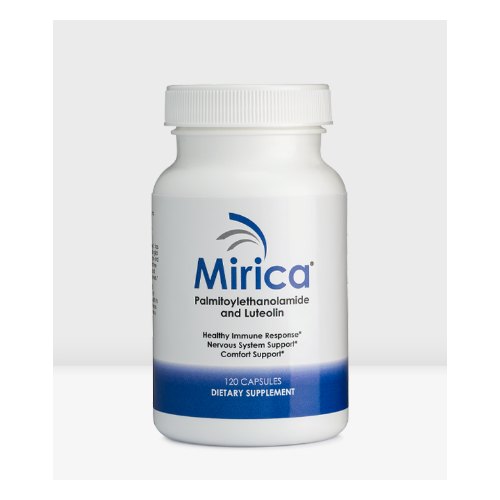
Young Nutraceuticals Mirica PEA and Luteolin
A twice-daily capsule pairing 630 mg of palmitoylethanolamide (Levagen PEA) with 24 mg of luteolin per two-capsule serving, the two compounds people with mast cell and histamine problems ask about.
- Format
- Capsule
- Type
- Herbal
- Cost
- See the price on Amazon
- Customer rating
- See the reviews on Amazon
Not sure it suits your symptoms? The quiz matches one product to you in one to three minutes.
Why it might work
Palmitoylethanolamide is a fatty acid amide the body makes itself; it is thought to act on the PPAR-alpha receptor and to damp down mast cell and glial cell activity, which is why it is studied for pain and inflammation. Luteolin is a flavonoid that blocks mast cell release in cell studies, and the brand pairs the two on the strength of laboratory work showing more mast cell inhibition together than apart. In IBS, the PEA trials were built on the idea that mucosal mast cells drive abdominal pain, though the adult trial did not change mast cell counts even as pain fell. Dose is where the label can be checked: the maintenance serving gives 630 mg of PEA, inside the range of the Levagen+ pain trials, while 24 mg of luteolin is about a third of the 70 mg in the ultramicronized PEA-luteolin product used in the European trials. PEA dissolves poorly, and the label does not say whether the material is micronized, so absorption against the trial formulations cannot be read from the panel.
What the trials show
No trial of Mirica itself was found. Its PEA is Gencor’s Levagen, and Gencor-funded trials of the dispersible Levagen+ form at 300 to 600 mg a day improved knee osteoarthritis scores in 111 adults over eight weeks and diabetic nerve pain in 70 adults, while a 2024 systematic review of 47 PEA trials found the strongest evidence in pain. For the gut, two placebo-controlled 12-week trials gave PEA with polydatin (400 mg of PEA a day in 54 adults; three doses a day in 70 children) and reduced IBS abdominal pain against placebo, but that pairing is not this one. The mast cell claim behind the luteolin rests on laboratory work, and the only human PEA-plus-luteolin trials are in post-COVID smell loss, dementia and stroke, with a different ultramicronized product.
What the label discloses
Every active carries a printed amount: 630 mg of PEA, 24 mg of luteolin and 24 mg of sunflower lecithin per two capsules, in a cellulose capsule and nothing else. The brand says third-party tested in a cGMP-registered facility but names no laboratory, the label gives a Bentonville, Arkansas manufacturer while the site footer gives Ormond Beach, Florida, and the Amazon listing’s directions (two to three capsules twice a day with food) differ from the bottle’s (two capsules twice a day, then one).
Who this tends to suit
The quiz pairs it with answers that mention abdominal pain, general abdominal discomfort and symptoms that follow particular foods. It is scored for a goal of a steady daily routine, day-to-day comfort or pain and tenderness. Whether it is the best fit for you depends on the rest of your answers — what you have already tried, what format you will take, and anything that has to be ruled out.
Where it may not fit
The label supports gluten-free, dairy-free, vegan, no added sweeteners and minimal ingredient list. If you are pregnant or breastfeeding, expect Mirica PEA and Luteolin to be missing from your results on purpose; that decision is routed to a clinician, not made here. Like any capsule, it depends on being taken as often as the label directs.
Reactions and warnings
Reviewers on the brand’s site say it did nothing after a month at four capsules a day; one 2024 brand-site review describes stomach upset and facial swelling that stopped on stopping. The label says it is not intended for women who are pregnant or breastfeeding and carries no medication warning.
The questions that come up
Does Mirica work for histamine intolerance or mast cell activation?
No trial has tested Mirica, or any PEA and luteolin product, in people with histamine intolerance or mast cell activation syndrome. The case rests on laboratory studies in which PEA and luteolin reduce mast cell release, and on the brand-site reviewers who bought it for MCAS and describe fewer flares and tolerating more foods. The only human PEA-plus-luteolin trials used a different ultramicronized product for post-COVID smell loss, dementia and stroke.
Does Mirica work for pain?
The PEA in Mirica is Gencor’s Levagen, and Gencor-funded trials of the Levagen+ form at 300 to 600 mg a day improved knee osteoarthritis scores in 111 adults and diabetic nerve pain in 70 adults over eight weeks. A 2024 systematic review of 47 PEA trials found pain the strongest area.
How do you take Mirica, and how long before it works?
The bottle says two capsules in the morning and two in the evening for four weeks, then one capsule twice a day. The Amazon listing prints a higher range, two to three capsules twice a day with food, then one to two, and says it can take up to 60 days to judge. Two capsules give 630 mg of PEA and 24 mg of luteolin.
Is Mirica safe, and what are the side effects?
A 2016 pharmacology review found no serious adverse reactions to PEA in trials up to 49 days but too few patients to rule them out beyond 60 days. One brand-site reviewer describes stomach upset and facial swelling that stopped when she stopped. The label says it is not intended for women who are pregnant or breastfeeding and carries no medication warning.
How much does Mirica cost?
Youngnutra.com charges $43.88 for the 60-capsule bottle and $69.88 for the 120, with 12% off on a subscription. At the maintenance dose of two capsules a day the 60-capsule bottle is about $1.46 a day; the four-week starting dose doubles it.
What is the difference between Mirica and Mirica Advanced?
Mirica Advanced adds polydatin to the PEA and luteolin and sells for $58.88 for 60 capsules on the brand site. Polydatin is the compound paired with PEA in the two placebo-controlled IBS trials, so the Advanced formula is closer to what those trials used; the original Mirica has no polydatin.
What is Young Nutraceuticals’ refund policy?
Returns are accepted within 30 days only on unused, unopened products, and the cost of the return label is deducted from the refund. The subscription renews automatically and the terms say it can be canceled only after at least two recurring shipments have been sent, from the account settings or in writing at least five business days before the next shipment, taking effect the following month. Amazon handles returns on its own listings under its usual terms.
One check first. Young Nutraceuticals sells a supplement, not a treatment, and if you are pregnant or breastfeeding the decision belongs with a doctor or pharmacist, not with this page.
Is Mirica PEA and Luteolin the one, or is something else?
The quiz weighs your symptoms and routine and names one match, which may or may not be Mirica PEA and Luteolin.
Take the quiz →Free, private, and it names one product.
Alternatives in the same role
These sit in the same role as Young Nutraceuticals Mirica PEA and Luteolin — discomfort and cramping — so they are the sensible things to weigh it against.
See all the products we have researched →
Background reading
Where the numbers on this page come from, explained at length.