
Comparison
Culturelle vs Florastor: which one to take with antibiotics
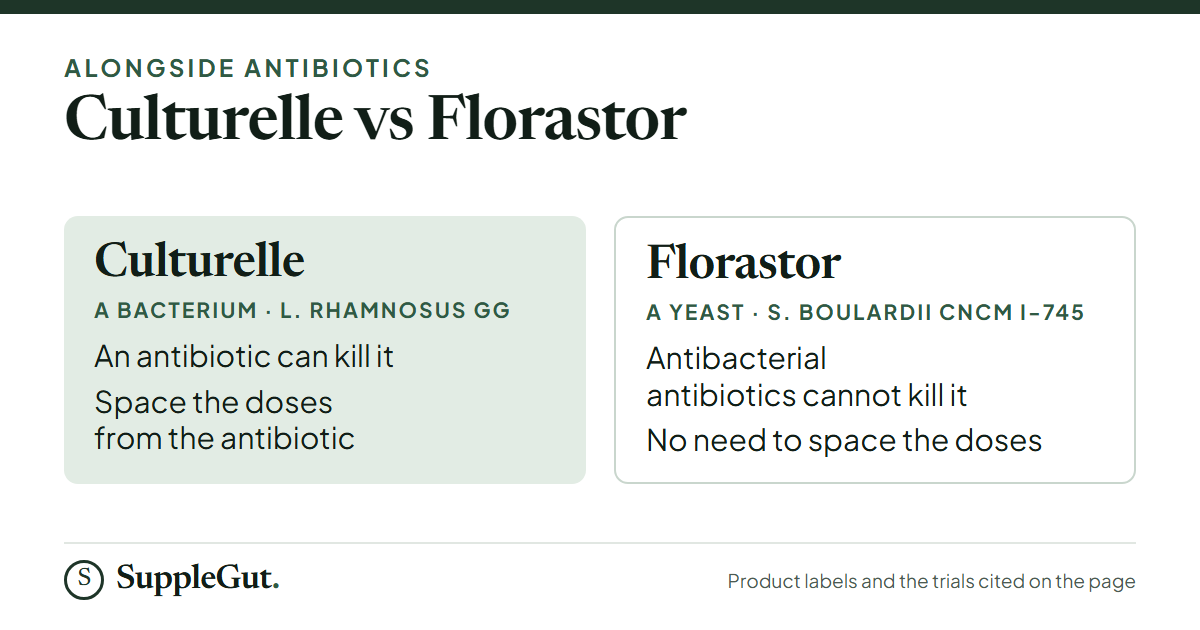
Culturelle vs Florastor, or Florastor vs Culturelle: if you are asking this with a prescription in your hand, the answer is Florastor: it is a yeast, so an antibacterial antibiotic has no way to kill it, and you do not have to space the doses. Culturelle is a bacterium — the better everyday choice at roughly half the daily cost, dairy-free and once a day, but an antibiotic does not spare it. That single difference decides this comparison.
The short answer
Culturelle Digestive Daily Probiotic
$0.75 a day · 4.7★ from 3,383 ratings at iHerb
Roughly half the daily cost, once-a-day dosing, and the cleanest label of the two — vegan, gluten-free and dairy-free. Lactobacillus rhamnosus GG is arguably the most-studied probiotic organism sold to consumers anywhere.
- You want a steady daily probiotic rather than a short course
- You avoid dairy or eat vegan
- You want one capsule a day
- You are price-sensitive about something you will take for months
Florastor Unisex Daily Probiotic
$1.31 a day · 4.6★ from 1,292 ratings at Walmart
It is a yeast — Saccharomyces boulardii CNCM I-745 — so an antibacterial antibiotic cannot kill it. You do not have to space the doses, and it keeps working through the whole course. Its meta-analysis is also the larger of the two, at 21 trials in 4,780 people.
- You are mid-course on antibiotics right now
- You have tried a bacterial probiotic during antibiotics and it did nothing
- You want the largest trial base on this specific endpoint
Not sure which of the two fits you? The quiz asks about your symptoms before it names one.
One caution that applies to both, and to yeast especially. Live-organism supplements are not for everyone. If you are immune-suppressed, have a central venous catheter, or are seriously unwell in hospital, clear any live probiotic — and S. boulardii in particular — with a clinician before you take it. Both of these are also preventive rather than curative for antibiotic-associated diarrhea, so they are meant to be started with the antibiotic course, not after it has already gone wrong.
Side by side
✓ marks the product with the advantage on that row. Rows with no mark are a genuine tie or a matter of preference.
Where they differ
1. Bacterium against yeast, and it matters in exactly one situation
An antibiotic prescribed for a bacterial infection does not distinguish between the bacteria making you ill and the bacteria in a probiotic capsule. That is why bacterial probiotics come with advice to space the doses a couple of hours from the antibiotic, and why some people take one all week and feel it did nothing.
S. boulardii is a yeast. An antibacterial antibiotic has no mechanism to kill it. You can take it alongside the tablet, at the same time, for the whole course. If you are asking this question because you have a prescription in your hand, that is the difference that decides it.
Outside that window the advantage largely disappears, and you are choosing between a $1.31-a-day yeast and a $0.75-a-day bacterium with a bigger review pool and a cleaner label.
2. Two strong evidence bases, on the same endpoint
Culturelle
One of the best-studied strains sold as a supplement. A meta-analysis of 12 randomized trials in 1,499 people found L. rhamnosus GG cut antibiotic-associated diarrhea from 22.4% to 12.3%, with separate evidence for acute diarrhea. This label states the same strain at 10 billion CFU. Note that a different Culturelle product (IBS Complete Support) was previously asked by NAD to drop certain claims — that finding does not concern this Digestive Daily formula.
Florastor
Strain-specific evidence, which is rare. A meta-analysis of 21 trials in 4,780 people found this yeast cut antibiotic-associated diarrhea from 18.7% to 8.5%, and a review of the CNCM I-745 strain specifically covers antibiotic-associated diarrhea and diarrhea duration.
This is unusual and worth pausing on. Most probiotic comparisons involve one product with strain-level evidence and one with none. Here both organisms have meta-analyses on the same outcome. Florastor’s is larger — 21 trials in 4,780 people, taking antibiotic-associated diarrhea from 18.7% to 8.5%. Culturelle’s covers 12 trials in 1,499 people, 22.4% down to 12.3%. Both are around a ten-percentage-point absolute reduction.
What you cannot conclude from that. Those are two separate meta-analyses with different trial sets, different patient populations, different antibiotics and different baseline event rates. Placing the numbers side by side is useful for scale and misleading if you read it as a race. We know of no randomized trial that puts these two organisms directly against each other, and until one exists nobody can tell you on evidence which is stronger.
3. Price, over a realistic course
Culturelle is about $22.50 a month; Florastor is about $39.30. For a ten-day antibiotic course the difference is small enough to ignore — roughly $5.60 — so if you are buying for a course, buy the one that suits the situation and do not think about the money. For a daily habit you keep up for a year, the same gap is about $204.40, and price stops being a rounding error.
4. The label detail most people miss
Culturelle
LGG is disclosed at strain level with its CFU count, and the ingredient list is short — the strain plus inulin. It is vegan, gluten-free and dairy-free, and non-GMO, though no CFU-through-expiry guarantee or third-party testing certificate is stated.
Worth knowing: inulin is a fermentable prebiotic fiber, and a small number of people find it produces gas of its own.
Florastor
The organism is disclosed at strain level with the milligram amount per capsule, and the product is shelf-stable with a roughly three-year life. Important label detail: it contains lactose from milk. CFU through expiry and third-party testing are not stated.
If you are lactose intolerant — a very common reason to be shopping in this aisle in the first place — read that line twice before you buy.
5. Convenience
Culturelle is one capsule a day. Florastor is taken more than once a day. Over a ten-day course that is trivial. As a long-term habit, once-daily is the one people keep up.
Which one to take for travel
Travelers’ diarrhea is the other reason people arrive at this comparison, and it is the one question where the two can be answered against each other properly. Both organisms appear in the same 2018 meta-analysis of 11 randomized trials — so unlike the antibiotic evidence further up this page, this is a like-for-like reading rather than two separate analyses placed side by side.
Across all probiotics pooled, the risk of travelers’ diarrhea fell by about 15%: a relative risk of 0.85, with a confidence interval of 0.79 to 0.91. Heterogeneity was low at 28.4%, and the author reports no publication bias and no conflicts of interest. Split by organism, the two do not perform alike.
| Organism | Trial | Relative risk | Reached significance |
|---|---|---|---|
| S. boulardiiFlorastor | Kollaritsch 1989 | 0.840.76 to 0.94 | ✓ yes |
| S. boulardiiFlorastor | Kollaritsch 1993 | 0.810.69 to 0.96 | ✓ yes |
| L. rhamnosus GGCulturelle | Oksanen 1990 | 0.880.75 to 1.04 | no |
| L. rhamnosus GGCulturelle | Hilton 1997 | 0.520.18 to 1.52 | no |
Both S. boulardii trials cleared significance. Neither L. rhamnosus GG trial did, because both confidence intervals cross 1.0 — the point at which an effect cannot be told apart from no effect at all. The Hilton figure looks the most impressive of the four at 0.52, and is the weakest of them: its interval runs from 0.18 to 1.52, wide enough to contain both a halving of the risk and a worsening of it. A large-looking number from a small trial is not a strong result.
Read the size of the effect, not just its direction. A relative risk of 0.84 is about a one-sixth reduction in the chance of getting ill. It is not protection. Most people taking it on a trip will be no better off, and a minority will avoid an episode they would otherwise have had. A separate review puts the reduction across the two S. boulardii trials at between 5% and 11%, and notes that probiotics look better at preventing travelers’ diarrhea than at treating it once it has started. That review’s senior author declares paid consultancy with two pharmaceutical companies.
Neither is a substitute for the things that decide whether you get ill — what you eat and drink, and having a plan if you do. All four trials above are decades old and were run in different destinations from the one you are probably going to.
What customers say
Culturelle
Praised for
- noticeably less gas and bloating within a couple of weeks
- being a brand pharmacists and physicians commonly recommend
- staying steady through a course of antibiotics or travel
Complaints
Some say it caused new stomach upset or gassiness rather than fixing it, and a few feel it is pricier than it needs to be for a single-strain formula.
Florastor
Praised for
- being easy to take
- working alongside antibiotics without being canceled out
- keeping digestion steady through a course of treatment
Complaints
Price is the recurring objection — reviewers rate it well but call it expensive.
Where they are the same
- Both are single-organism products, disclosed at strain level with an amount. That is more transparency than most of this aisle offers, and it is the main reason both are in our catalog at all.
- Both have their strongest evidence on antibiotic-associated diarrhea — which means both are better bought for a reason than bought vaguely.
- Neither publishes a third-party testing certificate, and neither states a guaranteed live count through to the expiry date.
- Both are shelf-stable and need no refrigeration.
- Both should be cleared with a clinician if you are pregnant, breastfeeding, immune-suppressed, or on prescription medication.
Other Culturelle products
Culturelle sells the same strain at a higher dose, and a four-strain version aimed at women. Neither is the product in the table above, and neither has the trial evidence discussed on this page behind it at that dose.
Read the full research on each
In one line: Culturelle Digestive Daily Probiotic — start here for most people.
Speak to a doctor first if you are pregnant, breastfeeding, trying to conceive, immune-suppressed, or taking prescription medication — and before starting anything if you have blood in your stool, unexplained weight loss, persistent vomiting, or pain severe enough to wake you at night. Those are signs to get looked at, not to try a supplement.
Taking antibiotics, or something else entirely?
The answer to this comparison changes completely depending on why you are asking. Our quiz asks what you are dealing with and tells you whether a probiotic is the right category at all.
Find your match →Free · Private · No sign-up · 1–3 minutes
Related guides
Other comparisons
Where these numbers come from
- Culturelle Digestive Daily label, rating and buy page — www.iherb.com/pr/culturelle-probiotics-digestive-daily-probiot
- Florastor label, lactose disclosure and buy page — www.amazon.com/dp/B09X1Z4X6K?tag=supplegut-20
- Florastor rating pool — www.walmart.com/reviews/product/14894568
- Bae JM. Prophylactic efficacy of probiotics on travelers’ diarrhea: an adaptive meta-analysis of randomized controlled trials. Epidemiology and Health. 2018;40:e2018043 — pooled RR 0.85 (0.79–0.91); strain rows for Kollaritsch 1989 and 1993, Oksanen 1990 and Hilton 1997 — www.e-epih.org/journal/view.php?doi=10.4178%2Fepih.e2018043
- Kelesidis T, Pothoulakis C. Efficacy and safety of the probiotic Saccharomyces boulardii for the prevention and therapy of gastrointestinal disorders. Therapeutic Advances in Gastroenterology. 2012;5(2):111–125 — 5% to 11% reduction across two travelers’ diarrhea RCTs — pmc.ncbi.nlm.nih.gov/articles/PMC3296087
- Our full research page on Culturelle — supplegut.com/supplements/culturelle-digestive-daily-probiotic
- Our full research page on Florastor — supplegut.com/supplements/florastor-unisex-daily-probiotic
Prices and star ratings are point-in-time snapshots and move around. Where a figure could not be confirmed from a manufacturer label or retailer listing, this page says so rather than estimating.