
Guide
Does Almape Papaya Seeds work? What the papaya trials tested, and what this capsule contains
Quick answer
Does Almape Papaya Seeds work? No trial of Almape, or of papaya seed in SIBO, IBS or IMO, was found. The only human papaya-seed trials tested seed in honey or porridge against intestinal parasites in children. The label prints 4,500 mg of “Papaya Extract” without the plant part or enzyme activity, plus 150 mg each of ginger and peppermint leaf against 1.2 g of ginger and peppermint oil in the trials. The 4.82 rating appears only on the brand’s own page, which shows two different review totals.
Almape Papaya Seeds, sold as “The Complete Gut Reset Formula,” is a 60-capsule bottle taken as two capsules a day. The brand’s page says it “hits SIBO, IBS, and IMO at the root” and helps clear parasites. What sets it apart from the capsules beside it is that claim, and the fact that no trial has tested papaya seed in any of those conditions. This page sets out what the label prints, what the papaya-seed and ingredient trials did test, what the reviews can and cannot show, and what the brand’s own terms say about subscriptions and refunds.
What Almape Papaya Seeds is, and what is on the label
The brand site prints ten lines for a two-capsule serving, each with an amount: Papaya Extract 4,500 mg, pomegranate extract 500 mg, apple pectin extract 500 mg, and seven lines at 150 mg each (wakame, bladderwrack, fennel seed, ginger root, turmeric root, peppermint leaf and nori). The total is 6,550 mg, which matches the page’s own “6550mg” figure. It is not a proprietary blend, so every amount is disclosed. The other ingredients are a hypromellose vegetable capsule and rice flour. There are no vitamins, no probiotics and no sweeteners.
What the line does not say is as important as what it does. The panel reads “Papaya Extract,” not papaya seed extract, while the marketing text calls it papaya seed extract. The plant part, the extract ratio, the solvent and the papain (protein-digesting enzyme) activity are not printed, so 4,500 mg of extract cannot be converted into an amount of seed or an amount of working enzyme. The brand’s graphic says “3rd Party Tested” without naming a laboratory or showing a result. We found no photograph of a printed Supplement Facts panel from Almape; the figures above come from the product page text and the brand’s own graphic.
There are two versions of the formula in circulation. The Amazon listing for Almape describes a “five-ingredient blend” of papaya seed, fennel, turmeric, apple pectin and peppermint, with no amounts and no Supplement Facts image among the listing images we read. The brand site prints ten lines. We could not establish which label ships in the bottle.
The trial of the product itself
We searched PubMed and ClinicalTrials.gov for Almape and for its sister brand Elava and found no trial of either. The statistics on the product page are not trials. The page reports that 94% had less bloating, with complete elimination within three weeks, “based on a four-week independent customer panel,” and a graphic says 91% had less bloating and gas after two weeks. No sample size, method or source is given for either figure. The page also carries a “scientifically proven” badge, which is a brand claim, and an ad says Almape “uses clinically studied doses of each ingredient,” which the next sections compare with the trials.
What the papaya-seed trials tested
For SIBO, IBS and IMO (methane-dominant overgrowth), we found no trial of papaya seed: a PubMed search for papaya and SIBO returns no records. The only human trials of papaya seed we could find are two parasite studies in African children. In the first, 60 children in Nigeria who had parasites on stool microscopy and no symptoms were given a single 20 mL dose of an elixir of air-dried papaya seeds in honey or honey alone. Seven days later stools had cleared in 23 of 30 children (76.7%) on the elixir and 5 of 30 (16.7%) on honey, with no harmful effects noted (Okeniyi et al., 2007). In the second, 326 school children in three Kenyan schools (one school per group, not individually randomized) had a daily 300 mL porridge fortified with ground dried papaya seeds for two months. Ascaris egg counts fell 63.9% (209.7 to 75.7 eggs per gram), against 78.8% for the drug albendazole, while the control group’s counts rose without reaching significance (Kugo et al., 2018).
Both trials used whole dried seed in honey or food, in children in tropical settings, and measured parasites. Neither measured bloating, IBS or SIBO, and neither tested a capsule extract, so what the capsule’s 4,500 mg corresponds to is unknown. The sister site Elava’s “71.4%” parasite-clearance figure matches the lowest per-parasite rate in the first study, a seed-and-honey elixir. For parasite background see the parasites guide.
The nearest trials of papaya for digestion used a fruit preparation. In a double-blind trial of volunteers with chronic indigestion, 20 mL a day of a papaya preparation for 40 days improved constipation and bloating in the early-returning group, and the benefit did not persist after washout (Muss et al., 2013). That is a different preparation from seed. We found no trial of papaya-derived papain for bloating in healthy adults or people with IBS.
The evidence for the other ingredients
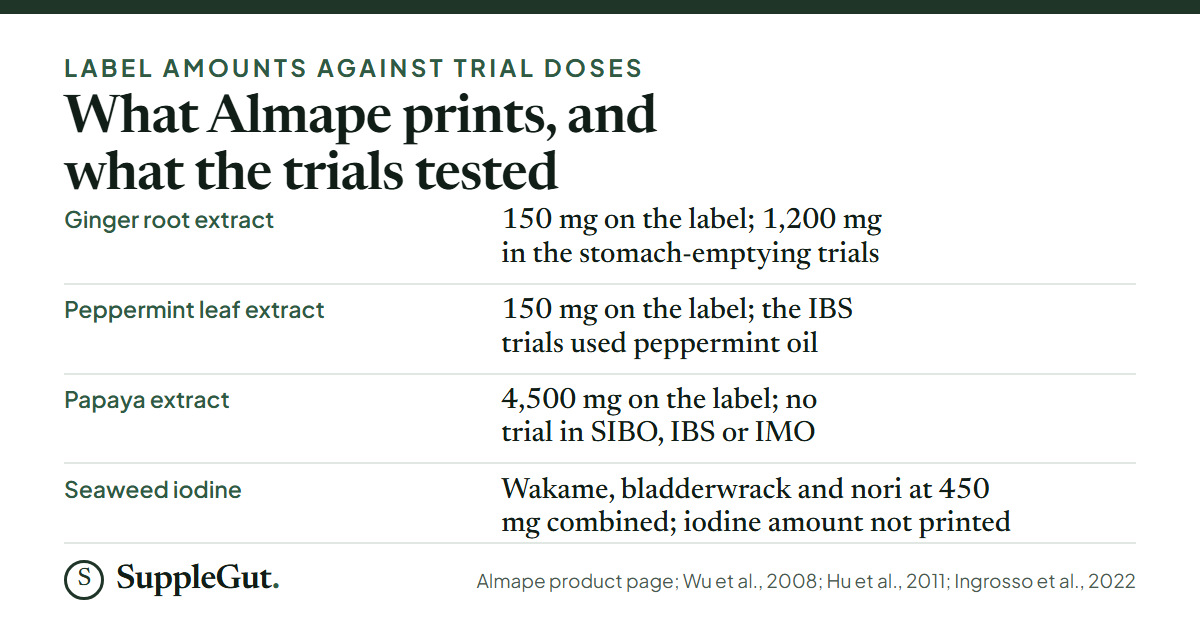
The 150 mg lines are where label amounts and trial amounts part furthest. Ginger at 1.2 g halved gastric half-emptying time in 24 healthy volunteers (13.1 minutes against 26.7 on placebo; Wu et al., 2008), and in 11 people with functional dyspepsia it shortened it from 16.1 to 12.3 minutes with no change in symptoms (Hu et al., 2011). The label has 150 mg of ginger root extract, about an eighth of the trial dose.
Peppermint has the largest body of IBS evidence, but in the form of oil. A meta-analysis of 10 randomized trials in 1,030 patients found peppermint oil better than placebo for overall symptoms (relative risk of not improving 0.65, number needed to treat 4) and for abdominal pain (relative risk 0.76, number needed to treat 7), with more side effects and a certainty of evidence the authors graded very low (Ingrosso et al., 2022). Almape lists 150 mg of peppermint leaf extract. That is not oil, and the trials do not cover it. A capsule built for peppermint oil, with a placebo-controlled trial of the finished product, is covered in the IBgard guide.
For fennel, turmeric, apple pectin, pomegranate and the three seaweeds we found no randomized trial at the label amounts for bloating. Single-ingredient ginger and fennel capsules are in the catalog as Nature’s Way Ginger Root and Nature’s Way Fennel Seed, and a papain-and-bromelain chewable is American Health Super Papaya Enzyme Plus.
| Ingredient | Almape label | What the trials tested |
|---|---|---|
| Papaya | 4,500 mg “Papaya Extract” | Whole seed in honey or porridge, for parasites in children; no gut-symptom trial |
| Ginger | 150 mg root extract | 1.2 g, stomach emptying |
| Peppermint | 150 mg leaf extract | Oil preparations, in IBS |
| Fennel, turmeric, pectin, pomegranate | 150 to 500 mg | No bloating trial found at these amounts |
How to take it
The page says two capsules a day, with a glass of water, preferably with food; the graphic says with food. A bottle is 30 servings. Because no trial of the product exists there is no studied time to effect: the brand’s own customer panel ran four weeks, the first children’s trial was a single dose with a check at seven days, and the second ran two months.
Side effects and who should not take it
The brand’s FAQ says to consult a healthcare professional if you have specific health concerns, are pregnant or breastfeeding, have a medical condition or take medications. The sister brand’s FAQ leaves out the pregnancy line. No allergen or facility statement is printed; the capsule holds rice flour.
Two points come from the research literature and not from the label. The three seaweeds (wakame, bladderwrack and nori, 450 mg combined) carry iodine and the label prints no iodine amount; case reports describe thyroid dysfunction after kelp supplements (PubMed 31517826, 25355748), and an analysis of 15 algae supplements, not this product, found iodine that could exceed needs and, in some, lead or arsenic (Reboredo et al., 2021). And in a laboratory study, papaya seed extract slowed human sperm (PubMed 31128152); we found no human fertility study.
What the reviews say
Almape’s own page shows 4.82 out of 5 from 6,379 reviews in the header. The review widget lower on the page says “Based on 6,829 reviews” with an average of 4.78, while its star bars (5,481, 728, 119, 32 and 19) add to 6,379. Both are hosted on the brand’s page. The page also shows a Trustpilot graphic reading 4.8, but Trustpilot has no profile for tryalmape.com and the page links to none. The Amazon listings for Almape are new and show no ratings, and we found no Better Business Bureau profile. The three reviews visible on the page are short and general, and the same testimonial wording appears on both sister sites under different names and states.
The praise on Almape’s page is less bloating, easier digestion, fast delivery and easy ordering, and lower prices on multiple bottles. Independent complaints about Almape do not exist to read, which is different from there being none. The sister site Elava is the closest independent record: its Trustpilot profile shows 1.9 from 21 reviews, 90% of them one star, is unclaimed, and its complaints center on automatic subscriptions, cancellation and refund emails going unanswered. Elava’s own page header says 3,463 reviews while its widget says 74, and its Amazon listing shows 3.8 from 12 ratings.
Who the advisors are
The product page presents two names as “Digestive Wellness Advisors” with quotes under them. We found no credentials, practice or publications for either name. The Meta ad library shows about 270 results for the product name, many from pages with personal names that tell first-person stories about SIBO or IMO lasting five years or more and about passing something after days on papaya seed extract. These are brand claims, not trial results.
Price, subscription and refund terms
On the brand site one bottle is $33.99 (shown with a $69.98 strike-through whose source is not given), three bottles are $67.98 (“Buy 2, get 1 free”) and five are $101.97 (“Buy 3, get 2 free,” with a gift card and an e-book), beside a countdown timer on an autumn sale. At two capsules a day that is $1.13 a day for one bottle, $0.76 for three and $0.68 for five. The page offers 20% off with automatic refills; the dollar price was not shown, and 20% off the one-bottle price would be $27.19, or $0.91 a day. Amazon lists $26.99 to $29.99 ($0.90 to $1.00 a day). Shipping is free, with optional add-ons of $4.95 and $5.95 at checkout.
The page promises a “90-Day Money-Back Guarantee” and says “Zero commitment, Cancel Anytime.” The published refund policy is narrower: dietary supplements can be returned only if the bottle is unopened, unused and sealed, opened or used supplements are non-returnable, and sale items are non-returnable. Subscribers agree to keep the subscription until at least the second replenishment order has been received, and cancelling before then carries a charge equal to the 20% discount on the first order. After the second delivery, cancelling is free. Elava’s policy limits refunds to 50% of the purchase price for eligible returns. A single bottle can be bought one time on the brand site.
Who Almape is for
- Someone who has read the ten-line label and wants papaya, ginger, peppermint and fennel in one capsule, knowing the ginger and peppermint amounts are well below trial doses.
- A buyer comfortable with unspecified seaweed iodine and a papaya line that does not say which part of the plant it is.
- A person who will order one bottle, read the refund and subscription terms first, and keep the unopened-bottle rule in mind.
Anyone with persistent bloating, a diagnosis of SIBO or IBS, or symptoms such as weight loss or blood in the stool needs a clinician rather than a capsule. For a starting point based on the cause, the bloating and gas guide and the quiz sort options by symptom.
The products in this catalog
Common questions
Does Almape Papaya Seeds work for SIBO or IBS?
The brand’s page says it “hits SIBO, IBS, and IMO at the root,” but we found no trial of papaya seed in people with SIBO, IBS or IMO. The human papaya-seed studies that exist tested seed in honey or porridge for intestinal parasites in children in Nigeria and Kenya. The 91% and 94% figures on the site come from an unnamed customer panel with no published sample size.
Do papaya seeds kill parasites?
Two small trials in African children found lower parasite counts after whole dried papaya seed in honey or porridge: stools cleared in 23 of 30 children against 5 of 30 after a single dose, and Ascaris egg counts fell 63.9% over two months. Neither tested a capsule extract, and Almape’s label does not say how much seed its 4,500 mg of extract represents. See the parasites guide for background.
What is in Almape Papaya Seeds, and why do two labels differ?
The brand site prints ten lines for two capsules: 4,500 mg papaya extract, 500 mg each of pomegranate and apple pectin, and 150 mg each of wakame, bladderwrack, fennel, ginger, turmeric, peppermint leaf and nori. The Amazon listing instead names five ingredients (papaya seed, fennel, turmeric, apple pectin, peppermint) with no amounts. Which label ships in the bottle is unresolved.
Is Almape Papaya Seeds safe, and what are the side effects?
The brand says to consult a healthcare professional if pregnant, breastfeeding, taking medication or living with a medical condition. The formula holds three seaweeds with no iodine amount printed, and case reports describe thyroid problems after kelp supplements. In a laboratory study papaya seed extract slowed human sperm, and no human fertility study was found.
How much does Almape Papaya Seeds cost?
One 60-capsule bottle is $33.99 on the brand site, which is $1.13 a day at two capsules. Three bottles are $67.98 ($0.76 a day) and five are $101.97 ($0.68 a day), and Amazon lists it at $26.99 to $29.99 with no ratings yet. The page offers 20% off with automatic refills but did not show that price.
What is the difference between Almape and Elava?
They are sister sites with the same product name, the same 4,500 mg papaya extract line and similar ads under personal-name pages. Elava’s Amazon panel lists apple peach, wasabi, bittermelon and noni where the websites list apple pectin and seaweeds. Elava has a 1.9 Trustpilot score from 21 reviews, while Almape has no Trustpilot profile despite a Trustpilot graphic on its page.
How do I cancel or get a refund?
The page promises a 90-day money-back guarantee, and the published refund policy limits returns to unopened, unused, sealed bottles and excludes sale items. Subscribers who cancel before the second replenishment order pay a charge equal to the 20% discount; after it, cancelling is free. Contact on the policy pages is info@tryalmape.com, and a single bottle can be bought one time instead.
Sources
- Okeniyi JAO, Ogunlesi TA, Oyelami OA, Adeyemi LA. Effectiveness of dried Carica papaya seeds against human intestinal parasitosis: a pilot study. Journal of Medicinal Food, 2007. PubMed 17472487
- Kugo M, et al. Papaya seed fortified porridge and intestinal parasites in Kenyan school children. BMC Complementary and Alternative Medicine, 2018. PubMed 30526582
- Muss C, et al. Papaya preparation in digestive disorders. Neuro Endocrinology Letters, 2013. PubMed 23524622
- Ingrosso MR, et al. Peppermint oil in irritable bowel syndrome: systematic review and meta-analysis. Alimentary Pharmacology & Therapeutics, 2022. PubMed 35942669
- Wu KL, et al. Effects of ginger on gastric emptying and motility in healthy humans. European Journal of Gastroenterology & Hepatology, 2008. PubMed 18403946
- Hu ML, et al. Effect of ginger on gastric motility and symptoms of functional dyspepsia. 2011. PubMed 21218090
- Kelp supplement case reports (PubMed 31517826, 25355748); Reboredo FH, et al. Elemental composition of algae supplements. Plants, 2021. PubMed 34685850
- Papaya seed extract and human sperm, in vitro study. PubMed 31128152
- Brand pages: label text, directions, price and claims (tryalmape.com); refund and subscription terms (Almape, Elava); Amazon listings (Almape, Elava)
- Review platforms and advertising: Trustpilot profile for tryelava.com; Trustpilot search for tryalmape.com; Meta Ad Library
Not sure which product fits your situation?
This guide covers the mechanics. The quiz takes your specific symptoms, routine and preferences and matches you to one product from the catalog.
Take the quiz →