
Guide
How Do Parasites Affect Gut Health?
Intestinal parasites can affect gut health in several ways: they may cause diarrhea, abdominal pain, bloating, nausea, poor nutrient absorption, inflammation, blood loss, or anemia. The effect depends on the organism, how heavy the infection is, and the person’s immune health. Some infections cause no symptoms at all; others can become serious without proper diagnosis and treatment.
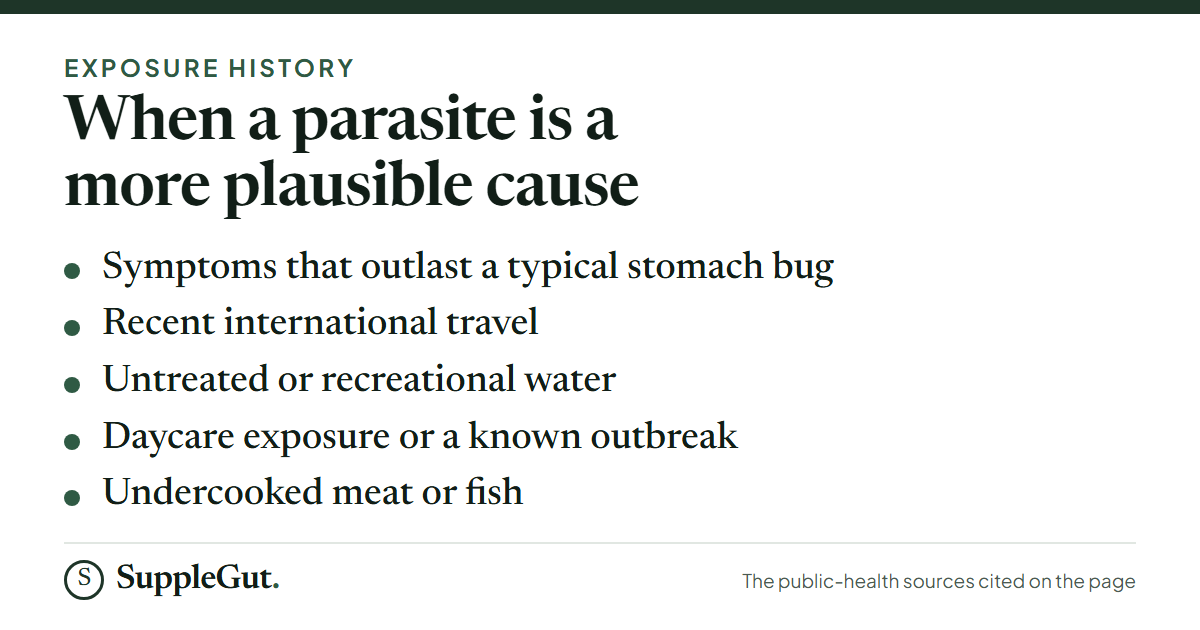
Parasites are more plausible when digestive symptoms persist longer than a typical stomach bug or follow a meaningful exposure, such as recent international travel, untreated or recreational water, daycare exposure, a known outbreak, contaminated food, soil exposure, or undercooked meat or fish. Persistent diarrhea, especially with greasy or floating stool, bloating, cramps, nausea, fatigue, appetite loss, or unintentional weight loss, can justify a discussion about testing with a clinician. Anal itching that is worse at night is more consistent with pinworm; blood in stool, visible worms or segments, anemia, significant weight loss, severe symptoms, or immune suppression warrant prompt medical advice.
What counts as a gut parasite?
A parasite is an organism that lives in or on a host and uses the host for survival. In the digestive tract, parasites fall into two main groups: protozoa, which are microscopic single-celled organisms, and helminths, which are worms.
The table ranks the most relevant intestinal parasites from more to less commonly encountered in the United States. This is a practical rather than absolute ranking: testing and reporting vary, and infections such as roundworm, whipworm, hookworm, and tapeworm are much more common in some parts of the world than in the U.S.
| Approximate U.S. commonness | Parasite | Type | Typical source or route of exposure | How it can affect the gut |
|---|---|---|---|---|
| 1 | Giardia duodenalis (also called G. intestinalis or G. lamblia) | Protozoan | Contaminated drinking or recreational water, food, close contact, or daycare exposure | The most common intestinal parasite identified in the U.S. It can cause diarrhea, gas, bloating, cramps, nausea, greasy or floating stool, fatigue, and malabsorption. |
| 2 | Pinworm (Enterobius vermicularis) | Roundworm | Swallowing microscopic eggs transferred from hands, bedding, surfaces, or close household contact | Usually causes itching around the anus, particularly at night. It does not usually cause persistent diarrhea or malabsorption. |
| 3 | Cryptosporidium | Protozoan | Contaminated pools or recreational water, drinking water, food, animal contact, or close contact | A leading cause of waterborne disease in the U.S. It typically causes watery diarrhea, cramping, nausea, fatigue, dehydration, and sometimes weight loss. |
| 4 | Cyclospora cayetanensis | Protozoan | Contaminated fresh produce or food | Can cause prolonged watery diarrhea, bloating, cramping, fatigue, appetite loss, and weight loss. CDC lists it among common foodborne parasites in the U.S. |
| 5 | Entamoeba histolytica | Protozoan | Contaminated food or water, particularly in areas with inadequate sanitation; close contact | May cause no symptoms, diarrhea, or dysentery. Invasive infection can cause severe colitis and, rarely, spread beyond the intestine. |
| 6 | Dientamoeba fragilis and Blastocystis species | Protozoa | Fecal-oral transmission; exact routes can be unclear | These organisms are sometimes found on stool testing, but a positive result does not always establish the cause of digestive symptoms. |
| 7 | Strongyloides stercoralis | Roundworm | Larvae entering through skin exposed to contaminated soil, usually during travel or residence in endemic areas | May cause no symptoms, abdominal pain, diarrhea, rash, or intermittent digestive symptoms. Infection can become dangerous after immune-suppressing medication. |
| 8 | Hookworm | Roundworm | Larvae entering through skin exposed to contaminated soil | Worms attach to the small intestine and can cause blood loss, iron-deficiency anemia, fatigue, and abdominal symptoms. It is uncommon in most U.S. settings but remains important after certain travel or soil exposures. |
| 9 | Roundworm (Ascaris lumbricoides) | Roundworm | Swallowing eggs from contaminated soil, food, or water | May cause abdominal discomfort, nutritional effects, or—in heavy infections—intestinal obstruction. It is more common in areas with inadequate sanitation. |
| 10 | Whipworm (Trichuris trichiura) | Roundworm | Swallowing eggs from contaminated soil, food, or water | Can cause abdominal pain, diarrhea, bloody stool, anemia, and growth effects in heavier infections. |
| 11 | Tapeworms, including Taenia species and fish tapeworms | Cestode (flatworm) | Undercooked pork, beef, or freshwater fish, depending on species | May cause no symptoms or mild digestive symptoms. Some species can have significant complications outside the gut, so species-specific diagnosis matters. |
| 12 | Trichinella species | Roundworm | Undercooked pork or wild game | Usually begins with gastrointestinal symptoms, but the most significant illness occurs after larvae migrate into muscle, where they can cause fever, muscle pain, and swelling. |
A positive stool result needs clinical interpretation. Some organisms can appear in people without symptoms, while others are more clearly associated with disease. The organism, symptoms, travel and exposure history, immune status, and test method should guide what happens next.
How parasites can affect the gut
Diarrhea, cramps, bloating, and nausea
Protozoal infections are a common cause of parasite-related digestive symptoms. Giardia can cause diarrhea, abdominal pain, bloating, nausea, vomiting, gas, greasy or floating stool, fatigue, and dehydration. Symptoms commonly begin one to two weeks after infection and may persist for two to six weeks; a smaller number of people develop longer-lasting symptoms (CDC, About Giardia Infection; CDC DPDx, Giardiasis).
Cryptosporidium most often causes watery diarrhea that can last days to weeks, along with cramps, fatigue, fever, vomiting, poor appetite, and weight loss. Illness may be much more severe or prolonged for people with weakened immune systems (CDC, Treating Crypto).
These symptoms are not specific to parasites. Viral gastroenteritis, food intolerance, inflammatory bowel disease, celiac disease, medication effects, and functional gastrointestinal disorders can overlap considerably. Symptoms alone cannot confirm a parasite.
Malabsorption and unintended weight loss
Some intestinal parasites interfere with normal digestion and absorption. Chronic giardiasis, for example, can involve recurrent symptoms, malabsorption, and debilitation (CDC DPDx, Giardiasis). Global health literature on intestinal parasite infections also identifies malabsorption, diarrhea, blood loss, impaired work capacity, and reduced growth as major consequences where these infections are prevalent.
A person with persistent loose stool, floating or greasy stool, unexplained weight loss, or fatigue after a higher-risk exposure should not assume the cause is dysbiosis or a need for a cleanse. Those symptoms warrant a clinician’s assessment.
Blood loss, iron deficiency, and anemia
Not all worms behave the same way. Hookworms attach to the intestinal wall and can cause blood loss, which may contribute to anemia. CDC guidance also notes that whipworm can cause bloody stool and anemia, while other soil-transmitted worms can cause abdominal symptoms and, when present in high numbers, obstruction or other complications.
Unexplained iron-deficiency anemia deserves a medical workup, particularly after travel or exposure in settings where soil-transmitted helminths are more common.
Changes to the gut microbiome and immune signaling
Parasites and the gut microbiome influence each other. Reviews of the field report that parasites can alter the intestinal environment, including epithelial integrity, immune signaling, nutrient availability, and the composition of resident microbes. Existing gut microbes can also influence a parasite’s ability to establish, survive, or be expelled (Hartmann et al., 2024; review of helminthic and protozoan dynamics, 2026).
Different organisms can have contrasting associations with microbial diversity and composition. Helminths and protozoa do not have interchangeable effects, and studies vary by parasite species, population, geography, diet, and methods used to measure the microbiome (review of helminthic and protozoan dynamics, 2026). Consumer microbiome testing is not a standalone test for a parasite infection.
How parasite infections are diagnosed
Testing should match the suspected organism. For suspected Giardia, clinicians can use stool antigen testing, molecular testing, or microscopy; CDC recommends collecting three stool samples over several days because parasite shedding can vary (CDC, Clinical Testing and Diagnosis for Giardia Infection; CDC, About Giardia Infection).
Pinworm is different: a stool test is often not the best initial method. A clinician may recommend a morning tape test to collect eggs around the anal area, sometimes repeated over several mornings (CDC, About Pinworm Infection; CDC, Clinical Overview of Pinworm Infection).
A correct diagnosis matters because treatment is organism-specific. CDC lists nitazoxanide as an FDA-approved option for diarrhea caused by Cryptosporidium in immunocompetent people at least one year old, while medications used for pinworm include mebendazole, pyrantel pamoate, or albendazole (CDC, Cryptosporidium treatment efficacy; CDC, Clinical Overview of Pinworm Infection). Treatment choice, dose, timing, and whether household contacts need treatment should come from a clinician or pharmacist familiar with the diagnosis.
Parasite-cleanse products in the catalog
These products are commonly marketed for parasite-cleanse protocols. They are not diagnostic tests or established treatments for a confirmed intestinal parasite. If symptoms or exposure history make infection plausible, ask a clinician about appropriate testing and treatment.
| Product | Catalog link | Typical ingredients or positioning | Price shown in catalog | What to know |
|---|---|---|---|---|
| Gaia Herbs Oil of Oregano | View product | Oregano-oil herbal product | $0.93/day | Marketed for digestive and antimicrobial support; not a validated parasite treatment. |
| Thorne Berberine | View product | Berberine supplement | About $1.47–$2.93/day | May interact with medications; do not use it instead of identifying the cause of persistent symptoms. |
| NOW Foods Green Black Walnut Wormwood Complex | View product | Black walnut and wormwood blend | About $0.17–$0.68/day | Commonly used in cleanse protocols; product marketing does not establish treatment for a specific parasite. |
| Renew Life PARA SMART Cleansing Formula | View product | 15-day cleanse program | About $2.00/day over 15 days | A time-limited herbal protocol, not a replacement for stool testing or medical treatment. |
| Allergy Research Group Artemisinin | View product | Artemisinin supplement | About $0.90–$3.58/day | Do not self-prescribe for unexplained digestive symptoms. |
| CellCore Biosciences Para 1 | View product | Parasite-cleanse protocol product | About $1.57/day standard dose; up to $3.91/day for aggressive protocols | The catalog has no meaningful review base for this product. |
When not to self-treat
Seek medical advice instead of starting a cleanse if you have persistent diarrhea, dehydration, fever, severe or worsening abdominal pain, blood or black stool, visible worms or segments in stool, significant weight loss, anemia, a weakened immune system, or a meaningful travel, water, food, or soil exposure.
Prevention that actually helps
| Prevention step | Why it matters |
|---|---|
| Wash hands with soap and water after using the toilet, changing diapers, handling animals or soil, and before preparing or eating food | Reduces fecal-oral spread of parasites and other gastrointestinal infections (AAFP, Common Intestinal Parasites). |
| Use safe drinking water | Boil or appropriately filter/purify water before drinking or brushing teeth when camping or traveling where water may be contaminated. |
| Handle and cook food safely | Thoroughly cook meat and avoid cross-contamination during food preparation (AAFP, Common Intestinal Parasites). |
| Avoid swallowing recreational water | Recreational water can spread organisms including Giardia and Cryptosporidium. |
| Follow household instructions after a pinworm diagnosis | CDC advises treating household members and caregivers at the same time because reinfection is common (CDC, About Pinworm Infection). |
Common questions
Can parasites cause bloating and gas?
Yes. Giardia can cause bloating, gas, abdominal pain, nausea, and diarrhea. Those symptoms are also common in many non-parasitic digestive conditions, so testing—not symptom matching—is needed for diagnosis.
Can a parasite affect the gut microbiome?
Yes. Research reviews show that intestinal parasites can alter the gut environment and microbial composition, while gut microbes can also affect parasite colonization and clearance. The direction and significance of the change depend on the species and context.
Can you have a parasite without symptoms?
Yes. CDC guidance notes that many intestinal parasite infections are asymptomatic or subclinical. Whether to test depends on exposure risk, symptoms, individual circumstances, and clinician judgment.
How do doctors test for intestinal parasites?
Many infections are evaluated with stool testing, which may include microscopy, antigen tests, or molecular tests. For Giardia, CDC recommends three stool samples collected over several days to improve accuracy. Pinworm is usually assessed with a tape test rather than routine stool testing.
Do parasite cleanses work?
Do not rely on a cleanse to diagnose, prevent, or treat a suspected intestinal parasite. Evidence-based treatment depends on identifying the specific organism, and an unverified cleanse can delay appropriate care.
What is the best supplement for parasites?
There is no over-the-counter supplement that can be responsibly recommended as a proven replacement for diagnostic testing and parasite-specific medication. If the goal is recovery from diarrhea or an infection, hydration and clinician-directed treatment matter more than adding a broad herbal blend.
Sources
- Centers for Disease Control and Prevention. "About Giardia Infection," cdc.gov/giardia/about; "DPDx – Giardiasis," cdc.gov/dpdx/giardiasis; "Clinical Testing and Diagnosis for Giardia Infection," cdc.gov/giardia/hcp/diagnosis-testing
- Centers for Disease Control and Prevention. "About Pinworm Infection," cdc.gov/pinworm/about; "Clinical Overview of Pinworm Infection," cdc.gov/pinworm/hcp/clinical-overview
- Centers for Disease Control and Prevention. "Treating Crypto," cdc.gov/cryptosporidium/treatment; "Treatment Efficacy" (Cryptosporidium clinical care), cdc.gov/cryptosporidium/hcp/clinical-care
- Hartmann et al. "Interaction between Intestinal Parasites and the Gut Microbiota: Implications for the Intestinal Immune Response and Host Defence." 2024. pmc.ncbi.nlm.nih.gov/articles/PMC11356857
- "The dual role of intestinal parasites in shaping human gut microbiota: distinguishing helminthic and protozoan dynamics." 2026. pmc.ncbi.nlm.nih.gov/articles/PMC13059267
- American Academy of Family Physicians. "Common Intestinal Parasites." American Family Physician. aafp.org/afp/2023/1100/intestinal-parasites
SuppleGut’s quiz considers your symptoms, routine, and preferences and matches you with a product from the catalog. It does not diagnose parasite infections. Persistent diarrhea, weight loss, blood in stool, significant exposure risk, or suspected infection should be discussed with a clinician.
Not sure which product fits your situation?
This guide covers the mechanics. The quiz takes your specific symptoms, routine and preferences and matches you to one product from the catalog.
Take the quiz →