
Guide
Does Balance ONE Time-Release Probiotic work? The 12 organisms, the 15 billion CFU and the studies behind it
Quick answer
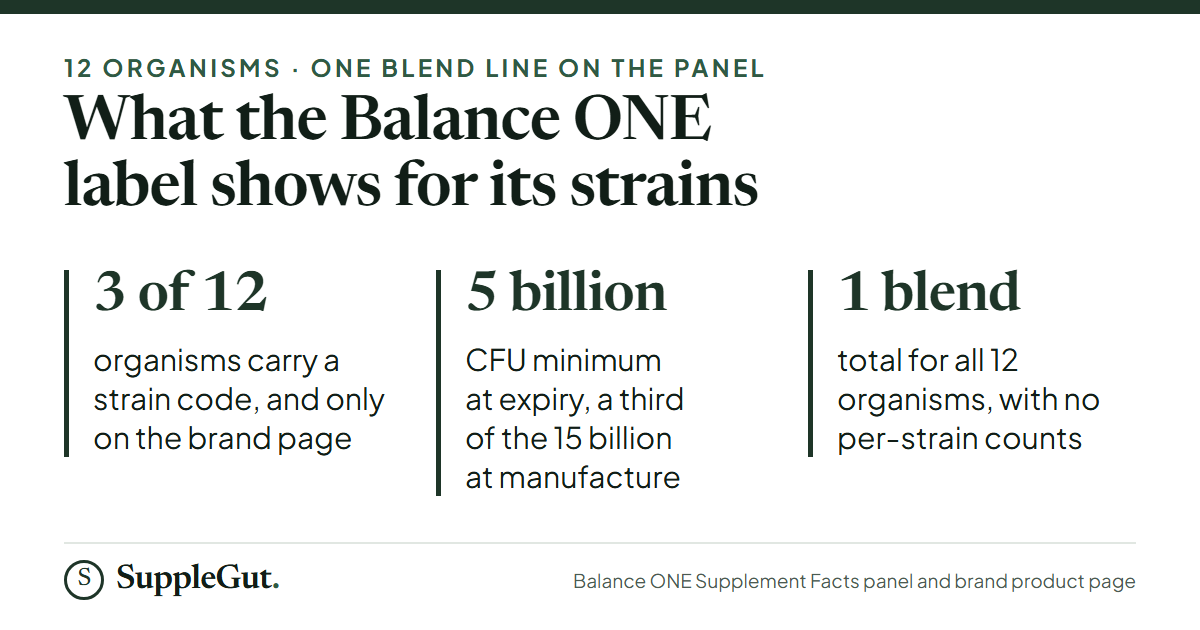
Does Balance ONE Time-Release Probiotic work? No trial of the tablet exists that we could find. The brand cites studies of three of its strains, in healthy volunteers, measuring laboratory markers, colds and vaccine response, not digestive symptoms. The label gives one blend total for 12 organisms, 15 billion CFU at manufacture and a minimum of 5 billion at expiry, and strain codes appear for three of the 12 on the brand page only. Amazon shows 4.5 from 3,068 ratings; the brand’s own widget shows 4.8, with some reviews rewarded with a coupon.
Balance ONE Time-Release Probiotic is a once-a-day tablet of 12 probiotic species, 15 billion CFU at manufacture and 25 mg of prebiotic FOS, sold by Balance One Supplements Inc. on its own site and on Amazon, where it has been listed since 2018. What sets it apart from a capsule is the tablet: a matrix the brand says releases the cultures over 8 to 10 hours. This page sets out which strains the label names, what the brand’s cited studies measured, and where the reviews come from.
What Balance ONE is, and the strain picture
The panel prints one line, “Probiotic Blend”, at 127 mg and 15 billion CFU, with the 12 organisms listed as species and no per-organism counts. That sits beside the brand page’s “No proprietary blends”. The other ingredients are microcrystalline cellulose, hypromellose, pectin, sodium carbonate, stearic acid, silicon dioxide and turmeric; the page also names guar gum, which the panel does not.
| Organism | Strain designation |
|---|---|
| L. plantarum | 299 (DSM 6595), on the brand page and Amazon |
| L. paracasei | 8700:2 (DSM 13434), on the brand page and Amazon |
| L. acidophilus | La-14, on the brand page only |
| L. casei, B. longum, B. breve, B. infantis, L. brevis, L. salivarius, L. rhamnosus, Lactococcus lactis, S. thermophilus | None: species only (nine of the 12) |
The panel itself prints no strain codes. The 15 billion is a count “at time of manufacture”; the label’s own minimum at expiration is 5 billion, a third of that. Amazon’s bullets add that the tablet delivers “60% of our 15 Billion CFU alive”. Note that L. plantarum 299 (DSM 6595) is a different deposit from 299v (DSM 9843), the strain in the IBS trials.
The time-release claim
The brand names its tablet technology BIO-tract and claims “up to 15x better survivability”, footnoted as BIO-tract against standard capsules “under in-vitro test conditions”. The maker, Probi, publishes a one-page summary of a stomach-and-small-intestine model (three hours each) using L. plantarum and B. lactis, with higher survival for tablets than vegetable capsules; the numbers appear only in a chart, and B. lactis is not on this label. We found no published study of this tablet or peer-reviewed BIO-tract survival paper. Other brands’ listings use the same “15X” wording.
The studies the brand cites
We found no trial of the finished tablet. The brand’s page cites strain studies, and none had a digestive-symptom endpoint:
- L. plantarum 299: 14 healthy adults, six weeks, 10 billion CFU a day; microbiota unchanged, the IL-6 response of rectal-lining samples to an inflammatory stimulus was lower. Two authors hold minority shares in Probi AB (Stene et al., 2022).
- L. paracasei 8700:2: tested only together with L. plantarum HEAL9, which is not in this product. In 272 healthy adults, one or more colds occurred in 67% against 55% (Berggren et al., 2011); in 898 adults the primary endpoint, cold severity, was not reduced, though colds were fewer (1.24 against 1.36) (Ahrén et al., 2021).
- L. acidophilus La-14: 83 healthy volunteers took seven strains around a cholera vaccine; serum IgG rose, and “overall vaccination was not influenced” (Paineau et al., 2008).
The doses cannot be compared: the 299 study used 10 billion CFU of one strain, the 8700:2 trials 1 billion in total, and Balance ONE gives one blend figure.
Evidence for probiotics as a class
A 2023 meta-analysis of 82 IBS trials in 10,332 people rated combination probiotics “very low certainty” for global symptoms and for bloating; Lactobacillus strains and L. plantarum 299v were low certainty, with no excess adverse events (Goodoory et al., 2023). A strain-by-strain analysis found efficacy depends on the strain, with 299v at RR 4.6 (1.9 to 11.0) for abdominal pain relief in single-strain trials (McFarland et al., 2021). The brand’s reflux claim rests on a review of 13 studies, 11 reporting benefit, with quality high in five, medium in two and low in six, by DuPont-employed authors (Cheng and Ouwehand, 2020); the brand’s FAQ says probiotics “may help some people”. For dose context see the CFU guide.
How to take it, and side effects
One tablet daily with or without food, swallowed whole or broken in half; no refrigeration. The brand suggests half a tablet for the first week for a sensitive gut or a first probiotic, and a different time of day from antibiotics. Amazon’s directions add “up to 3 tablets per day”, which the brand site does not say; that would be $1.60 a day. The studies above ran 3 to 12 weeks.
The brand notes temporary gas or bloating at the start, and FOS, 25 mg here, is fermentable. The product is “not specifically formulated or tested” as low-histamine. It is stated vegan, gluten-free and dairy-free, and there is no “contains” line; Lactococcus lactis and S. thermophilus are dairy-associated species. Amazon’s safety text advises asking a practitioner first if pregnant, nursing, on medication or with a health condition.
What the reviews say
Amazon shows 4.5 from 3,068 ratings (75% five-star, 12% four, 7% three, 2% two, 4% one). Amazon collects these independently of the brand’s invitations, though the seller is the brand, and the review text is behind a sign-in. Amazon’s own summary lists digestive effects, effectiveness, value and the time-release design as positives and no negative topics. The brand’s site shows 4.8 from 1,568 on a Judge.me widget that includes related products’ reviews; many entries are labeled “collected from invite” and 5 of the first 10 we read “rewarded with a coupon”. Its Trustpilot profile is unclaimed with no reviews.
Reviewers praise less bloating and gas, one tablet a day with no side effects, and results better than other probiotics tried. The recurring complaint is no effect; one reviewer with diabetes saw none, and Amazon’s 6% of one- and two-star ratings has no readable text.
Cost and refund terms
One 60-tablet bottle is $31.97 on the brand site and on Amazon, about $0.53 a day. Three bottles are $91.11 ($0.51) and six $178.39 ($0.50). A subscription takes 15% off, $27.17 a bottle ($0.45 a day), renewing every 30 to 180 days; the page defaults to one bottle, not a subscription. US shipping is free above $20.
The 90-day guarantee refunds the first opened bottle of each product in cash with no return, takes unopened bottles in multipacks back with a free US label, and covers Amazon orders when the buyer emails support with the order number. The terms are governed by British Columbia law. We found no independent billing complaints; Amazon review text and Reddit could not be read, which is an absence of data.
Who Balance ONE is for
- Someone who wants a once-daily tablet with no refrigeration and a single-bottle price near $0.53 a day.
- Someone for whom species-level labeling with three strain codes is enough.
- Someone who wants a refund route that covers Amazon purchases.
Other probiotics in the catalog include Culturelle, Align and Seed DS-01; see Align vs Culturelle and the probiotic chooser.
The products in this catalog
Common questions
Does Balance ONE probiotic work?
No trial of this tablet exists that we could find. The brand cites studies of three of its strains, mostly in healthy volunteers, measuring immune or laboratory markers or common colds rather than digestive symptoms. Reviews are mostly positive (4.5 from 3,068 on Amazon, 4.8 from 1,568 on the brand’s site), and a few reviewers report no benefit. For choosing between products see the probiotic chooser.
Which strains are in Balance ONE?
The panel lists 12 species: L. plantarum, L. paracasei, L. acidophilus, L. casei, B. longum, B. breve, B. infantis, L. brevis, L. salivarius, L. rhamnosus, Lactococcus lactis and S. thermophilus. The brand page gives strain designations for three: L. plantarum 299 (DSM 6595), L. paracasei 8700:2 (DSM 13434) and L. acidophilus La-14. The other nine are species only, and no organism has its own CFU count.
Is 15 billion CFU enough, and what is the expiry count?
The label gives 15 billion CFU at manufacture and a minimum of 5 billion at expiration, shared across 12 organisms. The per-strain amount cannot be read, so it cannot be compared with a trial dose. The CFU guide covers how counts relate to trials.
Is a time-release probiotic better than a capsule?
The brand claims its BIO-tract tablet gives “up to 15x better survivability” than standard capsules, footnoted as an in-vitro comparison. The maker’s summary describes a stomach-and-intestine model with two other organisms and shows the numbers only in a chart. We found no study of this exact tablet.
What are the side effects of Balance ONE?
The brand says some people notice temporary gas or bloating at the start and suggests half a tablet for the first week. It contains 25 mg of FOS, a fermentable prebiotic, and the brand says it is not specifically formulated as low-histamine. Amazon’s label tells people who are pregnant, nursing, on medication or with a health condition to check with a practitioner, and the brand suggests a different time of day from antibiotics.
How much does Balance ONE cost, and how does the subscription work?
One 60-tablet bottle is $31.97, about $0.53 a day, the same price on Amazon. A subscription takes 15% off ($27.17, about $0.45 a day) and renews every 30 to 180 days; the page defaults to one bottle. Three and six bottles are $91.11 and $178.39. US shipping is free above $20.
What is the refund policy, and who makes Balance ONE?
Balance One Supplements Inc. lists a Wilmington, Delaware address, and the product has been on Amazon since 2018. Its 90-day guarantee refunds the first opened bottle in cash without a return, takes unopened multipack bottles back for a refund, and covers Amazon orders. Its Trustpilot profile is unclaimed with no reviews, and we found no billing complaints either way.
Sources
- Goodoory VC, Khasawneh M, Black CJ, et al. “Efficacy of Probiotics in Irritable Bowel Syndrome: Systematic Review and Meta-analysis.” Gastroenterology, 2023;165(5):1206–1218. doi.org/10.1053/j.gastro.2023.07.018
- McFarland LV, Karakan T, Karatas A. “Strain-specific and outcome-specific efficacy of probiotics for the treatment of irritable bowel syndrome.” EClinicalMedicine, 2021;41:101154. doi.org/10.1016/j.eclinm.2021.101154
- Cheng J, Ouwehand AC. “Gastroesophageal Reflux Disease and Probiotics: A Systematic Review.” Nutrients, 2020;12(1):132. doi.org/10.3390/nu12010132
- Stene C, Röme A, Palmquist I, et al. “Administration of probiotics to healthy volunteers: effects on reactivity of intestinal mucosa and systemic leukocytes.” BMC Gastroenterology, 2022;22(1):100. doi.org/10.1186/s12876-022-02185-1
- Berggren A, Lazou Ahrén I, Larsson N, et al. “Randomised, double-blind and placebo-controlled study using new probiotic lactobacilli for strengthening the body immune defence against viral infections.” European Journal of Nutrition, 2011;50(3):203–210. doi.org/10.1007/s00394-010-0127-6
- Ahrén IL, Hillman M, Nordström EA, et al. “Fewer Community-Acquired Colds with Daily Consumption of Lactiplantibacillus plantarum HEAL9 and Lacticaseibacillus paracasei 8700:2.” Journal of Nutrition, 2021;151(1):214–222. doi.org/10.1093/jn/nxaa353
- Paineau D, Carcano D, Leyer G, et al. “Effects of seven potential probiotic strains on specific immune responses in healthy adults.” FEMS Immunology & Medical Microbiology, 2008;53(1):107–113. doi.org/10.1111/j.1574-695X.2008.00413.x
- Probi, “BIO-tract” one-page summary (probi.com)
- Brand page: label, strain designations, directions, claims, refund policy and price (balanceone.com/products/probiotics; refund policy); Amazon listing: price, ratings and directions (amazon.com/dp/B07CZPV8W1)
Not sure which product fits your situation?
This guide covers the mechanics. The quiz takes your specific symptoms, routine and preferences and matches you to one product from the catalog.
Take the quiz →