
Guide
Does Biome Protect work? One spore probiotic, a phage blend and what the trials cover
Quick answer
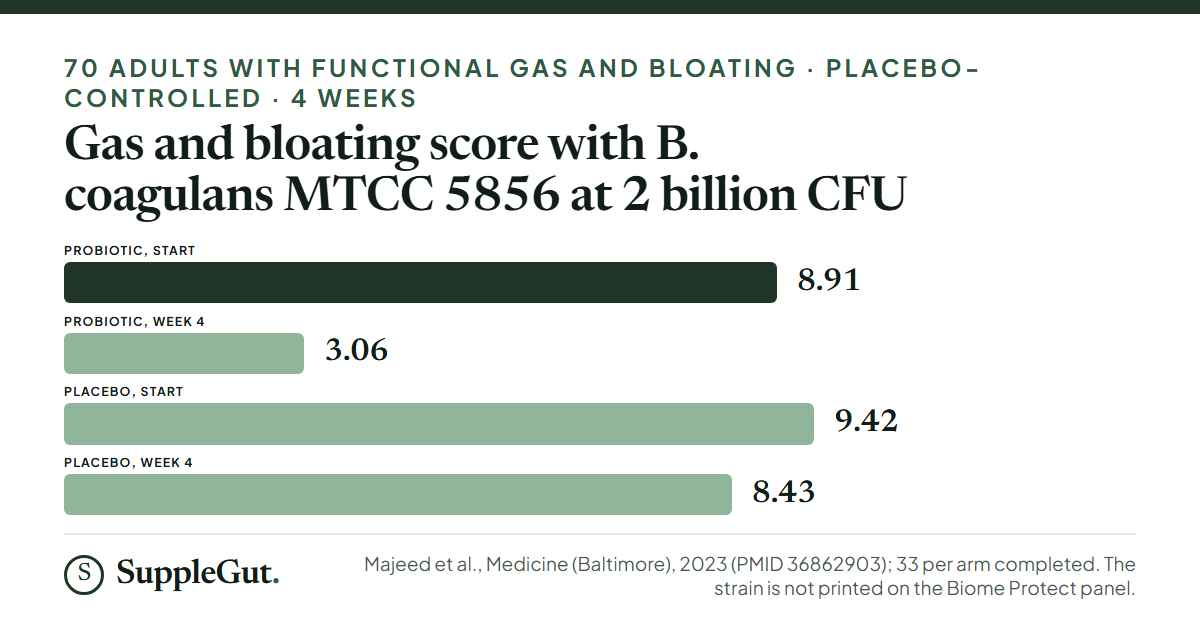
Does Biome Protect work? We could find no trial of Biome Protect itself. Its one probiotic, Bacillus coagulans at 2 billion CFU, matches the dose of three small placebo-controlled trials of the MTCC 5856 strain, including a 70-adult trial in which gas and bloating scores fell from 8.91 to 3.06 against 9.42 to 8.43 on placebo, but the panel prints no strain, so those results may not apply. The tributyrin and three-phage ingredients have no human trial for these brands. On Amazon, 64% of 138 ratings are five-star; on the brand site, 73% of 587 reviews are.
Biome Protect is a two-capsule, once-a-day formula from Adapt Naturals, the supplement brand founded by Chris Kresser. It puts four kinds of ingredient in one serving: a spore-forming probiotic, tributyrin (a form of butyrate), a three-phage blend the label calls a prebiotic, and four fruit and seed extracts. This page sets out what the panel prints, what trials exist for each part and at what dose, how the review pools differ, and what the brand’s terms say.
What Biome Protect is, and what it is not
The Supplement Facts panel lists, per serving of two vegetarian capsules: tributyrin (as CoreBiome) 300 mg; Bacillus coagulans 2 billion CFU; 50 mg each of pomegranate fruit extract, grape seed extract, cranberry fruit extract and blueberry fruit extract (200 mg of plant extracts in all); and FortiPhage Prebiotic Blend 15 mg, listed as three bacteriophages named by code (ECCR 664-1, ECML-117 and ECML-359, all Myoviridae) with no amount given for each. A pouch holds 60 capsules, which is 30 servings. The other ingredients are hydroxypropyl methylcellulose, microcrystalline cellulose, magnesium stearate and silicon dioxide, with no sweeteners.
It is not a multi-strain Lactobacillus and Bifidobacterium probiotic. There is one organism. The panel prints the species and the CFU count but no strain designation. The brand’s web page says “as LactoSpore”, a trade name that trial abstracts tie to the strain B. coagulans MTCC 5856. That wording is in the web copy, not on the panel we read, so the link between this capsule and those trials rests on the brand’s page alone.
The formula has changed. A review on the brand site names the earlier phage ingredient as PreforPro, a four-phage product, and a rating site still lists it. Today’s panel says FortiPhage in its place. We could not find when the change was made, so ratings and reviews on both the brand site and Amazon cover at least two formulas.
The trial of the product itself
There is none. We searched PubMed and ClinicalTrials.gov under “Biome Protect” and “FortiPhage” and found no study, and no published study combines these four components. The brand’s description, a “research-backed 4-in-1 blend”, rests on literature about the separate ingredients, set out below.
The evidence for the probiotic
The probiotic is the part with the clearest trials, and they are of one strain. In a randomized, double-blind, placebo-controlled trial in southern India, 70 adults with functional gas and bloating took B. coagulans MTCC 5856 at 2 billion spores a day or placebo for four weeks; 66 completed. The GSRS indigestion score fell from 8.91 to 3.06 on the probiotic (P < .001) against 9.42 to 8.43 on placebo (P = .11), the global evaluation score rose from 3.0 to 9.0 against 3.0 to 4.0, and no adverse events were reported (Majeed et al., Medicine (Baltimore), 2023).
Two earlier pilot trials from the same group used the same dose. In 36 newly diagnosed patients with diarrhea-predominant IBS (18 per arm), 90 days of the strain on top of standard care reduced bloating, vomiting, diarrhea, abdominal pain and stool frequency against placebo (Majeed et al., Nutrition Journal, 2016). In 40 patients with major depression and IBS, 90 days improved depression scores and IBS quality of life against placebo (Majeed et al., Food & Nutrition Research, 2018). Both call themselves pilots in their titles. The abstracts do not state who funded them.
Two things bound these results. The label’s 2 billion CFU is the same dose, so the dose matches. But the panel does not print the strain, so the match holds only if the capsule contains MTCC 5856. And every trial is small: the largest randomized 70 people and the longest ran 90 days.
The evidence for the other ingredients
Tributyrin. CoreBiome is the brand name of the tributyrin. We found no human trial of it for bloating or IBS. The brand-linked paper is a laboratory study: in a simulated upper gut about 41% of a capsule dose was converted to butyrate in the small intestine and about 59% remained for the colon, (Duysburgh et al., Frontiers in Nutrition, 2025). The brand’s statement that this form is “proven to reach your colon intact” is a claim; the paper tested a simulated gut, not people. For a different butyrate form, a 66-patient trial of microencapsulated sodium butyrate added to IBS therapy for 12 weeks found less pain on defecation at four weeks, while the reductions in abdominal pain, flatulence and disordered defecation were not statistically significant (Banasiewicz et al., Colorectal Disease, 2013).
Bacteriophages. Phages are viruses that infect specific bacteria. The brand calls the three here a prebiotic. Intralytix, the owner of the FortiPhage name, describes it as three Myoviridae phages “to maintain healthy gut microflora”; its page does not name the phages or cite a human study, and we found no FortiPhage trial. The only human trials of a phage supplement that we found used the earlier four-phage product. In the PHAGE safety study, 43 adults with mild to moderate gastrointestinal distress took it in a crossover design for 28 days per arm; it was safe and well tolerated, but participants reported symptom improvements on both the supplement and the placebo (Gindin et al., Journal of the American College of Nutrition, 2019). In healthy adults over 28 days, fecal E. coli fell with no change in microbiome diversity (Febvre et al., Nutrients, 2019). Both results belong to a different product.
Fruit and seed extracts. We found no gut-symptom trial of pomegranate, grape seed, cranberry or blueberry extract at 50 mg each.
How to take Biome Protect
The label says two capsules once a day, or as directed by a healthcare practitioner. The brand’s FAQ suggests taking it with meals when possible but allows an empty stomach. For what it calls intensive support, the brand says to start at two capsules and, if tolerated, go to four capsules a day for 6 to 8 weeks or until symptoms improve, then return to two. We found no trial of the four-capsule dose, which would be 4 billion CFU, 600 mg of tributyrin and 30 mg of the phage blend. The brand says to allow 30 to 60 days for deeper shifts; the strain trials above ran four weeks and 90 days.
Side effects and who should not take it
The pouch advises consulting a physician before use if you are pregnant, nursing, have a medical condition or take any medication. The brand page and the Amazon listing add a warning for anyone on a blood thinner or anticoagulant; no reason is given, and we did not find that line in the pouch text we read. We found no age statement.
A minority of reviewers report effects after starting: worse bloating, gas or diarrhea, acid reflux, nausea, or anxiety and a racing heart, some within an hour of a dose and some at one capsule a day. Among the 44 one- and two-star brand-site reviews we read, about 15 describe this; the larger group says nothing changed.
What the reviews say
Two pools, read separately. The brand’s own site shows 4.47 from 587 reviews through a hosted review widget (73% five-star, 13% four, 6% three, 4% two, 4% one),. Amazon, where Adapt Naturals is also the seller, shows 4.1 from 138 ratings (64% five-star, 11% four, 9% three, 3% two, 13% one). Trustpilot has a claimed profile for the brand with no reviews, and the rating site SuppCo lists a 9.13 score while stating that product-specific testing is not currently verified by it.
We could retrieve 432 of the brand-site reviews. Of the 302 five-star ones, 93 mention bloating and 74 mention bowel movements, regularity or constipation. The recurring praise is less bloating, more regular bowel movements, and a simple routine; several reviewers say they switched from Seed. The recurring complaint is no change after weeks, in about 27 of the 44 low-star reviews. Price comes up in 16 reviews across ratings, and in Amazon’s own summary of review text, 11 of 12 mentions of value for money are negative.
What the certificate of analysis shows
The brand’s testing page says it posts certificates of analysis and names no laboratory. The Biome Protect certificate (lot 260522) is on the letterhead of Total Nutrition Technology, the contract manufacturer, so it is the maker’s own quality-control document rather than an independent laboratory’s. It lists the label claims (tributyrin, B. coagulans CFU, the plant extracts and FortiPhage) with the method “by input”, meaning supplier controls rather than a test. So the certificate does not measure CFU, tributyrin or plant-extract content in the finished capsule. What it does measure is yeast and mold (under 10), coliforms, Salmonella and E. coli (absent per 25 g), S. aureus, heavy metals, gluten (under 5.0 ppm) and genetically modified material (negative).
The subscription and refund terms
A single pouch is $57.93 on the brand site and $57.95 on Amazon. The brand’s subscription takes 10% off ($52.14) with delivery every 4, 8 or 12 weeks, and the page states “No commitment. Change or cancel anytime.” Two-, three- and six-pouch packs are priced at exactly the single-pouch rate multiplied up ($115.92, $173.79, $347.58), so they carry no discount. Shipping is free in the US on orders over $85, which a single pouch does not reach. Amazon Subscribe & Save is $52.15.
The brand states a 90-day, 100% money-back guarantee on all purchases. The policy page says refunds take 5 to 10 business days, returns start through a Happy Returns portal, and the company reserves the right to change the policy if it believes it is being abused; it does not say who pays return shipping. Of the 432 brand-site reviews we read, none reports being charged after cancelling. Two reviewers refer to a 60-day guarantee, which is not what the brand’s pages say now. Amazon’s full review text is behind a sign-in, so that is an absence of data rather than evidence either way.
Who Biome Protect is for
- Bloating, gas or irregular bowel movements, the symptoms the reviews and the strain trials most often describe.
- Someone who wants a spore-forming probiotic, tributyrin and a phage blend in one capsule, and accepts that the combination has no trial.
- Someone who will take it daily for at least four weeks and can use the 90-day refund window if there is no change.
Where a trial of the finished product matters more, Seed DS-01 is a 24-strain capsule with a trial of the product itself. Thorne Bacillus Coagulans is also a single-species spore probiotic, at about $0.55 a day on the catalog price, and its listing does not name the strain either. Peak Performance CoreBiome Tributyrin is the tributyrin ingredient on its own. For another capsule that combines tributyrin, two probiotic species and a fiber blend, see the Bio Complete 3 guide; for reading a CFU figure, see how many CFU you need, and the quiz starts from symptoms.
Cost
At the label dose of two capsules, a $57.93 pouch lasts 30 days, which is $1.93 a day; the 10% subscription price is $1.74 a day. At the brand’s intensive four-capsule dose a pouch lasts 15 days, which is $3.86 a day at the one-time price. Multi-packs cost the same per day as a single pouch.
The products in this catalog
Common questions
Does Biome Protect work?
No trial of Biome Protect itself was found. Its probiotic, Bacillus coagulans at 2 billion CFU, matches the dose of three small placebo-controlled trials of one named strain (MTCC 5856), but the panel does not print a strain. On the brand’s own review widget 73% of 587 reviews are five-star, and on Amazon 64% of 138 ratings are, while about 27 of the 44 one- and two-star brand-site reviews we read say nothing changed.
What is in Biome Protect?
Per two capsules: 300 mg of tributyrin (CoreBiome), 2 billion CFU of Bacillus coagulans with no strain printed, 50 mg each of pomegranate, grape seed, cranberry and blueberry extracts, and 15 mg of a three-phage blend called FortiPhage. The other ingredients are hydroxypropyl methylcellulose, microcrystalline cellulose, magnesium stearate and silicon dioxide. The pouch says it is made without gluten or GMOs and gives no “contains” statement.
What are bacteriophages, and are they safe in a supplement?
Bacteriophages are viruses that infect specific bacteria; the brand calls its three-phage blend a prebiotic. We found no trial of FortiPhage. A 43-adult safety study of a different four-phage supplement found it safe and tolerable over 28 days, with symptom improvements on both supplement and placebo, so its results are not for this ingredient.
What are the side effects of Biome Protect?
The pouch advises asking a physician first if you are pregnant, nursing, have a medical condition or take medication, and the brand page and Amazon listing add blood thinners. Some reviewers report worse bloating, gas, diarrhea, reflux, nausea or anxiety after starting, and some stopped within days; about 15 of the 44 low-star brand-site reviews we read describe this.
How do you take Biome Protect, and how long does it take?
The label says two capsules once a day, with meals when possible though an empty stomach is allowed. The brand also describes four capsules a day for 6 to 8 weeks as intensive support, a dose we found no trial of. The brand says most people feel better within days and to allow 30 to 60 days; the strain trials ran four weeks and 90 days.
How much does Biome Protect cost, and what is the refund policy?
One 30-day pouch is $57.93 on the brand site and $57.95 on Amazon, which is $1.93 a day, or $1.74 a day on the brand’s 10% subscription. Multi-packs carry no discount. The brand states a 90-day money-back guarantee through support or a Happy Returns portal and a subscription that can be changed or cancelled anytime; it does not say who pays return shipping.
Biome Protect or Seed DS-01: which has the stronger evidence?
Seed DS-01 has a trial of the finished product, run by the brand; Biome Protect has none, and no trial compares the two. Biome Protect’s probiotic has small strain trials at the same 2 billion CFU dose if the capsule contains that strain. See the Seed DS-01 page for its label.
Sources
- Majeed M, Nagabhushanam K, Paulose S, et al. "The effects of Bacillus coagulans MTCC 5856 on functional gas and bloating in adults: A randomized, double-blind, placebo-controlled study." Medicine (Baltimore), 2023;102(9):e33109. doi.org/10.1097/MD.0000000000033109
- Majeed M, Nagabhushanam K, Natarajan S, et al. "Bacillus coagulans MTCC 5856 supplementation in the management of diarrhea predominant Irritable Bowel Syndrome: a double blind randomized placebo controlled pilot clinical study." Nutrition Journal, 2016;15:21. doi.org/10.1186/s12937-016-0140-6
- Majeed M, Nagabhushanam K, Arumugam S, et al. "Bacillus coagulans MTCC 5856 for the management of major depression with irritable bowel syndrome: a randomised, double-blind, placebo controlled, multi-centre, pilot clinical study." Food & Nutrition Research, 2018;62. doi.org/10.29219/fnr.v62.1218
- Gindin M, Febvre HP, Rao S, et al. "Bacteriophage for Gastrointestinal Health (PHAGE) Study: Evaluating the Safety and Tolerability of Supplemental Bacteriophage Consumption." Journal of the American College of Nutrition, 2019;38(1):68–75. doi.org/10.1080/07315724.2018.1483783
- Febvre HP, Rao S, Gindin M, et al. "PHAGE Study: Effects of Supplemental Bacteriophage Intake on Inflammation and Gut Microbiota in Healthy Adults." Nutrients, 2019;11(3):666. doi.org/10.3390/nu11030666
- Banasiewicz T, Krokowicz Ł, Stojcev Z, et al. "Microencapsulated sodium butyrate reduces the frequency of abdominal pain in patients with irritable bowel syndrome." Colorectal Disease, 2013;15(2):204–209. doi.org/10.1111/j.1463-1318.2012.03152.x
- Duysburgh C, Verstrepen L, Van Meulebroek L, et al. "Tributyrin (CoreBiome) enhances butyrate levels and modulates the gut microbiota, barrier function, and immune response in vitro." Frontiers in Nutrition, 2025;12:1712993. doi.org/10.3389/fnut.2025.1712993
- Brand page: label, directions, price, refund and subscription terms. adaptnaturals.com/products/biome-protect; refund policy adaptnaturals.com/policies/refund-policy; third-party testing page and certificate of analysis for lot 260522 adaptnaturals.com/pages/third-party-testing
- Amazon listing: price, ratings and review summary. amazon.com/dp/B0DNRMFRZM
- Intralytix: FortiPhage description. intralytix.com; SuppCo: rating page for Biome Protect. supp.co
Not sure which product fits your situation?
This guide covers the mechanics. The quiz takes your specific symptoms, routine and preferences and matches you to one product from the catalog.
Take the quiz →