
Guide
Does Biome V3 work? Six species without strains, a pinch of guar fiber and fulvic acid
Quick answer
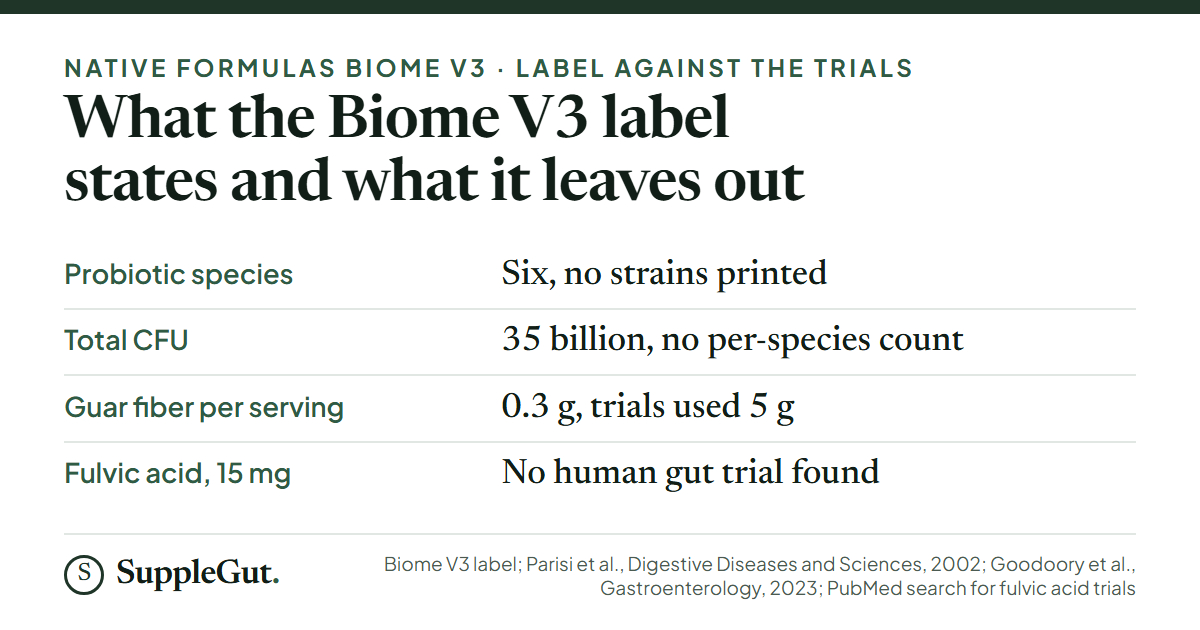
Does Biome V3 work? We could find no trial of Biome V3 itself. The label lists six probiotic species with no strain designations, so strain trials cannot be matched to it, and 35 billion CFU in a 100 mg blend with no per-species count. It has 300 mg of Sunfiber guar fiber where the IBS and constipation trials used 5 g a day, and 15 mg of fulvic acid, for which no human gut trial exists; the trial the brand cites tested an eczema cream. The brand site shows 4.7 from 33 owner-replied reviews and Amazon shows 4.1 from 66 ratings.
Biome V3 is a two-capsule probiotic from Native Formulas that combines three things: six bacterial species, a small amount of Sunfiber guar fiber, and fulvic acid with molybdenum, which the brand calls “fulvic minerals”. The brand’s bottle reads 35 billion CFU, 6 strains. This page sets out what the label prints, what trials exist for each part and at what dose, how the two review pools differ, and what the brand’s published terms say.
What Biome V3 is, and what it is not
The Supplement Facts panel lists, per serving of two vegetarian capsules: molybdenum 45 mcg (as molybdenum glycinate chelate); Sunfiber partially hydrolyzed guar gum 300 mg; fulvic acid 15 mg; and a probiotic blend of 100 mg providing 35 billion CFU. A bottle holds 60 capsules, which is 30 servings. The other ingredients on the Amazon listing are hypromellose (the capsule), vegetable magnesium stearate, microcrystalline cellulose and silica. No sweeteners, flavors or colors are listed.
The blend is the part to read closely. It names six species, Lactobacillus plantarum, Bacillus subtilis, Bifidobacterium lactis, B. bifidum, B. breve and B. longum, in no stated order of amount, and none carries a strain designation. The 35 billion CFU is the total for the whole blend, with no count for any species. The panel also does not say whether the count holds at the time of manufacture or at expiry. The brand describes the species as “highly researched and specialized” and as histamine-degrading, and its pages name no strains, deposit numbers or trial citations to back either description.
It is not a single-strain product, and it is not a fiber supplement: 300 mg of fiber is about 1% of the 28 g daily value. It is a soil-based and bifidobacteria probiotic with small amounts of three added ingredients.
The trial of the product itself
There is none. We searched PubMed and ClinicalTrials.gov under “Biome V3” and “Native Formulas” and found no study of this product, and the brand’s pages cite none. Its product-page footnote says that studies suggest probiotics can increase the effectiveness of an antimicrobial protocol, which is a statement about probiotics in general. The evidence below is for the ingredient classes, in most cases at strain and dose levels the label does not let a reader match.
The evidence for the probiotic
The largest review of probiotics for irritable bowel syndrome pooled 82 randomized trials in 10,332 adults and rated the certainty of the evidence as low to very low across almost all analyses. Benefit for overall symptoms was supported with moderate certainty only for Escherichia strains and with low certainty for Lactobacillus strains and for L. plantarum 299v; for combination probiotics and for Bacillus strains it was very low. Adverse events were not significantly higher than on placebo (Goodoory et al., Gastroenterology, 2023). A six-species blend belongs to the combination group.
A 2026 strain-by-strain analysis of 32 articles found efficacy in IBS for specific named strains, among them B. longum 35624, L. plantarum 299v and Bacillus coagulans Unique IS2, and not for several others. The point it makes is that results belong to strains, not to species names (Maslennikov et al., Journal of Clinical Medicine, 2026). None of those strains is named on the Biome V3 label.
The same holds for the individual species. A meta-analysis of 14 trials in 1,182 adults with functional constipation found probiotics shortened gut transit by 12.4 hours and added 1.3 bowel movements a week; the effect was significant for B. lactis (1.5 more a week), but those were particular B. lactis strains, and the authors noted high heterogeneity and risk of bias (Dimidi et al., American Journal of Clinical Nutrition, 2014). For B. subtilis, the trial we found tested one named strain, BS50, in 76 healthy adults for six weeks at 2 billion CFU a day; a composite of bloating, burping and flatulence improved in 47.4% against 22.2% on placebo. The study was maker-funded (Garvey et al., Gut Microbes, 2022). The label’s B. subtilis has no strain printed and no amount, inside a 35 billion CFU total.
The dose arithmetic: 35 billion CFU in 100 mg is about 350 billion CFU per gram of blend, or 17.5 billion per capsule. At the label maximum of eight capsules the total is 140 billion CFU.
The evidence for the guar fiber
Sunfiber is a trademarked partially hydrolyzed guar gum, a soluble fiber that gut bacteria ferment. The brand calls it FODMAP friendly and says it is approved by Monash University; we did not check that claim. The trials of this fiber use about 5 g a day. In 188 adults with IBS, 12 weeks of 5 g of partially hydrolyzed guar gum was judged a success in 60% against 40% for wheat bran in an open trial, and more people switched from bran to the guar than the reverse (Parisi et al., Digestive Diseases and Sciences, 2002). In 52 care-home residents with chronic constipation, 5 g a day for four weeks did not change bowel frequency or stool form, though laxative use was lower in weeks three and four (Chan et al., Journal of Nutrition, Health & Aging, 2022). In 44 adults with a loose-stool tendency, three months of the fiber normalized stool form against placebo and raised Bifidobacterium, with employees of the supplier among the authors (Yasukawa et al., Nutrients, 2019).
The label has 0.3 g per serving, 6% of the trial dose. At eight capsules it reaches 1.2 g, which is 24%. These trials do not test whether 6% to 24% of the dose does anything for stool form.
The evidence for fulvic acid and molybdenum
Fulvic acid is the ingredient the brand leans on to explain why its probiotics take hold and why the gut lining is supported. We found no human trial of oral fulvic acid for gut symptoms. A PubMed search for fulvic acid with human and trial terms returned no records. A search pairing it with gut, bowel, constipation or IBS returned 30, almost all in chickens, fish, other animals, or environmental chemistry. A 2026 paper on two fossil-based fulvic acid formulations used cell lines and animal models, with employees of the formulations’ maker among the authors. The human trial the brand’s fulvic acid article cites is a 36-person study of a fulvic acid cream for eczema over four weeks (Gandy et al., 2011), a skin product tested on skin. Its other citation is a cell study. The panel does not say where the 15 mg of fulvic acid comes from, and we found no source on the safety of oral fulvic acid at this dose in people.
Molybdenum is a mineral the body needs in small amounts. The NIH fact sheet says it is a cofactor for four enzymes, including aldehyde oxidase, that handle sulfur amino acids, purines and drugs and toxins, and that deficiency has not been reported outside a rare genetic disorder. The adult recommended daily allowance is 45 mcg and the upper limit 2,000 mcg (NIH Office of Dietary Supplements). The label’s 45 mcg is exactly the allowance. The brand says molybdenum breaks down acetaldehyde and clears “die-off” toxins; we found no trial of molybdenum supplements for that, and a dose equal to the daily allowance is the amount the body is already expected to get.
How to take Biome V3
The label says to take two capsules, up to eight capsules a day, and adds that it may be taken to help restore flora after antibiotics or food poisoning. The brand’s FAQ calls the ideal pattern one serving in the morning and one in the evening. The label does not say whether to take it with food. It needs no refrigeration. A bottle lasts 30 days at two capsules, 15 days at four and about a week at eight. The strain trials above ran four to twelve weeks, which makes a month at the label serving a fair first test.
Side effects and who should not take it
The bottle says to consult a doctor before use if you are pregnant, nursing or taking any medications, to stop if an adverse reaction occurs, and not to use it if the seal is broken. The Amazon listing’s safety text is different: it tells anyone who is pregnant or breastfeeding, has a bleeding disorder or liver damage, or takes anticoagulant drugs to consult a professional. That sentence is word for word the warning on the brand’s sister product, Restore 3, a formula that contains serrapeptase, so it appears to have been carried over from that listing rather than written for this one. Nothing in the sources we read ties Biome V3’s ingredients to bleeding or liver effects, and the brand-site reviews describe no side effects; that widget is discussed below.
The panel gives no age statement and no allergen list. The bottle icons say gluten free, soy free, vegan and non-GMO, and the web page says “allergen-free” without itemizing. Third-party testing is not stated; the brand says its products are made in FDA-registered, GMP-certified facilities, and we found no certificate of analysis or CFU-at-expiry result.
What the reviews say
Two pools, read separately. The brand’s own site shows 4.7 from 33 reviews and says 94% of reviewers would recommend it. The widget is on the brand’s own WordPress site and every review we read carries a company reply. The text of the reviews we read on pages one to five is positive, star ratings are not shown in the text, and two reviews appear twice with identical wording under different dates. Amazon, where Native Formulas is the seller, shows 4.1 from 66 ratings: 58% five-star, 18% four, 9% three, 6% two and 9% one. Amazon’s review summary calls quality excellent and effectiveness mixed, with some customers saying it works better than store brands. The full Amazon review text is behind a sign-in, so we did not read it. There is no Trustpilot profile for the brand, and the Better Business Bureau lists an A+ rating, no accreditation, no customer reviews and two complaints in three years.
The recurring praise on the brand site is more energy and mental clarity, a probiotic and prebiotic that did not cause bloating, and more regular bowel movements. One reviewer says the added fiber stands out for someone who cannot tolerate high-FODMAP fibers. The only low scores are on Amazon, where 15% of the 66 ratings are one or two stars and the reasons are not visible without the sign-in. One brand-site reviewer mentions choosing autoship by accident and having it canceled quickly.
The subscription and refund terms
A single bottle is $59 on the brand site, or $49 on the monthly subscription, with free shipping on all orders. Multi-bottle packs are $159 for three, $176 for four and $259 for six. On Amazon it is $59 for one bottle and $106 for two, which is $53 a bottle.
The brand’s terms page says that to cancel auto-ship you must call at least one day before the date your next monthly delivery ships. The brand’s FAQ, for its Restore 3 monthly program, says you can cancel by emailing or calling at any time, with immediate confirmation. The two pages differ, so the stricter reading is the safer one to plan around. The refund policy covers the most recent order within 60 days of delivery, one refund per customer in a 60-day period, with all bottles returned opened or unopened, shipping not refunded, and no refund when a payment dispute has been opened. The Amazon listing is marked non-returnable for food safety reasons. We found no independent billing complaints, but with no Trustpilot profile and the review widget controlled by the brand, that is an absence of data rather than evidence either way.
Who Biome V3 is for
- Someone who wants a probiotic with a low-FODMAP guar fiber included, and who accepts that the fiber amount is small.
- Someone who wants a spore species (B. subtilis) and bifidobacteria in one capsule and will judge it by how they feel over a month rather than by strain-level evidence.
- Someone comfortable with the subscription terms above, or buying a single bottle on Amazon.
Where a named strain matters, Jarrow Ideal Bowel Support is a single strain, L. plantarum 299v, with a 214-person IBS trial behind it, at 10 billion CFU. Just Thrive is a spore-based probiotic of four Bacillus strains. If the guar fiber is the part you want, Sunfiber powder is the same ingredient on its own. For reading a CFU figure, see how many CFU you need; for choosing between a probiotic and a fiber, see probiotic or fiber; and the quiz starts from symptoms.
Cost
At the label serving of two capsules a bottle lasts 30 days, which is $1.97 a day at $59, or $1.63 on the $49 subscription. At the brand’s morning-and-evening pattern of four capsules a day it is $3.93 a day, and at the eight-capsule maximum $7.87. The six-bottle pack at $259 works out to $1.44 a day at the label serving.
The products in this catalog
Common questions
Does Biome V3 work?
No trial of Biome V3 was found. The label lists six probiotic species with no strain designations, 300 mg of guar fiber (trials of that fiber used 5 g a day) and 15 mg of fulvic acid, which has no human gut trial. The brand’s page shows 4.7 from 33 reviews, each with a company reply, and Amazon shows 4.1 from 66 ratings.
What is in Biome V3, and what does fulvic acid do?
Two capsules hold 35 billion CFU of six species (L. plantarum, B. subtilis, B. lactis, B. bifidum, B. breve and B. longum) in a 100 mg blend, plus 300 mg of Sunfiber guar fiber, 15 mg of fulvic acid and 45 mcg of molybdenum. The brand says fulvic acid helps probiotics establish and supports the gut lining. The human trial it cites tested a cream for eczema, and the gut studies of fulvic acid we found were in animals and cell models.
What strains are in Biome V3?
The label prints species only, with no strain designations, no per-species amounts and no deposit numbers. That means a trial of a named strain, such as L. plantarum 299v or B. subtilis BS50, cannot be applied to it. For a capsule that prints its strain, see the Jarrow 299v page.
How many capsules of Biome V3 should you take, and what does it cost?
The label says two capsules and up to eight a day, and the brand’s FAQ suggests one serving in the morning and one in the evening. A 60-capsule bottle is $59 one time or $49 on the monthly subscription, which is $1.97 or $1.63 a day at two capsules and $3.93 a day at four on the one-time price. Amazon lists $59 for one bottle and $106 for two.
Is Biome V3 safe, and does it have side effects?
The bottle says to consult a doctor if pregnant, nursing or taking any medication, and to stop if a reaction occurs. The Amazon listing adds bleeding disorders, liver damage and anticoagulant drugs, a sentence that matches the brand’s Restore 3 label word for word. The brand-site reviews we read describe no side effects, so no pattern could be drawn from them.
Can you cancel the Biome V3 subscription and get a refund?
The terms page says to call at least one day before the next monthly shipment, while the brand’s FAQ says email or phone works. The 60-day refund covers the most recent order, one refund per customer, with all bottles returned and shipping not refunded. A single bottle can also be bought on Amazon, where the listing is marked non-returnable.
Is Biome V3 low FODMAP?
The brand calls its Sunfiber guar fiber a FODMAP-friendly prebiotic and says Monash University has approved it; we did not check that claim. The fiber is 300 mg per serving, about 1% of the daily value, so it adds little fermentable fiber either way.
Sources
- Goodoory VC, et al. Meta-analysis of probiotics in irritable bowel syndrome (82 randomized trials, 10,332 adults). Gastroenterology, 2023. PMID 37541528
- Dimidi E, et al. Meta-analysis of probiotics in functional constipation (14 randomized trials, 1,182 adults). American Journal of Clinical Nutrition, 2014. PMID 25099542
- Maslennikov R, et al. Strain-specific meta-analysis of single-strain probiotics in irritable bowel syndrome. Journal of Clinical Medicine, 2026. PMID 41682832
- Garvey SM, et al. Bacillus subtilis BS50 randomized trial in 76 healthy adults. Gut Microbes, 2022. PMID 36269141
- Parisi GC, et al. Partially hydrolyzed guar gum 5 g a day against wheat bran in 188 adults with irritable bowel syndrome. Digestive Diseases and Sciences, 2002. PMID 12184518
- Chan TC, et al. Partially hydrolyzed guar gum in care-home residents with chronic constipation. Journal of Nutrition, Health & Aging, 2022. PMID 35297467
- Yasukawa Z, et al. Partially hydrolyzed guar gum and stool form in adults with a loose-stool tendency. Nutrients, 2019. PMID 31509971
- Gandy JJ, et al. Topical fulvic acid in eczema, the human trial cited on the brand’s fulvic acid page. 2011. PMID 21931500
- NIH Office of Dietary Supplements. Molybdenum fact sheet for health professionals. ods.od.nih.gov
- Ducrotté P, Sawant P, Jayanthi V. Lactobacillus plantarum 299v (DSM 9843) in irritable bowel syndrome. World Journal of Gastroenterology, 2012. doi.org/10.3748/wjg.v18.i30.4012
- Brand pages: label, directions, price, terms and refund policy. nativeformulas.com/product/biome-v3; terms; refund policy; Amazon listing: amazon.com/dp/B0B356RDJ9
Not sure which product fits your situation?
This guide covers the mechanics. The quiz takes your specific symptoms, routine and preferences and matches you to one product from the catalog.
Take the quiz →