Stool form and regularity
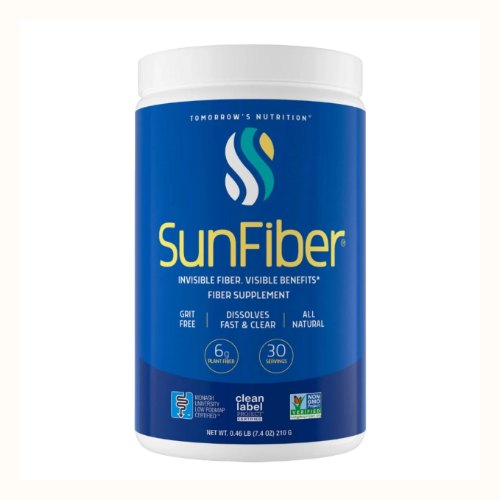
Tomorrow’s Nutrition Sunfiber PHGG Powder
Partially hydrolyzed guar gum in a tasteless powder, the low-FODMAP fiber that helps both constipation and loose stools in the trials.
- Format
- Powder, once a day
- Type
- Fiber
- Cost
- See the price on Amazon
- Customer rating
- 4.9 out of 5 from 966 ratings from tomorrowsnutrition.com
Not sure it suits your symptoms? The quiz matches one product to you in one to three minutes.
What buyers keep saying
- A tasteless powder that dissolves in any drink
- Gentle on the stomach with no bloating
- Easier, more regular bowel movements
Those are the themes that recur across the reviews. Moderate review confidence — 4.9 from 966 reviews on the brand’s own store (tomorrowsnutrition.com).
How it is meant to work
Guar gum is a thick gel; partially hydrolyzing it cuts the chains so it dissolves clear and does not thicken, while still being fermented slowly in the colon into short-chain fatty acids. That slow fermentation adds water and bacterial mass to hard stools and, by a different route, firms loose ones, which is why the trials see it help in both directions with little gas.
On the label
The only ingredient is Sunfiber, a branded partially hydrolyzed guar gum, at 6 g of soluble fiber per serving. Monash University low-FODMAP certification is stated. No third-party testing certificate is published beyond the ingredient supplier’s. The catalog also lists the same ingredient from California Gold Nutrition at a lower price.
The evidence, such as it is
Ingredient-level evidence, and reasonably good. A randomized trial in 188 people with IBS found partially hydrolyzed guar gum improved symptoms at least as well as wheat bran with far better tolerance. Trials in constipation and in diarrhea-predominant bowels both show normalization of stool form, which is unusual for a fiber. Sunfiber is the branded PHGG used in several of these studies and is certified low FODMAP by Monash University. No trial of this Tomorrow’s Nutrition packaging specifically was found.
Who it fits
In the quiz it comes up for people who describe constipation, irregular bowel habits, bloating, loose stools and alternating constipation and loose stools. The goal it serves is regularity or a steady daily routine. That is the symptom side. The quiz also asks what has already failed for you, which format you will take and what has to be excluded before it names Sunfiber PHGG Powder.
When something else fits better
On diet, the label backs vegan, gluten-free, dairy-free, no added sweeteners and minimal ingredient list. Keeping to a powder once a day, every day is part of whether Sunfiber PHGG Powder works for anyone.
Side effects, and who should check first
It is more expensive per serving than plain psyllium or the same ingredient from other brands. The effect builds over weeks rather than days. It has no cholesterol effect, because it does not gel the way psyllium does.
Check it against your own symptoms
If you are weighing Sunfiber PHGG Powder against alternatives, the quiz does that weighing for your symptoms and shows the ledger.
Take the quiz →Three minutes, no account.
Others we researched for the same job
Stool form and regularity: that is the job Tomorrow’s Nutrition Sunfiber PHGG Powder does, and these are the other entries doing it.
See all the products we have researched →
Head-to-head comparisons
Side-by-side reads that put Tomorrow’s Nutrition Sunfiber PHGG Powder or a close stand-in against the product people most often weigh it against.
Related reading
Longer reads on the mechanism and the evidence for products like this one.