
Guide
Probiotic or fiber: which one do you need?
Quick answer
Do I need a probiotic or a fiber? Pick by symptom. Hard, infrequent or incomplete stools: fiber, and specifically psyllium, which had the clearest effect across 16 randomized fiber trials. Loose stools during antibiotics: a probiotic, L. rhamnosus GG or S. boulardii. Loose stools with IBS: either can help, and psyllium at 10 g a day has the larger trial. Bloating: neither is the first choice, and fermentable fiber can make it worse. Reflux: neither.
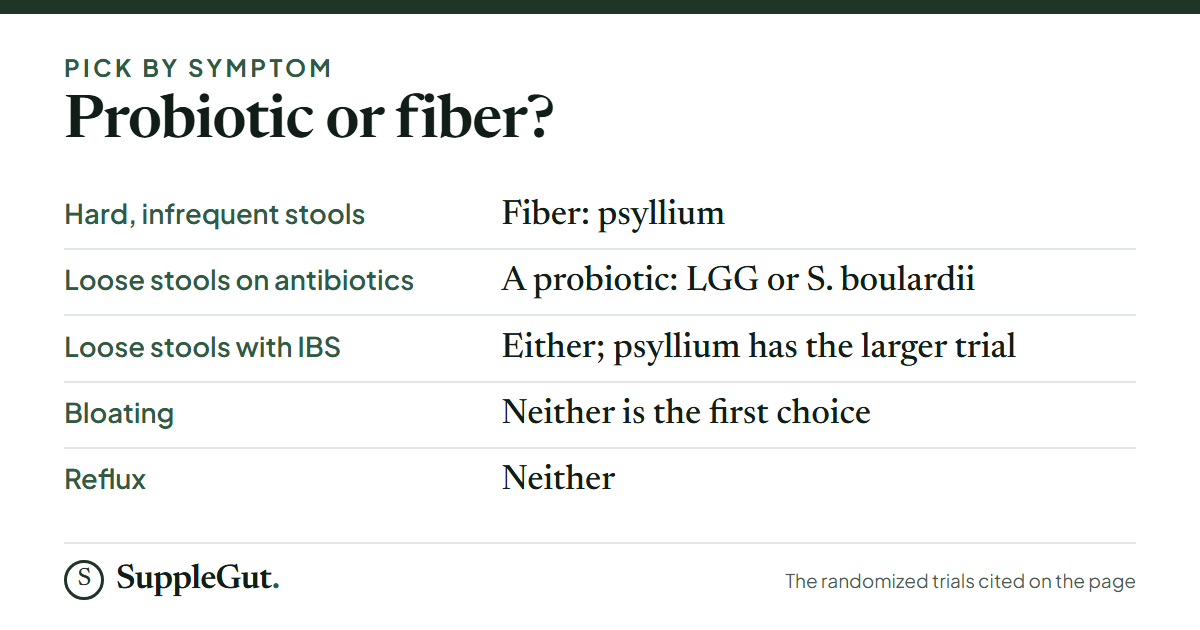
Fiber and probiotics sit on the same shelf and get bought for the same complaints, but they do different jobs. Fiber is a bulk that holds water and changes what your stool is made of. A probiotic is a live organism that has to reach the colon and do something there, and only a handful of strains have been shown to. Which one you need follows from the symptom, so this page goes symptom by symptom.
What each one actually does
Fiber in supplement form means psyllium, methylcellulose, wheat dextrin, inulin or partially hydrolyzed guar gum, and they behave differently. Psyllium is a gel-forming fiber that holds water all the way through the colon, which is why it softens and bulks stool and why it is the one fiber with a guideline recommendation for constipation. Wheat dextrin and inulin are non-viscous and fermented, which means gas and no laxative effect. The Metamucil vs Benefiber comparison is that distinction in two tubs.
A probiotic is a named strain of bacteria or yeast at a stated dose. The evidence is strain-specific: L. rhamnosus GG has trials in antibiotic diarrhea, B. longum 35624 in IBS, and neither result transfers to the other strain or to the other problem. The which-probiotic guide matches strains to problems.
Constipation: fiber first
A meta-analysis of 16 randomized trials in 1,251 adults with chronic constipation found fiber produced a response in 66% against 41% on control, with the effect significant for psyllium and pectin and concentrated above 10 g a day for four weeks or more (van der Schoot et al., 2022). The 2023 AGA/ACG guideline gives fiber a conditional recommendation and polyethylene glycol a strong one (Chang et al., 2023). Probiotics do not appear in that guideline’s recommendations at all. So the order is psyllium at a real dose for a month, then a conversation about PEG, and a probiotic only if there is a separate reason for one. The constipation guide grades everything else.
Loose stools: it depends on why
- During or after antibiotics: a probiotic. L. rhamnosus GG cut antibiotic-associated diarrhea from 22.4% to 12.3% across 12 trials in 1,499 people (Szajewska and Kołodziej, 2015); S. boulardii has 21 trials in 4,780 people and survives the antibiotic (McFarland, 2010). Fiber has no trial here.
- Diarrhea-predominant IBS: either. The largest probiotic trial is the Bio-Kult formula in 400 adults over 16 weeks (Ishaque et al., 2018). Psyllium at 10 g a day gave 57% of 275 primary-care IBS patients adequate relief in the first month against 35% on placebo, whatever their bowel habit, while bran made people worse (Bijkerk et al., 2009). Psyllium’s gel absorbs water in either direction, which is why it firms loose stool as well as softening hard stool.
- Loose stools after a stomach bug, or with a food trigger: the loose-stools guide covers glutamine and the enzymes.
Bloating and gas: neither, usually
Fermentable fiber feeds gas; the constipation meta-analysis above measured flatulence going up meaningfully on fiber. So inulin, wheat dextrin and even psyllium can make bloating worse before anything gets better, and a probiotic is only a candidate if its strain has a bloating trial: B. longum 35624 in 362 women (Whorwell et al., 2006) and Seed DS-01 in 350 adults (Allegretti et al.). The category with the most bloating trials is neither: enteric-coated peppermint oil, nine randomized trials in 726 people (Khanna et al., 2014). The one fiber with a bloating result is partially hydrolyzed guar gum, which is non-viscous and had less bloating and gas at 6 g a day over 12 weeks in 108 people with IBS, with no benefit for pain or stool frequency. The bloating guide starts from the cause.
Reflux: neither
Neither fiber nor probiotics has a reflux trial worth the name. Alginate does: across 14 randomized trials in 2,095 patients it beat placebo and antacids with an odds ratio of 4.42, though not a PPI (Leiman et al., 2017). The reflux guide grades the rest.
Can you take both?
Yes, and nothing in the trials suggests a conflict, but no trial tested the pair either. Start one at a time, a month apart, or you will not know which one helped. Psyllium needs a full glass of liquid with each dose and two hours between it and other medicines; a probiotic taken with antibiotics should be the yeast, or the bacterium taken a few hours from the antibiotic dose.
Which one for you?
The quiz asks the symptom, the pattern, what you take and what you have tried, and names the one product with the strongest case for that picture. One to three minutes, no sign-up.
Take the quiz →The products in this catalog
Common questions
Is fiber or a probiotic better for constipation?
Fiber, and specifically psyllium. A meta-analysis of 16 randomized trials in 1,251 adults found a response in 66% against 41% on control, with the effect belonging to psyllium and pectin at more than 10 g a day for four weeks or more. The 2023 gastroenterology guideline recommends fiber and polyethylene glycol and makes no recommendation for probiotics.
Is fiber or a probiotic better for diarrhea?
It depends on the cause. Diarrhea during antibiotics has probiotic evidence: L. rhamnosus GG across 12 trials in 1,499 people and S. boulardii across 21 trials in 4,780. Loose stools with IBS have evidence for both: the Bio-Kult formula in 400 adults, and psyllium at 10 g a day in 275 primary-care IBS patients, where 57% had adequate relief in the first month against 35% on placebo.
Does fiber help bloating?
Usually the opposite. Fermentable fibers such as inulin and wheat dextrin make gas, and the constipation meta-analysis measured flatulence rising meaningfully on fiber. The one fiber with a bloating result is partially hydrolyzed guar gum, which reduced bloating and gas at 6 g a day over 12 weeks in 108 people with IBS.
Can I take a probiotic and psyllium together?
Yes; no trial suggests a conflict, and no trial tested the pair. Start one at a time, a month apart, so you know which one helped. Psyllium needs a full glass of liquid per dose and two hours away from other medicines.
Which fiber supplement is best?
Psyllium for regularity or cholesterol, because it is the only supplement fiber with meta-analysis and guideline evidence and an FDA-authorized cholesterol claim. Plain psyllium husk gives 7 g of fiber in a serving with one ingredient; Metamucil is the same fiber flavored and sweetened at 3.4 g a teaspoon. Wheat dextrin (Benefiber) and methylcellulose (Citrucel) have no placebo-controlled constipation trial.
Do probiotics help with constipation?
Not on the current evidence. The 2023 AGA/ACG guideline on chronic constipation makes no recommendation for probiotics, and none of the strains with strong trials (LGG, S. boulardii, B. longum 35624) was tested for constipation. Psyllium is the supplement with the trials.
Sources
- van der Schoot A, et al. "The Effect of Fiber Supplementation on Chronic Constipation in Adults: An Updated Systematic Review and Meta-Analysis of Randomized Controlled Trials." American Journal of Clinical Nutrition, 2022. pmc.ncbi.nlm.nih.gov/articles/PMC9535527
- Chang L, et al. "AGA-ACG Clinical Practice Guideline: Pharmacological Management of Chronic Idiopathic Constipation." Gastroenterology, 2023. pubmed.ncbi.nlm.nih.gov/37211380
- Bijkerk CJ, et al. "Soluble or insoluble fibre in irritable bowel syndrome in primary care? Randomised placebo controlled trial." BMJ, 2009. pubmed.ncbi.nlm.nih.gov/19713235
- Szajewska H, Kołodziej M. "Systematic review with meta-analysis: Lactobacillus rhamnosus GG in the prevention of antibiotic-associated diarrhoea in children and adults." 2015. pubmed.ncbi.nlm.nih.gov/26365389
- McFarland LV. "Systematic review and meta-analysis of Saccharomyces boulardii in adult patients." 2010. pubmed.ncbi.nlm.nih.gov/20458757
- Ishaque SM, et al. "A randomized placebo-controlled clinical trial of a multi-strain probiotic formulation (Bio-Kult) in the management of diarrhea-predominant irritable bowel syndrome." 2018. pubmed.ncbi.nlm.nih.gov/29801486
- Whorwell PJ, et al. "Efficacy of an encapsulated probiotic Bifidobacterium infantis 35624 in women with irritable bowel syndrome." 2006. pubmed.ncbi.nlm.nih.gov/16863564
- Allegretti JR, et al. "A Randomized, Placebo-Controlled Trial Evaluating Multi-Species Synbiotic Supplementation for Bloating, Gas, and Abdominal Discomfort." pmc.ncbi.nlm.nih.gov/articles/PMC12845427
- Khanna R, MacDonald JK, Levesque BG. "Peppermint oil for the treatment of irritable bowel syndrome: a systematic review and meta-analysis." Journal of Clinical Gastroenterology, 2014. pubmed.ncbi.nlm.nih.gov/24100754
- Sunfiber partially hydrolyzed guar gum: the 12-week trial in 108 IBS patients at 6 g a day, as cited on the ingredient’s listing. iherb.com
- Leiman DA, et al. "Alginate therapy is effective treatment for GERD symptoms: a systematic review and meta-analysis." Diseases of the Esophagus, 2017. pmc.ncbi.nlm.nih.gov/articles/PMC6036656
- McRorie JW. "Evidence-Based Approach to Fiber Supplements and Clinically Meaningful Health Benefits, Part 2." Nutrition Today, 2015. pmc.ncbi.nlm.nih.gov/articles/PMC4415970
Not sure which product fits your situation?
This guide covers the mechanics. The quiz takes your specific symptoms, routine and preferences and matches you to one product from the catalog.
Take the quiz →