
Guide
Do Black Girl Vitamins fiber gummies work? Five grams of fiber, two ingredient lists and the trial doses
Quick answer
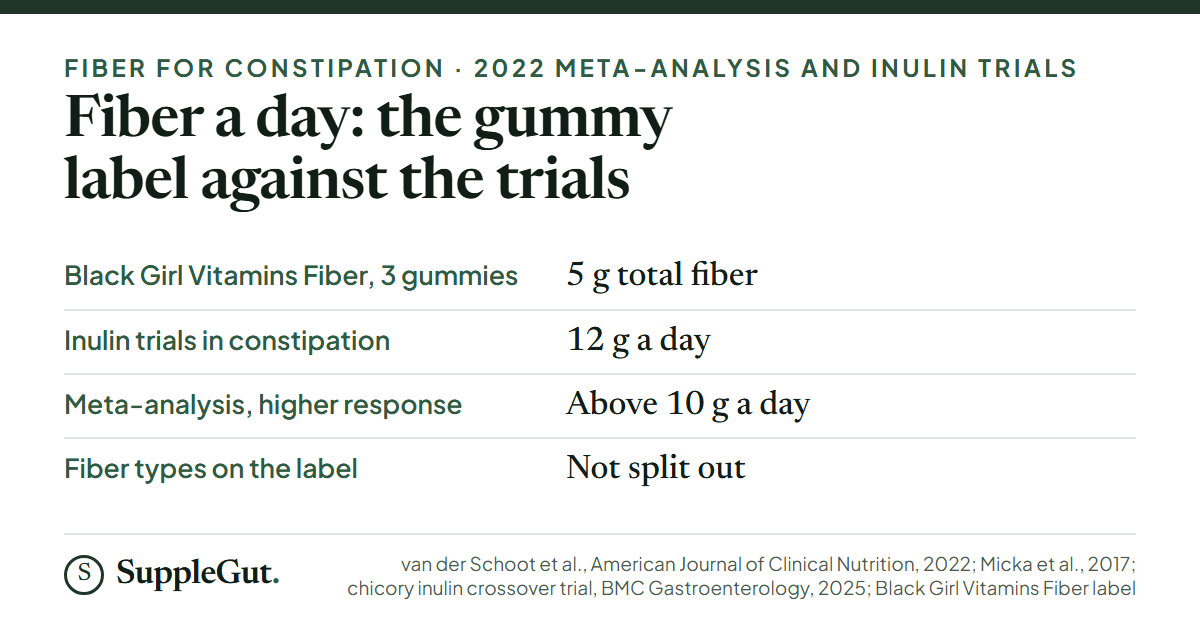
Do Black Girl Vitamins fiber gummies work? No trial of the gummies has been published. A serving of three prints 5 g of fiber with no split by type, while the 2022 constipation meta-analysis tied the clearer response to more than 10 g a day and the inulin trials used 12 g. Amazon reviewers (4.7 from 381 ratings) mostly praise taste and regularity, a minority report no change, and the brand and Amazon print different ingredient lists.
Black Girl Vitamins Fiber is a once-a-day fiber gummy: three orange and mixed berry gummies, vegan by the brand’s statement, sold on the brand site, Amazon and Walmart, and marketed for digestion, regularity and bloat relief. What sets it apart from the fiber on the next shelf is that its label prints a single fiber total, 5 g, and two different ingredient lists circulate for it. This page sets out what the panel prints, where the two lists differ, what the trials say about fiber doses, and what the reviews and terms show.
What Black Girl Vitamins Fiber is, and what it is not
The Supplement Facts panel gives a serving of three gummies, which is a 30-day supply in a 90-gummy bottle. Per serving it prints 25 calories, 9 g of total carbohydrate, 5 g of dietary fiber (18% of the daily value), 3 g of total sugars, all 3 g of them added sugar (6% of the daily value), and 15 mg of sodium. No named active ingredient has a line of its own, and the panel does not split the 5 g by fiber type or amount. Of the 9 g of carbohydrate, 5 g is fiber.
It carries a Supplement Facts panel, not a Drug Facts panel, so it is sold as a dietary supplement rather than an over-the-counter fiber laxative. The brand describes it as vegan, gluten-free, halal and non-GMO, with no artificial dyes, sweeteners or sugar alcohols. The named sweetener is cane sugar. The allergen line is a may-process statement for a facility that also handles milk, soy, wheat, egg, peanuts, tree nuts, fish and shellfish; it is neither a contains nor a free-from statement, and sesame is not on it. No testing laboratory is named for the gummy. The brand states an FDA-registered facility and US manufacture.
Two ingredient lists that do not match
The Amazon listing prints: chicory root fiber, sugar, water, pectin, citric acid, natural flavors, sodium citrate, vegetable juice (for color) and turmeric (for color). The brand page describes the fiber as tapioca fiber and pectin, with chicory root fiber and tapioca fiber on one of its image panels, and mentions a coconut oil finish. The Amazon list has no tapioca fiber or coconut oil; the brand page names both. Which list is on the physical bottle is not established from what we could read, and the brand has not explained the difference. One Walmart reviewer wrote that the gummies differed from the website, and the brand replied that labels can change with the season as a formulation is adjusted.
Neither list uses the word inulin. Chicory root fiber is normally inulin or oligofructose, but that is an inference, not something the label prints. The brand does not say what its tapioca fiber is (a resistant dextrin, a soluble tapioca fiber syrup or something else), and a PubMed search for human trials of soluble tapioca fiber returned none. The brand’s own panel image also differs between its site and Amazon on servings per container, 90 on one and 30 on the other. The bottle front reads 90 gummies and a 30-day supply, which fits 30.
The trial of the product itself
There is none. We searched PubMed and ClinicalTrials.gov for the brand and the product and found no study of the gummy. The product page quotes percentages such as 88.9% improved regularity, 83.3% reduced bloating and gas, and 75% better appetite control. Its own footnote says they come from an analysis of verified customer reviews and describe the positive rate among reviewers who reported those specific concerns. They are figures from review text, not results of a trial with a comparison group. Whatever evidence the gummy has sits with its ingredient classes, and the amount of each fiber in it is not printed.
The evidence for the fiber, and the dose
The main evidence is a 2022 meta-analysis of 16 randomized trials in 1,251 adults with chronic constipation. Across all fibers, 311 of 473 people (66%) responded on fiber against 134 of 329 (41%) on control (risk ratio 1.48, 95% CI 1.17 to 1.88). Psyllium and pectin had significant effects, stool frequency improved, and flatulence was higher on fiber. The authors tied the benefit to doses above 10 g a day (van der Schoot et al., American Journal of Clinical Nutrition, 2022). A serving of these gummies is 5 g, half that range, and the pectin share of it is not stated.
For the chicory fiber, a 2014 meta-analysis pooled five randomized trials in 252 people. Inulin improved stool frequency and consistency and shortened transit time, and the review found that pain and bloating did not improve. A 2017 placebo-controlled crossover trial in 44 adults with constipation gave chicory inulin at 12 g a day, as three 4 g doses, for four weeks: median stool frequency was 4.0 a week against 3.0 on placebo (Micka et al., 2017). A 2025 crossover trial in 39 adults with functional constipation also used 12 g a day for four weeks and found larger changes in stool frequency, abdominal symptoms and quality of life than placebo; the authors noted a carry-over effect and re-analyzed the first period alone, which supported the result.
At 5 g a day, the nearest studied dose is a gut-bacteria trial, not a constipation trial. In 30 healthy adults, inulin at 5 g and at 8 g a day each raised bifidobacteria over placebo across two weeks, with no difference between the doses (Bouhnik et al., 2007). That matches the gummy’s total only if all 5 g were inulin, which the label does not say. A 2021 systematic review of 41 over-the-counter trials of at least four weeks found moderate evidence for psyllium and SupraFiber and insufficient evidence for polydextrose, inulin and FOS.
Set against those figures, a serving prints 5 g of total fiber from a source that is either chicory root fiber and pectin or tapioca fiber and pectin, depending on the list. The trials do not test 5 g for constipation, and none tested this formula, so they neither show that the gummies work nor that they do not. Reaching the 10 to 12 g a day used in the trials would take two to three servings, which is not the label direction.
Gas and bloating
Fermentable fibers such as chicory inulin produce gas. In a tolerance trial of chicory inulin at 5 and 10 g in 26 healthy adults, the most frequent symptoms were flatulence followed by bloating, and doses up to 10 g a day of native inulin were described as well tolerated (Grabitske and Slavin, 2010). The constipation meta-analysis likewise found more flatulence on fiber. The brand markets the gummy for bloat relief; the inulin meta-analysis above did not find bloating to improve, and the brand’s 83.3% figure is the review-text count described earlier. Reviewers split on this: some report no cramping and no gas, others report feeling constipated or bloated.
Fiber and GLP-1 medicines
The brand’s advertising mentions GLP-1 medicines, and reviewers on the brand page mention taking the gummies on them. Constipation is a documented effect of these drugs: a 2025 network meta-analysis of 39 studies in 33,354 adults without diabetes found semaglutide and liraglutide associated with a higher risk of constipation. A 2026 narrative review says several human trials found fiber supplements improve bowel function and stool consistency, and that fiber could be a low-cost option during GLP-1 treatment. That is a perspective on fiber in general, not a trial of a fiber gummy. We could find no trial of this gummy, or of any fiber gummy, in people on GLP-1 medicines.
How to take Black Girl Vitamins Fiber
The directions are three gummies daily, or as directed by a healthcare professional. We found no instruction about food, water or time of day. The trials above ran for four weeks or longer, so a month is the shortest fair test, and the inulin tolerance work suggests gas is most likely in the first days on a new fiber. The label does not advise drinking water with fiber or starting with fewer gummies.
Side effects and who should check first
The label caution reads: take only as directed, do not exceed the suggested dosage, and pregnant or nursing mothers, children under 18 and people with a known medical condition should consult a physician before use. It adds that the product may settle during shipping and that the natural colors will darken over time. There is no medication statement in the product text. The recurring effects in the research and the reviews are gas and bloating, and a minority of reviewers report constipation instead of relief. Each serving also carries 3 g of added sugar, which one Walmart reviewer raised as a concern for someone with diabetes.
What the reviews say
The scores differ in how independent they are. On the brand’s own page the review widget shows 4.8 from 277 reviews, 242 of them five-star; it is self-hosted, includes some reviews of other products, and some reviewers say they received a free bottle. Amazon shows 4.7 from 381 ratings, 85% of them five-star. Walmart shows 4.8 from 705 ratings and 292 written reviews, and a number of its three-star reviews are marked as coming from the brand’s own site, so it is not fully independent. Trustpilot shows 2.3 from 70 reviews for the whole brand rather than this gummy, on an unclaimed profile; none of the first 20 reviews read was about the fiber gummy.
Amazon’s summary of review text counts 57 mentions of effectiveness, 48 positive and 9 negative, and 19 of digestibility, 12 positive and 7 negative. The recurring praise is taste and ease of taking, a daily bowel movement and less bloating, including from people on GLP-1 medicines, and no cramping. The recurring complaints are no noticeable effect or too early to tell, sweetness and the sugar content, gummies clumped together in the bottle, and a few reports of constipation. A handful mention short counts or slow delivery.
The subscription and refund terms
The brand site offers a subscription at 15% off with the option to cancel or pause. Its FAQ asks for changes or cancellations at least 7 business days before the next order date, and says the brand cannot cancel or refund an order inside that window, that tracking the subscription is the customer’s responsibility, and that a subscription ends automatically when a payment fails. Refund requests are to be made within 30 days of delivery by contacting the team. The pages do not say whether an opened bottle qualifies. A fiber reviewer on the brand page says the card was charged three to four days before shipping, and Trustpilot reviewers describe unanswered refund emails. The bottle can be bought once without a subscription on the brand site, and on Amazon or Walmart.
Who Black Girl Vitamins Fiber is for
- Someone who wants a chewable once-a-day fiber and prefers a gummy to a powder or a capsule.
- Someone comfortable with a 5 g total from an unspecified mix, who may add a second serving only after a month at the label dose.
- Someone who accepts 3 g of added sugar a day in a fiber product.
When the grams of a single fiber matter, the options that print them are different formats. NOW Foods inulin powder is a single-ingredient chicory inulin, the fiber the 12 g trials used. Amazon Basics Fiber Gummy is another chicory root fiber gummy, and gas is the most common complaint in its reviews. Metamucil Fiber Gummies contain no psyllium. For psyllium itself, see the psyllium husk vs Metamucil comparison and the ColonBroom guide, and the quiz starts from symptoms instead of a product.
Cost
On the brand site a 30-day bottle (90 gummies) is $21.19, or $0.71 a day, or $18.01 ($0.60 a day) on the 15% subscription. The two-bottle option is $34.00 ($0.57 a day) and the three-bottle option is $60.00 ($0.67 a day). Amazon and Walmart list the same 90-gummy bottle at $26.99, or $0.90 a day. The brand site banner offers free shipping on orders over $55 and on the bundles; the shipping fee for a single bottle was not stated on the page. Reaching a 10 g daily amount with these gummies would double the daily cost.
The products in this catalog
Common questions
Do Black Girl Vitamins fiber gummies work for constipation?
No trial of this product was found. Each serving gives 5 g of fiber, and in 16 trials of fiber for chronic constipation, 66% responded against 41% on control, with the better response tied to more than 10 g a day. Amazon reviewers (4.7 from 381 ratings) mostly praise taste and regularity, and a minority say they noticed no change.
What fiber is in Black Girl Vitamins fiber gummies, and why do the ingredient lists differ?
Three gummies print 5 g of dietary fiber with no breakdown by type. Amazon lists chicory root fiber and pectin, while the brand page names tapioca fiber, pectin and a coconut oil finish. Which list is on the bottle is not established, and neither list uses the word inulin.
How much sugar do the fiber gummies have?
A serving of three gummies has 3 g of total sugars, all of it added sugar (6% of the daily value), 9 g of carbohydrate and 25 calories. The named sweetener is cane sugar, and the brand states there are no artificial sweeteners or sugar alcohols. One reviewer reported a label showing 6 g, but the panel images read 3 g.
Do the fiber gummies cause gas or bloating?
Fermentable fibers like chicory inulin commonly cause flatulence and then bloating at 5 to 10 g a day, according to a tolerance trial in 26 adults. Some reviewers report no cramping, while a few report constipation or an unsettled stomach. The label advises pregnant or nursing women, people under 18 and people with a medical condition to consult a physician first.
Can fiber gummies help constipation on a GLP-1 medicine?
No trial of this gummy, or of any fiber gummy, in people on GLP-1 medicines was found. Constipation is a documented effect of semaglutide and liraglutide, and a 2026 review calls fiber supplements a possible low-cost option without testing a product. Reviewers on the brand page mention taking the gummies on GLP-1 medicines and staying regular.
How much do Black Girl Vitamins fiber gummies cost?
A 30-day bottle of 90 gummies is $21.19 on the brand site ($0.71 a day), or $18.01 ($0.60 a day) with the 15% subscription. The two and three bottle options are $34.00 and $60.00. Amazon and Walmart list the single bottle at $26.99, or $0.90 a day.
Can you cancel the Black Girl Vitamins subscription and get a refund?
The brand FAQ asks for changes or cancellations at least 7 business days before the next order date and says it cannot cancel or refund an order inside that window. Refund requests are to be made within 30 days of delivery. The single bottle can also be bought once, without a subscription, on the brand site, Amazon and Walmart.
Sources
- van der Schoot A, Drysdale C, Whelan K, Dimidi E. "The Effect of Fiber Supplementation on Chronic Constipation in Adults: An Updated Systematic Review and Meta-Analysis of Randomized Controlled Trials." American Journal of Clinical Nutrition, 2022;116(4):953–969. PMID 35816465. doi.org/10.1093/ajcn/nqac184
- Inulin and chronic constipation: meta-analysis of five randomized controlled trials (252 subjects). Nutrición Hospitalaria, 2014. PMID 25208775. pubmed.ncbi.nlm.nih.gov/25208775
- Micka A, et al. Chicory inulin 12 g a day in adults with constipation, randomized double-blind placebo-controlled crossover trial (NCT02548247). International Journal of Food Sciences and Nutrition, 2017. PMID 27492975. pubmed.ncbi.nlm.nih.gov/27492975
- Chicory inulin 12 g a day in functional constipation, randomized crossover trial in 39 adults (NCT05447481). BMC Gastroenterology, 2025. PMID 41233756. pubmed.ncbi.nlm.nih.gov/41233756
- Bouhnik Y, et al. Inulin at 5 g and 8 g a day and fecal bifidobacteria in healthy adults. European Journal of Clinical Nutrition, 2007. PMID 17268410. pubmed.ncbi.nlm.nih.gov/17268410
- Grabitske HA, Slavin JL. Gastrointestinal tolerance of chicory inulin products. Journal of the American Dietetic Association, 2010. PMID 20497775. pubmed.ncbi.nlm.nih.gov/20497775
- Systematic review of over-the-counter therapies for chronic constipation (41 randomized trials). American Journal of Gastroenterology, 2021. PMID 33767108. pubmed.ncbi.nlm.nih.gov/33767108
- Ismaiel A, et al. Network meta-analysis of gastrointestinal adverse events with GLP-1 receptor agonists in adults without diabetes. International Journal of Obesity, 2025. PMID 40804463. pubmed.ncbi.nlm.nih.gov/40804463. Fiber supplementation during and after GLP-1 receptor agonist treatment (perspective). Journal of Nutrition, 2026. PMID 41730476. pubmed.ncbi.nlm.nih.gov/41730476
- Black Girl Vitamins Fiber: label, directions, price, subscription terms and reviews. brand page, FAQ; Amazon listing for the ingredient list; Walmart listing; Trustpilot profile
Not sure which product fits your situation?
This guide covers the mechanics. The quiz takes your specific symptoms, routine and preferences and matches you to one product from the catalog.
Take the quiz →