
Comparison
Psyllium husk vs Metamucil: the same fiber, so which is better?
Metamucil is psyllium husk — it says so on the front of the canister. So whether you searched for psyllium husk vs Metamucil or Metamucil vs psyllium husk, this is not a comparison of two fibers. It is a question of what the brand name adds, what it costs, and how many servings each one takes to reach a dose that has been shown to do something.
Quick answer
Is Metamucil the same as psyllium husk? Yes. Its active ingredient is psyllium husk, so the evidence, the mechanism and the cautions are the same for both.
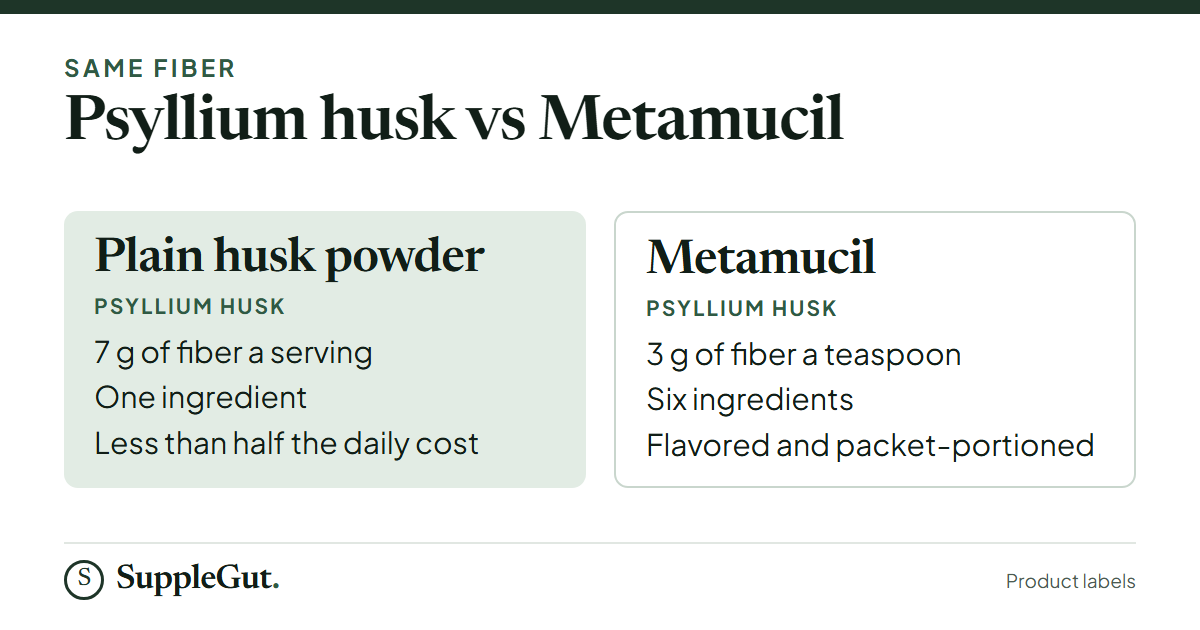
Which is better? Plain psyllium husk powder for most people: 7 g of fiber a serving against 3 g a teaspoon, one ingredient instead of six, and less than half the daily cost. Metamucil wins on compliance — orange, sweetened, packet-portioned and on every pharmacy shelf — which matters if unflavored psyllium is something you will stop drinking.
The short answer
Plain psyllium husk powder
$0.31 a day · 4.7★ from 23,144 ratings at iHerb
One ingredient. 7 g of fiber in a serving against Metamucil’s 3 g per teaspoon, at less than half the daily cost. No aspartame, no Yellow 6, no orange flavoring, and no phenylalanine warning to read.
- You will tolerate an unflavored drink
- You want a real dose in one serving rather than three
- You want the shortest ingredient list available
- You are watching the cost of something taken daily for years
Metamucil 4-in-1 Fiber Powder, Sugar-Free Orange
$0.22–0.25 a dose · 4.6★ from 7,984 ratings at Walmart Business
The compliance-friendly version. Orange, sugar-free, sold in single-serve packets, stocked in every pharmacy in the country, and it prints the FDA-authorized cholesterol claim on the pack. A fiber you drink beats a cheaper one in the cupboard.
- You know from experience you will not drink unflavored psyllium
- You want packets for travel or for work
- You want to buy it tonight, in person
Not sure which of the two fits you? The quiz asks about your symptoms before it names one.
The caveat. Same active ingredient means the same job, the same time-to-effect and the same cautions. Neither is gentler than the other. Both need a full glass of liquid, both carry a choking risk if taken dry, and both need to be taken at least two hours away from other medicines.
Side by side
✓ marks the product with the advantage on that row. Rows with no mark are a genuine tie or a matter of preference.
Where they differ
1. Same fiber, so the evidence is identical
Every study worth citing here is about psyllium the ingredient, not about a brand. A meta-analysis of 16 randomized trials in 1,251 people with chronic constipation found responders at 66% against 41% on control, with psyllium one of only two fibers reaching significance. The American College of Gastroenterology identified psyllium as the only fiber supplement with sufficient evidence to recommend. For cholesterol, 28 trials in 1,924 people at a median dose of about 10.2 g a day found LDL down 0.33 mmol/L, with apolipoprotein B down on high-quality evidence.
None of that literature is a Metamucil study. It applies equally to the tub with one ingredient in it.
2. Dose is where the two diverge
Metamucil’s own pack states that one serving supplies 2.4 g of the soluble psyllium fiber, and the FDA-authorized claim it prints requires 7 g a day of soluble fiber from psyllium. That is about three servings. The constipation meta-analysis found the effect appeared above roughly 10 g a day of fiber for four weeks or more. So the label’s “up to three times a day” is not upselling, it is what the evidence requires.
The soluble split, from the label. NOW’s supplement facts give the 9 g serving as 7 g of fiber: 6 g soluble, 1 g insoluble, and the label itself says a serving supplies 6 of the 7 g of soluble fiber a day behind the cholesterol claim. So one level tablespoon of plain husk is a fraction short of the FDA threshold, where Metamucil needs three teaspoons to reach it.
3. What the extra ingredients are doing
Maltodextrin gives the powder bulk and flow. Citric acid, orange flavor and Yellow 6 make it drinkable and orange. Aspartame sweetens it without sugar. None of that is dangerous and all of it is optional. What it costs you: a phenylketonurics warning, an artificial color, and a gluten-free status that is not stated on the canister at all — only on some single-serve packet listings, and there with a “may contain trace amounts under 20 ppm” qualifier.
4. The money, over a realistic timeframe
Plain psyllium at $0.31 for one serving is about $113 a year. Metamucil at regularity dosing is about $241–274. Nobody takes a fiber supplement for a week; the meta-analysis says four weeks minimum before you judge it, and most people who benefit take it for years. That is where the gap compounds.
5. Where Metamucil wins
Compliance, and it is not a small thing. The most common failure mode for psyllium is not that it did not work — it is that the tub is still three-quarters full in March. Flavored, sweetened, packet-portioned psyllium gets taken. If you have already tried the unflavored version and quietly given up on it, paying the premium is the correct decision.
Switching from Metamucil to plain psyllium husk: how much to take
Metamucil’s drug label puts about 3.4 g of psyllium husk in one teaspoon or packet. A level tablespoon of plain husk powder is 9 g, so it carries roughly two and a half Metamucil doses of psyllium. To match a single Metamucil teaspoon, start with one level teaspoon of plain powder (about 3 g) in a full glass of water, and step up toward the tablespoon over one to two weeks if you were taking Metamucil two or three times a day. The gas that comes with any jump in fiber is the reason to step rather than swap outright.
Store-brand psyllium vs Metamucil
The pharmacy-shelf generics are Metamucil’s formula, not plain husk. Walmart’s Equate Sugar-Free Fiber Therapy declares 3.5 g of psyllium husk per 5.8 g teaspoon on its drug label, with the same maltodextrin, citric acid, aspartame and Yellow 6, and 21 mg of phenylalanine a dose against Metamucil’s 25 mg. The label also carries the standard line that it is not made or distributed by Procter & Gamble. Walmart lists the 180-dose tub at $15.16, about 8 cents a dose, where Metamucil runs 22 to 25 cents; three doses a day is roughly $0.25 against $0.66 to $0.75. On dose and ingredients a store brand is Metamucil; on price it sits between Metamucil and the plain powder.
Side effects: the same for both
Because the fiber is identical, so are the side effects. The constipation meta-analysis measured a clear rise in flatulence on fiber against control, which is why every label starts at one dose a day. Both drug labels carry the same two warnings: taking psyllium without enough fluid can make it swell and block the throat or esophagus, and psyllium can cause allergic reactions in people sensitive to inhaled or ingested psyllium. Metamucil and the store brands add a phenylketonurics warning for the aspartame; plain husk does not need one.
Where they are the same
- The same active fiber, so the same mechanism. Both gel, both resist fermentation, both work by holding water in the stool.
- Both need a full glass of liquid. Psyllium taken without enough fluid can swell and block the throat. Neither product is safe to take dry, and neither should be taken by anyone with difficulty swallowing.
- Both need to be spaced from medicines — at least two hours before or after.
- Both cause some gas and bloating while you adjust. Start at one serving a day and build up.
- Both take weeks. Four is the number the trial evidence uses.
- Neither publishes a third-party testing certificate.
If you want Metamucil’s psyllium without the powder
Metamucil also sells its psyllium as a capsule, which sidesteps the taste and the mixing but costs more per gram of fiber and needs several capsules to reach a powder-sized dose.
Read the full research
Common questions
Is Metamucil the same as psyllium husk?
Yes. Metamucil’s active ingredient is psyllium husk, and its over-the-counter drug label declares approximately 3.4 g of psyllium per packet or teaspoon. What differs from a plain psyllium powder is the dose per serving (2.4 g of soluble psyllium fiber against 7 g of fiber in one serving of plain husk) and the other ingredients: maltodextrin, citric acid, orange flavor, aspartame and Yellow 6.
Which is better, psyllium husk or Metamucil?
For most people, plain psyllium husk powder: more than twice the fiber per serving, one ingredient, and about $113 a year against $241–274 for Metamucil at regularity dosing. Metamucil is the better choice if an orange, sweetened, single-serve product is what will keep you taking it every day, because a fiber you actually drink beats a cheaper one that sits in the cupboard.
Is pure psyllium husk better than Metamucil?
On dose, ingredient list and cost, yes. On evidence, they are identical, because every trial worth citing studied psyllium the ingredient rather than a brand. Neither is gentler than the other, and both carry the same full-glass-of-water warning.
How much psyllium is in Metamucil?
Metamucil’s OTC label states approximately 3.4 g of psyllium husk per single-serve packet or rounded teaspoon, of which the pack states 2.4 g is soluble psyllium fiber. Reaching the 7 g a day behind the FDA cholesterol claim takes three teaspoons.
Is NOW psyllium husk the same as Metamucil?
Same active fiber. NOW’s tub is psyllium husk powder and nothing else, at 7 g of fiber per serving; Metamucil is psyllium husk plus maltodextrin, flavoring, aspartame and Yellow 6 at 3 g of total fiber per teaspoon.
Psyllium husk powder or Metamucil capsules?
The capsules sidestep the taste and the mixing but cost more per gram of fiber and need several capsules to reach a powder-sized dose. If you can tolerate a drink, the powder is the cheaper way to a full dose.
How much psyllium husk equals a teaspoon of Metamucil?
About one level teaspoon of plain psyllium husk powder, roughly 3 g. Metamucil’s label declares approximately 3.4 g of psyllium husk per teaspoon or packet, and a level tablespoon of plain powder is 9 g, so the tablespoon serving is close to two and a half Metamucil doses.
Is Equate fiber the same as Metamucil?
In everything but the name. Equate Sugar-Free Fiber Therapy declares 3.5 g of psyllium husk per teaspoon with the same inactive ingredients (maltodextrin, citric acid, aspartame, Yellow 6), against Metamucil’s approximately 3.4 g. At Walmart’s $15.16 for 180 doses it costs about a third as much per dose.
Does psyllium husk have the same side effects as Metamucil?
Yes. The fiber is the same, so the gas and bloating in the first weeks, the choking warning if taken with too little fluid, and the psyllium allergy warning apply to both. Only Metamucil and the store brands carry the phenylketonurics warning, because of the aspartame.
What’s better, Metamucil or psyllium husk powder?
For most people, plain psyllium husk powder: 7 g of fiber in a serving against about 3 g per teaspoon of Metamucil, one ingredient instead of six, and less than half the daily cost. Metamucil is better if flavor and packets are what keep you taking it, because a fiber you drink beats a cheaper one in the cupboard.
In one line: Plain psyllium husk powder — best value by a wide margin.
Which fiber for constipation, on one page
Which fibers have the trials, the dose that worked, and how to take it without the gas. Sent by email, then two short follow-ups over ten days. Unsubscribe any time.
Your address is used for these three emails and nothing else. How we handle it.
Speak to a doctor first if you are pregnant, breastfeeding, trying to conceive, immune-suppressed, or taking prescription medication — and before starting anything if you have blood in your stool, unexplained weight loss, persistent vomiting, or pain severe enough to wake you at night. Those are signs to get looked at, not to try a supplement.
Is fiber even the right category for you?
Psyllium is excellent for hard or infrequent stools and does very little for some of the other things people buy it for. Our quiz asks what you are experiencing before it recommends anything.
Find your match →Free · Private · No sign-up · 1–3 minutes
Related guides
Other comparisons
Where these numbers come from
- NOW psyllium husk powder, ingredients, fiber per serving, 4.7 from 23,144 — www.iherb.com/pr/now-foods-psyllium-husk-powder-12-oz-340-g/89
- Metamucil supplement facts, other ingredients, per-dose price, cholesterol claim wording — www.heb.com/product-detail/metamucil-4-in-1-psyllium-husk-fibe
- Metamucil dosing and warnings (official) — www.metamucil.com/en-us/products/fiber-powders/sugar-free-oran
- Metamucil OTC drug label; 3.4 g psyllium per packet; phenylalanine — dailymed.nlm.nih.gov/dailymed/drugInfo.cfm?setid=a9824f73-5ea2
- Metamucil rating, 4.6 from 7,984 — business.walmart.com/ip/Metamucil-Fiber-Supplement-Sugar-Free-
- Constipation meta-analysis, 16 trials, 1,251 people — pubmed.ncbi.nlm.nih.gov/35816465
- Psyllium LDL meta-analysis, 28 trials, 1,924 people — pubmed.ncbi.nlm.nih.gov/30239559
- ACG: psyllium the only fiber supplement with sufficient evidence — pmc.ncbi.nlm.nih.gov/articles/PMC4415970
- FDA authorized health claim, 7 g/day soluble psyllium, 21 CFR 101.81 — www.law.cornell.edu/cfr/text/21/101.81
- Metamucil gluten-free wording on the packets SKU — www.amazon.com/Metamucil-MultiHealth-Singles-Sugar-Free-Packet
- NOW psyllium husk powder supplement facts: 1 level tbsp (9 g), 7 g fiber, 6 g soluble, 1 g insoluble — www.nowfoods.com/products/supplements/psyllium-husk-powder
- Equate Sugar-Free Fiber Therapy drug label: 3.5 g psyllium per 5.8 g teaspoon, inactive ingredients, 21 mg phenylalanine — dailymed.nlm.nih.gov/dailymed/drugInfo.cfm?setid=286f2401-48eb
- Equate fiber powder, 180 doses, $15.16 at Walmart — www.walmart.com/ip/Equate-Sugar-Free-Daily-Fiber-Powder-Orange
Prices and star ratings are point-in-time snapshots and move around. Where a figure could not be confirmed from a manufacturer label or retailer listing, this page says so rather than estimating.