
Guide
Does ColonBroom work? What is in the scoop and what the psyllium trials say
Quick answer
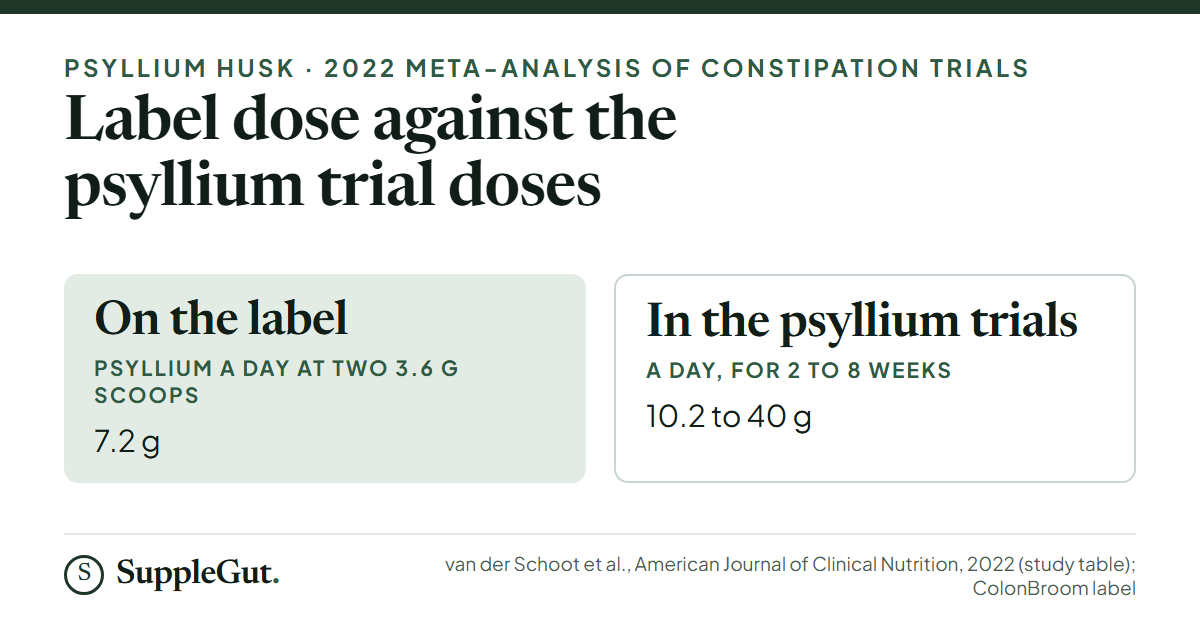
Does ColonBroom work? ColonBroom is psyllium husk powder, the fiber with the clearest effect in a 2022 meta-analysis of constipation trials (response risk ratio 1.82, about three more bowel movements a week). The open question is the dose: a scoop holds 3.6 g of psyllium, 7.2 g a day at the label’s two scoops, while the psyllium trials in that review used 10.2 to 40 g a day. No trial of ColonBroom itself has been published, and the reviews on Walmart and Amazon mostly report better regularity, with a minority reporting no effect.
ColonBroom is a strawberry-flavored psyllium husk powder stirred into a glass of water once or twice a day. The fiber is the same psyllium that sits on every pharmacy shelf; what is different is the flavoring (stevia, with no artificial color) and the way the brand site sells it, mainly as a recurring subscription. This page sets out the label, the evidence for psyllium and the dose it was tested at, the directions, the reviews by platform, the published terms and the cost.
What ColonBroom is, and what it is not
One scoop, about 5.7 g, lists 3.6 g of psyllium husk powder, 3 g of dietary fiber (2 g of it soluble), 20 calories, 4 g of carbohydrate and 49 to 60 mg of sodium, depending on which of two label versions you receive. It is not a blend: psyllium is the one named active. The rest is natural flavor, citric acid, stevia leaf extract, fruit and vegetable juice for color and rice hulls as an anti-caking agent, with sea salt and crystallized lemon on the brand-site version. It carries a Supplement Facts panel, not a Drug Facts panel, and the brand site and the Amazon label state no third-party testing, NSF or USP mark or certificate of analysis. ColonBroom also sells a Premium blend and a GLP-1 Booster; this page covers only the plain strawberry psyllium powder.
The trial of the product itself
There is none. We searched Europe PMC and ClinicalTrials.gov for ColonBroom and found no studies. The brand’s headline figures (83% lost weight in 10 weeks, 82% fewer cravings in week one, 90% bloating relief by week two) carry its own footnote: they come from a self-reported survey conducted with ColonBroom Premium, and “no clinical trials have been conducted on other ColonBroom products at this time.” A second footnote refers to a survey of 1,475 users who reported weight loss after four weeks or more. Whatever evidence the powder has sits with psyllium.
The evidence for psyllium, and the dose
The main evidence is a 2022 meta-analysis of 16 randomized trials in 1,251 adults with chronic constipation. For fiber overall, 66% of people responded (311 of 473) against 41% on control (134 of 329), a risk ratio of 1.48. The psyllium subgroup of three trials did better: a response risk ratio of 1.82 (95% CI 1.51 to 2.20) and 3.08 more bowel movements a week (95% CI 0.61 to 5.54), though the stool-frequency results varied widely between trials. Fiber overall also improved stool consistency and increased flatulence compared with control. The authors concluded that psyllium, doses above 10 g a day and at least four weeks of treatment appear optimal. Funders listed include the Almond Board of California and the British Dietetic Association (van der Schoot et al., American Journal of Clinical Nutrition, 2022).
The doses matter here. The psyllium powder trials in the review’s study table gave 10.2 g a day for 8 weeks (22 adults), 10.8 g for 2 weeks (201), 20 g for a month (20) and 40 g for 4 weeks (54). ColonBroom’s label gives 3.6 g a scoop, so 3.6 g a day in the first week and 7.2 g a day at the two-scoop direction. That is below the lowest psyllium dose in the table and below the review’s 10 g threshold; three scoops would reach 10.8 g, and the label directs two.
None of this shows that 7.2 g does nothing. No trial in the review tested 3.6 g or 7.2 g, so the evidence for psyllium comes from larger amounts than this label supplies. For the timeline of psyllium in general, see how long psyllium takes to work.
How to take ColonBroom
The brand’s directions: one scoop a day for the first week, then two scoops a day, morning and late afternoon, each in 12 to 14 fl oz (360 to 420 ml) of water, 30 to 60 minutes before eating and not before bed, and at least 2 hours before or after any medication. The Amazon label reads up to two times a day, 30 to 60 minutes before a meal, and suggests 2 to 3 months of use. The meta-analysis authors point to at least four weeks as a minimum treatment length. Taking psyllium without enough liquid can cause choking, which is why the label stresses the water.
Side effects and who should not take it
The brand label warns that the powder may swell in the throat and cause blockage or choking without sufficient water, that the first days may bring bowel changes or “a little bloating,” and that it may cause an allergic reaction in people sensitive to psyllium or strawberries. It advises consulting a physician if you are pregnant or nursing, or have swallowing difficulties, irritable bowel syndrome, abdominal pain, nausea or vomiting; the Amazon label adds prescription-drug use and any digestive disorder. It is for adults only. The first-days bloating matches the meta-analysis, where fiber increased flatulence. In the reviews, a minority report constipation or stomach pain.
What the reviews say
Walmart shows 4.4 from 735 ratings (70% five-star, 7% one-star) on the 40-serving bottle. Amazon shows 4.3 from 247 ratings on the 30- and 150-serving listings (69% five-star, 7% one-star) and 4.3 from 54 on the 50-serving one. Trustpilot rates the brand site 4.0 from 3,872 reviews (50% five-star, 18% one-star), and the brand’s own plans page cites 12,375 reviews with no score. The recurring praise is the taste and easy mixing, more regular bowel movements within days and less morning bloating. The recurring complaints are price for a psyllium product, no effect or stomach upset in a minority, and ordering and billing on the brand site; several of the one-star Trustpilot reviews name the GLP-1 Booster rather than the powder. The Walmart and Amazon reviews we read carried no billing-complaint pattern.
The subscription and refund terms
The brand site’s plans page opens on the Subscribe tab, with One-time purchase as the second tab. Prices per bottle:
| Plan | Subscribe | One time |
|---|---|---|
| 1 bottle | $39.99, monthly | $69.99 |
| 3 bottles | $26.99, every 3 months | $54.99 |
| 6 bottles | $19.99, every 6 months | $42.99 |
The published terms say you can cancel any time. Cancelling before the first recurring charge means paying the difference between the subscription and one-time price; after the first recurring charge no difference applies. Refunds are for products proven not as described or faulty, within 14 days of delivery, unopened and with visual proof; they are issued for the initial purchase and not for recurring subscription goods, and in the US and Canada a $15 prepaid return label is deducted. Trustpilot reviewers report charges after cancelling, a fee to cancel and refused refunds, and the company replies publicly under them. Single bottles are sold on Walmart (sold and shipped by Walmart.com) and Amazon under those retailers’ return terms. One unresolved detail: the label graphic on the brand site says 60 servings a bottle, the subscription cards say 30, and the one-time cards give no count, so the per-serving figures here use 30.
Who ColonBroom is for
- Someone who wants psyllium and would rather drink a flavored, stevia-sweetened glass than an unflavored husk.
- Regularity or morning bloating as the goal, the two things the reviews most often praise.
- Someone who will mix a powder twice a day, 30 to 60 minutes before meals, with a full glass of water.
If the dose in the trials is the priority, which psyllium husk to buy sets out how much psyllium each product supplies per serving, and constipation treatments with strong evidence places psyllium among the other options. The price and sweetener comparison with Metamucil is at Metamucil vs ColonBroom.
Cost
At the label’s two servings a day and 30 servings a bottle, the brand site works out at $2.67, $1.80 and $1.33 a day on the one-, three- and six-bottle subscriptions and $4.67, $3.67 and $2.87 a day on the one-time prices. Walmart’s $34.98 for 40 servings is about $1.75 a day, Amazon’s $29.99 for 30 servings about $2.00 a day, and Amazon’s 150-serving listing at $39.99 about $0.53 a day.
The products in this catalog
Common questions
Does ColonBroom work for constipation?
ColonBroom is psyllium husk, and psyllium raised the response rate (risk ratio 1.82) and stool frequency (+3.08 bowel movements a week) in a 2022 meta-analysis. Those psyllium trials used 10.2 to 40 g a day, and the label gives 3.6 g a scoop, 7.2 g at the two-scoop direction, so the results may not carry over at the label dose. No trial of ColonBroom itself has been published.
How much psyllium is in a scoop of ColonBroom?
One scoop, about 5.7 g, lists 3.6 g of psyllium husk powder, 3 g of dietary fiber (2 g soluble) and 49 to 60 mg of sodium depending on the label version. The brand directs one scoop a day for the first week, then two a day, which is 7.2 g of psyllium.
Does ColonBroom help you lose weight?
We could find no trial of ColonBroom, and the brand’s weight figures come, by its own footnote, from a self-reported survey of a different product, ColonBroom Premium. The trial evidence for psyllium is strongest for stool frequency and consistency rather than weight.
What are the side effects of ColonBroom?
The label names choking if the powder is taken without enough water, a change in bowel movements or a little bloating in the first days, and allergy to psyllium or strawberries. It advises a doctor first if you are pregnant or nursing, or have swallowing difficulty, IBS, abdominal pain, nausea or vomiting, and taking it at least 2 hours apart from medication. A minority of reviewers report constipation or stomach pain.
How much does ColonBroom cost, and can I buy one bottle?
On the brand site a bottle is $39.99 on a monthly subscription or $69.99 one time, falling to $19.99 and $42.99 on the six-bottle plans. Walmart lists 40 servings at $34.98 and Amazon 30 servings at $29.99, about $1.75 and $2.00 a day at two scoops. Both retailers sell a single bottle with no subscription.
Can I cancel a ColonBroom subscription, and how do refunds work?
The published terms say a subscription can be cancelled any time; cancelling before the first recurring charge means paying the difference between the subscription and one-time price. Refunds are for products proven not as described or faulty, within 14 days, and not for recurring subscription goods. Trustpilot reviewers report charges after cancelling, and Walmart and Amazon sell the same powder under their own return terms.
ColonBroom vs Metamucil: what is the difference?
Both are psyllium at similar doses, 3.6 g a ColonBroom scoop against about 3.4 g in a Metamucil packet, each with 3 g of fiber a serving. They differ in sweetener, price and how they are sold; the full side-by-side is at Metamucil vs ColonBroom.
Sources
- van der Schoot A, Drysdale C, Whelan K, Dimidi E. "The Effect of Fiber Supplementation on Chronic Constipation in Adults: An Updated Systematic Review and Meta-Analysis of Randomized Controlled Trials." American Journal of Clinical Nutrition, 2022;116(4):953–969. PMID 35816465. doi.org/10.1093/ajcn/nqac184
- ColonBroom ingredients page: Supplement Facts, directions and warnings. colonbroom.com/ingredients
- ColonBroom plans page: prices, servings and delivery schedules. colonbroom.com/organic/plans/original
- ColonBroom help center: subscription cancellation policy and refund policy. cancellation, refunds
- Amazon listings: label text, price and ratings. amazon.com/dp/B0GK144S76, amazon.com/dp/B0FN9LKC87
- Walmart listing: 40 servings, price and ratings. walmart.com
- Trustpilot: colonbroom.com reviews. trustpilot.com/review/colonbroom.com
- ClinicalTrials.gov and Europe PMC searches for “ColonBroom”: no studies. clinicaltrials.gov
Not sure which product fits your situation?
This guide covers the mechanics. The quiz takes your specific symptoms, routine and preferences and matches you to one product from the catalog.
Take the quiz →