Guide
Does DelighTeas Stomach Relief and Happy Liver tea work? Five herbs, the forms they were tested in, and a pouch with no weights
Quick answer
Does DelighTeas Stomach Relief and Happy Liver tea work? We found no study of the blend. Each of its five herbs has human data, but in other forms: fennel tea at 5 g a cup in 159 women after surgery, ginger capsules in 11 people with dyspepsia, peppermint oil capsules in 1,030 people with IBS, a licorice extract in dyspepsia, and milk thistle extract and liver enzymes in fatty liver disease. The pouch prints no weight per herb, so a teaspoon cannot be set against any of those doses. Amazon shows 4.6 from 1,040 ratings.
DelighTeas Ayurvedic Stomach Relief & Happy Liver Tea is a loose-leaf, caffeine-free blend of five organic herbs: milk thistle seed, ginger root, fennel seed, peppermint leaf and licorice root. The pouch leads with two claims, stomach comfort and liver support. This page sets what is printed on the pouch beside what human trials found for each herb in the form it was tested, then covers brewing, cautions, reviews and the cost of a cup.
What the pouch lists and what it backs up
The back of the 5 oz (140 g) pouch prints the ingredients in this order: organic milk thistle seed, organic ginger root, organic fennel seed, organic peppermint leaf and organic licorice root. A Nutrition Facts panel gives 50 servings per container, a serving of 1 teaspoon (2.8 g) and zero calories. No weight is printed for any single herb. U.S. food labels list ingredients from largest to smallest by weight, which would put milk thistle first and licorice last, but the label gives no way to see how large the gaps are.
The brand, DelighTeas by A&I Nutreats of Leander, Texas, states that the blend is caffeine free, vegan, gluten free and free of sugar, preservatives and GMOs. The pouch carries the USDA Organic seal and says it is certified organic by Oregon Tilth. It also says the ingredients are lab tested to ensure they are free of pesticides, lead and other heavy metals. No laboratory is named and no certificate of analysis is linked, so the testing line is a statement from the brand rather than a result a buyer can open. The label has no “contains” line and no facility statement; the vegan and gluten-free wording is all it says about allergens. None of the herbs is a laxative: there is no senna, cascara, aloe latex or rhubarb in the list.
Has the blend itself been studied?
We found nothing. A PubMed search under the brand name and the maker’s name returned no records, and ClinicalTrials.gov lists no study under the brand name. All five herbs are plain organic botanicals rather than trademarked ingredients, so no branded-ingredient trial attaches to the product either. What exists is human data on each herb alone, in the form and at the dose its researchers chose.
The missing weights decide how far any of it applies. A teaspoon of this blend weighs 2.8 g in total, shared among five herbs. That is a hard ceiling on what any one of them contributes, and it is smaller than the 5 g of fennel fruit alone in the fennel tea trial below.
The five herbs, one at a time
| Herb (printed order) | Human data found | Form tested |
|---|---|---|
| Milk thistle seed | Liver enzymes in fatty liver disease; no gut trial found | Silymarin extract |
| Ginger root | Stomach emptying in 11 people with dyspepsia | 1.2 g in capsules |
| Fennel seed | Bowel recovery in 159 women after surgery | Tea, 5 g of fruit per cup |
| Peppermint leaf | IBS symptoms in 1,030 people across 10 trials | Peppermint oil capsules |
| Licorice root | Dyspepsia symptom scores | Extract, 75 mg twice a day |
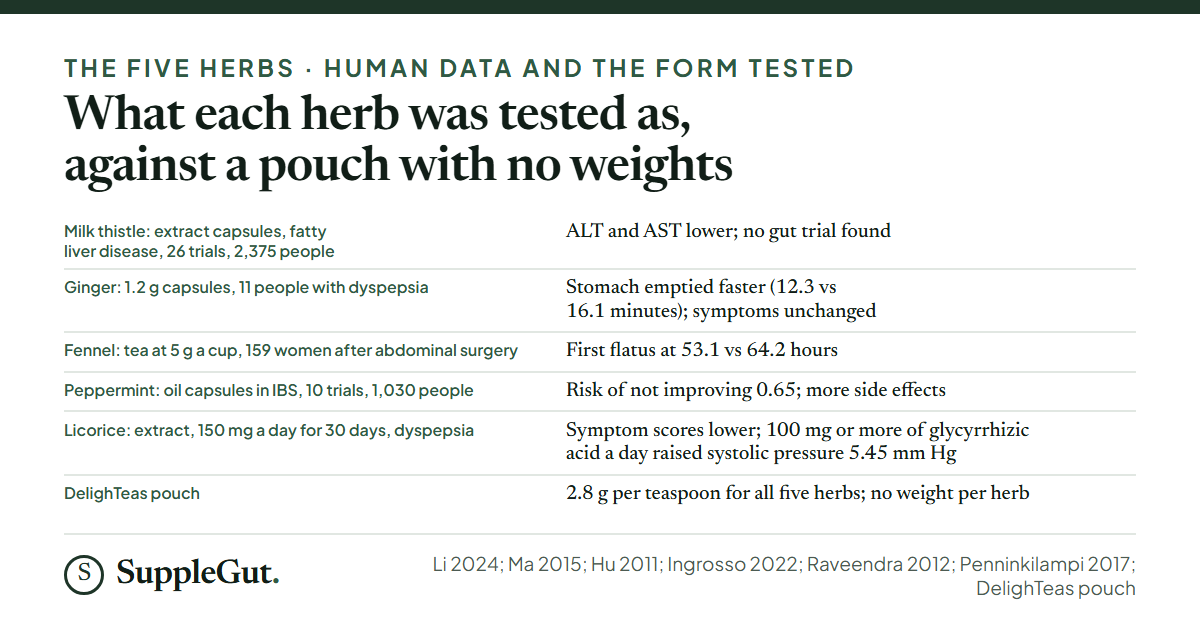
Milk thistle. A 2024 meta-analysis pooled 26 randomized trials in 2,375 people with fatty liver disease and found that silymarin, an extract of milk thistle, lowered the liver enzymes ALT and AST (Li et al., Annals of Hepatology, 2024). The trials gave the extract in capsules to people with a diagnosed liver condition. This tea steeps whole seed in hot water, so those results do not carry over to a cup. Searches for milk thistle in irritable bowel syndrome, dyspepsia, constipation or bloating turned up no relevant human trial.
Ginger. In 11 people with functional dyspepsia, a randomized, double-blind crossover trial gave 1.2 g of ginger in capsules or placebo. Half of the test meal left the stomach in 12.3 minutes after ginger against 16.1 after placebo, but gut symptoms and gut hormone levels did not differ (Hu et al., World Journal of Gastroenterology, 2011). It is a small motility result without a symptom result. The ginger tea guide sets the wider ginger trials beside a tea bag.
Fennel. This is the only herb here with a trial of an actual tea. In 159 women who had abdominal surgery for gynecologic cancer, a cup of fennel fruit tea twice a day, made from 5 g of dried fruit in 130 mL of boiled water, was compared with water. The tea group passed first flatus at 53.1 hours against 64.2, had a first bowel movement at 4.3 days against 5.4, and left hospital at 5.6 days against 6.7 (Ma et al., Sichuan Da Xue Xue Bao Yi Xue Ban, 2015). The patients were recovering from surgery, and 5 g of fennel fruit in the cup is more than the whole DelighTeas teaspoon holds.
Peppermint. A 2022 meta-analysis of 10 randomized trials in 1,030 people with irritable bowel syndrome found peppermint oil more effective than placebo for global symptoms (risk of not improving 0.65, 95% CI 0.43 to 0.98; about 4 people treated for one to benefit). Side effects were more frequent on peppermint oil, and the authors rated the quality of evidence very low (Ingrosso et al., Alimentary Pharmacology & Therapeutics, 2022). Those were oil capsules, not leaf in a cup; the peppermint tea guide covers what exists for the tea.
Licorice. A 2012 placebo-controlled trial gave a licorice extract (Glycyrrhiza glabra, sold as GutGard) at 75 mg twice a day for 30 days to people with functional dyspepsia. Total symptom scores were lower than on placebo at day 15 and day 30 (Raveendra et al., Evidence-Based Complementary and Alternative Medicine, 2012). That is a standardized extract at 150 mg a day; the root in this blend has no stated amount. The same herb has a safety finding that matters more for a daily tea, covered below.
Across the five herbs the pattern is the same: some human data, but in capsules, extracts, small samples or surgical patients, and none at an amount the pouch lets a buyer match.
How the pouch frames “detox” and the liver
The front of the pouch reads “Herbal Detox Tea” and “Happy Liver,” each with an asterisk. The brand’s product page says the blend gently stimulates the natural cleansing of the liver, and Amazon’s benefit field reads “Support Digestion, Liver Detox, Stomach Relief.” Those are the brand’s statements. The page describes milk thistle as a potent antioxidant that may help improve liver cleansing, ginger as helping with upset stomach and indigestion, fennel as supporting heartburn relief and helping with cramps and gas, peppermint as helping to relax the intestinal muscles, and licorice as possibly helping with bloating and indigestion.
Neither “detox” nor “liver cleansing” is defined on the pouch, and the asterisk leads to the standard line that the product is not intended to diagnose, treat, cure or prevent any disease. We found no trial that measured liver cleansing or liver function for this blend or for steeped milk thistle seed. The stomach statements sit on the herb-by-herb data above; the liver statement sits on silymarin extract in fatty liver disease.
Making a cup
The pouch directions are 1 teaspoon of blend in a tea infuser, 1 cup of boiled water, steeped 5 minutes. They say to drink it daily, especially before, during or after meals, and that it can be served as an iced drink. The brand’s page says to enjoy it throughout the day. The number of cups a day is not stated. A pouch yields about 50 cups at the stated serving. For comparison, the Traditional Medicinals ginger and peppermint labels call for 10 to 15 minutes of steeping, two to three times as long.
Side effects, licorice and the label’s cautions
The pouch says to consult a health care provider before use if you are pregnant, nursing, taking any medications or have a medical condition. The brand’s page repeats the pregnancy, nursing and medication wording. The label lists no other warning.
Licorice root has the most specific safety finding of the five. A meta-analysis of 18 studies (337 people) who took a product with at least 100 mg of glycyrrhizic acid a day found that systolic blood pressure rose by 5.45 mm Hg (95% CI 3.51 to 7.39), diastolic by 3.19 mm Hg, and plasma potassium fell by 0.33 mmol/L. Blood pressure rose in step with the daily dose, and the authors noted the finding matters most for people with existing cardiovascular disease (Penninkilampi et al., Journal of Human Hypertension, 2017). The pouch prints no licorice weight and no glycyrrhizin content, so whether a daily cup sits above or below 100 mg cannot be worked out from the label. The licorice here is the last herb listed, which on the label-order convention makes it the smallest part by weight.
Anyone with high blood pressure, low potassium, heart disease or a prescription that affects either has a specific reason to raise the licorice with a prescriber before drinking this daily. The label’s general medication line points the same way.
One Amazon reviewer says the tea contains peppermint, which they found good for nausea but terrible for heartburn, and the single 3-star review on Vitacost is titled “Sensitive stomach.” The peppermint tea guide sets out the reflux question for that herb.
What buyers report
Amazon shows 4.6 out of 5 from 1,040 ratings on the brand’s listing: 79% five-star, 12% four, 6% three, 1% two and 2% one. Amazon’s summary of the review text counts 121 mentions of taste (105 positive), 42 of effectiveness (38 positive), 40 of digestive effects (36 positive), 17 of ingredients (all positive) and 17 of value for money (9 positive, 8 negative). Vitacost shows 4.78 from 18 reviews on a review app the retailer hosts: 15 five-star, 2 four-star and 1 three-star. Those reviews are mostly one line, and several are not in English. The brand’s own site has no review widget, and no Trustpilot profile for it turned up.
Three themes recur in praise. The first is stomach comfort, in lines such as “it helps calm my stomach” and “great for stomach aches.” The second is drinking it after a meal. The third is the warm, spicy taste and the teaspoon per cup, which makes a pouch last. The complaints are the price, a taste some found weak or unwelcome, one reviewer who found the blend mostly fennel and could not pick out the licorice, and the peppermint and heartburn comment above. Amazon’s full review text sits behind a sign-in, so this section reads the page summary and the snippets it shows.
Cost per cup, pyramid bags and Subscribe & Save
| Route | Price | Cups | Per cup |
|---|---|---|---|
| Brand site, 5 oz loose | $16.90 | 50 | $0.34 |
| Amazon, one pouch | $16.90 | 50 | $0.34 |
| Amazon Subscribe & Save (10% off) | $15.21 | 50 | $0.30 |
| Vitacost, 5 oz loose | $16.90 | 50 | $0.34 |
The per-cup figures assume one teaspoon a cup. Because the directions give no daily count, the cost of a day depends on how many cups you drink. A second version comes in 30 pyramid bags of 4 g each. It is $19.95 on Amazon, about $0.67 a bag, and shows 4.5 from 35 ratings. It is a separate listing from the one rated above.
On the brand’s site, a return or replacement is available within 30 days of purchase, with no process described, and shipping is free over $60. The brand’s product page lists no subscription plan. Amazon lists the loose blend as non-returnable, with refunds or replacements for damaged or defective items through the order page, and Subscribe & Save can be cancelled at any time.
DelighTeas beside the Traditional Medicinals ginger and peppermint teas
Two single-herb Traditional Medicinals teas cover two of the same herbs. The comparison is mostly one of what the label prints.
| DelighTeas blend | TM Ginger | TM Peppermint | |
|---|---|---|---|
| Herbs | Five | Ginger | Peppermint |
| Printed amount | 2.8 g per teaspoon, all herbs together | 1,500 mg ginger per bag | 1,500 mg leaf per bag |
| Steep | 5 minutes | 10 to 15 minutes | 10 to 15 minutes |
| Form | Loose leaf | Tea bag | Tea bag |
A Traditional Medicinals ginger bag holds 1,500 mg of ginger alone. For ginger to match that in one DelighTeas teaspoon, it would have to make up more than half of the 2.8 g, and the label does not say. The Traditional Medicinals peppermint bag is likewise labeled by leaf weight with no menthol figure. Neither single-herb tea has a trial of the tea itself behind it, and the DelighTeas blend does not either. What the single-herb labels offer is an amount to compare. The Traditional Medicinals ginger page and the peppermint page carry their labels. The fennel tea is the single-herb match for the herb with the tea trial, and the It’s Health Tea GERD tea is another multi-herb blend without amounts per herb.
Who it is for
- Someone who wants a caffeine-free, laxative-free herbal tea to drink with or after meals, where the buyers’ most common description is a calmer stomach.
- Someone who values organic certification and a loose-leaf format and accepts that the amount of each herb is not printed.
- Someone drawn to the liver framing, who should know the milk thistle data are for extract in fatty liver disease and that no study measured liver effects of this tea.
- Someone who is pregnant or nursing, takes medications, has a medical condition or has blood pressure or potassium concerns, for whom both the label and the licorice finding point to a provider conversation first.
The products in this catalog
Common questions
Is there any research behind the DelighTeas stomach and liver blend?
Not on the blend. Searches under the brand name returned no trial. The herbs have human data one at a time, mostly as capsules or extracts: fennel tea after abdominal surgery, ginger capsules and stomach emptying, peppermint oil in IBS, a licorice extract in dyspepsia, and milk thistle extract and liver enzymes in fatty liver disease.
Which herbs are in DelighTeas Stomach Relief and Happy Liver, and how much of each?
Organic milk thistle seed, ginger root, fennel seed, peppermint leaf and licorice root, in that printed order. A serving is 1 teaspoon (2.8 g) of the whole blend. The pouch prints no weight for any single herb.
How many cups does one pouch make, and what does each cost?
A 5 oz pouch makes about 50 cups at a teaspoon each. At $16.90 that is about $0.34 a cup, and Amazon Subscribe & Save at $15.21 is about $0.30. The 30-bag pyramid version is $19.95 on Amazon, about $0.67 a bag.
Does the licorice in this tea raise blood pressure?
A meta-analysis of 18 studies (337 people) taking at least 100 mg of glycyrrhizic acid a day found systolic pressure up 5.45 mm Hg and potassium down 0.33 mmol/L. The pouch prints no licorice weight and no glycyrrhizin figure, so where a cup falls against 100 mg is unknown. The label asks anyone taking medications or with a medical condition to consult a health care provider first.
Can milk thistle tea detox or clean the liver?
The pouch and the brand’s page use that framing. The human data are for silymarin, an extract of milk thistle, in 26 trials of 2,375 people with fatty liver disease, where ALT and AST fell. No trial of steeped milk thistle seed, and none of this blend, measured liver cleansing.
How do you brew DelighTeas Stomach Relief and Happy Liver, and when do you drink it?
The pouch says to put 1 teaspoon in an infuser, add 1 cup of boiled water and steep 5 minutes. It says to drink it daily, especially before, during or after meals, and it can be served iced. The number of cups a day is not stated.
What do Amazon and Vitacost buyers say about it?
Amazon shows 4.6 from 1,040 ratings and Vitacost 4.78 from 18 reviews. Buyers mostly describe a calmer stomach, often after a meal, and a warm, spicy taste. Complaints are the price, the taste for some, and one buyer saying the peppermint made heartburn worse.
Who should check with a provider before drinking this tea?
The pouch asks anyone who is pregnant, nursing, taking any medications or living with a medical condition to consult a health care provider before use. Because it holds licorice root, people with blood pressure or potassium concerns have a specific reason to ask.
Sources
- Li S, Duan F, Li S, Lu B. “Administration of silymarin in NAFLD/NASH: A systematic review and meta-analysis.” Annals of Hepatology, 2024;29(2):101174. PubMed 38579127
- Ma HW, Zhao JT, Zhao X. “The effect of fennel tea drinking on postoperative gut recovery after gynecological malignancies operation.” Sichuan Da Xue Xue Bao Yi Xue Ban, 2015;46(6):940–943. PubMed 26867333
- Hu ML, Rayner CK, Wu KL, et al. “Effect of ginger on gastric motility and symptoms of functional dyspepsia.” World Journal of Gastroenterology, 2011;17(1):105–110. PubMed 21218090
- Ingrosso MR, Ianiro G, Nee J, et al. “Systematic review and meta-analysis: efficacy of peppermint oil in irritable bowel syndrome.” Alimentary Pharmacology & Therapeutics, 2022;56(6):932–941. PubMed 35942669
- Raveendra KR, Jayachandra, Srinivasa V, et al. “An extract of Glycyrrhiza glabra (GutGard) alleviates symptoms of functional dyspepsia: a randomized, double-blind, placebo-controlled study.” Evidence-Based Complementary and Alternative Medicine, 2012;2012:216970. PubMed 21747893
- Penninkilampi R, Eslick EM, Eslick GD. “The association between consistent licorice ingestion, hypertension and hypokalaemia: a systematic review and meta-analysis.” Journal of Human Hypertension, 2017;31(11):699–707. PubMed 28660884
- DelighTeas: product page, pouch front and back images, and price. delighteas.com
- Amazon listing for DelighTeas Stomach & Liver Tea (ASIN B01MSTKCY3): price, ratings and review summary. amazon.com
- Amazon listing for the 30-bag pyramid version (ASIN B0CXML89MS). amazon.com
- Vitacost listing for DelighTeas Stomach Relief & Happy Liver loose blend: price and reviews. vitacost.com
Which product is right for you?
This page explains how the products work. The quiz does the matching: it takes your symptoms, routine and preferences and names one product.
Take the quiz →