
Guide
Does Emma Relief work? The ingredients, the berberine dose, the vitamin B6 and what reviewers report
Quick answer
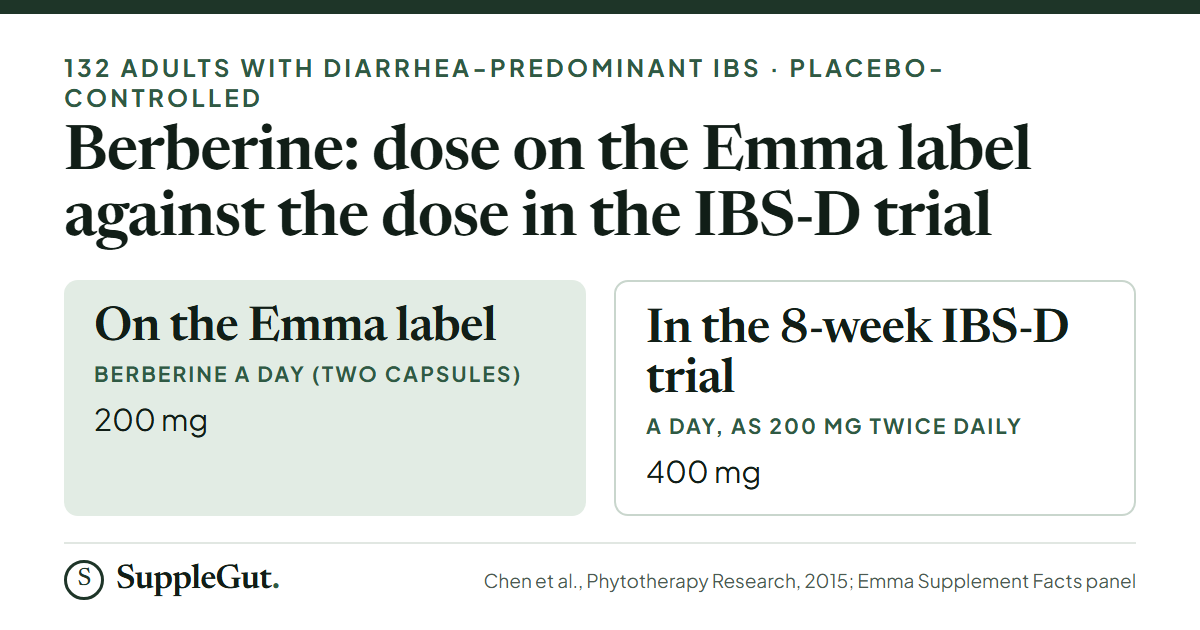
Does Emma Relief work? No trial of Emma itself was found. The brand’s “94% easier passing stools” figure comes from an 8-week consumer survey with no published size or method. Its lead ingredient, berberine, cut diarrhea, pain and urgency in a placebo-controlled trial of 132 people with diarrhea-predominant IBS at 400 mg a day; Emma has 200 mg and is marketed for constipation. Each daily serving also holds 15 mg of vitamin B6 (882% of the Daily Value). Reviews split: 4.0 on Amazon from 11,119 ratings, 3.6 on Trustpilot from 2,752.
Emma is a 60-capsule bottle from Enclave BioActives, taken as two capsules a day. It is sold as Emma Relief on Amazon, at Target and at emmarelief.com, and simply as Emma on the restartyourdigestion.com page that its ads lead to. The brand’s pages name six ingredients; the Supplement Facts panel prints 19 lines, each with its own amount. This page sets out what is on the panel, how each amount compares with the trials, the vitamin B6 figure, and what reviewers and the brand’s own terms say about billing.
What Emma is, and what is on the label
Each two-capsule serving holds berberine hydrochloride 200 mg, resveratrol 125 mg, quercetin 125 mg, star anise seed 100 mg, garlic bulb 100 mg, deglycyrrhizinated licorice (DGL) extract 50 mg, chicory root inulin 50 mg and larch arabinogalactan 50 mg. It also holds nine vitamins and two minerals: vitamin D 20 mcg, thiamin 20 mg, riboflavin 20 mg, niacin 20 mg, vitamin B6 15 mg, folate 400 mcg DFE, vitamin B12 100 mcg, biotin 500 mcg, pantothenic acid 20 mg, magnesium 90 mg and zinc 15 mg. There is no proprietary blend, no ingredient carries a trademarked name, and the brand’s pages do not describe the vitamins and minerals. We found no testing certificate or lab name.
The trial of the product itself
We searched PubMed and ClinicalTrials.gov and found no trial of Emma. The brand cites an “8-week consumer study” in which participants reported 94% easier passing stools, 89% less frequent bloating and 95% less cramping severity; an Amazon graphic says 80% reported more regular bowel movements. Sample size, controls and method are not stated anywhere we read, and the study is not in PubMed. The funnel page says it shows “all 19 studies” referenced, and links a citations pop-up; the pop-up we loaded contained only the word “Citations”.
The evidence for the ingredients
The lead ingredient has the strongest human data. In a placebo-controlled trial of berberine hydrochloride in diarrhea-predominant IBS, 196 people were recruited and 132 randomized to 400 mg a day for 8 weeks (200 mg twice a day) or placebo. The berberine group had lower diarrhea frequency (P=0.032), abdominal pain frequency (P<0.01) and urgency (P<0.01) (Chen et al., 2015). Emma has half that dose, and the brand markets the capsule mainly for constipation (its funnel also says it suits diarrhea and alternating bowel habit). An umbrella review of 11 berberine meta-analyses lists constipation and diarrhea among berberine’s common side effects (Li et al., 2023). We found no trial of berberine for constipation or bloating.
| Ingredient | Emma a day | Human evidence we found |
|---|---|---|
| Berberine | 200 mg | IBS-D trial above, at 400 mg a day |
| DGL licorice extract | 50 mg | GutGard, a branded extract, 150 mg a day: dyspepsia (50 people, 30 days) and reflux symptoms (200 enrolled, 28 days); Emma’s extract is not named as GutGard |
| Chicory inulin | 50 mg | 12 g a day for 4 weeks in 39 people with functional constipation; Emma has 0.4% of that dose |
| Quercetin, resveratrol | 125 mg each | No human trial in gut symptoms found |
| Star anise, garlic, arabinogalactan | 100, 100, 50 mg | No trial in IBS, bloating or constipation found |
The licorice trials are in dyspepsia and reflux (Raveendra et al., 2012; Raj et al., 2025), and the inulin trial was a crossover whose authors acknowledge a carry-over problem (Puhlmann et al., 2025). One mouse study reports quercetin reducing berberine-induced constipation (Cui et al., 2024); that is animal data.
Vitamin B6: 15 mg a day
The panel prints vitamin B6 15 mg as pyridoxine hydrochloride, 882% of the Daily Value, alongside B12 at 4,167%, thiamin at 1,667% and biotin at 1,667%. The US tolerable upper intake level for B6 in adults is 100 mg a day, and the European Food Safety Authority lowered its adult level to 12 mg a day in 2023, based on nerve damage seen at 50 mg a day (EFSA, 2023).
Emma’s 15 mg sits above the European level and below the US level. One Trustpilot reviewer wrote that they stopped Emma after their doctor found a very high B6 level in their blood. That is a single report, and the label does not list a B6 warning.
How to take Emma
The brand store says 2 capsules a day with water, preferably before a meal; Amazon says with a meal and adds that sensitive stomachs can start with 1 capsule and build up. With no trial of the product there is no studied time to effect: the berberine trial ran 8 weeks, and reviewers who report no effect describe 6 weeks to 3 months.
Side effects and who should not take it
The brand says not to take Emma while pregnant or breastfeeding, to talk to a doctor first if you take medication, especially for blood sugar or blood pressure, and to see a doctor if constipation lasts over two weeks or comes with pain, blood in the stool or weight loss. Memorial Sloan Kettering adds that berberine may worsen jaundice in infants, may raise cyclosporin and tacrolimus levels, and lowers CYP2D6, 2C9 and 3A4 enzyme activity in humans, which can change how other medicines are handled (MSKCC). Reviewers report abdominal pain, worse constipation, nausea and vomiting in some cases.
What the reviews say
Amazon shows 4.0 from 11,119 ratings (62% five-star, 13% one-star), with review text behind a sign-in; its own summary calls effectiveness and side effects “mixed”. Target shows 4.84 from 7,089 on a listing the brand runs. Trustpilot shows 3.6 from 2,752 reviews (47% five-star, 23% one-star); the profile is on a paid Trustpilot plan, and the company replies to most negative reviews with templated text. The Better Business Bureau lists two Enclave profiles, each rated B, not accredited, with 20 complaints in three years. The brand’s own review pages show 1,440 reviews on emmarelief.com and 312 on the funnel.
Reviewers praise more regular bowel movements, less bloating and gas, and easy-to-swallow capsules. They complain of no change after weeks or months, pain or worse constipation in some, and billing and refunds.
Billing, subscription and refund terms
The restartyourdigestion.com page offers 1, 4 or 8 bottles one time at $59, $49 and $39 each, or on subscription at $53.10, $44.10 and $35.10, and the option selected when it loads is the 8-bottle subscription: $280.80, renewing every 240 days. Static text beside the price box reads “$97.00 $35/Bottle” and “Instant Savings: $495.20” without explanation. The single-bottle price there adds $4.95 shipping, while the brand’s shipping policy says mainland US shipping is free.
The refund policy states a 90-day guarantee for product used as directed for 30 days. A single bottle needs no return but is limited to one refund per product per year; on a multi-pack the brand refunds the first used bottle plus unopened bottles returned, and shipping and handling is deducted. The terms say subscriptions renew every 28, 30, 56 or 364 days, and give an email address for cancelling that names a different Konscious brand; the funnel gives a phone number. A cancellation refunds automatically only if the order has not yet shipped.
Recent one-star Trustpilot reviews describe ordering one bottle and being billed for three, being offered 50% back on three bottles, and emails without replies. We found no FTC, state attorney general or National Advertising Division action by web search. A single bottle can be bought one time on the brand store, Amazon or Target.
How Emma is advertised
Meta’s ad library shows about 77 active ads for the funnel page under the name “Reset Digestion”. One says you could have “pounds of toxic, stuck waste”; the funnel’s own FAQ says there is no scientific study of “20 pounds of undigested” waste. The funnel quotes gastroenterologist Gina Sam, M.D., and the brand store states she is a paid member of its medical advisory board.
Who Emma is for
- Someone who has read the panel and wants berberine, DGL, quercetin and the vitamins in one capsule, knowing the berberine dose is half the IBS-D trial’s.
- A person not pregnant or breastfeeding, taking none of the medicines named in the warnings, and comfortable with 15 mg of B6 a day.
- A buyer who will choose a single bottle rather than the selected multi-bottle plan.
For diarrhea with cramping, the loose-stool guide covers the options with trials, and berberine alone is on the Thorne Berberine page. For constipation, the fibers with trial evidence, including psyllium (NOW Psyllium Husk Powder), are in the constipation guide.
Cost
One bottle is $59 on emmarelief.com ($1.97 a day), or $2.13 with the $4.95 shipping shown on the store page, and $59.99 on Amazon and Target ($2.00). Three bottles are $49 each ($1.63 a day) and six are $39 each ($1.30). The 15% subscription is $50.15 a bottle every 30 days ($1.67 a day).
The products in this catalog
Common questions
Does Emma Relief work?
No trial of Emma itself was found. The brand’s 94% figure for easier stools comes from an 8-week consumer survey whose size and method are not published. Berberine, the lead ingredient, reduced diarrhea, pain and urgency in a placebo-controlled trial of people with diarrhea-predominant IBS at 400 mg a day; the label has 200 mg. Reviews are mixed: 4.0 on Amazon from 11,119 ratings and 3.6 on Trustpilot from 2,752.
What are the Emma Relief side effects?
The brand says not to take it while pregnant or breastfeeding and to talk to a doctor first if you take medication, especially for blood sugar or blood pressure. Berberine can raise levels of the immunosuppressants cyclosporin and tacrolimus, and its listed side effects are upset stomach, diarrhea and constipation. Trustpilot reviewers report abdominal pain, worse constipation and vomiting in some cases, and Amazon’s own review summary mentions stomach pains.
How much vitamin B6 is in Emma?
Two capsules hold 15 mg of vitamin B6 as pyridoxine hydrochloride, printed as 882% of the Daily Value. That is below the 100 mg a day US upper level for adults and above the 12 mg a day upper level the European Food Safety Authority set in 2023. One Trustpilot reviewer wrote that their doctor found a high B6 level in their blood; that is a single report.
What do the billing and refund terms say?
The brand store says 90-day money-back guarantee, and its policy page limits it: used for 30 days as directed, one refund per product per year on a single bottle, and on a multi-pack a refund of the first used bottle plus any unopened returns, with shipping and handling deducted. The restartyourdigestion.com page opens with an 8-bottle subscription selected, renewing every 240 days. Trustpilot and the Better Business Bureau show recurring reports of extra bottles billed and partial or slow refunds, and a single bottle can be bought one time instead.
How do you take Emma, and how long before it works?
The brand store says 2 capsules a day with water, preferably before a meal; Amazon says with a meal and suggests starting at 1 capsule for sensitive stomachs. No trial of the product exists, so there is no studied time to effect. The berberine trial ran 8 weeks, and Trustpilot reviewers who report no effect describe 6 weeks to 3 months of use.
How much does Emma cost, and where can you buy it?
One 60-capsule bottle (30 days) is $59 on emmarelief.com, which is $1.97 a day, and $59.99 on Amazon and Target. Three bottles are $49 each and six are $39 each; the 15% subscription makes one bottle $50.15 every 30 days. Amazon marks the listing non-returnable, so its terms differ from the brand store’s.
Is Emma better than fiber for constipation?
They are different products with different evidence. Emma holds 50 mg of chicory inulin, while the constipation trial of inulin used 12 g a day, and fiber supplements are dosed in grams. The fibers with trial evidence are in the constipation guide.
Sources
- Chen C, Tao C, Liu Z, et al. "A Randomized Clinical Trial of Berberine Hydrochloride in Patients with Diarrhea-Predominant Irritable Bowel Syndrome." Phytotherapy Research, 2015;29(11):1822–1827. doi.org/10.1002/ptr.5475
- Li Z, Wang Y, Xu Q, et al. "Berberine and health outcomes: An umbrella review." Phytotherapy Research, 2023;37(5):2051–2066. doi.org/10.1002/ptr.7806
- Raveendra KR, Jayachandra, Srinivasa V, et al. "An Extract of Glycyrrhiza glabra (GutGard) Alleviates Symptoms of Functional Dyspepsia: A Randomized, Double-Blind, Placebo-Controlled Study." Evidence-Based Complementary and Alternative Medicine, 2012;2012:216970. doi.org/10.1155/2012/216970
- Raj JP, Saxena U, Belhekar MN, et al. "Efficacy and Safety of GutGard in Managing Gastroesophageal Reflux-Related Symptoms: A Phase III, Single-Centre, Double-Blind, Randomized Placebo-Controlled Trial." Complementary Medicine Research, 2025;32(1):26–36. doi.org/10.1159/000543367
- Puhlmann ML, Wegh CAM, van der Zalm SCC, et al. "Inulin-induced improvements on bowel habit and gut microbiota in adults with functional constipation." BMC Gastroenterology, 2025;25(1):806. doi.org/10.1186/s12876-025-04409-6
- Cui M, Li Y, Zheng T. "Efficacy and Molecular Mechanism of Quercetin on Constipation Induced by Berberine via Regulating Gut Microbiota." International Journal of Molecular Sciences, 2024;25(11):6228. doi.org/10.3390/ijms25116228
- EFSA Panel on Nutrition, Novel Foods and Food Allergens. "Scientific opinion on the tolerable upper intake level for vitamin B6." EFSA Journal, 2023;21(5):e08006. doi.org/10.2903/j.efsa.2023.8006; NIH Office of Dietary Supplements, "Vitamin B6" (ods.od.nih.gov)
- Memorial Sloan Kettering Cancer Center, "Berberine" (mskcc.org)
- Brand pages: label, directions, price, claims, refund and subscription terms (emmarelief.com, refund policy, terms, restartyourdigestion.com); Amazon listing (amazon.com/dp/B0CT62SVG5); Target listing; Trustpilot and the Better Business Bureau profiles
Not sure which product fits your situation?
This guide covers the mechanics. The quiz takes your specific symptoms, routine and preferences and matches you to one product from the catalog.
Take the quiz →