Guide
Does First Day Women’s Probiotic work? Two Bacillus strains with trials, a kiwi prebiotic at a tenth of its dose, and no trial of the gummy
Quick answer
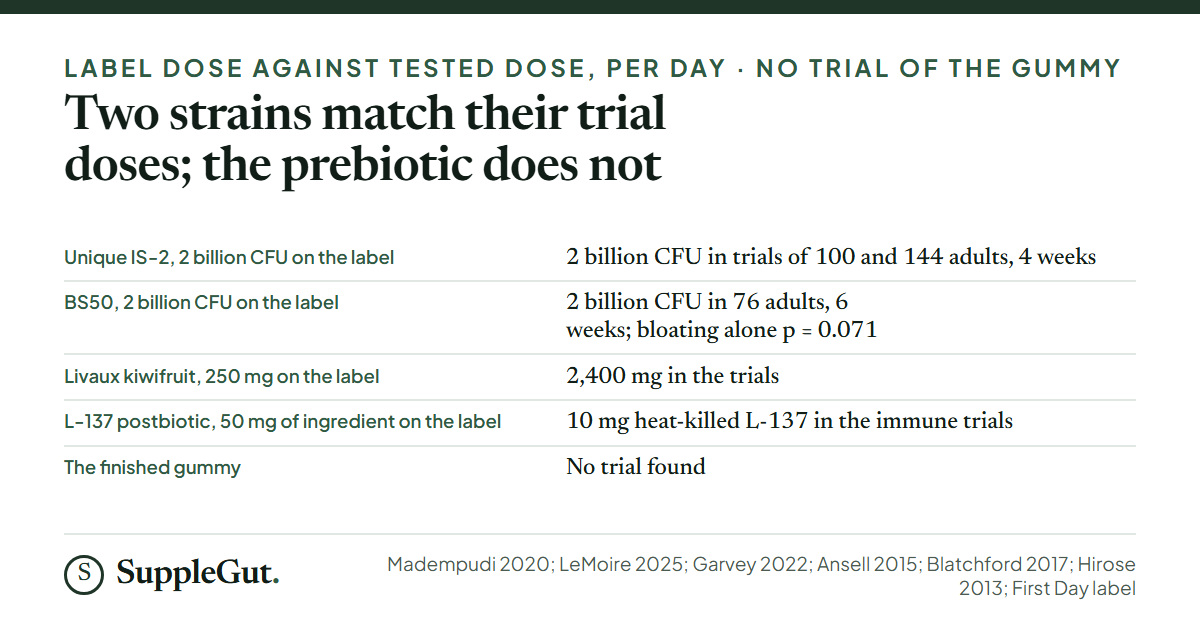
Does First Day Women’s Probiotic work? The gummy itself has no trial. Its two Bacillus strains do, at the same 2 billion CFU a day on the label: Unique IS-2 raised stool frequency and improved stool form in 100 constipated adults and in 144 healthy adults over four weeks, and BS50 improved a bloating, burping and flatulence score in 76 healthy adults over six weeks, though bloating alone was not significant. The kiwifruit prebiotic is at 250 mg against 2,400 mg in its trials. Amazon shows 4.5 from 235 ratings.
First Day Women’s 3-in-1 Pre+ Post+ Probiotic is a kiwi-flavored gummy taken two at a time, once a day. The brand calls it a “tribiotic”: a kiwifruit prebiotic, a heat-treated bacterial postbiotic and two spore-forming probiotics, each carrying a trade name. The finished gummy has no trial of its own; the two probiotic strains do, at the same dose the label prints. This page sets out the panel, those trials, the brand’s vaginal, immune and skin claims, the servings mismatch, the reviews, the price and the billing terms.
What two gummies contain
The Supplement Facts panel on the brand’s product page gives a serving as two gummies and lists every active with its own amount, with no proprietary blend. Per serving:
| Line on the panel | Amount |
|---|---|
| Livaux® gold kiwifruit powder (New Zealand) | 250 mg |
| Immuno-LP20®, heat-treated Lactobacillus plantarum strain L-137 | 50 mg |
| Bacillus coagulans Unique IS-2® | 20 mg, 2 billion CFU |
| Bacillus subtilis OPTIBIOME® BS50™ | 20 mg, 2 billion CFU |
| Calories / total carbohydrate / total sugars | 15 / 3 g / 2 g (all 2 g added) |
All four actives are trade-name ingredients, and the trademark credits are printed at the foot of the panel image. The two live probiotics add up to 4 billion CFU a day. The L-137 postbiotic is a non-living preparation, so it has a weight and no CFU. The 50 mg is the amount of the ingredient; the panel does not say how much of it is L-137 itself. The gummy base is organic tapioca syrup, organic cane sugar, water and pectin, with natural flavors, citric acid, tapioca starch and turmeric, sweet potato and carrot juice for color. The panel states it is free of the top nine allergens, and the brand lists it as vegan, non-GMO and gluten-free.
The brand says the product is tested for potency and purity, and the bottle image carries a Clean Label Project badge. We did not find a lab report or certificate of analysis on the pages we read.
A trial of the gummy as sold
None exists. Searches of PubMed and ClinicalTrials.gov under the product name, the brand name and the word “tribiotic” returned no study of this gummy, and the product page cites no study of its own. The list of trials on the page concerns micronutrients in the brand’s multivitamins. What can be checked is each ingredient, and the sections below take them in turn. Nothing tests all four together, and no trial used the gummy format.
The two Bacillus strains and what their trials found
The label dose of 2 billion CFU a day for each strain matches the dose used in the human trials of that strain. That is a closer match than many probiotics offer, though each strain was tested on its own, never combined with the other.
B. coagulans Unique IS-2. Two placebo-controlled trials used 2 billion CFU a day for four weeks:
- 100 adults with functional constipation. Bowel movements rose more on the strain than on placebo (p < 0.001), 98% of the strain group reached normal stool consistency against 74% on placebo, and incomplete evacuation, painful defecation and abdominal pain eased. The authors include staff of Unique Biotech, the strain’s maker (Madempudi et al., Probiotics and Antimicrobial Proteins, 2020).
- 144 healthy adults with infrequent bowel movements. Bowel-movement frequency rose (p = 0.037) and stool consistency was better than on placebo at week four (p = 0.018), driven by fewer hard stools. The paper also reports no effect on gastrointestinal symptoms or quality of life. PepsiCo staff are among the authors (LeMoire et al., Beneficial Microbes, 2025).
B. subtilis BS50. A placebo-controlled trial of 76 healthy adults gave 2 billion CFU a day for six weeks. A composite score for bloating, burping and flatulence improved in 47.4% on the strain against 22.2% on placebo (odds ratio 3.2, 95% CI 1.1 to 8.7, p = 0.024), and burping improved in 44.7% against 22.2% (p = 0.041). Bloating on its own improved in 31.6% against 13.9%, which did not reach significance (p = 0.071). The authors include staff of BIO-CAT, the strain’s supplier (Garvey et al., Gut Microbes, 2022). Our Fuel Daily Tribiotic guide covers the same trial for a product whose label does not print the strain.
Taken together, the constipation and stool-form results are the firmest, and the bloating result rests on a composite score. The brand’s page headline says “Reduced Bloating” and its copy mentions relief of bloating, constipation and gas; those are the brand’s words. Because the strains were tested separately and not in this gummy, the trial figures describe the strains, not this product. How CFU counts are read is set out in the CFU guide.
The kiwifruit prebiotic and the heat-treated postbiotic
Livaux gold kiwifruit powder is at 250 mg a day. The kiwifruit trials used 2,400 mg of the gold powder, nearly ten times the label amount. In a crossover of 19 healthy and 9 functionally constipated adults, 28 days per period, the gold powder at 2,400 mg raised mean daily bowel movements in the healthy group (p = 0.009 against washout), while the nine constipated adults showed no significant differences (Ansell et al., Nutrition Research, 2015). In the same nine constipated adults, Livaux at 2,400 mg raised Faecalibacterium prausnitzii, a gut bacterium, from 3.4% to 7.0% of the stool microbiota (p = 0.024), a laboratory measure and not a symptom (Blatchford et al., Journal of Nutritional Science, 2017). The label amount has not been tested.
Immuno-LP20 is heat-treated L. plantarum L-137. Because it is not alive, it is a postbiotic, and its trials are about immunity, not digestion. The one most often cited is a 12-week trial of 78 healthy adults with high psychological stress, where a 10 mg daily dose of heat-killed L-137 in a tablet was followed by a lower incidence of upper respiratory tract infections than in the control group (Hirose et al., Journal of Nutritional Science, 2013). Smaller placebo-controlled trials looked at immune markers in 60 healthy adults (Hirose et al., Journal of Nutrition, 2006), inflammation and lipids in 100 overweight adults (Tanaka et al., European Journal of Nutrition, 2019) and dry skin in 80 adults (Yoshitake et al., Frontiers in Medicine, 2022). Staff of the ingredient’s maker, House Foods, are authors on each, and all used 10 mg of heat-killed L-137 in a tablet or capsule. We found no trial of L-137 for digestive symptoms.
The vaginal, immune and skin claims
The brand’s page promises “life-changing relief” from abnormal vaginal discharge, itch and odor by maintaining healthy vaginal flora, and the Amazon bullets describe Unique IS-2 as clinically studied for vaginal flora. The brand also describes the product as supporting digestive, immune and feminine health. These are brand claims, and the studies behind them are small.
The vaginal study is a 40-woman trial of bacterial vaginosis, with 20 women per group and no placebo. One group took antibiotics plus two capsules of 1 billion CFU Unique IS-2 each; the other took antibiotics alone. Symptoms eased in 80% of the probiotic group against 45% of the antibiotic-only group (Sudha et al., Indian Journal of Microbiology, 2012). It tested an add-on to antibiotic treatment in women who already had the infection. It did not test a gummy, or prevention in women without symptoms.
The immune and skin claims rest on the L-137 trials above, which used 10 mg of the heat-killed organism in a tablet or capsule, not a gummy. We found no trial of the immune or skin claims in this product, and no study of the kiwifruit or L-137 measured vaginal outcomes.
Servings: 25 on the panel, 60 gummies on the bottle, 30 on Amazon
The sources disagree. The panel image and the brand page say 25 servings per bottle, which is 50 gummies at two a day. The bottle image reads “60 gummies.” Amazon lists a 60-gummy pouch with 30 servings. The brand page’s own per-day price divides by 30. We could not tell from the pages whether the panel image is from an older 50-gummy bottle or whether the pouch is a separate pack of the same formula, and Amazon’s panel was not read. The price per day on this page is shown both ways for that reason.
Taking it, side effects and the sugar
The directions for adult women are two gummies once a day, chewed thoroughly, at any time of day or with a meal. Keep the pouch tightly closed after opening. The label lists no cautions on the panel; the Amazon safety text says for adult use only, to keep it away from children, and to consult a healthcare professional before use if pregnant, nursing, taking medication or managing a medical condition. It says to stop and consult a professional if any adverse reaction occurs.
Two gummies carry 2 g of added sugar from cane sugar and tapioca syrup, 4% of the daily value, in 15 calories. The brand says it has no artificial sweeteners. Some reviews describe gas, and a few say they could not tolerate the taste. The probiotic side effects guide covers the usual effects and when to stop. The abstracts of the 2022 and 2025 strain trials describe the strains as well tolerated.
What reviewers say
Amazon shows 4.5 out of 5 from 235 ratings on the 60-count pouch: 75% five-star, 12% four, 7% three, 3% two and 3% one. Amazon’s review summary reports positive comments on gut health, digestion and bloating, and on taste, with some reviewers disagreeing on value for money.
The brand’s page runs the Judge.me review app and shows 4.87 from 219 reviews. That figure pools several product records. Only 32 of the 219 sit on this product’s own record, with a mean of 4.53; 114 belong to the refill pouch, 65 to starter packs and 8 to a gut add-on. And 179 of the 219 carry Judge.me’s badge “review earned for future purchase,” a reward tied to leaving a review. Most of the 219 are dated 2024 and 2025, and 13 are from 2026.
Trustpilot shows 3.5 from 808 reviews for firstday.com as a whole, not this gummy: 70% five-star and 18% one-star. Its recent low scores describe subscription charges, shipments the reviewer did not expect and refund refusals; the billing terms are below.
Across the sources, praise centers on taste, more regular bowel movements within weeks, less bloating and the ease of a daily routine with refills by subscription. Complaints are a lack of noticeable effect, gas, a few taste objections, and price and billing.
Price per day, the first-bottle offers and Amazon
The standard price on the brand site is $49.00 a bottle. On the panel’s 25 servings that is $1.96 a day; at 30 servings it is $1.63. The brand page lists first-bottle promotions tied to a discount code: $29.40 for a monthly subscription and $34.30 for a one-time purchase. The page prints those as $0.98 and $1.14 a day, dividing by 30; on 25 servings they are $1.18 and $1.37. The page also lists free shipping on the first order, and a free gift on orders of $75 or more.
On Amazon a 60-gummy pouch is $54.95, or $1.83 a day at 30 servings.
The subscription, the 45-day refund and the cancellation page
The product page lists monthly delivery first, with one-time purchase available below it. The store’s plans give no discount on the first monthly order and 15% off after it; a 90-day plan takes $1 off the first order and 20% off after. The brand says the first order includes a refillable bottle and later orders arrive as refill pouches every 30 days, with skip, pause and cancel options. A seven-day “try before you buy” plan also exists in the store’s plan data.
The refund policy offers a “45-day satisfaction guarantee” of up to three bottles or $100. It covers only the first purchase of a product, once per customer, and the 45 days count from the order date, not from delivery. A request goes to support by chat or email with a name and order number. The cancellation-policy link in the page footer leads to a page-not-found error, so the cancellation terms there could not be read. The Trustpilot reviews we saw describe difficulty finding how to cancel and charges after a delay. Amazon purchases follow Amazon’s own terms.
Who this gummy is for
- An adult woman who prefers a gummy to a capsule and wants two spore-forming strains with printed CFU and strain names.
- Someone whose main goal is more regular, softer stools, the outcome the Unique IS-2 trials measured.
- Someone who accepts that the vaginal, immune and skin claims are the brand’s, resting on small trials of single ingredients.
- Someone comfortable with a subscription and with 2 g of added sugar a serving.
First Day also sells kids’ and teens’ versions, which have their own labels and are not covered here. For other spore-based probiotics, see Just Thrive and Thorne Bacillus Coagulans; Culturelle 4-in-1 Probiotics for Women has its own page. The which probiotic guide and the quiz start from the symptom.
The entries this page refers to
Common questions
Is there evidence behind First Day’s women’s probiotic gummy?
Not for the gummy: PubMed and ClinicalTrials.gov show no study of it. Each of its two probiotics has placebo-controlled trials at the same 2 billion CFU a day. Unique IS-2 improved stool frequency and form over four weeks in 100 constipated adults (2020) and in 144 healthy adults (2025), and BS50 improved a bloating, burping and flatulence score in 76 adults (2022).
What is in two First Day Women’s 3-in-1 gummies?
Livaux gold kiwifruit powder 250 mg, Immuno-LP20 heat-treated L. plantarum L-137 50 mg, Bacillus coagulans Unique IS-2 (2 billion CFU) and Bacillus subtilis OPTIBIOME BS50 (2 billion CFU), with 2 g of added sugar from cane sugar and tapioca syrup. The panel states it is free of the top nine allergens.
Can these gummies help with vaginal health or recurring vaginal symptoms?
The brand says so, and the Amazon bullets cite Unique IS-2 for vaginal flora. The study behind it enrolled 40 women with bacterial vaginosis, 20 per group, and tested the strain as an add-on to antibiotics with no placebo: symptoms eased in 80% against 45% on antibiotics alone. It did not test a gummy or women without the infection.
Is a bottle 25 servings or 30?
The sources disagree. The panel image and the brand page say 25 servings of two gummies, the bottle image reads 60 gummies, and Amazon lists a 60-gummy pouch as 30 servings. The brand page’s own per-day prices divide by 30.
What does a day of First Day Women’s Probiotic cost?
The standard price is $49.00 a bottle, which is $1.96 a day on 25 servings or $1.63 on 30. The brand page lists first-bottle promotions of $29.40 (subscription) and $34.30 (one-time) with a discount code. Amazon sells 60 gummies for $54.95, about $1.83 a day at 30 servings.
How does the 45-day money-back guarantee work?
It refunds up to three bottles or $100, counted from the order date. It covers only the first purchase of a product and is available once per customer. A request goes to support by chat or email with the order number. The cancellation-policy link in the page footer leads to a page-not-found error.
Are there side effects, and who should check with a clinician first?
The Amazon safety text says to consult a healthcare professional before use if pregnant, nursing, taking medication or managing a medical condition, and to stop if an adverse reaction occurs. Some reviews describe gas, and a few an intolerable taste. Two gummies carry 2 g of added sugar.
Do the review scores on Amazon, the brand site and Trustpilot agree?
Amazon shows 4.5 from 235 ratings. The brand’s Judge.me widget shows 4.87 from 219 reviews, but only 32 are on this product’s record and 179 carry a reward-for-review badge. Trustpilot shows 3.5 from 808 for firstday.com as a whole, with 18% one-star reviews.
Sources
- Madempudi RS, Neelamraju J, Ahire JJ, et al. “Bacillus coagulans Unique IS2 in Constipation: A Double-Blind, Placebo-Controlled Study.” Probiotics and Antimicrobial Proteins, 2020;12(2):335–342. PubMed 30911991
- LeMoire A, Replogle R, Shinn L, et al. “Bacillus coagulans Unique IS2 improves stool characteristics in healthy adults with infrequent bowel movements.” Beneficial Microbes, 2025;16(5):533–543. PubMed 40456531
- Garvey SM, Mah E, Blonquist TM, et al. “The probiotic Bacillus subtilis BS50 decreases gastrointestinal symptoms in healthy adults.” Gut Microbes, 2022;14(1):2122668. PubMed 36269141
- Sudha MR, Yelikar KA, Deshpande S. “Clinical Study of Bacillus coagulans Unique IS-2 (ATCC PTA-11748) in the Treatment of Patients with Bacterial Vaginosis.” Indian Journal of Microbiology, 2012;52(3):396–399. PubMed 23997330
- Ansell J, Butts CA, Paturi G, et al. “Kiwifruit-derived supplements increase stool frequency in healthy adults.” Nutrition Research, 2015;35(5):401–408. PubMed 25931419
- Blatchford P, Stoklosinski H, Eady S, et al. “Consumption of kiwifruit capsules increases Faecalibacterium prausnitzii abundance in functionally constipated individuals.” Journal of Nutritional Science, 2017;6:e52. PubMed 29152256
- Hirose Y, Yamamoto Y, Yoshikai Y, Murosaki S. “Oral intake of heat-killed Lactobacillus plantarum L-137 decreases the incidence of upper respiratory tract infection in healthy subjects with high levels of psychological stress.” Journal of Nutritional Science, 2013;2:e39. PubMed 25191589
- Hirose Y, Murosaki S, Yamamoto Y, et al. “Daily intake of heat-killed Lactobacillus plantarum L-137 augments acquired immunity in healthy adults.” Journal of Nutrition, 2006;136(12):3069–3073. PubMed 17116721
- Tanaka Y, Hirose Y, Yamamoto Y, et al. “Daily intake of heat-killed Lactobacillus plantarum L-137 improves inflammation and lipid metabolism in overweight healthy adults.” European Journal of Nutrition, 2020;59(6):2641–2649. PubMed 31620886
- Yoshitake R, Nakai H, Ebina M, et al. “Beneficial Effect of Heat-Killed Lactobacillus plantarum L-137 on Skin Functions in Healthy Participants.” Frontiers in Medicine, 2022;9:912280. PubMed 35872749
- First Day: product page, Supplement Facts and bottle images, refund policy and selling-plan data. firstday.com; refund policy
- Amazon listing for First Day Probiotic Gummies for Women (ASIN B0F6G2RHX8): price, servings, safety text, ratings and review summary. amazon.com
- Trustpilot: ratings and reviews for firstday.com. trustpilot.com
Want this narrowed to one product?
Reading is one thing, choosing is another. Answer the quiz and it weighs your own symptoms and routine and picks one product.
Take the quiz →