Guide
Does GutPersonal The Gut Soother work? 4 g of glutamine a scoop against the 15 g a day in the IBS trial
Quick answer
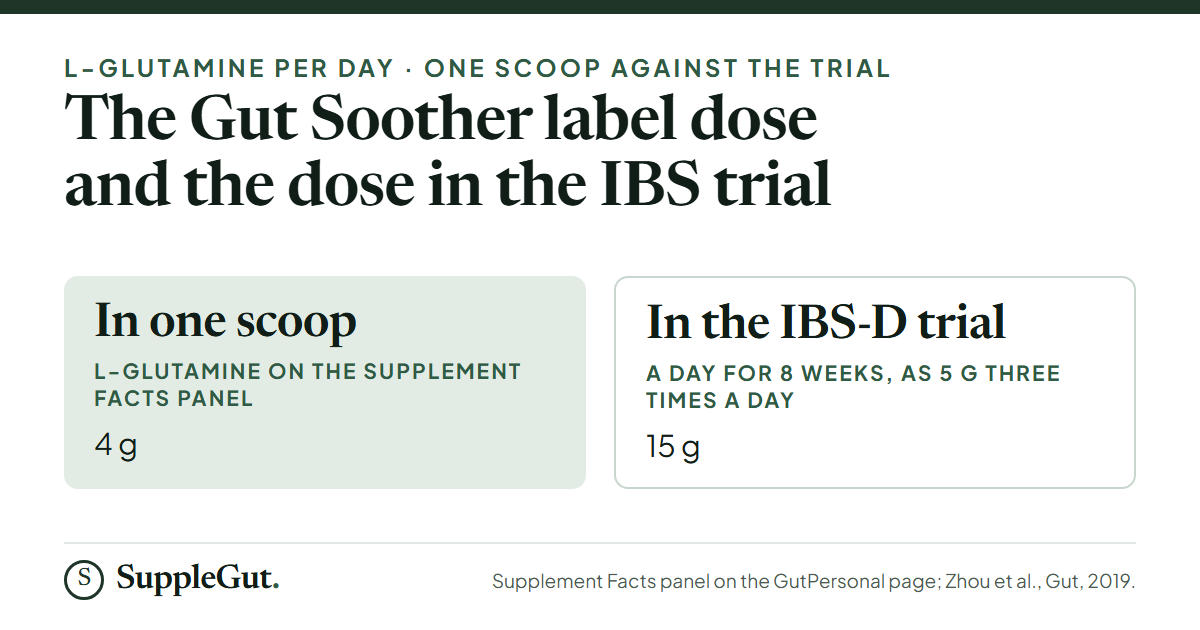
Does The Gut Soother work for bloating or heartburn? We could find no study of this blend. The one positive placebo-controlled glutamine trial gave 15 g a day for 8 weeks to adults with post-infectious IBS with diarrhea, and 79.6% improved against 5.8% on placebo; one scoop here holds 4 g. A review of seven trials in inflammatory bowel disease found no effect, and we found no trial of glutamine or deglycyrrhizinated licorice for heartburn. The brand’s review widget shows 4.81 from 70 reviews.
The Gut Soother is GutPersonal’s L-glutamine powder, a chocolate or vanilla scoop that adds deglycyrrhizinated licorice, aloe gel, N-acetyl-D-glucosamine, zinc and vitamin A to 4 g of glutamine. The brand markets it for bloating, heartburn and gut-lining support. This page sets the panel beside the glutamine trials, then covers the reviews, the price by route and the refund terms.
What is in a scoop of The Gut Soother
The jar reads “L-Glutamine Powder with Aloe & DGL to Soothe Abdominal Discomfort,” and the brand’s tagline promises to “tame the bloating and ease the irritation.” The page lists “Heartburn + acid reflux relief,” “Calms inflammation” and “Supports healing of leaky gut” among its benefits, and carries an “Instant Relief” badge. Those are the brand’s claims, and the page cites no study for them. The panel is headed Supplement Facts, with one 6.4 g scoop as the serving and about 30 servings to the jar.
| Line as printed | Per scoop |
|---|---|
| L-glutamine USP | 4 g |
| N-acetyl-D-glucosamine | 500 mg |
| Deglycyrrhizinated licorice root extract | 400 mg |
| Aloe vera leaf gel extract | 75 mg |
| Zinc (as zinc bisglycinate chelate) | 10 mg (91% of the Daily Value) |
| Vitamin A (as palmitate) | 600 mcg (67%) |
Other ingredients are natural flavors, organic rebaudioside A (a stevia extract) and silicon dioxide, for 5 calories a scoop. The page shows one panel for both flavors, and we did not check whether the chocolate and vanilla panels differ. It lists no laxative herbs, prints no allergen or free-from statement for this product, and carries a “Third-Party Tested” badge without naming a laboratory.
Four grams of glutamine against a trial that used fifteen
We searched PubMed for the brand name and the product name and found no study of this powder. The glutamine research that exists tested glutamine alone. The trial most often cited randomized 106 adults who completed 8 weeks (54 on glutamine, 52 on placebo) with IBS with diarrhea that began after a gut infection and with raised intestinal permeability. The glutamine group took 5 g three times a day, 15 g in all. A fall of 50 or more points on the IBS severity score came in 43 of 54 on glutamine (79.6%) against 3 of 52 on placebo (5.8%). The score at week 8 was 181 against 301, daily bowel movements were 2.9 against 5.4, permeability returned to normal in the glutamine group only, and adverse events were low and similar between groups (Zhou et al., Gut, 2019). The authors call for larger trials. It tested plain glutamine, so it says nothing about the licorice, aloe, zinc or vitamin A in this scoop.
One scoop here holds 4 g, about a quarter of the trial’s daily amount; the half-scoop starting dose holds 2 g. Three scoops come to 12 g, and reaching 15 g takes nearly four. The trial population was also narrow: people with post-infectious diarrhea-predominant IBS and high permeability, not bloating, heartburn or “leaky gut” in general.
Glutamine in inflammatory bowel disease, and the heartburn question
A systematic review of seven clinical trials of glutamine in inflammatory bowel disease, using oral doses of 21 to 30 g as well as enteral and parenteral routes, found no effect on the course of disease, permeability, intestinal symptoms or inflammation markers (Severo et al., Clinical Nutrition ESPEN, 2021). That is a different condition from the one in the IBS trial, and it shows the positive result does not carry across every gut diagnosis.
For heartburn and reflux, which the product page leads with, we found no trial of glutamine. Reviewers do describe it: eight of the 70 mention heartburn, reflux or acid, several say they use it alongside acid-reducing medicine, and one on a proton pump inhibitor wrote that the heartburn was “significantly more tolerable.” The acid reflux guide and the gastritis guide set out the supplements that do have trials.
Licorice, aloe and the rest of the scoop
Deglycyrrhizinated licorice (DGL) is the heartburn-facing ingredient. A PubMed search for DGL or licorice extract with dyspepsia returned no randomized trial, though the search was not exhaustive. The panel prints 400 mg of the extract and not how much glycyrrhizin remains in it.
Aloe vera has trials in IBS. An umbrella review of nutrition trials listed it among interventions that improved symptoms with small effects and low to very low certainty (Zeraattalab-Motlagh et al., Nutrition Reviews, 2025), while a commentary notes a double-blind trial in 160 people with IBS in which aloe was not effective (Dimidi and Whelan, Neurogastroenterology & Motility, 2020). Those were oral aloe preparations in IBS, not a 75 mg dose of leaf gel inside a glutamine powder, and none addressed heartburn. The label says leaf gel, not latex, and prints no aloin statement.
PubMed returned 46 records for N-acetylglucosamine in inflammatory bowel disease, and we did not read them, so we make no claim about the 500 mg here.
Half a scoop to start, and what a day of scoops adds up to
The directions: start with half a scoop, move to a full scoop after a few days, and fit it into a morning or evening routine. The FAQ calls the powder gentle, non-habit forming and safe for daily use, “even multiple times a day during flare-ups.” Nothing is printed about food, and reviewers stir it into coffee, yogurt, oatmeal, water or smoothies.
- One scoop: 4 g of glutamine, 400 mg of licorice extract, 10 mg of zinc.
- Three scoops: 12 g of glutamine, 1.2 g of licorice extract, 30 mg of zinc and 1,800 mcg of vitamin A.
Pregnancy, medicines and what reviewers report
The panel image and product page print no warning text. The brand’s FAQ says “There is not enough adequate research to support the safety during pregnancy and breastfeeding,” and that you should check with a healthcare provider first. On medicines it says the product is generally safe but to check with your doctor if you take prescription drugs. Among the reviews, one reports stomach cramp that eased at half a scoop, and another did not tolerate the stevia and says customer service helped.
Seventy reviews, all on the brand’s own page
The product page runs a Judge.me widget showing 4.81 out of 5 from 70 reviews: 61 five-star, 7 four-star, 1 three-star, none two-star and 1 one-star. Of the 70, 63 are flagged as verified buyers and 7 are not, and the brand has replied to 24. The reviews run from 2022 to 2026. We found no Amazon, Walmart, Target or iHerb listing carrying the brand name and no Trustpilot profile, so this widget is the only rating that exists for the product.
By keyword, bloating comes up in 14 reviews, heartburn, reflux or acid in 8, nausea, upset, cramp or diarrhea in 7 and sleep in 6. Praise centers on:
- a vanilla or chocolate flavor that mixes easily;
- a calmer stomach and less bloating after meals or indulgent days;
- less heartburn for some, with comments such as “within minutes” and “totally gone.”
Complaints are a taste some cannot get down (“an unflavored option would be a good addition”), stomach cramp at a full scoop, bloating that did not fully go away, and the stevia.
What a jar costs by route, and how refunds work
| Route | Price | Per day at one scoop |
|---|---|---|
| One time, about 30 scoops | $64.95 | $2.17 |
| 1-month delivery (10% off) | $58.46 | $1.95 |
| 3-month delivery (15% off) | $165.62 | $1.84 |
| 6-month delivery (20% off) | $311.76 | $1.73 |
The page opens with the 1-month delivery card active, and One Time Purchase is a separate option. The three-month and six-month plans carry free shipping, the brand lists gifts on subscription orders two, four and six, and a banner offers $15 off a first order. In the 70 reviews one mentions the subscription and none describes unwanted charges.
The refund policy, as printed, allows 30 days to return unopened products for a full refund; for opened ones it asks you to email hello@gutpersonal.com to find a solution, and it does not refund shipping. A Happy Gut Guarantee page describes a full refund of a first purchase of each product, bought through gutpersonal.com and reported within 30 days of delivery. One reviewer wrote that an opened jar could not be taken back.
Who this suits
- Someone who wants a flavored glutamine powder and accepts that 4 g a scoop is below the amount any gut trial used.
- Someone already looking at licorice and aloe with glutamine in one scoop, who has checked the pregnancy and medication notes first.
- Someone comfortable buying from the brand’s site, the only place the product turned up.
Glutamine and licorice alternatives in the catalog
For glutamine alone, NOW Foods L-Glutamine Powder is listed at $0.27 a day and Thorne L-Glutamine Powder at $0.74, each at about 5 g a serving. Wellah L-Glutamine is covered in its own guide. For licorice without glutamine there is Natural Factors Chewable DGL, taken before meals. The loose-stool trials are set out in the loose stools and IBS-D guide, the same brand’s magnesium has its own guide, and the quiz matches symptoms to products. No trial compares any of these with The Gut Soother.
Products this guide draws on
Common questions
Does The Gut Soother work for bloating or heartburn?
We could find no study of this blend, and no trial of glutamine or deglycyrrhizinated licorice for heartburn or reflux. Glutamine at 15 g a day helped people with post-infectious IBS with diarrhea in one placebo-controlled trial. On the brand’s review widget the product holds 4.81 from 70 reviews; 14 mention bloating and 8 mention heartburn, reflux or acid.
What is in a scoop of The Gut Soother?
One 6.4 g scoop lists 4 g of L-glutamine, 500 mg of N-acetyl-D-glucosamine, 400 mg of deglycyrrhizinated licorice root extract, 75 mg of aloe vera leaf gel extract, 10 mg of zinc and 600 mcg of vitamin A. It is flavored with natural flavors and sweetened with organic rebaudioside A, a stevia extract. Every active has its own weight, and there is no proprietary blend.
How much does The Gut Soother cost per day?
A jar of about 30 scoops is $64.95 one time, which is $2.17 a day at one scoop and $1.08 at the half-scoop starting dose. The monthly plan the page pre-selects is $58.46 ($1.95 a day), the three-month plan is $165.62 ($1.84) and the six-month plan is $311.76 ($1.73). At three scoops a day the one-time price is $6.50.
Is it safe in pregnancy, and does it interact with medicines?
The brand’s own FAQ says there is not enough research to support safety during pregnancy and breastfeeding, and to check with a healthcare provider first. It calls the product generally safe and says to check with a doctor if you take prescription medications. The panel lists licorice extract and aloe gel, and neither the glycyrrhizin left in the licorice nor an aloin statement is printed.
How many scoops a day, and what do reviewers say about side effects?
The brand says to start with half a scoop and move to a full scoop after a few days, and calls it safe for daily use, even several times a day during flare-ups. One reviewer reported stomach cramp that eased after cutting back to half a scoop. Seven of the 70 reviews mention nausea, upset, cramp or diarrhea.
Can I get a refund, and is it sold anywhere else?
The refund policy gives 30 days to return unopened products for a full refund, handles opened ones by email, and does not refund shipping; a Happy Gut Guarantee covers a first order within 30 days. One reviewer says an opened jar could not be taken back. We found the product on the brand’s own site only.
How does it differ from plain L-glutamine powder?
Plain powders such as NOW Foods L-Glutamine Powder list glutamine alone, at about 5 g a serving. The Gut Soother puts 4 g of glutamine beside licorice, aloe, N-acetyl-D-glucosamine, zinc and vitamin A. No head-to-head trial of the two was found.
Sources
- Zhou Q, Verne ML, Fields JZ, et al. “Randomised placebo-controlled trial of dietary glutamine supplements for postinfectious irritable bowel syndrome.” Gut, 2019;68(6):996–1002. PMID 30108163. pubmed.ncbi.nlm.nih.gov/30108163
- Severo JS, da Silva Barros VJ, Alves da Silva AC, et al. “Effects of glutamine supplementation on inflammatory bowel disease: A systematic review of clinical trials.” Clinical Nutrition ESPEN, 2021;42:53–60. PMID 33745622. pubmed.ncbi.nlm.nih.gov/33745622
- Zeraattalab-Motlagh S, Ranjbar M, Mohammadi H, et al. “Nutritional Interventions in Adult Patients With Irritable Bowel Syndrome: An Umbrella Review of Systematic Reviews and Meta-analyses of Randomized Clinical Trials.” Nutrition Reviews, 2025;83(3):e1343–e1354. PMID 39110917. pubmed.ncbi.nlm.nih.gov/39110917
- Dimidi E, Whelan K. “Food supplements and diet as treatment options in irritable bowel syndrome.” Neurogastroenterology & Motility, 2020;32(8):e13951. PMID 32697018. pubmed.ncbi.nlm.nih.gov/32697018
- GutPersonal: product page for The Gut Soother (claims, directions, price, subscription tiers and Judge.me reviews). gutpersonal.com/products/the-soother-glutamine-powder
- GutPersonal: Supplement Facts panel image for The Gut Soother. panel image
- GutPersonal refund policy and Happy Gut Guarantee pages. refund policy; Happy Gut Guarantee

Want this narrowed to one product?
Reading is one thing, choosing is another. Answer the quiz and it weighs your own symptoms and routine and picks one product.
Take the quiz →