
Comparison
Methylcellulose vs psyllium: which fiber has the evidence?
Both are soluble fibers sold as bulk laxatives, both are taken with a full glass of water, and both largely resist fermentation, so neither feeds gas the way inulin does. The difference is what has actually been tested. Psyllium has a large trial record for constipation and cholesterol. Methylcellulose — the fiber in Citrucel — has an over-the-counter indication and very little controlled evidence behind it.
Quick answer
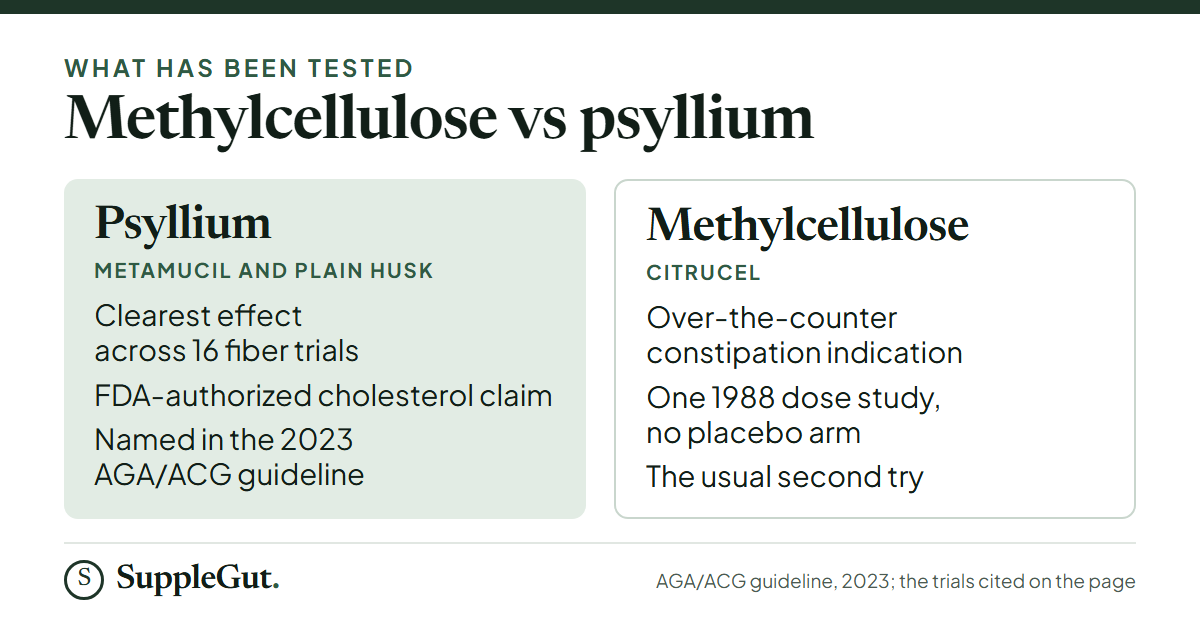
Psyllium is the fiber with the evidence. The clearest effect in a meta-analysis of sixteen randomized fiber trials, an FDA-authorized cholesterol claim, and the 2023 AGA/ACG guideline’s line that among fiber supplements only psyllium appears to be effective.
Methylcellulose is the fiber to try second. It has an over-the-counter indication for constipation and a 1988 dose study, but no placebo-controlled trial in constipated people. Its real case is tolerance: if psyllium left you bloated even after a slow start, Citrucel is the standard next thing to reach for.
The short answer
Plain psyllium husk powder
$0.31 a day · 4.7★ from 23,144 ratings at iHerb
A meta-analysis of 16 randomized fiber trials in 1,251 people with chronic constipation found 66% responded to fiber against 41% on placebo, with psyllium doing better than fiber as a whole. Psyllium is the fiber the 2023 AGA/ACG guideline singles out, and the one with an FDA-authorized cholesterol claim at 7 g of soluble fiber a day. One serving of the plain powder is 7 g of fiber; a dose of Citrucel is 2 g.
- Hard, dry or infrequent stools
- You also want the cholesterol effect
- You want the fiber that the trials and the guideline actually name
Citrucel Sugar Free Orange Powder
$39.30 for 32 oz · 4.7★ from 1,563 ratings at Amazon
A viscous, non-fermentable fiber with an over-the-counter laxative label. The evidence is thin: a 1988 study of 59 chronically constipated people found 1, 2 and 4 g a day all increased stool frequency and water content — but it compared methylcellulose with psyllium, not with placebo. Its label calls it “a non-allergenic fiber,” and its gas claim rests on laboratory testing.
- Psyllium gave you gas or bloating you could not get past
- You react to psyllium itself, which is a known if uncommon allergen
- You want a pharmacy-shelf product with a filed OTC drug label
Not sure which of the two fits you? The quiz asks about your symptoms before it names one.
What “non-fermentable” buys you. Gas from a fiber supplement comes from bacteria fermenting it in the colon. Psyllium and methylcellulose both largely resist that, which is why neither is in the same league as inulin or wheat dextrin for bloating. The only head-to-head data is a 2026 trial in 30 healthy volunteers that tested whether each fiber could blunt the fermentation of a 15 g dose of inulin: psyllium cut the early breath-hydrogen rise significantly (p = 0.033 against placebo) and methylcellulose did not reach significance (p = 0.49). The authors could not show it was non-inferior. That is a study of what each fiber does to another fiber’s gas, not of gas from the fibers themselves, but it does not support the idea that methylcellulose is the gentler of the two.
Side by side
✓ marks the product with the advantage on that row. Rows with no mark are a genuine tie or a matter of preference.
Where they differ
1. The evidence gap is the whole story
Psyllium’s constipation evidence is a meta-analysis of 16 randomized fiber trials in 1,251 people, in which 66% responded to fiber against 41% on placebo and psyllium did better than fiber as a whole, plus more than twenty controlled cholesterol trials behind the FDA claim. The 2023 joint guideline from the American Gastroenterological Association and the American College of Gastroenterology suggests fiber supplementation for chronic constipation and adds that “among the evaluated fiber supplements, only psyllium appears to be effective, with very limited and uncertain data on bran and inulin.” Methylcellulose is not mentioned.
The methylcellulose record is one study. In 1988, 59 chronically constipated people took 1, 2 or 4 g of methylcellulose a day or 3.4 g of psyllium; every arm increased stool frequency, water content and solids. There was no placebo arm, so the study shows methylcellulose does something, not how much of that something is the fiber. A 2017 review by two of the field’s fiber researchers puts it directly: methylcellulose “has an over-the-counter indication for relief of constipation, but there are no well-controlled clinical studies in constipated patients to support efficacy versus placebo.”
2. Gel or no gel
The same review’s summary of the mechanism is “fiber needs to gel.” Psyllium forms a viscous gel that resists fermentation and keeps holding water all the way through the colon, which is the laxative mechanism. Methylcellulose is viscous but is classed in that literature as non-gel-forming, and the one trial that tested the distinction on cholesterol found the difference: 105 people with high cholesterol took psyllium, methylcellulose or calcium polycarbophil three times a day for eight weeks. Only the psyllium group’s LDL fell against placebo (−8.8%, p = 0.02).
3. Gas
Citrucel’s pack says it “won’t ferment to cause excess gas,” footnoted to laboratory testing. Psyllium is also largely non-fermented, and the 2026 volunteer trial above is the only head-to-head data; it favored psyllium. In practice some people who bloat on psyllium do better on methylcellulose, and that experience is a fair reason to switch. It is not evidence that methylcellulose is the gentler fiber in general.
4. Dose
One serving of plain psyllium is 7 g of fiber. A rounded tablespoon of Citrucel is 2 g of methylcellulose, and the label caps you at three a day, so 6 g is the ceiling. The trial doses for psyllium run 6–15 g a day; the 1988 methylcellulose study found an effect from 1 g.
5. Where methylcellulose wins
Tolerance and allergy. Psyllium is a recognized allergen for a small number of people; Citrucel’s label calls methylcellulose “a non-allergenic fiber.” Citrucel also sells as an over-the-counter drug with a filed label, so the warnings are printed on the pack in the standard format. And it is orange and sweet, which is the same compliance argument that Metamucil makes against plain psyllium.
Where they are the same
- Both need a full glass of liquid. Both labels carry the same warning: taken without enough fluid, the powder can swell and block the throat. Neither should be taken by anyone with difficulty swallowing.
- Both take 12 to 72 hours to produce a first bowel movement, and both labels say stop and see a doctor if constipation lasts more than seven days or there is rectal bleeding.
- Both are best spaced from medicines — bulk fibers can slow the absorption of drugs taken at the same time.
- Both sugar-free versions use aspartame and carry a phenylalanine warning: 48.6 mg per adult dose of Citrucel, 25 mg per teaspoon of Metamucil. Plain psyllium powder has neither.
Read the full research
Common questions
Is methylcellulose better than psyllium?
Not on evidence. Psyllium had the clearest effect in a meta-analysis of 16 randomized fiber trials in 1,251 people with constipation, and has an FDA-authorized cholesterol claim and the 2023 AGA/ACG guideline’s statement that among fiber supplements “only psyllium appears to be effective.” Methylcellulose has one 1988 study in 59 constipated people with no placebo arm. Methylcellulose is the reasonable second choice if psyllium gave you gas or bloating you could not get past.
Does methylcellulose cause less gas than psyllium?
Both are largely non-fermentable, which is why neither is in the same league as inulin for gas. Citrucel’s “won’t cause excess gas” claim rests on laboratory fermentation testing. The one head-to-head trial, in 30 healthy volunteers in 2026, found psyllium significantly blunted the early fermentation of a 15 g inulin dose (p = 0.033 against placebo) while methylcellulose did not reach significance (p = 0.49). Some people do tolerate methylcellulose better in practice; that is a reason to try it, not proof it is gentler.
Is Citrucel the same as Metamucil?
No. Metamucil is psyllium husk; Citrucel is methylcellulose, a chemically modified plant cellulose. Both are orange, sugar-free powders with an over-the-counter laxative label, and both sugar-free versions are sweetened with aspartame, but the fibers are different and only psyllium carries the cholesterol claim.
Does methylcellulose lower cholesterol?
No effect was found in the one direct comparison: an 8-week trial in 105 people with high cholesterol in which psyllium lowered LDL cholesterol by 8.8% against placebo while methylcellulose did not. Psyllium is the fiber with the FDA-authorized cholesterol claim at 7 g of soluble fiber a day.
How much methylcellulose is in a dose of Citrucel?
2 g per rounded tablespoon of the sugar-free powder, up to three times a day, each with at least 8 ounces of liquid. One serving of plain psyllium husk powder supplies 7 g of fiber.
In one line: Plain psyllium husk powder — best evidence for constipation and cholesterol.
Which fiber for constipation, on one page
Which fibers have the trials, the dose that worked, and how to take it without the gas. Sent by email, then two short follow-ups over ten days. Unsubscribe any time.
Your address is used for these three emails and nothing else. How we handle it.
Speak to a doctor first if you are pregnant, breastfeeding, trying to conceive, immune-suppressed, or taking prescription medication — and before starting anything if you have blood in your stool, unexplained weight loss, persistent vomiting, or pain severe enough to wake you at night. Those are signs to get looked at, not to try a supplement.
Is a bulk fiber the right category at all?
Fiber is the right first step for hard or infrequent stools and the wrong one for several other things people buy it for. Our quiz asks what you are experiencing before it names anything.
Find your match →Free · Private · No sign-up · 1–3 minutes
Related guides
Other comparisons
Where these numbers come from
- NOW psyllium husk powder, fiber per serving, 4.7 from 23,144 — www.iherb.com/pr/now-foods-psyllium-husk-powder-12-oz-340-g/89
- Citrucel OTC drug label: 2 g methylcellulose per rounded tablespoon, directions, warnings, 48.6 mg phenylalanine — dailymed.nlm.nih.gov/dailymed/drugInfo.cfm?setid=9d5f2244-a610
- Citrucel Sugar Free Orange: pack sizes and the non-fermentable claim with its laboratory-testing footnote — www.citrucel.com/products/sugar-free-orange-mix
- Citrucel 32 oz price and rating, 4.7 from 1,563 — www.amazon.com/dp/B010SI4TCI?tag=supplegut-20
- Hamilton JW et al. Clinical evaluation of methylcellulose as a bulk laxative. Dig Dis Sci 1988;33:993-8 (59 constipated people, no placebo arm) — pubmed.ncbi.nlm.nih.gov/2839321
- Lambeau KV, McRorie JW. Fiber supplements and clinically proven health benefits. J Am Assoc Nurse Pract 2017;29:216-23 (methylcellulose evidence statement; Anderson 1991 cholesterol trial) — pmc.ncbi.nlm.nih.gov/articles/PMC5413815
- Reid et al. Modified cellulose or psyllium and colonic gas production with inulin: randomised placebo-controlled trial in 30 volunteers. Food Funct 2026 — pmc.ncbi.nlm.nih.gov/articles/PMC12869852
- Chang L et al. AGA-ACG Clinical Practice Guideline: Pharmacological Management of Chronic Idiopathic Constipation. Gastroenterology 2023;164:1086-1106 — pubmed.ncbi.nlm.nih.gov/37211380
- Guideline summary with the fiber wording quoted above — pmc.ncbi.nlm.nih.gov/articles/PMC11775994
- Fiber constipation meta-analysis, 16 trials, 1,251 people — pubmed.ncbi.nlm.nih.gov/35816465
- FDA authorized health claim, 7 g/day soluble psyllium, 21 CFR 101.81 — www.law.cornell.edu/cfr/text/21/101.81
Prices and star ratings are point-in-time snapshots and move around. Where a figure could not be confirmed from a manufacturer label or retailer listing, this page says so rather than estimating.