
Guide
Does It's Health Tea GERD tea work? Eight herbs, no amounts, and what the ginger trials show
Quick answer
Does It’s Health Tea GERD tea work? No trial of this tea exists, and the label prints no amount for any of its eight herbs. Ginger, its lead ingredient, shortened stomach emptying by about four minutes at 1.2 g in capsules in an 11-person dyspepsia trial without changing symptoms; a bag holds about 2.4 g of all eight herbs together. Amazon reviews average 4.1 from 315 ratings, 63% five stars and 12% one star. The blend includes whole licorice root, which carries glycyrrhizin and cautions for blood pressure and potassium.
It’s Health Tea GERD Natural Herbal Tea is a 3 oz pouch of dried, loose-leaf herbs sold with 35 empty paper tea bags that the buyer fills. The label lists eight herbs, ginger root, slippery elm, yarrow, fennel seed, chamomile, rosemary, licorice root and marshmallow root, and prints an amount for none of them. This page sets out what the listings say, what the research on each herb shows, what the licorice means for blood pressure and potassium, and what the reviews report.
What the tea is, and what the label leaves out
The brand’s site lists the ingredients as organic ginger root, slippery elm, yarrow, fennel seed, chamomile, rosemary, licorice root and marshmallow root. The Amazon listing gives the same eight herbs in a different order, with slippery elm first and ginger third, and does not say organic. Ingredient lists normally run from the largest to the smallest by weight, so the two lists do not agree on which herb is the largest, and neither prints the weights. There is no sweetener, flavor or caffeine. It is dried herb, not an extract.
The images we could find, from the brand’s site and the Amazon gallery, show the front of the pouch and marketing graphics. We did not find a Supplement Facts panel or an amount per bag anywhere. The arithmetic from the Amazon figures is about 85 g of tea across 35 bags, which is about 2.4 g of blend per bag across eight herbs. If the herbs were present in equal parts, which nothing says, each would contribute about 0.3 g a bag. The brand’s own instructions page describes a lighter cup as 1 teaspoon, about 1 g, and a stronger one as 1 tablespoon, about 3 g, so the amount in a cup depends on how the bag is filled.
The listings also disagree about the pack. The image of the pouch front says 2 oz, the eBay listing says 2 ounces and 30 bags, and Amazon and the brand’s ads say 3 oz and 35 bags. We could not resolve that from the pages. Amazon files the listing under antacids, which is Amazon’s category, not a claim on the label; the brand’s site does not describe the tea as an antacid, and the listing carries the usual dietary-supplement statement that the FDA has not evaluated it.
The trial of the tea itself
We could find no trial of this tea, and the brand makes no trial claim on its product page or in the ads we read. Its claims are about tradition and comfort: a blend “designed to support stomach comfort and pH balance” for occasional heartburn, and herbs “traditionally used” to soothe after-meal discomfort. So the evidence has to come from the herbs, and none of the herb trials used a product with these eight herbs at these unprinted amounts.
What the research shows for each herb
Ginger is the herb the product is built around, and it has the most research. In a randomized, double-blind crossover study of 11 people with functional dyspepsia (upper-abdominal fullness and discomfort with no structural cause), 1.2 g of ginger in capsules shortened the time for half of a meal to leave the stomach from 16.1 minutes on placebo to 12.3 minutes. The symptoms the volunteers reported did not differ between ginger and placebo (Hu et al., World Journal of Gastroenterology, 2011). A four-week placebo-controlled trial of 126 people with functional dyspepsia used a supplement of ginger plus artichoke leaf extract and found an advantage over placebo for nausea, fullness, pain and bloating, but it combined two ingredients, and two of its authors work for the supplement’s maker (Giacosa et al., Evidence-Based Complementary and Alternative Medicine, 2015).
For reflux itself, a 2022 systematic review of dietary, nutraceutical and probiotic treatments for GERD symptoms pooled two studies of ginger-containing supplements and found an odds ratio of 7.50 for symptom relief (95% confidence interval 3.62 to 15.54), graded high certainty, while the other 16 interventions showed no significant effect (Martin et al., Clinical Nutrition ESPEN, 2022). From the abstract we could not identify which two studies were pooled, so we do not know their doses or whether either used a tea. We found no trial of ginger tea in reflux or dyspepsia.
| Herb | What we could find |
|---|---|
| Ginger | Small trials in dyspepsia at capsule doses of 1.2 g and up; a two-study pooled GERD result whose studies are not identified in the abstract |
| Slippery elm | No randomized trial in reflux or dyspepsia; two uncontrolled studies of multi-herb formulas that cannot be separated by ingredient |
| Marshmallow root | EU monograph accepts it on long-standing use as a soothing preparation for mild stomach discomfort, at 2 to 5 g of root per cup, three times a day; no reflux trial |
| Chamomile | EU monograph accepts it on long-standing use for minor bloating and spasms, at 1.5 to 4 g per cup, three to four times a day; no trial for reflux |
| Fennel seed, yarrow, rosemary | No reflux or dyspepsia randomized trial located with the tools we used |
| Licorice root | A placebo-controlled dyspepsia trial of a standardized extract (75 mg twice a day), which is a different preparation from root in a tea bag |
Two of those rows carry doses worth setting against the bag. The marshmallow monograph describes 2 to 5 g of root in a cup, and a bag holding about 2.4 g of an eight-herb blend would fall below that even if it were all marshmallow. For slippery elm, the evidence is two uncontrolled studies of formulas with several ingredients, one in 31 people with irritable bowel syndrome and one in 43 adults with digestive complaints, and both reported improvement without a comparison group (Hawrelak and Myers, 2010; Ried et al., 2020).
The class-level review is the Cochrane analysis of non-Chinese herbal medicines for functional dyspepsia, 41 trials and 4,477 participants. It found some herbs may be effective, on moderate to very low certainty evidence, and called for more high-quality trials (Báez et al., 2023). It covers dyspepsia, not GERD. None of its trial doses can be compared with this tea, because the tea prints none.
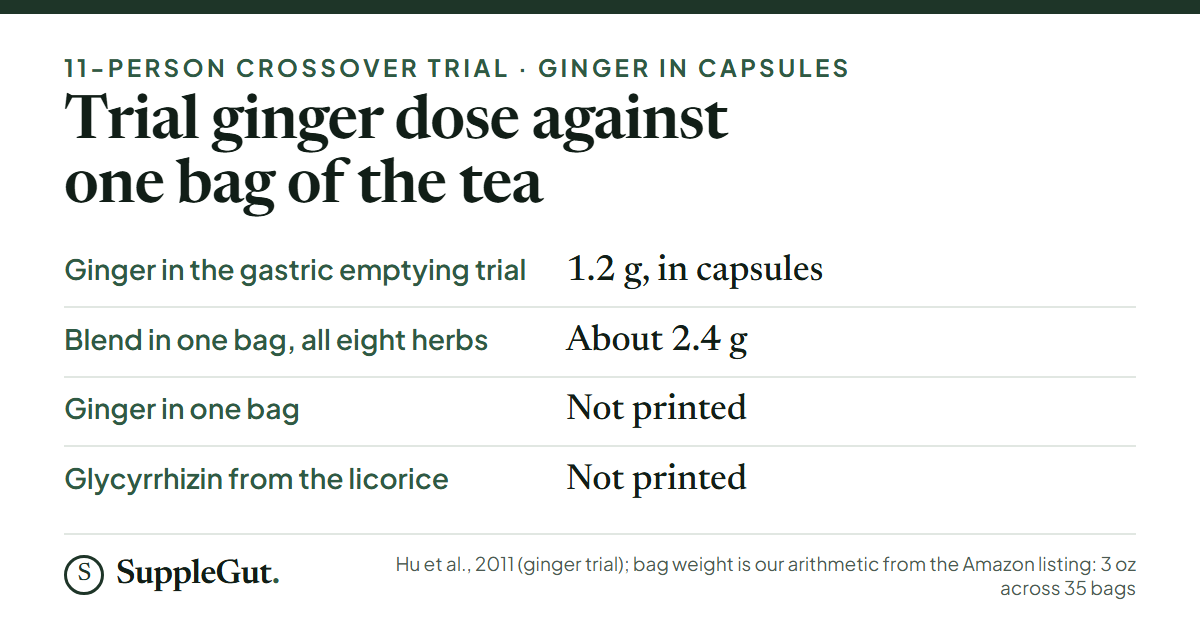
The comparison in the chart is the main limit on the evidence. The ginger that shortened gastric emptying was 1.2 g of ginger alone. A bag of this tea holds about 2.4 g of eight herbs together, and the share that is ginger is not printed.
The licorice question
The blend contains licorice root, and the listing does not say deglycyrrhizinated (DGL), the form with the glycyrrhizin removed. Whole licorice root carries glycyrrhizin, which blocks an enzyme that keeps cortisol from acting on the kidney. At higher or long-term intakes that can cause sodium retention, low potassium, swelling and raised blood pressure. The National Center for Complementary and Integrative Health notes that large amounts or long use can cause serious effects including irregular heartbeat, that small amounts have been linked to severe effects in people with high blood pressure, heart or kidney conditions, and that interactions with corticosteroids have been reported. Memorial Sloan Kettering lists interactions with diuretics, digoxin, corticosteroids, blood pressure drugs and warfarin.
Case reports include swelling, high blood pressure and a potassium level of 3.1 mmol/L after three weeks of licorice herbal teas (Blanpain, Cureus, 2023). How much glycyrrhizin is in a cup of this tea is the open question: the amount of licorice in the blend is not printed. For scale, the testing site ConsumerLab reports 46 mg of glycyrrhizic acid per brewed cup in a licorice tea it tested, which is not this product, and cites 100 mg a day as the European Scientific Committee on Food’s figure for most adults. We cannot place this tea on that scale.
One reviewer on the brand’s page reports noticing foot swelling after two cups a day and names licorice root as the herb that raised a concern. That is a single account, and the cause is not established. The brand’s page carries no licorice, blood pressure or pregnancy warning; the Amazon listing says to consult a healthcare professional before use, especially if pregnant, nursing or taking medications.
How to take it
The brand’s product page says to steep one tea bag in hot water for 5 to 7 minutes and drink 1 to 2 cups daily, especially after meals or in the evening. Amazon’s directions say to use it morning and evening after meals. The brand’s general instructions page gives 3 to 5 minutes for herbal teas in boiling water, which differs from the product page. Because the bags are empty, the amount of tea in each is up to the buyer: one reviewer used about a teaspoon a bag, and another used one bag for 2 quarts of iced tea.
No trial sets a fair test period for this blend. The reviews that describe relief mostly describe it within the first few days; the ones that describe none usually say so in the same window.
Side effects, medicines and who should check first
Besides the licorice cautions above, reviewers report a headache and sinus symptoms, bloating, a feeling of fullness, and reflux that was better at first and then worse. The blend includes chamomile and yarrow, which belong to the daisy family, and fennel, which belongs to the carrot family; the pages carry no allergy warning for either family, and no statement about milk, wheat, soy, tree nuts or cross-contact. The Amazon and eBay listings describe it as gluten free and vegan.
Marshmallow root and slippery elm both contain mucilage, a gel-forming fiber. The EU marshmallow monograph says absorption of other medicines may be delayed and advises taking them at least half an hour to an hour apart; MedlinePlus describes the same concern, on theoretical grounds, for slippery elm. Anyone on a daily medicine, including a proton pump inhibitor or blood pressure tablets, can ask a pharmacist about the timing, and the licorice cautions above apply to the blood pressure and potassium side as well. The Amazon listing advises checking with a healthcare professional if pregnant or nursing.
What the reviews say
Amazon shows 4.1 out of 5 from 315 ratings: 63% five stars, 13% four, 7% three, 5% two and 12% one star. The review text sits behind a sign-in, so the one-star share carries no readable reasons. The brand’s own page shows the same score and republishes about 20 Amazon reviews, each linking to its Amazon page, so it is one source of ratings, not two. The brand’s selection may or may not match the 315. There is no Trustpilot profile for the brand, and an eBay seller of the same product shows 100% positive feedback from 118 ratings at the seller level, not for this tea.
The recurring praise is taste and ease of drinking (Amazon’s summary counts taste at 58 mentions and digestibility at 56), relief from heartburn within a cup or a few days, and a generous quantity in the pouch. The recurring complaints are having to fill the bags, no help or worse reflux for a minority, a strong herbal flavor that one reviewer compared to oregano water, and the monthly cost for a daily drinker.
Where it is sold, returns and who is behind it
The brand’s site has no checkout: the product page’s button goes to Amazon and no price is shown. The Amazon listing is sold by a third-party seller, and Amazon marks it non-returnable for food-safety reasons. The eBay seller does not accept returns, though eBay’s Money Back Guarantee is shown. The brand’s site has no return, refund or subscription policy, and Subscribe & Save is an Amazon option, not a brand program. The site gives a corporate address in Aventura, Florida and an email, and names no owner, company or herbalist, though the ads and the listing describe the blend as herbalist-crafted. We found no testing, certificate of analysis or manufacturing statement on the brand page, Amazon listing or ads.
Who this tea is for
- Someone who wants a mild, caffeine-free after-dinner herbal tea and is comfortable filling their own tea bags.
- Someone with occasional post-meal discomfort who has no high blood pressure, heart or kidney condition, is not pregnant or nursing, and does not take diuretics, corticosteroids or digoxin.
- A person content with a traditional-use product that has no trial of its own.
For comparison, the catalog holds Traditional Medicinals Organic Ginger Tea, a single-herb ginger tea, and Nature’s Way Slippery Elm Bark Capsules, where the amount of slippery elm is printed. The Liáo Herbal guide covers another licorice-containing reflux product, and the quiz starts from symptoms rather than products. Heartburn that is frequent, wakes you at night, or comes with trouble swallowing, black stools or weight loss is a reason to see a doctor.
Cost
A 3 oz pouch with 35 bags is $24.99 on Amazon, or $22.49 on Subscribe & Save. That is about $0.71 a day at one cup and $1.43 at two, or $0.64 to $1.29 on Subscribe & Save. The eBay seller lists $24.99 for one pouch and $19.99 each for four or more, with 30 bags a pouch, which is $0.83 a day at one cup for a single pouch and $0.67 at four or more. Shipping is free with Prime or over $35 on Amazon and free on eBay.
The products in this catalog
Common questions
Does It’s Health Tea GERD tea work?
No trial of this tea was found. Ginger, its first-listed herb on the brand’s site, sped stomach emptying in an 11-person trial in functional dyspepsia at 1.2 g in capsules without changing symptoms, and the label gives no amount for any of the eight herbs. Amazon reviews average 4.1 from 315 ratings (63% five stars, 12% one star), and reviewers describe relief within days, no change, or worse symptoms.
Is It’s Health Tea GERD tea safe, and does the licorice matter?
The blend contains whole licorice root, which carries glycyrrhizin; at higher or long-term intakes it can raise blood pressure and lower potassium, and its amount in this tea is not printed. Amazon’s safety text says to consult a healthcare professional if pregnant, nursing or taking medications, and one reviewer reported foot swelling on two cups a day. The Liáo Herbal guide covers the same licorice cautions in more detail.
What is in It’s Health Tea GERD tea?
Organic ginger root, slippery elm, yarrow, fennel seed, chamomile, rosemary, licorice root and marshmallow root, with no sweetener or caffeine. No amount is printed for any herb, and the brand’s site and Amazon list them in a different order. It is a loose-leaf blend, about 2.4 g per bag by our arithmetic, sold with 35 empty bags to fill yourself.
How do you take it, and how many cups a day?
The brand says to steep one bag in hot water for 5 to 7 minutes and drink 1 to 2 cups a day, especially after meals or in the evening. Because the bags are empty, the amount per cup depends on how you fill them; the brand’s instructions page describes about 1 g for a lighter cup and about 3 g for a stronger one. Marshmallow root and slippery elm can delay the absorption of other medicines, so the monograph advises spacing them half an hour to an hour apart.
How much does It’s Health Tea GERD tea cost?
A 3 oz pouch with 35 bags is $24.99 on Amazon and $22.49 on Subscribe & Save, which is about $0.71 a day at one cup and $1.43 at two. The brand’s site shows no price and links to Amazon. The same product is $24.99 on eBay, with 30 bags a pouch.
Who makes It’s Health Tea, and can the tea be returned?
The brand lists an office in Aventura, Florida and names no owner, company or herbalist, and the Amazon seller is a third party. Amazon marks the tea non-returnable for food-safety reasons and the eBay seller does not accept returns. The brand has no checkout or refund policy of its own, and we found no Trustpilot profile and no billing complaints.
What other ginger or slippery elm products does the catalog hold?
For a single-herb ginger tea, see Traditional Medicinals Organic Ginger Tea; for slippery elm with the amount printed, Nature’s Way Slippery Elm Bark Capsules. The quiz matches products to symptoms.
Sources
- Hu ML, Rayner CK, Wu KL, et al. "Effect of ginger on gastric motility and symptoms of functional dyspepsia." World Journal of Gastroenterology, 2011;17(1):105–110. doi.org/10.3748/wjg.v17.i1.105
- Giacosa A, Guido D, Grassi M, et al. "The Effect of Ginger (Zingiber officinalis) and Artichoke (Cynara cardunculus) Extract Supplementation on Functional Dyspepsia: A Randomised, Double-Blind, and Placebo-Controlled Clinical Trial." Evidence-Based Complementary and Alternative Medicine, 2015;2015:915087. doi.org/10.1155/2015/915087
- Martin Z, Spry G, Hoult J, et al. "What is the efficacy of dietary, nutraceutical, and probiotic interventions for the management of gastroesophageal reflux disease symptoms? A systematic literature review and meta-analysis." Clinical Nutrition ESPEN, 2022;52:340–352. doi.org/10.1016/j.clnesp.2022.09.015
- Báez G, Vargas C, Arancibia M, et al. "Non-Chinese herbal medicines for functional dyspepsia." Cochrane Database of Systematic Reviews, 2023;6:CD013323. doi.org/10.1002/14651858.CD013323.pub2
- Raveendra KR, Jayachandra, Srinivasa V, et al. "An Extract of Glycyrrhiza glabra (GutGard) Alleviates Symptoms of Functional Dyspepsia: A Randomized, Double-Blind, Placebo-Controlled Study." Evidence-Based Complementary and Alternative Medicine, 2012;2012:216970. doi.org/10.1155/2012/216970
- Hawrelak JA, Myers SP. "Effects of two natural medicine formulations on irritable bowel syndrome symptoms: a pilot study." Journal of Alternative and Complementary Medicine, 2010;16(10):1065–1071. doi.org/10.1089/acm.2009.0090; Ried K, Travica N, Dorairaj R, et al. "Herbal formula improves upper and lower gastrointestinal symptoms and gut health in Australian adults with digestive disorders." Nutrition Research, 2020;76:37–51. doi.org/10.1016/j.nutres.2020.02.008
- Blanpain JS. "A Licorice-Flavored Edema: A Case Report of Glycyrrhizic Acid Toxicity From Chronic Licorice Root Consumption." Cureus, 2023;15(1):e34425. doi.org/10.7759/cureus.34425
- European Medicines Agency, EU herbal monographs on Althaea officinalis root (EMA/HMPC/436679/2015) and Matricaria recutita flower (EMA/HMPC/55843/2011): marshmallow root, chamomile; MedlinePlus, slippery elm
- NIH National Center for Complementary and Integrative Health, "Licorice Root" (nccih.nih.gov/health/licorice-root); Memorial Sloan Kettering Cancer Center, "Licorice" (mskcc.org); ConsumerLab, licorice supplements review (consumerlab.com)
- Brand page: ingredients, directions, reviews and claims (itshealthtea.com) and instructions page (itshealthtea.com/instructions); Amazon listing: price, ratings, directions and safety text (amazon.com/dp/B0B2LZK99D); eBay listing: price and return terms (ebay.com/itm/125614274567)
Not sure which product fits your situation?
This guide covers the mechanics. The quiz takes your specific symptoms, routine and preferences and matches you to one product from the catalog.
Take the quiz →