
Guide
Does milktab work? A 27,000 FCC lactase tablet, and the doses the trials used
Quick answer
Does milktab work? No trial of milktab was found. Lactase on its own lowered breath hydrogen by 55% in 47 adults at 13,500 FCC in one sitting and by 33% at 9,000 FCC in 24 adults, and each tablet holds 27,000 FCC, a dose no trial tested, with protease and lipase that have no human trial in lactose intolerance. Reviews split: 4.2 from 239 ratings on Amazon with 12% one-star, 4.9 from 58 on the brand’s own page, and 2.7 from four on Trustpilot.
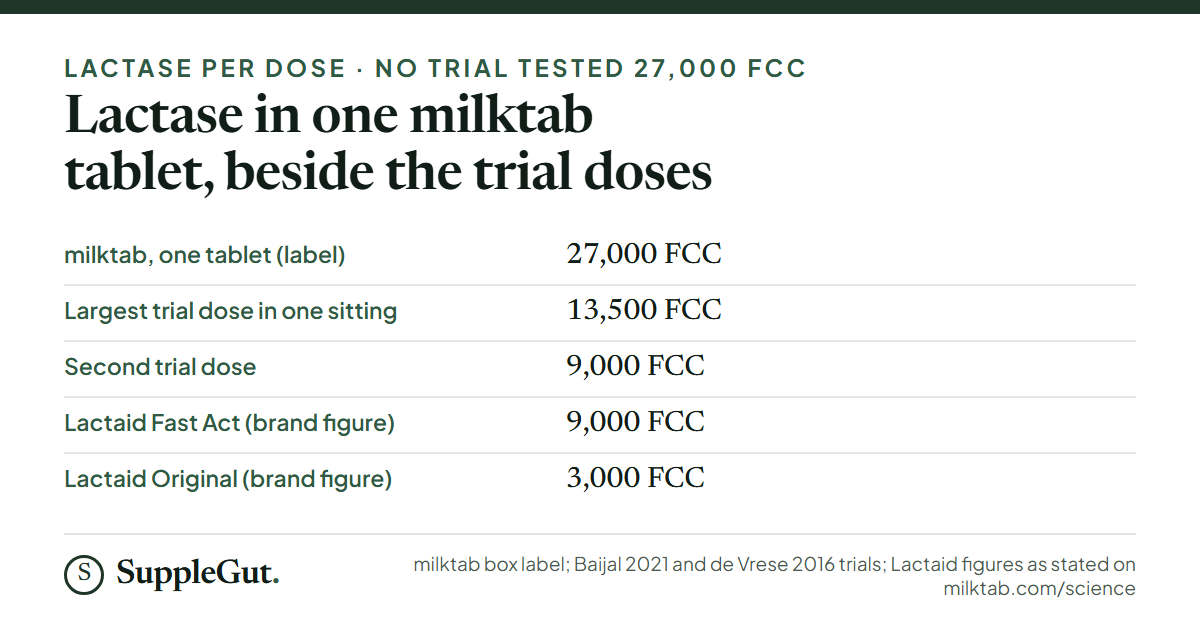
milktab is a lactase tablet with two extra enzymes in it. Each round tablet holds 27,000 FCC of lactase, 22,000 FCC of protease and 1,000 FIP of lipase, taken with the first bite of dairy, and the brand markets it on that lactase figure, which it says is three times Lactaid Fast Act. This page sets out what the label prints, what the lactase trials used, what is known and not known about the added protease and lipase, what reviewers on each platform report, what the refund and subscription pages say, and what a tablet costs.
What milktab is, and what it is not
The Supplement Facts panel lists three enzymes, each with its own amount and no proprietary blend: lactase 27,000 FCC, protease 22,000 FCC and lipase 1,000 FIP, one tablet to a serving. The inactive ingredients are microcrystalline cellulose, croscarmellose sodium and silica, and the Amazon version of the label adds vegetable stearate, so the two label images differ by one excipient. The box front reads “50,000 enzyme units,” which is 27,000 plus 22,000 plus 1,000 added together; the lipase is printed in FIP units while the other two are in FCC, so that total adds unlike units and the three numbers are not directly comparable. The label does not name the organism the enzymes come from, and no manufacturer is stated.
It is a dietary supplement with a Supplement Facts panel, not a drug. The brand site states it is vegan, non-GMO, FODMAP-free and “third-party tested,” and Amazon adds gluten-free. No laboratory is named for the testing, and we could not find a certificate of analysis or a third-party certification mark.
How lactase works, and why the dose per meal matters
Lactase is the enzyme that splits lactose, the sugar in milk, into glucose and galactose. When the body makes too little, undigested lactose reaches the colon and is fermented, which produces gas, bloating, cramping and loose stools. A review of lactose malabsorption and intolerance notes that whether symptoms appear depends on how much lactose is eaten, how much lactase the person still makes, and the gut microbiome (Misselwitz et al., Gut, 2019). A lactase tablet works only on the meal it is eaten with, which is why the trials give it just before or with the lactose and measure hydrogen on the breath afterward: bacteria in the colon release hydrogen when they ferment lactose, so less hydrogen means less lactose arrived there.
The enzyme has to be present in the stomach and small intestine at the same time as the lactose. That is why the milktab directions say to take the tablet with the first bite of dairy, and why the amount that works scales with how much lactose is in the meal. A splash of milk in coffee and a bowl of ice cream are different loads.
What the lactase trials used
We found no trial of milktab, and none of any tablet that combines lactase, protease and lipase. The evidence is for lactase on its own, at lower doses than this tablet carries.
- 13,500 FCC in one sitting: a randomized, double-blind, placebo-controlled crossover in 47 adults with lactose intolerance gave three 4,500 FCC chewable tablets five minutes before a 25 g lactose load. Cumulative breath hydrogen over 180 minutes was 55% lower than on placebo, and symptom scores were lower too. The sponsor supplied the tablets and placebo and paid for the breath tests (Baijal et al., JGH Open, 2021).
- 3,300 and 9,000 FCC: a five-arm placebo-controlled crossover in 24 lactose malabsorbers on a 12.5 g lactose load. Peak hydrogen was 29% lower at 3,300 FCC and 33% lower at 9,000 FCC, and the higher dose also reduced flatulence (de Vrese et al., Clinical Nutrition, 2016).
- Doses in IU: 30 adults drinking 400 ml of milk had a mean peak hydrogen of 12 to 14 ppm after 3,000 or 6,000 IU of lactase, against 51 ppm on placebo (Montalto et al., European Journal of Clinical Nutrition, 2005). That trial used a different unit, so it does not sit on the FCC scale.
- Other designs: tilactase beat placebo in 60 lactose-intolerant adults (Ojetti et al., 2010), and a 129-adult, 42-day trial found a lactase tablet non-inferior to Lactaid (Francesconi et al., 2017).
The tablet carries 27,000 FCC, twice the largest single-sitting dose in a placebo-controlled trial we found and three times the 9,000 FCC dose. No trial tested 27,000 FCC, and we found no trial that compared a higher lactase dose with a lower one in the same people. The brand’s own studies page lists the Baijal and de Vrese trials and says its figure is more lactase than any dose in them. The directions allow a second tablet after 30 minutes, which would put up to 54,000 FCC across one dairy occasion. What a dose that high adds over 13,500 FCC for a given person is not answered by the trials.
The 55% and 33% figures come from different lactose loads (25 g and 12.5 g), different breath-hydrogen measures (cumulative and peak) and different people, so they are not one dose-response line.
The added protease and lipase
The brand’s science page explains that milk contains protein (casein) and fat as well as lactose, about 8 g of each in a cup, and describes protease and lipase as covering those. It cites no human trial of the two enzymes. Our PubMed searches for protease or lipase supplements and milk protein or milk fat digestion in people returned no trial in lactose intolerance; the one lipase hit was a study in piglets. The brand also states that milktab is the only lactase supplement formulated with protease among those over 3,000 FCC. That is a claim from the brand’s page, and the benefit of the two added enzymes at these doses has no human trial behind it that we could find.
The science page also says casein intolerance can look similar to lactose intolerance. A milk-protein allergy is a separate condition, and the label gives no guidance for it.
How to take milktab
The box directions: one tablet with the first bite of dairy, and a second tablet after 30 minutes if dairy continues, no more than two tablets in total. The site says no more than two tablets a day. It is taken per dairy occasion, not on a daily schedule. The tablet is round, and one Amazon reviewer says it is hard to swallow whole and cuts it in half; another reviewer describes the sleeve packaging as hard to get tablets out of without breaking them. Because the effect is tied to the meal, a fair test is a few dairy meals of different sizes, noting symptoms after each.
Side effects and who should not take it
The label images, the brand site, the Shopify page and Amazon’s listing carry no pregnancy, nursing, medication, age or medical-condition warning beyond the standard FDA disclaimer and the two-tablet limit. The one warning printed is an allergen statement: manufactured on shared equipment that might produce products containing milk, egg, soy, wheat, peanut, tree nut, fish, shellfish and sesame. That is a cross-contact statement, not an ingredient list, and the box does not say the tablet is dairy-free. Amazon’s summary of review text counts 33 mentions of stomach sensitivity, 28 of them positive (no upset stomach or cramps) and 5 negative.
What the reviews say
| Platform | Score | Count | Notes |
|---|---|---|---|
| Amazon | 4.2 of 5 | 239 ratings | 70% five-star, 12% one-star; independent |
| Brand site reviews page | 4.9 | 58 reviews | Self-hosted; all four or five stars, all dated 2024 |
| Brand site badge | 4.9 | “60K+ members” | Not a review count |
| Trustpilot | 2.7 | 4 reviews | Profile unclaimed |
| Better Business Bureau | Rating B | 2 complaints in 3 years | Not accredited; no customer reviews |
The independent figure is the Amazon one. Amazon’s own summary of review text counts 90 mentions of effectiveness, 79 positive and 11 negative, and 22 mentions of value for money, 14 positive and 8 negative. The recurring praise is that one tablet is enough where reviewers needed several of another brand, no bloating, cramping or diarrhea after pizza or ice cream, and a thin sleeve that fits in a wallet. The recurring complaints are that it did not work for the reviewer or the price was too high for the result, the taste and the hard-to-swallow shape, and a fulfillment problem: reviewers say they paid for the 45-count and received the 15-count, in one case three times in a row. Every label image we found shows the 15-count sleeve.
The refund and subscription terms
The brand states its refund window three ways. The home page badge says 30-day money-back. The Terms page says a “14-Day Happiness Guarantee”: tell the company within 14 days of receiving the product and the refund is full, with the product returned in its original packaging and the refund usually taking 3 to 5 days. The Shopify store’s refund policy says 30 days, still contains the placeholder text “[INSERT RETURN ADDRESS],” and lists perishable and personal care goods as non-returnable. Amazon orders follow Amazon’s standard returns.
The home page offers a subscription at 30% off the first order and then 10% off, with free shipping and “edit or cancel anytime,” and the checkout page says the item is a recurring purchase that authorizes charges to the payment method. A single box can be bought one time on the brand site or on Amazon. The four Trustpilot reviews concern the brand site: three are about shipping delays or no reply to messages, and one describes a returned product with no response and a subscription-management page the writer could not open. Four reviews on an unclaimed profile are a sample, not a measured rate, and the two BBB complaints do not show their details. We found no pattern of unexpected recurring charges.
Who milktab is for
- Someone with confirmed or strongly suspected lactose intolerance who wants one tablet per dairy occasion rather than several.
- A person for whom a lower-dose lactase has not been enough and who is willing to test a higher dose, knowing no trial tested it.
- Someone who wants each enzyme’s amount printed and no proprietary blend.
Lactaid Fast Act is the other tablet to compare; its page records the rating and price, and its lactase is lower per caplet. For milk drunk at home, Seeking Health Lactase Drops are added to the milk a day ahead, so the lactose is gone before the glass is poured. If the trigger is not dairy alone, FODZYME is a powder aimed at FODMAPs generally. The bloating and gas guide starts from the symptom, Do digestive enzymes work? covers the enzyme evidence as a group, and the quiz matches a pattern of symptoms to products.
Cost
| Route | Price | Per tablet |
|---|---|---|
| Amazon, 45 tablets, one time | $29.99 | $0.67 |
| Amazon, 45 tablets, subscribe discount | $26.99 | $0.60 |
| Brand site, 45 tablets | $29.00 | $0.64 |
| Amazon or brand site, 15 tablets | $12.95 | $0.86 |
The brand site also shows lower per-box prices for 3 and 5 boxes ($26.10 and $20.30 a box). One tablet per dairy occasion costs the per-tablet figure, and a second tablet doubles it. Against Lactaid, the comparison on cost per unit of lactase: at $0.67 a tablet for 27,000 FCC, milktab works out to about 2.5 cents per 1,000 FCC; at the roughly $0.20 a caplet recorded on the Lactaid page for 9,000 FCC (the figure the milktab science page gives for Lactaid Fast Act), Lactaid is about 2.2 cents per 1,000 FCC. Per caplet, Lactaid costs less; per unit of lactase, the two are close.
The products in this catalog
Common questions
Does milktab work?
No trial of milktab was found. Lactase alone lowered breath hydrogen by 55% in 47 adults at 13,500 FCC in one sitting and by 33% at 9,000 FCC in 24 adults; milktab has 27,000 FCC, a dose no trial tested, plus protease and lipase that have no human trial in lactose intolerance. On Amazon, 70% of 239 ratings are five-star and 12% are one-star, and 79 of 90 effectiveness mentions in Amazon’s summary are positive.
Is milktab safe, and what are the side effects?
The box carries no pregnancy, medication or age warning and limits use to two tablets, with the site saying no more than two a day. It lists microcrystalline cellulose, croscarmellose sodium and silica (plus vegetable stearate on the Amazon label version) and warns of shared equipment with milk, egg, soy, wheat, peanut, tree nut, fish, shellfish and sesame. Amazon’s review summary shows 5 negative of 33 mentions of stomach sensitivity.
How much does milktab cost?
A 45-tablet box is $29.99 on Amazon ($0.67 a tablet, or $26.99 with the subscribe discount) and $29.00 on the brand site ($0.64 a tablet). The 15-tablet sleeve is $12.95 ($0.86 a tablet). The brand site shows lower per-box prices for 3 and 5 boxes ($26.10 and $20.30).
milktab vs Lactaid: how do the doses compare?
The brand compares 27,000 FCC of lactase per tablet with 9,000 FCC in Lactaid Fast Act and 3,000 FCC in Lactaid Original, and adds protease and lipase that Lactaid does not have. Lactaid has more independent ratings (4.5 from 1,543 ratings at Walmart, as the Lactaid page records) than milktab (4.2 from 239 on Amazon). No trial compared the two, and the highest lactase dose tested against placebo was 13,500 FCC.
Do protease and lipase add anything to lactase?
The brand says protease covers milk protein and lipase covers milk fat, which are in milk alongside lactose. We found no human trial of either enzyme in lactose intolerance, and the lipase amount is printed in FIP units, which differ from the FCC units of the other two. The lactase trials tested lactase alone.
What is milktab’s refund policy?
The brand states it three ways: 14 days on the Terms page, 30 days on the home page and on the Shopify refund policy, which still holds the placeholder “[INSERT RETURN ADDRESS].” Subscriptions are described as “edit or cancel anytime.” Trustpilot shows 2.7 from four reviews on an unclaimed profile, three about shipping delays or no reply and one about a subscription page that would not load, and the BBB lists a B rating with 2 complaints in three years.
How do you take milktab?
The box says one tablet with the first bite of dairy, and a second tablet after 30 minutes if dairy continues, no more than two tablets total. It is taken per dairy occasion rather than on a daily schedule. A reviewer notes the round tablet is hard to swallow whole.
Sources
- Baijal R, Tandon RK, et al. Lactase tablets in lactose intolerance: randomized, double-blind, placebo-controlled crossover, 47 adults, 3 x 4,500 FCC. JGH Open, 2021. PMID 33490624. pubmed.ncbi.nlm.nih.gov/33490624
- de Vrese M, et al. Acid lactase at 3,300 and 9,000 FCC with yogurt culture in 24 lactose malabsorbers: randomized, double-blind, placebo-controlled crossover. Clinical Nutrition, 2016. PMID 25042846. pubmed.ncbi.nlm.nih.gov/25042846
- Montalto M, et al. Kluyveromyces lactis lactase added to milk, 30 lactose malabsorbers: double-blind, placebo-controlled crossover. European Journal of Clinical Nutrition, 2005. PMID 15674309. pubmed.ncbi.nlm.nih.gov/15674309
- Ojetti V, et al. Tilactase compared with L. reuteri and placebo in 60 lactose-intolerant adults. European Review for Medical and Pharmacological Sciences, 2010. PMID 20391953. pubmed.ncbi.nlm.nih.gov/20391953
- Francesconi CF, et al. Lactase tablet compared with Lactaid: multicenter, randomized, single-blind, non-inferiority trial, 129 adults, 42 days. Arquivos de Gastroenterologia, 2017. PMID 27706451. pubmed.ncbi.nlm.nih.gov/27706451
- Misselwitz B, et al. Update on lactose malabsorption and intolerance: pathogenesis, diagnosis and clinical management. Gut, 2019. PMID 31427404. pubmed.ncbi.nlm.nih.gov/31427404
- milktab box back label: Supplement Facts, directions and allergen statement. cdn.shopify.com
- milktab brand pages: home page, studies, science, reviews and terms; refund policy at shop.milktab.com.
- Amazon listings for the 45-count (B0DCPBXGJW) and 15-count (B0DL8TX1SQ): price, rating and review summary.
- Independent profiles: Trustpilot and the Better Business Bureau.

Not sure which product fits your situation?
This guide covers the mechanics. The quiz takes your specific symptoms, routine and preferences and matches you to one product from the catalog.
Take the quiz →