
Guide
Does Pinch Magic Fiber work? A 5 g psyllium powder with no trial of its own, and trials that used 10 g or more
Quick answer
Does Pinch Magic Fiber work? We found no trial of Pinch Magic Fiber. Psyllium, its main ingredient, helped chronic constipation in a meta-analysis of 16 trials in 1,251 adults, which judged doses above 10 g a day for at least four weeks to be optimal, and an IBS trial of 275 adults used 10 g a day. A scoop holds 5 g. No trial of the 50 mg or 150 mg of bromelain was found. The brand page shows 4.9 from 1,004 reviews, and there is no Amazon listing.
Pinch Magic Fiber is a flavored psyllium husk powder from Pinch, Inc. of Santa Monica, California, sold in a 28-serving jar in two flavors, Lemon Ginger and Tropical. One scoop holds 5,000 mg of psyllium husk powder, 5 g of fiber and no sugars, plus bromelain and vitamins C and D2. The brand sells it as a daily gut-health fiber, and nearly all of its review record sits on its own page. This page sets out what the two labels print, what the psyllium trials used, and what the reviews, price and refund terms say.
What Pinch Magic Fiber is, and what it is not
The panel is headed Supplement Facts, not Drug Facts or Nutrition Facts, so it is sold as a dietary supplement and not as an over-the-counter laxative. A serving is one scoop (approximately 6.9 g) and a jar holds 28. Both flavors print the same base: 20 calories, 5 g of total carbohydrate, 5 g of dietary fiber (18% of the Daily Value), 0 g of sugars, 90 mg of vitamin C (100%) and 20 mcg of vitamin D2 (100%), plus 5,000 mg of psyllium husk powder. The flavors differ in three lines:
| Per scoop | Lemon Ginger | Tropical |
|---|---|---|
| Psyllium husk powder | 5,000 mg | 5,000 mg |
| Bromelain | 50 mg | 150 mg |
| Ginger root extract | 100 mg | not present |
| Beet root powder | not present | 100 mg |
| Other ingredients | Citric acid, lemon flavor, annatto (color), turmeric root powder, stevia leaf extract | Citric acid, pineapple, mango and passionfruit flavors, stevia leaf extract |
Every active carries its own amount, so there is no proprietary blend. Psyllium is the only fiber named, and the 5 g fiber line matches the 5,000 mg of husk powder; the panel does not say what share of the husk is fiber. The panel lists no laxative herb such as senna, cascara or aloe, and it makes no antimicrobial claim. Sweetening is stevia, so the product is sugar-free, not unsweetened. The brand calls it a “prebiotic fiber,” but the label has no separate prebiotic ingredient.
The pages state no allergen line and no facility statement. The brand says the product is gluten-free, keto, vegan, Whole30 and non-GMO, which are its own statements, and it names no third-party testing body.
The brand’s older “magic ingredients” landing page does not match the current labels. It says Lemon Ginger has 3 g of organic cane sugar and no vitamins C or D, and it shows a $32 one-time and $25 subscription price. The product page and the panel images show 0 g of sugars, vitamins C and D2 in both flavors, and $35 and $27. This page follows the product page and the panel images.
Is there a trial of Pinch Magic Fiber itself?
We found none. A PubMed search for the product name with psyllium and bromelain returned no results, and the brand cites no study of its own powder. None of the ingredients is a branded or trademarked extract, so there is no branded-ingredient trial to point to either. The landing page carries statements from three physicians and a line that only 1 in 20 Americans reaches the daily fiber intake, with a government dietary guidelines source; neither is a trial of this product. The evidence below is for psyllium as a class and for bromelain on its own.
The psyllium trials, and the 5 g against 10 g dose gap
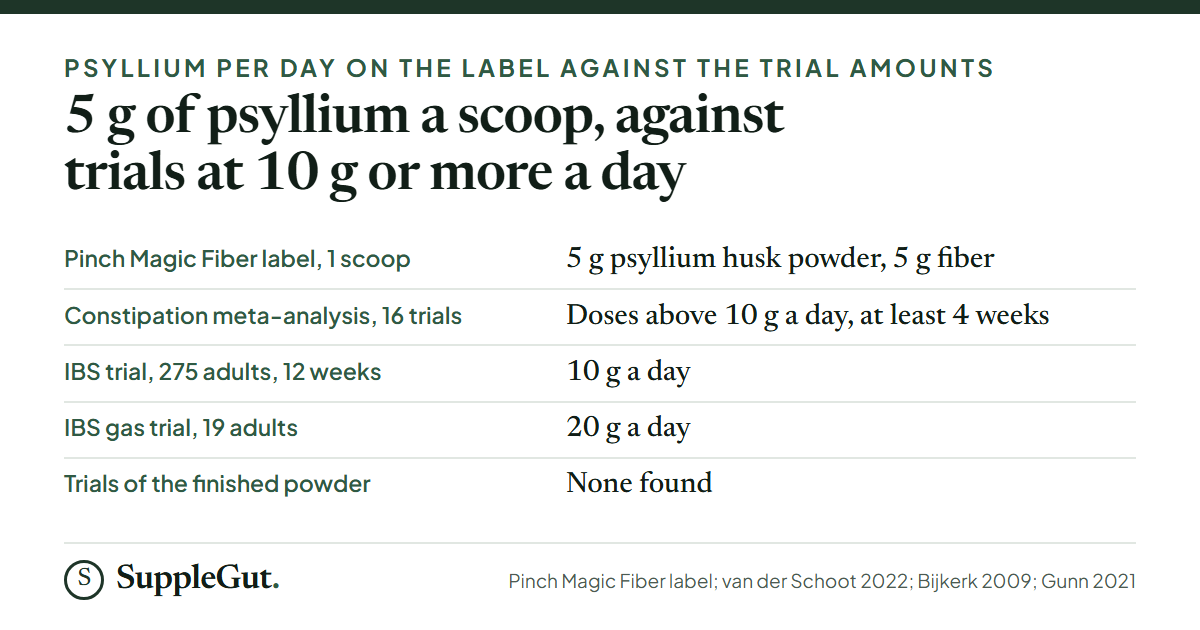
Psyllium has randomized trials in constipation and in irritable bowel syndrome (IBS). The recurring point is dose: the trials that found benefit used more psyllium a day than one scoop of Pinch holds.
- Chronic constipation. A meta-analysis of 16 randomized trials in 1,251 adults found fiber supplements raised response from 41% to 66% (risk ratio 1.48, 95% CI 1.17 to 1.88). Psyllium and pectin had significant effects, and the authors judged psyllium at doses above 10 g a day for at least four weeks to be optimal. Flatulence was higher on fiber than on control (SMD 0.80, 95% CI 0.47 to 1.13) (van der Schoot et al., American Journal of Clinical Nutrition, 2022).
- IBS in primary care. A trial of 275 adults compared 10 g a day of psyllium, 10 g of bran and a 10 g rice flour placebo for 12 weeks. In the first month 57% responded on psyllium against 35% on placebo (risk ratio 1.60, 1.13 to 2.26), and in the second month 59% against 41%. Symptom severity fell by 90 points on psyllium and 49 on placebo (P = 0.03), and only 64% of the psyllium group finished the 12 weeks (Bijkerk et al., BMJ, 2009).
- Gas in IBS. In a crossover trial of 19 people with IBS, 20 g of psyllium alone did not raise breath hydrogen and produced less colonic gas than 20 g of inulin. Psyllium added to inulin reduced inulin’s gas peak but did not directly inhibit its fermentation (Gunn et al., Gut, 2021).
| Source | Psyllium per day | Against one scoop of Pinch |
|---|---|---|
| Pinch Magic Fiber label | 5 g psyllium husk powder | One scoop, the labeled direction |
| Constipation meta-analysis, 16 trials | Above 10 g, at least 4 weeks | Pinch gives half of 10 g |
| IBS trial, 275 adults | 10 g, 12 weeks | Twice the Pinch amount |
| IBS gas trial, 19 adults | 20 g | Four times the Pinch amount |
The 5 g in a scoop is half the amount the constipation meta-analysis points to and half the IBS trial dose, so the trials do not show what this scoop does on its own. The directions give one scoop a day. The brand’s own FAQ says Pinch is “not a fast acting laxative” and gives four to six days before a change is noticed. How long psyllium takes to act is covered in the psyllium timing guide, and the constipation guide sets out the wider evidence.
Bromelain, ginger, beet and the vitamins
The brand says bromelain “aids in digestion and protein absorption.” We found no randomized trial of oral bromelain for digestion or gut symptoms: a PubMed query for it returned no results. The amounts here are 50 mg in Lemon Ginger and 150 mg in Tropical, and no trial used either. We did not search ginger (100 mg, Lemon Ginger) or beet root (100 mg, Tropical) separately, and at those amounts the panel supports only the psyllium evidence above. The turmeric in Lemon Ginger is listed under other ingredients with no amount.
The 90 mg of vitamin C and 20 mcg of vitamin D2 are each 100% of the Daily Value, in both flavors. The brand’s page also asterisks wider claims about cholesterol, blood sugar, mood and cognition. We found no study of this product for any of them.
How to take it
The brand’s directions are to add 8 oz of cool water to a shaker bottle, add one scoop, shake well and drink it quickly before the mixture thickens. It says any time of day works, morning before or after breakfast or evening before bed, and food is not required. The brand also sells a shaker bottle and a mixer. The thickening is why the 8 oz of water and the speed are in the directions.
The brand’s FAQ gives four to six days to notice a change. In the Okendo summary of recent reviews, some reviewers say it takes a few weeks to see the full effect. The constipation meta-analysis counted treatment durations of at least four weeks, which is longer than the brand’s window.
Side effects and who should check first
The panel images and the product page carry no warning text beyond the standard FDA disclaimer, and the sides of the jar were not photographed in full. The jar may carry statements the pages do not, so read it when it arrives. Gas, bloating and cramps are the usual effects of adding fiber, and the constipation meta-analysis found more flatulence on fiber than on control. Fibers that form a gel can slow the absorption of other pills, so a pharmacist can say how to space a specific medicine, and anyone with a bowel condition or a swallowing difficulty can ask a clinician first.
In the reviews, a few people report gas, bloating or worse symptoms, one saying it left them “extremely bloated” until they stopped, and one noting it was “not that great for ibs.” Many others in the same feed say it did not cause bloating at all.
What the reviews say
The product page runs an Okendo review widget showing 4.9 out of 5 from 1,004 reviews (4.876 on the widget’s own count): 927 five-star, 57 four-star, 5 three-star, 3 two-star and 12 one-star. The widget also shows 98% (982 of 1,004) answering yes to its closing question. This is a review feed the brand hosts, and the brand replies to many reviews. Okendo flags none of the reviews we read as incentivized, and 806 of the 1,088 records in the feed are marked verified buyer. We found no Amazon listing under the Pinch name in three searches, so there is no retailer rating. A Trustpilot profile for pinchmagic.com exists, but we could not verify its figures and do not use them here.
The low-star reviews cluster in one year. Of the 998 reviews in the feed for this product, 15 are one or two stars: 14 are dated 2023, one is dated 2025, and none is dated 2024 or 2026. The year 2024 holds 327 reviews in the feed. We did not find the reason for the gap.
Across the feed, 312 of the 998 reviews mention taste or flavor and 190 mention regularity or constipation. Okendo’s summary of the 100 most recent reviews says customers describe good taste, smooth mixing without grittiness, and improved digestion and less bloating, with a few noting that the powder thickens if not drunk quickly. The recurring praise is:
- Regularity. “Keeps me regular and on schedule” is typical of the five-star text.
- Taste and mixing. One reviewer writes that it “mixes really smoothly and is not gritty.”
- Customer service and a small daily dose. Several reviewers praise a quick reply after a first order, and one describes a full refund.
The recurring complaints, mostly in the 2023 reviews, are no noticeable effect after about two weeks, gas or bloating in a few people, and price, shipping or subscription problems. One 2023 one-star review says the company “can’t keep up with subscriptions,” and another says generic fiber works better at a lower price. Across all 1,088 records, subscription or autoship appears in 69 reviews, two of them rated three stars or lower, and refunds appear in two.
Almost all of the review evidence for Pinch comes from one brand-hosted widget. Okendo is a real review app and flags no review as incentivized, but there is no retailer or independent profile we could read to check it against.
Price, the subscription and the refund terms
A 28-serving jar is $35.00 one time, which is $1.25 a day. Other routes on the brand site:
| Route | Price | Per day |
|---|---|---|
| One jar, one time | $35.00 | $1.25 |
| One jar, subscription (every 28 days, 22.86% off) | $27.00 | $0.96 |
| Three jars, one time | $96.00 ($32.00 a jar) | $1.14 |
| Six jars, one time | $174.00 ($29.00 a jar) | $1.04 |
Shipping is extra: $3.50 standard, $6.50 expedited and $9.50 priority. The banner advertises a 10% first-order code. The product data allow a one-time purchase without a plan. We could not tell from the page source whether the subscription option is pre-selected, so check the selection before checking out.
The product page says the item is a deferred, subscription or recurring purchase and that continuing authorizes charges to the payment method until the order is fulfilled or cancelled. The landing page says subscribers can cancel or delay at any time, and the refund policy says a warning email goes out three days before a renewal.
The refund policy states a money-back guarantee, excluding delivery charges, for people who try Pinch for at least 7 consecutive days. Requests must be made within 30 days of delivery of the first order, and the jar must reach the brand within 15 days of the request. It covers a maximum of one jar per customer and only the first order, return shipping is the customer’s cost, and refunds are not available for customers who did not cancel their subscription in time.
Pinch vs Metamucil
Both are psyllium powders, so the active fiber is the same. Pinch prints 5,000 mg of psyllium husk a scoop with 0 g of sugars, stevia sweetening, bromelain and vitamins C and D2. The brand’s comparison table sets Pinch against “ordinary fiber” at 2,000 mg of fiber and 8 g of sugar, without naming a product, and that table is the brand’s claim. No trial compares the two. In the review feed, Metamucil is named in 42 of the 1,088 records, mostly by people who switched from it. One reviewer writes that Pinch “tastes better, you use less,” while a one-star reviewer writes that Metamucil “works better and is cheaper.” The Metamucil page has that label and its price.
Who Pinch Magic Fiber is for
- Someone who wants a flavored psyllium powder with 0 g of sugars, sweetened with stevia, in a lemon-ginger or tropical flavor.
- Someone who wants a once-a-day scoop shaken into 8 oz of water and is willing to drink it before it thickens.
- Someone who accepts the brand’s terms: a first-order, one-jar refund, and no refund for a renewal that was not cancelled in time.
For other psyllium powders with the amount printed, the catalog has Yerba Prima, NOW Foods and ColonBroom. The constipation guide starts from the symptom, as does the quiz.
The products in this catalog
Common questions
Does Pinch Magic Fiber work?
No trial of Pinch was found. Psyllium helped chronic constipation in a 16-trial meta-analysis that judged doses above 10 g a day for at least four weeks to be optimal, and a scoop of Pinch holds 5 g. The brand’s review widget shows 4.9 from 1,004 reviews, with 12 one-star reviews.
What is in Pinch Magic Fiber?
One scoop holds 5,000 mg of psyllium husk powder, 5 g of fiber, 0 g of sugars, 90 mg of vitamin C and 20 mcg of vitamin D2. Lemon Ginger adds 50 mg of bromelain and 100 mg of ginger root extract, and Tropical adds 150 mg of bromelain and 100 mg of beet root powder. Both use stevia, and there are no laxative herbs and no proprietary blend.
How do you take Pinch Magic Fiber, and how long does it take?
The brand says to shake one scoop into 8 oz of cool water and drink it quickly before it thickens, at any time of day. Its FAQ says it is “not a fast acting laxative” and gives four to six days to notice a change. The psyllium timing guide covers how long trials ran.
Does Pinch Magic Fiber cause gas or bloating?
A few reviewers report gas, bloating or worse symptoms, mostly in older reviews, and many say it did not cause them. The constipation meta-analysis found more flatulence on fiber than on control. The pages carry no warning text, so read the jar and ask a pharmacist how to space it from any medicine.
How much does Pinch Magic Fiber cost per day?
A 28-serving jar is $35.00 one time, about $1.25 a day, and $27.00 on the 28-day subscription, about $0.96. Bundles of three or six jars are $32 or $29 a jar. Shipping is extra, starting at $3.50.
Can you get a refund on Pinch Magic Fiber?
The brand states a money-back guarantee for people who try it for at least 7 consecutive days, with the request made within 30 days of the first delivery. It covers one jar and the first order only, return shipping is the customer’s cost, and a subscription renewal that was not cancelled in time is not refunded.
Pinch Magic Fiber vs Metamucil: what is the difference?
Both are psyllium. Pinch has 5 g of psyllium husk a scoop with 0 g of sugars, stevia, bromelain and vitamins C and D2. No trial compares them, and reviewers who switched from Metamucil are split between taste and price. The Metamucil page has its label.
Sources
- van der Schoot A, Drysdale C, Whelan K, Dimidi E. “The Effect of Fiber Supplementation on Chronic Constipation in Adults: An Updated Systematic Review and Meta-Analysis of Randomized Controlled Trials.” American Journal of Clinical Nutrition, 2022;116(4):953–969. PubMed 35816465
- Bijkerk CJ, de Wit NJ, Muris JW, Whorwell PJ, Knottnerus JA, Hoes AW. “Soluble or insoluble fibre in irritable bowel syndrome in primary care? Randomised placebo controlled trial.” BMJ, 2009;339:b3154. PubMed 19713235
- Gunn D, et al. Psyllium and inulin and colonic gas in irritable bowel syndrome (crossover MRI trial, 19 patients). Gut, 2021. PubMed 34353864
- Pinch: product page, Supplement Facts images for Lemon Ginger and Tropical, FAQ, and review widget (pinchmagic.com); bundle prices (pinchmagic.com/products/pinch-magic-fiber-bundles); landing page (pinchmagic.com/pages/magic-ingredients); refund and shipping policy (pinchmagic.com/policies/refund-policy)
- Okendo review aggregate and review feed for the Pinch Magic Fiber page.
Not sure which product fits your situation?
This guide covers the mechanics. The quiz takes your specific symptoms, routine and preferences and matches you to one product from the catalog.
Take the quiz →