Stool form and regularity
Metamucil 4-in-1 Sugar-Free Orange Powder
The pharmacy-shelf psyllium: the fiber with the strongest constipation evidence, flavored, sweetened and sold with an OTC laxative label.
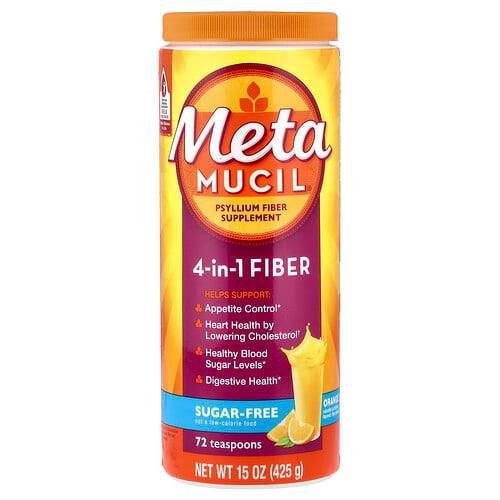
- Format
- Powder
- Type
- Fiber
- Cost
- $23.10 for the 15 oz tub (36 servings), about $0.64 a day
- Customer rating
- See the reviews on iHerb
Not sure it suits your symptoms? The quiz matches one product to you in one to three minutes.
Why it might work
Psyllium husk forms a viscous gel that resists fermentation and keeps holding water all the way through the colon, so stools become softer and bulkier; the same gel in the small intestine binds bile acids, which is the cholesterol mechanism. That is the ingredient in Metamucil, and everything else in the tub is there to make it orange, sweet and pourable. One teaspoon is a smaller dose than a serving of plain husk, so the pack directs up to three a day.
What the trials show
Strong evidence for psyllium the ingredient, not for the brand. A meta-analysis of 16 randomized trials in 1,251 people with chronic constipation found responders at 66% against 41% on placebo, and the 2023 AGA/ACG guideline names psyllium as the one fiber supplement that appears to be effective. Psyllium also carries an FDA-authorized cholesterol claim at 7 g of soluble fiber a day, which the pack prints. No trial of the Metamucil formulation as sold was found; the evidence applies because the active fiber is the same.
What the label discloses
The OTC drug label declares approximately 3.4 g of psyllium husk per rounded teaspoon, 3 g of total fiber and 2 g of soluble fiber; other ingredients are maltodextrin, citric acid, natural and artificial orange flavor, aspartame and Yellow 6. The pack states it is gluten-free and prints the FDA cholesterol claim. Sold as an OTC bulk laxative with a filed Drug Facts panel. No third-party testing is stated.
Read more on the plants in the formula.

Who this tends to suit
The quiz pairs it with answers that mention constipation, irregular bowel habits, a feeling of incomplete emptying and bloating. It is scored for a goal of regularity or a steady daily routine. Whether it is the best fit for you depends on the rest of your answers — what you have already tried, what format you will take, and anything that has to be ruled out.
Where it may not fit
The label supports gluten-free. Like any powder, it depends on being taken as often as the label directs.
Reactions and warnings
It is psyllium husk with maltodextrin, orange flavor, aspartame (25 mg phenylalanine per teaspoon) and Yellow 6; plain psyllium powder gives more than twice the fiber per serving for less money. One teaspoon is about 3.4 g of psyllium and 3 g of fiber; the pack counts three servings a day toward the 7 g of soluble fiber behind the cholesterol claim. It must be taken with a full glass of liquid or it can swell and block the throat, and the label warns of allergic reactions in people sensitive to psyllium.
Is 4-in-1 Sugar-Free Orange Powder the one, or is something else?
The quiz weighs your symptoms and routine and names one match, which may or may not be 4-in-1 Sugar-Free Orange Powder.
Take the quiz →Free, private, and it names one product.
Alternatives in the same role
Stool form and regularity: that is the job Metamucil 4-in-1 Sugar-Free Orange Powder does, and these are the other entries doing it.
See all the products we have researched →
Head-to-head comparisons
Side-by-side reads that put Metamucil 4-in-1 Sugar-Free Orange Powder or a close stand-in against the product people most often weigh it against.
Background reading
Where the numbers on this page come from, explained at length.