
Guide
Does LongevityRx Probiotic Trillion work? Five billion live CFU, a trillion in an undefined unit, and fourteen capsules
Quick answer
Does LongevityRx Probiotic Trillion work? No trial of the capsule or of its named strain, Bacillus subtilis AB22, was found. The panel prints 5 billion live CFU; the trillion on the bottle front is mostly postbiotic cell complexes counted in “TCC”, a unit the label does not define. Trials of other Bacillus strains at about 5 billion CFU a day for eight weeks are mixed, and this bottle holds 14 capsules for a 14-day course. Amazon shows 3.9 from 17 ratings; the brand’s own widget shows 80 reviews, 44 of them sharing one date.
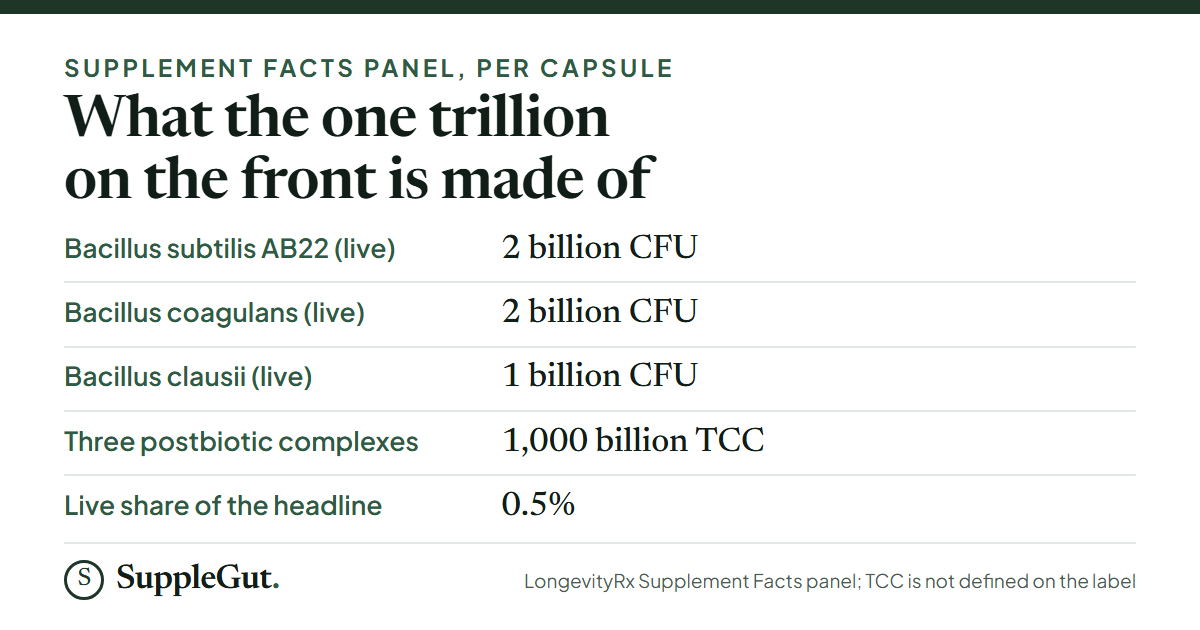
LongevityRx Probiotic Trillion is a once-a-day capsule of three Bacillus species and three “postbiotic” cell complexes, sold in a bottle of 14 capsules to be taken over 14 days. The bottle front says “1,000,000,000,000 Cells” and the Amazon title says “1 Trillion CFU”. The label’s live count is 5 billion CFU, and the rest of the trillion is a count in a unit the label does not define.
What Probiotic Trillion is, and what it is not
The Supplement Facts panel lists one proprietary blend, the TrillionBiotic Blend, at 649 mg per capsule. Seven items sit inside it, and a weight is printed for none of them. The only other ingredient is hypromellose, the capsule.
| Item as printed | Amount | Live or not |
|---|---|---|
| Bacillus subtilis AB22 | 2 billion CFU | Live; strain code printed |
| Bacillus coagulans | 2 billion CFU | Live; species only |
| Bacillus clausii | 1 billion CFU | Live; species only |
| Bacillus subtilis postbiotic complex | 600 billion TCC | Not live |
| Bacillus clausii postbiotic complex | 300 billion TCC | Not live |
| Bacillus coagulans postbiotic complex | 100 billion TCC | Not live |
| Humic soil extract | No amount printed | Not an organism |
The footnote “At time of manufacture” is attached to the counts. Because the 649 mg is one figure for all seven items, it cannot be split between the cell material and the humic soil extract.
One trillion cells, five billion live
The three postbiotic lines add up to 600 + 300 + 100 = 1,000 billion TCC, which is one trillion. The three live organisms add up to 2 + 2 + 1 = 5 billion CFU, which is 0.5% of that figure. CFU, colony-forming units, counts organisms that are alive and can multiply. A postbiotic complex is non-living cell material, so a count of it is not a count of live bacteria, and the label does not say what “TCC” counts or how it is measured. We found no human trial of these complexes at any dose.
The “1 Trillion CFU” in the Amazon title is therefore a different quantity from the CFU on the panel, and a cell count that includes non-living material does not say how many organisms arrive alive. For how live counts are read on other labels, see the guide to CFU.
The brand’s product page also names organisms and an ingredient that the panel does not list: Lactobacillus acidophilus, Bifidobacterium longum and a prebiotic fiber blend. The panel has only Bacillus species and humic soil extract.
The trial of the product itself
There is none. A search of PubMed and of ClinicalTrials.gov for the product, the brand and the strain turned up no study of this capsule, and none of Bacillus subtilis AB22: the one PubMed hit for the code is a paper on mite control in tea. The brand page calls AB-22 “clinically studied” and says it shows support for gut lining integrity; we could not match that claim to a publication. The figures on the page (82% improved digestion, 79% less bloated, 78% a mood boost) come from a survey of 235 members with no comparison group.
The evidence for the ingredients
Evidence exists for Bacillus probiotics as a class, in trials of other strains. At about 5 billion CFU a day for eight weeks:
- A pilot of Bacillus coagulans MY01 plus Bacillus subtilis MY02 in 68 adults with functional dyspepsia had 48% responders (12 of 25) against 20% (6 of 30) on placebo, a relative risk of 1.95 (95% CI 1.07 to 4.11).
- A 100-person trial of Bacillus subtilis ATCC 122264 in functional bloating found no difference from placebo overall, with less belching and flatulence in women.
For Bacillus clausii, 130 adults on H. pylori eradication therapy took 2 billion spores three times a day, and diarrhea in the first week was 29% against 48% on placebo. In 259 children with IBS, four B. clausii strains did not differ from placebo. Pooling across IBS trials, a review of 82 randomized trials in 10,332 patients rated the evidence for Bacillus strains as very low certainty for global symptoms and for bloating.
The label’s live count, 5 billion CFU, equals the daily dose in those trials, but the strains differ (MY01, MY02, GBI-30 and ATCC 122264 in the trials; AB22 and two unnamed strains on the label) and the schedule differs: 14 days a month on the label against 56 days without a break in the trials. The postbiotic share of the trillion has no trial dose to compare with.
How to take it, and what “30 Day Supply” means
The panel and brand page direct one capsule daily on an empty stomach for 14 days per month, with no refrigeration. A bottle holds 14 capsules, so a bottle is one course. The Amazon title ends in “30 Day Supply”; at one capsule a day the bottle lasts 14 days, and a monthly subscription ships one bottle a month, which is one course a month. Several verified reviewers raise this exact point.
The directions are not uniform across the brand’s own pages. The panel says empty stomach, while the FAQ says many of its capsules can be taken with or without food, and one reviewer asks which instruction is correct because the website and the bottle read differently.
Side effects and who should check first
No warning is printed on the panel or the product page, and we found no age warning or ingredient-specific warning. The brand’s FAQ says to speak with a healthcare provider before starting any supplement, especially if pregnant, nursing or taking prescription medication, and to review the ingredient list with a provider before using it alongside a prescription. Among reviewers, one reported that the capsule upset the bowels. Effects reported across probiotics are in the side-effects guide.
What the reviews say
Amazon shows 3.9 out of 5 from 17 ratings: 56% five-star, 13% four, 10% three, 11% two and 10% one. Amazon did not serve review text without a sign-in. Trustpilot has no profile for the brand.
The brand’s own page carries a Junip review widget that reads 80 reviews, with stars drawn at 4.56; our count of the 80 in its feed gives 4.63 (66 five-star, 6 four, 3 three, 2 two and 3 one). Of the 80, 44 share one date, and none of those 44 carries the verified-buyer flag. The other 36 are spread across a year. Across all 80, 35 carry the verified-buyer flag and 26 carry a flag marking the review as rewarded. The brand replies to none of them.
The recurring praise, in about 13 reviews for digestion and 9 for bloating, is better digestion, less bloating and use as a short course after antibiotics. The recurring complaint is the bottle: five of the 80 reviews raise the 14-capsule count or the price, and one reads “Expensive for 2 weeks”. The second complaint is no change in 14 days. No billing complaint appeared in the 80 Junip reviews.
Price, subscription and refunds
| Route | Bottle | Per day taken |
|---|---|---|
| Brand site, one time | $99.95 | $7.14 |
| Brand site, subscription, first order (30% off) | $69.97 | $5.00 |
| Brand site, subscription, later monthly orders (15% off) | $84.96 | $6.07 |
| Amazon, one time | $98.76 | $7.05 |
| Amazon, Subscribe and Save | $84.96 | $6.07 |
Per-day figures count the 14 days taken; over a 30-day month the brand’s one-time price is $3.33 per calendar day. The brand says subscribers can pause, skip or cancel at any time.
The brand’s pages give three different refund windows. The refund policy accepts returns only for damaged or defective products within 7 days of receipt, and excludes opened items and purchases made with a discount code or during a promotion. The return policy page starts returns in a self-service portal within 7 days of delivery, with a standard 15% handling fee, and does not accept opened items. The FAQ says unopened products can be returned within 30 days of purchase for a refund, store credit or replacement. We found no money-back guarantee for opened product. A single bottle can be bought without a subscription on the brand site and on Amazon.
Who Probiotic Trillion is for
- Someone who wants a short, fixed course of Bacillus spore-formers and accepts that no trial tests this capsule.
- Someone who will take it on an empty stomach for 14 days and is clear that a bottle is one course.
Other Bacillus products have their own pages with labels and counts to set beside this one: MegaSporeBiotic, Thorne Bacillus Coagulans and HU58 Bacillus subtilis. The Lemme Debloat guide covers another spore-former, and the probiotic chooser and the quiz start from symptoms instead of a product.
The products in this catalog
Common questions
Does LongevityRx Probiotic Trillion work?
No trial of the capsule, or of its named strain Bacillus subtilis AB22, was found. Other Bacillus strains at about 5 billion CFU a day for eight weeks gave 48% responders against 20% on placebo in a 68-person dyspepsia pilot and no overall change in bloating in a 100-person trial. This label has the same 5 billion CFU of live organisms but is taken for 14 days a month.
How many CFU does Probiotic Trillion have?
The panel prints 5 billion CFU of live organisms: Bacillus subtilis AB22 2 billion, Bacillus coagulans 2 billion and Bacillus clausii 1 billion. It also prints 1,000 billion “TCC” across three postbiotic complexes, a unit the label does not define. The bottle front says “1,000,000,000,000 Cells” and the Amazon title says “1 Trillion CFU”, but the live count is 0.5% of that figure.
What is a postbiotic complex, and does it count as CFU?
A postbiotic complex is non-living cell material, so a count of it is not a count of live bacteria and it is not CFU. The label gives these complexes in “TCC” and does not say what TCC counts. We found no human trial of them at any dose.
Why does Probiotic Trillion have only 14 capsules?
The directions are one capsule a day on an empty stomach for 14 days a month, so one bottle is one course. The Amazon title says “30 Day Supply”, and several verified reviewers say they expected a month of capsules. A monthly subscription ships one bottle a month.
How much does Probiotic Trillion cost?
One bottle is $99.95 on the brand site, or $7.14 for each day taken, and $98.76 on Amazon. A brand subscription is $69.97 for the first order (30% off) and $84.96 afterward (15% off), which is $5.00 and $6.07 a day. Amazon Subscribe and Save is $84.96.
Can Probiotic Trillion be returned?
The brand’s pages give three windows: 7 days for damaged or defective products only, 7 days through a portal with a 15% handling fee, or 30 days for unopened products. All three exclude opened bottles, and the refund policy also excludes purchases made with a discount code or during a promotion. We found no money-back guarantee for opened product.
Is Probiotic Trillion safe, and who should ask a provider first?
No warning is printed on the panel or product page. The brand’s FAQ says to speak with a healthcare provider before starting any supplement, especially if pregnant, nursing or taking prescription medication. One reviewer reported upset bowels; see the probiotic side-effects guide for what is reported across probiotics.
Sources
- Wauters L, Slaets H, De Paepe K, et al. Efficacy and safety of spore-forming probiotics in the treatment of functional dyspepsia: a pilot randomised, double-blind, placebo-controlled trial. Lancet Gastroenterology & Hepatology, 2021;6(10):784–792. PubMed 34358486
- Hun L. Bacillus coagulans significantly improved abdominal pain and bloating in patients with IBS. Postgraduate Medicine, 2009;121(2):119–124. PubMed 19332970
- Randomized trial of Bacillus subtilis ATCC 122264 in 100 adults with functional bloating (NCT06308146). Beneficial Microbes, 2025. PubMed 39929203
- Randomized trial of Bacillus clausii spores in 130 adults on H. pylori eradication therapy. Infectious Diseases and Therapy, 2020. PubMed 32897519
- Randomized trial of four Bacillus clausii strains in 259 children with IBS. Paediatric Drugs, 2023. PubMed 36380186
- Goodoory VC, Khasawneh M, Black CJ, Ford AC, et al. Efficacy of probiotics in irritable bowel syndrome: systematic review of 82 randomized trials. Gastroenterology, 2023. PubMed 37541528
- Brand page: label, directions, price, subscription and review widget. trylongevityrx.com; Supplement Facts panel image on the brand’s content network; FAQ trylongevityrx.com/pages/faqs
- Brand policies: refund policy and return policy
- Amazon listing: title, price, Subscribe and Save price and ratings. amazon.com/dp/B0G11TKLM1
- Junip product-review feed read from the brand page; Trustpilot (no profile for trylongevityrx.com); ClinicalTrials.gov search for the brand and strain (no study found).
Not sure which product fits your situation?
This guide covers the mechanics. The quiz takes your specific symptoms, routine and preferences and matches you to one product from the catalog.
Take the quiz →