
Guide
Does Silver Fern Reflux Pro work? The two extracts, the trials behind them and what the label leaves out
Quick answer
Does Reflux Pro work? No trial of Reflux Pro itself was found. GutGard at the label dose of 150 mg a day beat placebo on heartburn in a 200-person, 28-day trial (p = 0.005 at day 28), paid for by its maker, and Mucosave at 400 mg a day improved discomfort scores in 100 adults over 8 weeks, in capsules. The Mucosave reflux trial with the big 56.5% figure used a sachet that also held 500 mg of sodium alginate and 300 mg of sodium bicarbonate, which this product does not contain. The brand’s 81%, 83% and 95% figures could not be traced to a source, and the product has 5 reviews on the brand site and 2 ratings on Amazon, all five stars.
Reflux Pro is a 30-stick pouch of peppermint-flavored powder from Silver Fern Brand, LLC. Each 3 g stick carries two branded plant extracts at printed amounts: 400 mg of Mucosave FG (prickly pear cladode and olive leaf) and 150 mg of GutGard (a deglycyrrhizinated licorice extract). There is no proprietary blend, and each extract has a human trial. None tested this product, and the best-known one tested a different formula, so this page sets out which numbers carry over.
What Reflux Pro is, and what the label leaves out
The Supplement Facts panel lists a serving as one 3 g sachet, 30 servings a pouch. Mucosave FG is 400 mg and GutGard is 150 mg, each with its own amount. The other ingredients are allulose, natural peppermint flavors, Reb M (a stevia sweetener) and salt, with no amounts printed; the two extracts add up to 0.55 g, so those four make up about 2.45 g of the stick.
What the label does not give: the split between the prickly pear and olive leaf extracts, a glycyrrhizin figure for the licorice, and any allergen or free-from statement (milk, wheat, egg, soy, tree nuts, fish and sesame are all unaddressed). The brand says it formulates from third-party-tested ingredients; we found no certificate or lab name for this product.
What the brand claims and what we found
| Brand page claim | What we found |
|---|---|
| “Up to 81% reduction in heartburn” | We could not find 81% in the Mucosave papers, the registry record or the supplier brochure. |
| “Up to 83% reduction in nausea” and “up to 95% reduction in throat discomfort” | Neither figure appears in any source we read. |
| “51% reduction in indigestion symptoms over 30 days” | The only 30-day GutGard trial studied functional dyspepsia in 50 people; we did not find 51% in the paper text we read. |
| “A modern, science-backed alternative to acid blockers” | No trial compares either extract with a PPI, and nothing on the label says it lowers stomach acid. The trials were against placebo in people not taking PPIs. |
| A powder dissolved in the mouth “may offer faster and more effective support than capsules” | Untested; the brand page says its cited results were run on capsules. |
We found no trial of Reflux Pro itself in PubMed or on ClinicalTrials.gov.
The GutGard trials at the label dose
GutGard is a licorice root extract with most of the glycyrrhizin removed (at most 3.0% by its published specification). The label dose of 150 mg matches both trials, which gave 75 mg twice daily.
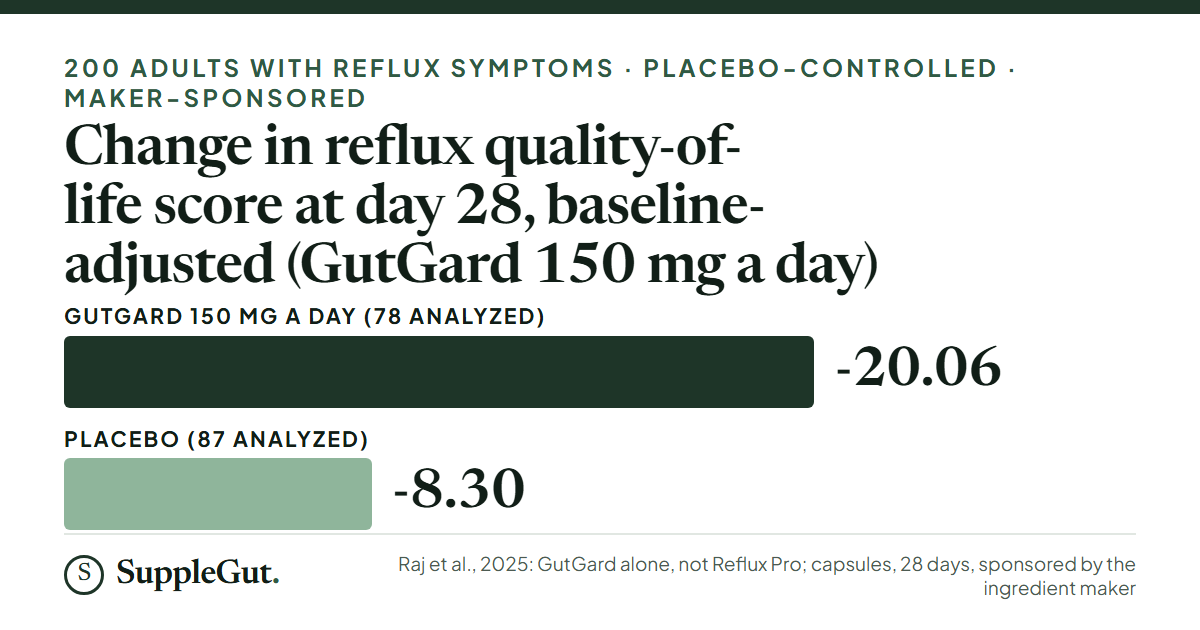
The reflux trial ran at one center in Mumbai: 200 adults with mild to moderate reflux symptoms, not on PPIs, randomized 100 and 100 to GutGard or placebo for 28 days (Raj et al., 2025). Heartburn scores favored GutGard at day 14 (p = 0.017) and day 28 (p = 0.005), and regurgitation at days 7, 14 and 28 (p = 0.025, 0.029, 0.022). The baseline-adjusted change in the quality-of-life score was −20.06 against −8.30 (p = 0.014), with 78 and 87 people analyzed at day 28. The raw day-28 totals (3.83 against 11.84, p = 0.305) and rescue-medicine use did not differ significantly. The sponsor and capsule supplier was Natural Remedies Private Limited, GutGard’s maker and gave technical input on the design. The earlier trial studied functional dyspepsia, not reflux: 50 people, 30 days, a lower total symptom score than placebo at days 15 and 30, 14 of 25 “markedly improved” against 0 of 25 on placebo (Raveendra et al., 2012). A Cochrane review counted that single 50-person study for licorice in dyspepsia, at moderate certainty (Báez et al., 2023).
The Mucosave trials, and why the big figure does not transfer
The Mucosave reflux trial is the source of the large numbers. In Italy, 118 adults with 2 to 6 days of reflux a week took one sachet a day or placebo for two months; the quality-of-life score (0 to 50, lower is better) fell from 22.09 to 5.76 on the active sachet (74.3%) against 22.41 to 18.15 on placebo (17.8%), a net 56.5% (Alecci et al., 2016). But the active sachet held 500 mg of sodium alginate and 300 mg of sodium bicarbonate alongside 400 mg of Mucosave, and the placebo was maltodextrin alone. The trial cannot separate the alginate and bicarbonate from the plant extracts. Reflux Pro contains neither. Two authors list Bionap, the maker of Mucosave, as their affiliation.
The nearest trial of Mucosave by itself gave 400 mg a day in capsules for 8 weeks to 100 adults with gastrointestinal discomfort, 60 on the extract and 40 on placebo, and both questionnaires improved on the extract (p < .001) (Malfa et al., 2021). We read only the abstract and the registry record, which lists healthy adults with reduced bowel movements; we cannot say how many had diagnosed reflux, and did not see the funding or dropouts. No third Mucosave trial turned up.
| Extract | One stick | Daily dose in the trials | Two sticks |
|---|---|---|---|
| Mucosave FG | 400 mg | 400 mg | 800 mg, not tested |
| GutGard | 150 mg | 150 mg (75 mg twice daily) | 300 mg, not tested |
How to take Reflux Pro
The label allows one or two sticks a day. The brand sets one stick daily for 60 to 90 days as “mild support” and two daily for 90 to 120 days for “moderate to severe” symptoms. Two sticks double both extracts, a dose no trial tested. The trials ran 28 days to 2 months. The brand warns the formula “may have a mildly bitter profile” from the herbal actives, and one reviewer finds the peppermint overwhelming but tolerable.
Alginate has its own evidence base, covered in the reflux guide. It should not be borrowed for this label, which contains none.
Side effects and who should not take it
The label caution is the standard one: pregnant or nursing mothers, anyone under 18 and people with known medical conditions should consult a physician. It carries no licorice-specific warning about blood pressure, potassium, diuretics or heart or kidney conditions. GutGard is deglycyrrhizinated, and at the 3.0% ceiling a 150 mg stick holds at most about 4.5 mg of glycyrrhizin (9 mg at two sticks); the brand prints no figure of its own. For the cautions that apply to whole licorice, see the Liáo Herbal guide, which uses whole root. The first GutGard trial reported no treatment-related adverse events; in the second, abdominal pain was less common on GutGard (3.1% against 13.4%) and other events did not differ.
What the reviews say
There are almost none. The brand’s own widget shows 5 reviews, all five stars, 2 flagged verified buyers. Amazon shows 2 ratings, both five stars, with the review text behind a sign-in; the Trustpilot page for the brand has 2 reviews across all its products and is unclaimed. Reviewers praise fewer night-time reflux episodes and less cough, symptoms returning when they stop, and sticks that need no water. The reservations are a strong peppermint taste and one report of diarrhea in a reviewer’s daughter.
Subscription and refund terms
The brand’s subscription takes 15% off, delivered every 4, 6 or 8 weeks. Its Subscribe and Save page says plans can be modified, paused or canceled at any time through a login, and gives no discount percentage, billing terms or minimum. The return policy accepts unopened products within 30 days of delivery with a 5% restocking fee, does not accept opened products, and does not refund shipping. A separately sold “satisfaction guarantee insurance” allows a return within 90 days of order. Amazon marks the listing non-returnable. We found no independent billing or refund complaints about Reflux Pro.
Who Reflux Pro is for
- Someone with mild to moderate heartburn or regurgitation who is not taking a PPI, the group the GutGard reflux trial enrolled.
- Someone happy with one stick a day, the dose the trials match.
- A person who prefers a single-serve stick taken without water.
For alginate, the raft-forming approach, see Hartspan KHelp. For deglycyrrhizinated licorice as a chewable, see Natural Factors Chewable DGL. The reflux guide lays out each option with its own evidence.
Cost
One pouch is $52.88 on the brand site (free shipping over $49), which is $1.76 a day at one stick and $3.53 at two. Two pouches are $94.06 ($1.57 a day at one stick). The subscription brings one pouch to $44.95 ($1.50 a day) and two to $79.95 ($1.33). Amazon lists $57.48 for one pouch and $107.96 for two. The brand’s 60 to 120 day course takes 2 to 8 pouches, or $106 to $423 at the one-time price.
The products in this catalog
Common questions
Does Silver Fern Reflux Pro work?
No trial of Reflux Pro itself was found. Each active has a trial at the label dose: GutGard 150 mg a day improved heartburn and regurgitation scores over placebo in 200 adults over 28 days, and Mucosave 400 mg a day improved discomfort scores in 100 adults over 8 weeks in capsules. The Mucosave reflux trial with the largest effect also contained alginate and bicarbonate, which this product does not. Only seven ratings exist, all five stars.
Is Reflux Pro safe, and what are its side effects?
The label says pregnant or nursing mothers, anyone under 18 and people with known medical conditions should consult a physician. The licorice extract is deglycyrrhizinated, with glycyrrhizin at most 3.0% of the extract per the 2025 trial paper, so a stick holds at most about 4.5 mg on that figure, but the label prints no amount and no licorice warning. The first GutGard trial reported no treatment-related adverse events and the second found abdominal pain less common than on placebo (3.1% against 13.4%) and no other difference. One reviewer reports diarrhea in a relative and another finds the peppermint strong.
How many sticks of Reflux Pro should you take a day?
The label allows one or two sticks a day, with or without food. One stick matches the doses used in the trials (400 mg Mucosave, 150 mg GutGard); two sticks, the brand’s tier for moderate to severe symptoms, double both, and no trial tested that. The brand suggests 60 to 90 days at one stick or 90 to 120 days at two, and the trials ran 28 days to 2 months.
Reflux Pro vs omeprazole or an alginate such as Gaviscon?
No study compares either of its ingredients with a PPI or an alginate. It contains no alginate, and nothing on the label says it lowers stomach acid; the trials were against placebo in people who were not taking PPIs. The brand calls it an alternative to acid blockers, which is a marketing claim rather than a trial result. For the options with head-to-head evidence, see the reflux guide.
How much does Reflux Pro cost?
One 30-stick pouch is $52.88 on the brand site with free shipping over $49, which is $1.76 a day at one stick and $3.53 at two. Two pouches are $94.06, and the subscription takes 15% off ($44.95 for one pouch). Amazon lists $57.48 for one pouch and $107.96 for two.
What is Reflux Pro’s refund policy?
The brand accepts unopened products within 30 days of delivery with a 5% restocking fee, does not accept opened products, and does not refund shipping. A separately sold satisfaction guarantee at checkout allows a return within 90 days of order. Amazon marks the listing non-returnable.
What are Mucosave FG and GutGard?
Mucosave FG is a branded extract of prickly pear cladode and olive leaf from Bionap, and GutGard is a branded flavonoid-rich licorice root extract with most of the glycyrrhizin removed, from Natural Remedies. Both are trademarked on the label, and each has its own amount in Reflux Pro. The Liáo Herbal guide covers a reflux product that uses whole licorice instead.
Sources
- Raj JP, Saxena U, Belhekar MN, et al. “Efficacy and Safety of GutGard in Managing Gastroesophageal Reflux-Related Symptoms: A Phase III, Single-Centre, Double-Blind, Randomized Placebo-Controlled Trial.” Complementary Medicine Research, 2025;32(1):26–36. doi.org/10.1159/000543367
- Raveendra KR, Jayachandra, Srinivasa V, et al. “An Extract of Glycyrrhiza glabra (GutGard) Alleviates Symptoms of Functional Dyspepsia: A Randomized, Double-Blind, Placebo-Controlled Study.” Evidence-Based Complementary and Alternative Medicine, 2012;2012:216970. doi.org/10.1155/2012/216970
- Báez G, Vargas C, Arancibia M, Papuzinski C, Franco JV. “Non-Chinese herbal medicines for functional dyspepsia.” Cochrane Database of Systematic Reviews, 2023;6:CD013323. doi.org/10.1002/14651858.CD013323.pub2
- Alecci U, Bonina F, Bonina A, et al. “Efficacy and Safety of a Natural Remedy for the Treatment of Gastroesophageal Reflux: A Double-Blinded Randomized-Controlled Study.” Evidence-Based Complementary and Alternative Medicine, 2016;2016:2581461. doi.org/10.1155/2016/2581461 (PMID 27818697)
- Malfa GA, Di Giacomo C, Cardia L, Sorbara EE, Mannucci C, Calapai G. “A standardized extract of Opuntia ficus-indica (L.) Mill and Olea europaea L. improves gastrointestinal discomfort: A double-blinded randomized-controlled study.” Phytotherapy Research, 2021;35(7):3756–3768. doi.org/10.1002/ptr.7074
- ClinicalTrials.gov record NCT04119817, Mucosave capsules 400 mg a day versus placebo. clinicaltrials.gov/study/NCT04119817
- Bionap, Mucosave FG product brochure (suggested dosage 400 mg a day). Bionap PDF
- Brand page: label, directions, claims and price (silverfernbrand.com/products/reflux-pro); return policy (silverfernbrand.com/pages/return-policy); subscription page (silverfernbrand.com/pages/subscribe-and-save)
- Amazon listing: price, ratings and returns text (amazon.com/dp/B0GPKR3XSS)
Not sure which product fits your situation?
This guide covers the mechanics. The quiz takes your specific symptoms, routine and preferences and matches you to one product from the catalog.
Take the quiz →