
Guide
Does Supergut work? What is in the scoop and what the trials say
Quick answer
Does Supergut Foundational Daily Fiber work? No trial of this powder was found. One of its four fibers, Solnul resistant potato starch, raised Bifidobacterium and reduced both diarrhea- and constipation-associated stools at 3.5 g a day in a 75-person placebo-controlled trial, but the label prints only a 6 g total for all four fibers. The brand’s own 2026 results (68% reporting bloating relief) are self-reported with no methods published. On Amazon, 71% of 192 ratings are five-star.
Supergut Foundational Daily Fiber is an unflavored powder that puts 6 g of fiber in a 7.8 g scoop from four named sources: resistant potato starch, soluble corn fiber, guar fiber and green banana resistant starch. What sets it apart from the fiber on the next shelf is the blend, since most powders are a single fiber. The label prints only the total, which shapes everything below.
What Supergut Foundational Daily Fiber is, and what it is not
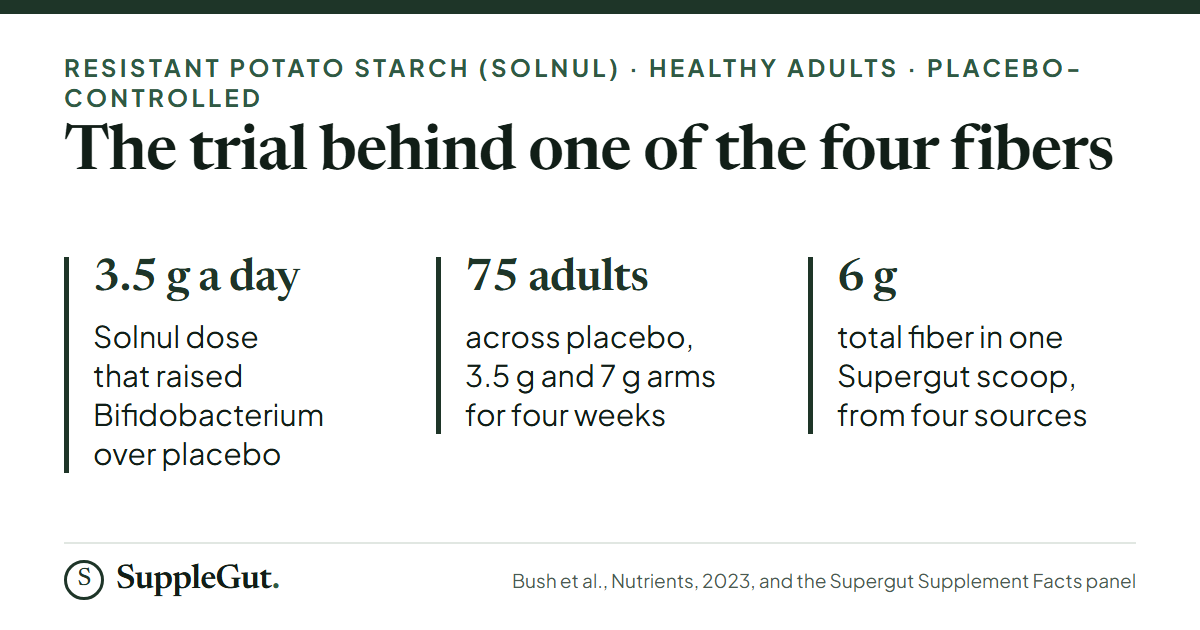
The panel for the unflavored canister lists 20 calories, 7 g of carbohydrate and 6 g of dietary fiber (22% of the daily value), 4 g of it soluble. All of it comes from one “Foundational Daily Fiber Blend”: resistant potato starch (Solnul), soluble vegetable fiber from non-GMO corn, guar fiber (Sunfiber) and green banana powder resistant starch. It is a proprietary blend, so there are no grams for any single fiber and no resistant-starch figure. There are no other ingredients, sweeteners or flavors in the unflavored version; two flavored versions (Pomegranate Berry and Peach Mango) have their own panels, which we did not read.
It is not a probiotic and contains no oat beta-glucan, which is in the brand’s separate GLP-1 Daily Support. The brand’s earlier shakes and a “Gut Balance” fiber mix are no longer in its shop. The label carries Third-Party Tested, Non-GMO Project Verified, GMP Certified and Monash University Low FODMAP Certified marks (the brand notes Monash receives a license fee), and the brand describes it as vegan and gluten-free. No laboratory is named, and the certificate of analysis linked from the Amazon page was not one we opened.
The trial of the product itself
There is none. The brand’s page footnotes a 2026 “Supergut and Tiny Health” pilot and observational study, with figures of 68% of daily users feeling bloating relief and 89% having daily or more frequent regularity, which the footnote says are partly self-reported. We found no protocol, participant count, control group, publication or registry entry for either study.
The one published Supergut trial tested a different product, an older prebiotic-fiber-enriched shake. In 192 adults with type 2 diabetes randomized over 12 weeks, HbA1c fell 0.64 percentage points more than on a fiber-free placebo shake (p = .01), diabetes distress scores fell 0.4 more (p = .03), and two butyrate-producing species increased. The fiber dose and formula are not in the abstract, so it cannot be compared with a 6 g scoop, and the authors include Supergut staff (Frias et al., Diabetes, Obesity and Metabolism, 2023).
The evidence for the ingredients
Solnul resistant potato starch has the closest trial. In 75 healthy adults (25 per arm) given placebo, 3.5 g or 7 g a day for four weeks, the 3.5 g group had a larger rise in Bifidobacterium than placebo (p = 0.038), while the 7 g group did not differ significantly (p = 0.14). Diarrhea- and constipation-associated bowel movements were both significantly fewer at 3.5 g. The authors work for or consult to the ingredient’s maker, who funded the trial (Bush et al., Nutrients, 2023). The dose gap: the whole blend here is 6 g, so if the four fibers were split evenly each would be about 1.5 g, below 3.5 g. The real split is not published.
Partially hydrolyzed guar gum, the class Sunfiber belongs to, was tested in 121 people with IBS (108 analyzed) at 6 g a day for 12 weeks. Bloating scores improved by 4.1 points against 1.2 on placebo (p = 0.03) and bloating plus gas by 4.3 against 1.12 (p = 0.035), with no effect on other symptoms; 49% of the placebo group dropped out against 22% on guar (Niv et al., Nutrition & Metabolism, 2016). The guar share of this blend is under 6 g and unknown.
Resistant starch and blood glucose is where most resistant-starch trials sit. A review of 36 trials (982 people with type 2 diabetes or prediabetes) found type 2 resistant starch improved fasting glucose (standardized difference -0.39) and fasting insulin (Pugh et al., Frontiers in Nutrition, 2023). A 19-trial meta-analysis found fasting glucose fell 0.09 mmol/L overall and 0.16 mmol/L at more than 28 g a day (Xiong et al., British Journal of Nutrition, 2020). The larger effects were at more than four times a 6 g scoop, and for glucose rather than gut symptoms. We found no placebo-controlled trial of green banana resistant starch in adults with gut symptoms.
How to take Supergut
The label says to mix one scoop (or one stick pack) into 8 to 12 oz of water, coffee or a smoothie, to start with one serving and increase gradually, and to aim for 25 to 30 g of fiber a day from all sources. The brand’s FAQ says to build from one scoop to two or three and that it can be taken at any time. Its product page headline reads “just two scoops a day”, so a 20-serving canister lasts 10 days at that dose.
For a fair test, the Solnul trial ran four weeks and the guar trial 12. Reviewers who report benefit describe regularity improving within about two weeks.
Side effects and who should not take it
The panel prints no warnings, and we found no pregnancy, medication, age or allergen statement beyond vegan and gluten-free; we did not see the physical canister. The brand’s own caution is to start slow. Added fermentable fiber can raise gas in some people, and reviewers say so: one Amazon reviewer reports increased flatulence, and one Trustpilot reviewer wrote of more bloating after finishing a canister.
What the reviews say
On Amazon the unflavored 20-serving listing shows 4.4 from 192 ratings (71% five-star, 4% one-star); Walmart shows 4.7 from 23 ratings; the brand’s own page shows 4.5 from 207 reviews through a review widget. Trustpilot has a brand-wide profile of 2.2 from 11 reviews, unclaimed and not invited by the brand, covering bars and other products as well. We found no Better Business Bureau profile.
The recurring praise is a flavorless powder that dissolves without clumping, better regularity and digestion, and easy mixing into oats, coffee or travel packs. The recurring complaints are the canister size and price (“the container is only half full” is how Amazon’s summary puts it), gas or bloating in some, and the unclear daily amount: 20 servings counted at one scoop, with the headline at two.
The subscription and refund terms
Subscribe & Save takes 20% off every order (the 40-serving canister at $40), defaults to every four weeks, and can be edited, skipped, paused or cancelled; the brand says it sends a renewal reminder before it ships. The 30-day money-back guarantee covers the first order only, as a refund or exchange. Single canisters can be bought one time on the brand site, on Amazon or at Walmart; Amazon marks the listing non-returnable for food safety reasons.
On the brand-wide Trustpilot profile, reviewers report being signed up for recurring subscriptions without a warning (2026), a live chat that cancelled a subscription within minutes (2024), repeated charges and orders paid but not shipped (2024, mostly about earlier bar and shake orders), and unordered products arriving (2025). Those are reviewer reports on a profile with no brand replies.
Who Supergut is for
- Someone who wants a multi-source fiber blend in an unflavored powder that mixes into coffee, oats or water.
- Someone adding fiber for a steady daily routine, willing to build up from one scoop.
- Someone who values a Low FODMAP certification and a vegan, gluten-free label.
- Someone who is fine with a 6 g total, not a single fiber at a trial dose.
If you want one fiber at the dose a trial used, California Gold Nutrition Sunfiber PHGG is plain guar fiber, and NOW Foods Psyllium Husk Powder is the psyllium option; the psyllium timeline and probiotic or fiber guide cover how each behaves.
Cost
On the brand site, 40 servings are $50, or $1.25 per scoop, and 20 servings are $27, or $1.35; subscribing brings the 40-serving canister to $40, or $1.00 a scoop. Amazon and Walmart list 20 servings at $24.96, or $1.25 a scoop. At the brand’s two-scoop headline dose the daily figure doubles, to about $2.50 to $2.70. Stick packs are $30 for 15, or $2.00 each.
The products in this catalog
Common questions
Does Supergut Foundational Daily Fiber work?
No trial of this powder was found. Its resistant potato starch (Solnul) raised Bifidobacterium and reduced diarrhea- and constipation-associated stools at 3.5 g a day in a 75-person trial, but the label gives only a 6 g total for four fibers. The brand cites 2026 observational results (68% reporting bloating relief) that are self-reported with no methods published. On Amazon, 71% of 192 ratings are five-star and 4% are one-star.
What is in Supergut Foundational Daily Fiber?
One 7.8 g scoop lists 6 g of dietary fiber, 4 g of it soluble, from a proprietary blend of resistant potato starch (Solnul), soluble corn fiber, guar fiber (Sunfiber) and green banana resistant starch. There are no other ingredients in the unflavored version, and no grams are printed for any single fiber. It contains no oat beta-glucan; that is in the brand’s separate GLP-1 Daily Support.
How many scoops of Supergut should you take a day?
The brand says to start with one scoop in 8 to 12 oz of water, coffee or a smoothie and build up to two or three as your body adjusts, at any time of day. Its product page headline says “just two scoops a day”, which empties the 20-serving canister in 10 days.
What are Supergut fiber side effects?
The panel lists none and the brand advises starting with one scoop and increasing slowly. One Amazon reviewer reports increased flatulence and one Trustpilot reviewer reports more bloating after a full canister. The blend carries a Monash University Low FODMAP certification, which the brand notes it pays a license fee to use.
How much does Supergut Foundational Daily Fiber cost?
On Supergut’s site 40 servings cost $50, which is $1.25 per scoop, and 20 servings cost $27. Subscribing takes 20% off, so the 40-serving canister is $40. Amazon and Walmart list the 20-serving canister at $24.96, and the brand’s headline dose of two scoops a day doubles the daily cost to about $2.50 to $2.70.
How do the Supergut subscription and refund terms work?
Subscribe & Save takes 20% off every order, with skip, pause and cancel options, and the brand says it sends a renewal reminder before each shipment. The 30-day money-back guarantee covers the first order only. On Trustpilot, whose brand-wide profile is unclaimed (2.2 from 11 reviews), reviewers report subscriptions renewing without a warning and, in 2024, orders that did not ship.
Supergut vs a plain Sunfiber powder?
Plain Sunfiber powders contain only partially hydrolyzed guar gum. Supergut combines Sunfiber guar fiber with resistant potato starch, green banana resistant starch and corn fiber in a 6 g scoop, without stating how much of each. The 12-week trial in irritable bowel syndrome that improved bloating used 6 g a day of partially hydrolyzed guar gum alone.
Sources
- Bush JR, Baisley J, Harding SV, et al. "Consumption of Solnul Resistant Potato Starch Produces a Prebiotic Effect in a Randomized, Placebo-Controlled Clinical Trial." Nutrients, 2023;15(7):1582. doi.org/10.3390/nu15071582
- Niv E, Halak A, Tiommny E, et al. "Randomized clinical study: Partially hydrolyzed guar gum (PHGG) versus placebo in the treatment of patients with irritable bowel syndrome." Nutrition & Metabolism, 2016;13:10. doi.org/10.1186/s12986-016-0070-5
- Pugh JE, Cai M, Altieri N, Frost G. "A comparison of the effects of resistant starch types on glycemic response in individuals with type 2 diabetes or prediabetes: A systematic review and meta-analysis." Frontiers in Nutrition, 2023;10:1118229. doi.org/10.3389/fnut.2023.1118229
- Xiong K, Wang J, Kang T, et al. "Effects of resistant starch on glycaemic control: a systematic review and meta-analysis." British Journal of Nutrition, 2020;125(11):1260–1269. doi.org/10.1017/S0007114520003700
- Frias JP, Lee ML, Carter MM, et al. "A microbiome-targeting fibre-enriched nutritional formula is well tolerated and improves quality of life and haemoglobin A1c in type 2 diabetes." Diabetes, Obesity and Metabolism, 2023;25(5):1203–1212. doi.org/10.1111/dom.14967
- Brand page: label, directions and price. supergut.com
- Brand subscriptions page. supergut.com/pages/subscriptions
- Amazon listing: ratings and price. amazon.com
- Trustpilot profile for supergut.com. trustpilot.com
Not sure which product fits your situation?
This guide covers the mechanics. The quiz takes your specific symptoms, routine and preferences and matches you to one product from the catalog.
Take the quiz →