
Guide
Does Terra Health Acid Relief work? The five plant extracts, the evidence for each and the subscription default
Quick answer
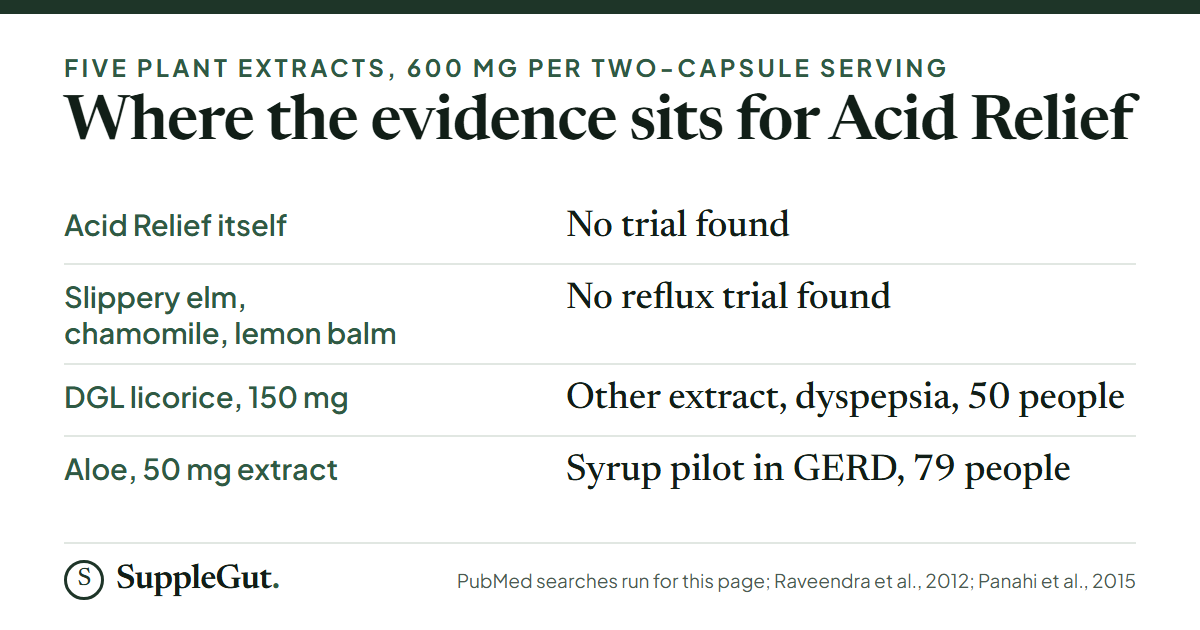
Does Terra Health Acid Relief work? No trial of Acid Relief was found, and none of its five plant extracts has a published heartburn or reflux trial at these doses. The nearest are a 79-person pilot of aloe syrup in GERD and a 50-person trial of a different licorice extract in dyspepsia. It is a dietary supplement with a Supplement Facts panel, not an antacid with a Drug Facts panel, and the brand’s directions allow up to 10 capsules a day in flares, five times the printed serving. Reviews: 5.0 from 240 on the brand’s own widget, 4.0 from 452 ratings on Amazon, 3.2 from 14 on Trustpilot.
Acid Relief is a 60-capsule bottle from Terra Health Essentials, sold for heartburn and described as a botanical alternative to antacids and acid blockers. It holds five plant extracts, each with its own printed amount, and the brand says they coat the esophagus and rebuild the digestive lining. It is a Supplement Facts product, not a Drug Facts product, and the brand’s directions go well past the printed serving. This page sets out the label, what each extract has been tested for, and what reviewers and the brand’s own terms say.
What Acid Relief is, and what it is not
The panel is headed Supplement Facts, and the bottle reads “Dietary Supplement”. There is no calcium carbonate, magnesium hydroxide, famotidine or other antacid, H2 blocker or PPI active. Amazon files the listing under its Antacids category, which is Amazon’s sorting, not the label. Per two capsules (30 servings a bottle):
| Extract | Amount | Raw herb equivalent (our arithmetic) |
|---|---|---|
| Slippery elm bark, 10:1 | 200 mg | about 2 g |
| Chamomile leaf, 10:1 | 150 mg | about 1.5 g |
| Deglycyrrhizinated licorice, “standardized to 3%” | 150 mg | not given |
| Aloe vera leaf, 5:1 | 50 mg | about 250 mg |
| Lemon balm leaf, 10:1 | 50 mg | about 0.5 g |
Each extract has its own amount, so there is no proprietary blend; the total is 600 mg. Not printed: what the licorice “3%” measures, the glycyrrhizin that remains, whether the aloe is aloin-free, the extraction solvent, or a manufacturer. The brand’s pages name no third-party testing.
What the brand claims and what we found
| Brand claim | What we found |
|---|---|
| “Actually heals your gut”; “rebuild your digestive lining” | We found no study of these extracts showing lining repair or reflux healing in people. |
| “Forms a protective barrier, blocking acid” | A mucilage idea; no trial measured coating. The label claims no acid reduction. |
| “Prilosec wasn’t designed to heal your gut” (ad) | Omeprazole’s labeled uses include healing erosive esophagitis. No trial compares Acid Relief with a PPI. |
| “Doctor-backed: Yes”; “safe for long term use” | No study cited; we found no long-term study. |
The trial of the product itself
None found. We searched PubMed for the brand and for its ingredient combinations, and the brand page names no trial.
The evidence for the ingredients
Aloe. One pilot randomized trial gave 79 people aloe vera syrup, 10 mL a day, against omeprazole or ranitidine for four weeks, and found it reduced the frequency of all assessed GERD symptoms (Panahi et al., 2015). The product holds 50 mg of dried extract, not a syrup, so form and dose are not comparable.
Licorice. The placebo-controlled trial is of a different extract, GutGard, at 75 mg twice a day for 30 days in 50 people with functional dyspepsia; symptom scores fell more than on placebo at days 15 and 30 (Raveendra et al., 2012). The daily 150 mg matches numerically, but Acid Relief does not print glabridin or glycyrrhizin content, so it cannot be shown to be the same extract, and dyspepsia is not reflux. A Cochrane review rates that single study as moderate certainty (Báez et al., 2023). We found no DGL trial in GERD or heartburn.
Chamomile and lemon balm. We found no trial of either for reflux. NIH says studies have not produced enough reliable evidence to rate chamomile for indigestion. Both appear, with whole licorice root and other herbs, in the six-herb liquid STW 5-II (Iberogast), which beat placebo in 120 people with functional dyspepsia (complete relief 43.3% against 3.3% at eight weeks) (Madisch et al., 2004) and in a meta-analysis of four trials in 613 people (Andresen et al., 2024). That is a different product, in dyspepsia, and Cochrane rates its effect as very low certainty.
Slippery elm. We found no randomized trial in GERD, heartburn or dyspepsia. An uncontrolled 16-week study of a seven-ingredient powder with slippery elm and aloe, at 5 to 10 g a day in 43 completers, saw symptom scores fall 60% to 80% (Ried et al., 2020), with no placebo and at far higher doses. A critical appraisal of popular esophageal remedies found a “substantial gap” between anecdote and evidence for slippery elm and licorice (Ahuja & Ahuja, 2019), and a 2025 review of 218 gastric-acid supplements found most claims rested on traditional use (Teterovska et al., 2025).
How to take Acid Relief
The label serving is 2 capsules a day, with or without food, with plenty of water; Amazon says the same. The brand page adds 2 capsules 20 to 30 minutes before a risky meal, 2 at the first sign of discomfort and 2 before bed, and “up to 10 capsules, spaced throughout the day” during a flare-up, then back to 2. That is five times the printed serving and a bottle in six days, about $8.17 a day at the one-time price (our arithmetic). The brand describes full results by week 12; Amazon says results vary.
Side effects and who should not take it
The label images and brand pages we read print only the FDA disclaimer, with no pregnancy, medication or allergy warning; the bottle’s back label was not seen. The brand’s FAQ says it can be used alone for soothing support while staying on a PPI. General references add cautions the label does not: chamomile can cause allergic reactions, including anaphylaxis, in people allergic to ragweed, daisies, chrysanthemums or marigolds, and has reported interactions with warfarin (NCCIH); oral aloe latex causes cramps and diarrhea, leaf extracts have been linked to cases of acute hepatitis, and aloe may be unsafe in pregnancy (NCCIH). DGL has most of the glycyrrhizin removed, but this label does not say how much is left. Reviewers report no effect or worse reflux in some cases.
What the reviews say
The brand’s product page shows 5.0 from 240 reviews on a widget it hosts, with none below three stars; its sitewide figures (6,204 customers, 91,475 five-star reviews, 109,200 customers) do not match each other or that widget. Amazon shows 4.0 from 452 ratings (63% five-star, 15% one-star), review text behind a sign-in; its summary calls effectiveness and side effects mixed and price a recurring concern. Trustpilot shows 3.2 from 14 reviews for the whole brand, half of them one-star. We found no Better Business Bureau profile.
Reviewers praise heartburn easing, with some cutting back on a PPI, better digestion, and support that answers and refunds. They complain of no effect or worse reflux, one-time orders that became subscriptions, and delivery and price.
Subscription and refund terms
The product page loads with “Subscribe and Save $30” selected: two bottles every month, $68. One Time Purchase is the unselected option above it, at $49 for one bottle. The refund policy gives 60 days on a customer’s first subscription order or first one-time purchase of a product, with one refund per product, a return authorization, return shipping paid by the customer, original shipping non-refundable, and no refund for renewals. The page headline says “60 Day Satisfaction Guarantee with Free Returns”. The subscription policy says a later cancellation stops future renewals but does not reverse a payment already processed.
Of 14 Trustpilot reviews, four say a one-time order became a subscription or that cancelling needed an email; one reports a charge with no delivery. One reviewer says subscriptions only happen if you choose them and are easy to change. Amazon lists the bottle as non-returnable, so single bottles bought there follow Amazon’s terms.
How it is advertised
Meta’s ad library shows about 680 active ads across the brand’s range, with Acid Relief ads under two page names, “Terra Health Essentials” and “The Journey Is The Destination”. They say it will “repair your digestive lining” and “treat the root cause of acid reflux”, and carry the 60-day guarantee.
Who Acid Relief is for
- Someone who wants a plant-extract capsule with printed amounts and understands none has a reflux trial at this dose.
- A person with no ragweed-family allergy and none of the medicines the references flag, who would buy one bottle one time.
- Someone who will keep to the printed serving rather than the 10-capsule flare direction.
The reflux guide covers the options with their own trials: alginate, DGL and melatonin. The catalog pages are Hartspan KHelp, an alginate product, and Natural Factors Chewable DGL. For another herbal product with a different safety profile, see the Liáo Herbal guide.
Cost
One bottle is $49.00 one time ($1.63 a day), two are $88 ($1.47) and three are $117 ($1.30). On subscription it is $39 ($1.30), $68 for two ($1.13) and $93 for three ($1.03). Amazon lists $49.00 and $44.10 on Subscribe & Save. Orders over $50 ship free; a single $49 bottle is under that.
The products in this catalog
Common questions
Does Terra Health Acid Relief work?
No trial of Acid Relief was found. Its five plant extracts have no published reflux or heartburn trials at these doses; the nearest are a pilot trial of aloe vera syrup in 79 people with GERD and a 50-person trial of a different licorice extract in functional dyspepsia. Reviews are split: the brand’s widget shows 5.0 from 240 reviews, Amazon 4.0 from 452 ratings (15% one-star), and Trustpilot 3.2 from 14 reviews, where some people report coming off a PPI and others report no effect or worse heartburn.
Is Acid Relief a drug or a supplement, and what is in it?
It is a dietary supplement with a Supplement Facts panel, not an over-the-counter medicine with a Drug Facts panel. Two capsules hold slippery elm extract 200 mg, chamomile extract 150 mg, deglycyrrhizinated licorice extract 150 mg, aloe vera extract 50 mg and lemon balm extract 50 mg, plus rice flour and a plant-cellulose capsule shell. There is no calcium carbonate, magnesium hydroxide or acid-reducing drug on the label.
Can I take Acid Relief with Prilosec or another PPI?
The brand’s FAQ says it can be used alone for soothing support if you must stay on a PPI, and its ads say Prilosec “wasn’t designed to heal your gut”. No study of Acid Relief with or against a PPI was found. The label images and pages we read carry no medication warning, and the bottle’s back label was not seen; general references list interactions for chamomile (warfarin) and licorice (diuretics, corticosteroids).
How many Acid Relief capsules should you take?
The label serving is 2 capsules a day, with or without food. The brand page also describes 2 capsules 20 to 30 minutes before a risky meal, 2 at the first sign of discomfort and 2 before bed, and says during a flare-up you can go up to 10 capsules a day, spaced out, then taper back to 2. The FAQ repeats up to 10 capsules a day for short-term flares, which would use a 60-capsule bottle in 6 days.
What are the side effects of Acid Relief?
The label images and brand pages we read print only the FDA disclaimer. Reviewers report no effect or worse reflux in some cases, and Amazon’s review summary lists side effects as a mixed topic. NIH’s National Center for Complementary and Integrative Health notes that chamomile can cause allergic reactions in people allergic to ragweed and related plants, and that oral aloe latex causes cramps and diarrhea; the label does not state aloin content.
How much does Acid Relief cost?
One 60-capsule bottle is $49.00 one time, which is $1.63 a day at two capsules, or $39 on subscription ($1.30 a day). Two bottles are $88 one time or $68 on subscription. The product page loads with the two-bottle monthly subscription at $68 selected; Amazon lists $49.00 and $44.10 on Subscribe & Save.
What are the subscription and refund terms?
The brand offers a 60-day return on the first purchase of each product, limited to one refund per product, with a return authorization, return shipping at the buyer’s cost and no refund for subscription renewals. Cancelling stops future renewals but does not reverse a payment already taken. Some Trustpilot reviewers describe a one-time order becoming a subscription or needing an email to cancel; others report quick replies and refunds. Amazon marks the listing non-returnable.
Sources
- Panahi Y, Khedmat H, Valizadegan G, et al. "Efficacy and safety of Aloe vera syrup for the treatment of gastroesophageal reflux disease: a pilot randomized positive-controlled trial." Journal of Traditional Chinese Medicine, 2015;35(6):632–636. doi.org/10.1016/s0254-6272(15)30151-5
- Raveendra KR, Jayachandra, Srinivasa V, et al. "An Extract of Glycyrrhiza glabra (GutGard) Alleviates Symptoms of Functional Dyspepsia: A Randomized, Double-Blind, Placebo-Controlled Study." Evidence-Based Complementary and Alternative Medicine, 2012;2012:216970. doi.org/10.1155/2012/216970
- Báez G, Vargas C, Arancibia M, et al. "Non-Chinese herbal medicines for functional dyspepsia." Cochrane Database of Systematic Reviews, 2023;(6):CD013323. doi.org/10.1002/14651858.CD013323.pub2
- Madisch A, Holtmann G, Mayr G, et al. "Treatment of functional dyspepsia with a herbal preparation. A double-blind, randomized, placebo-controlled, multicenter trial." Digestion, 2004;69(1):45–52. doi.org/10.1159/000076546
- Andresen V, Shah A, Fink C, et al. "Efficacy and Safety of STW 5-II for Functional Dyspepsia Treatment: A Patient Data-Based Meta-Analysis." Digestion, 2024;105(3):166–174. doi.org/10.1159/000535672
- Ried K, Travica N, Dorairaj R, et al. "Herbal formula improves upper and lower gastrointestinal symptoms and gut health in Australian adults with digestive disorders." Nutrition Research, 2020;76:37–51. doi.org/10.1016/j.nutres.2020.02.008
- Ahuja A, Ahuja NK. "Popular Remedies for Esophageal Symptoms: a Critical Appraisal." Current Gastroenterology Reports, 2019;21(8):39. doi.org/10.1007/s11894-019-0707-4
- Teterovska R, Skotele RE, Maurina B, et al. "Medicinal Plants in Food Supplements for Gastrointestinal Disorders: Critical Assessment of Health Claims on Gastric Acid Regulation." Nutrients, 2025;17(23):3674. doi.org/10.3390/nu17233674
- NIH National Center for Complementary and Integrative Health, "Chamomile" (nccih.nih.gov/health/chamomile) and "Aloe Vera" (nccih.nih.gov/health/aloe-vera)
- Brand page: label, directions, claims, price, refund and subscription policies (terrahealthessentials.com, refund policy, subscription policy); Amazon listing (amazon.com/dp/B0BZQTF576); Trustpilot; Meta Ad Library results for the brand’s domain
Not sure which product fits your situation?
This guide covers the mechanics. The quiz takes your specific symptoms, routine and preferences and matches you to one product from the catalog.
Take the quiz →