Guide
Does Twinings Pure Peppermint tea work? One ingredient, no tea trial, and 4.7 from 14,239 Amazon ratings
Quick answer
Does Twinings Pure Peppermint tea work? We found no trial of this tea, and a 2006 review states that clinical trials of peppermint tea are absent. The IBS trials tested peppermint oil capsules: a 2022 meta-analysis pooled 10 trials in 1,030 people, with very low quality evidence and more side effects than placebo. The box says “Helps Soothe Digestion,” which is the brand’s claim. The label lists one ingredient, peppermint, at about 2 g a bag by box weight, and Amazon shows 4.7 from 14,239 ratings.
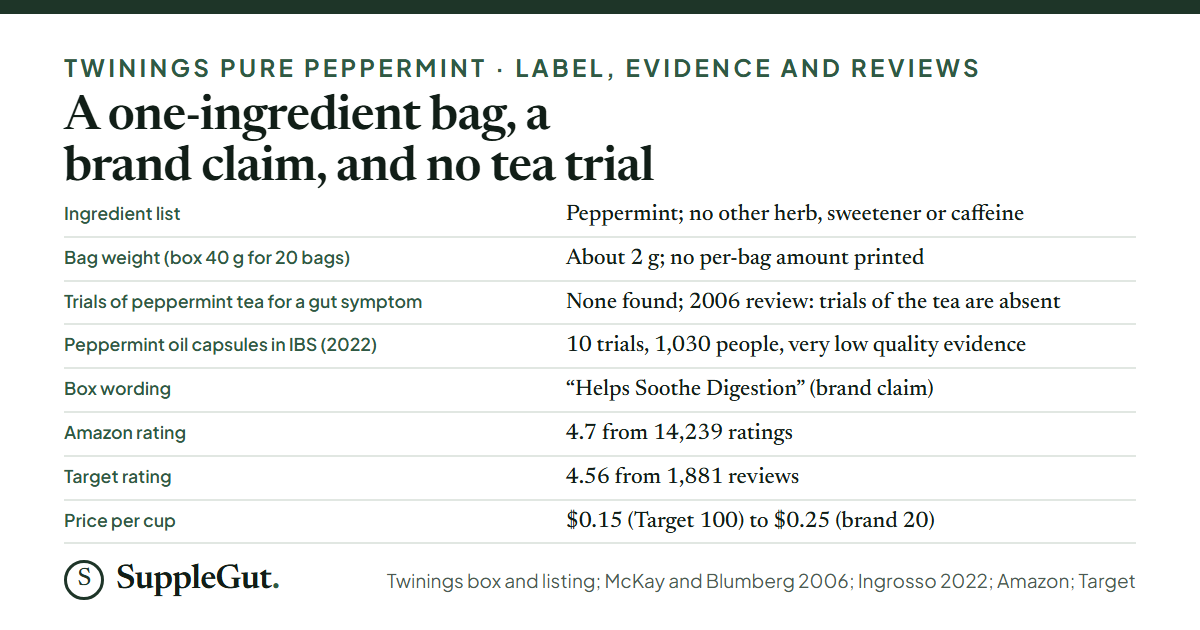
Twinings Pure Peppermint Herbal Tea is a bag of peppermint leaf and nothing else, sold in individually wrapped bags in 20, 50 and 100 counts. The box carries a digestion line, and the Amazon rating is high. This page covers the label, what the research does and does not say about peppermint tea, how to brew it, the reviews, the price per cup, and how it sits next to Traditional Medicinals peppermint and to peppermint oil capsules.
One ingredient on the label
The ingredient list reads “Peppermint.” Amazon’s listing text describes it as an herbal tea made with select peppermint leaves, and the brand’s UK page says “100% Peppermint.” No other herb is listed, and neither are flavorings, sweeteners or caffeine. The box front says “Naturally Caffeine-Free” and “Pure Herbal Tea,” and Amazon lists the diet type as kosher.
This is a food label, not a Supplement Facts panel. The brand’s UK page prints a nutrition table for 100 ml of brewed tea (2 kcal, with 0 g listed for fat, carbohydrate, protein and salt). The Amazon safety text says the tea is allergen-free but may have been processed in facilities that handle allergens, and it names no allergens. Neither the brand page nor the Amazon listing states any third-party testing, and vegan, gluten-free and organic claims do not appear on the pages read.
About 2 grams a bag, worked out from the box
The label prints no amount of peppermint per bag. What it does print on the 20-count box is a net weight of 1.41 oz (40 g), and the brand’s UK page gives the same 40 g for 20 bags. Divided by 20, that is about 2 g a bag. The figure is arithmetic from the box weight, so it holds only if the weight is the leaf in the bags and not the strings, tags and wrappers.
No figure for menthol or for the oil in a brewed cup is printed either. The brand does not say how much of the leaf’s oil ends up in the water.
Wrapped bags in 20, 50 and 100 counts
The brand’s own store sells the tea in 20, 50 and 100 bags, and each bag is individually wrapped. Amazon’s main listing is the 20-count, and a separate Amazon listing sells a six-pack of 20-count boxes. Target lists the 100-count. One bag makes one cup, and the label states no daily amount, so there is no stated number of cups per day. The brand store sells it as a one-time purchase with no subscription option on the product record, and Amazon runs its own Subscribe & Save program. The count is the main difference between listings: the price per cup falls from the 20-count to the 100-count, and the 50-count sits between them on the brand site.
Trials of peppermint tea, and the oil capsule trials next to them
Searches of PubMed and ClinicalTrials.gov returned no trial of a Twinings product and no trial of peppermint leaf tea for a gut symptom such as bloating, indigestion, nausea or IBS. The few tea records that turned up studied cognition and a histamine challenge, not digestion. That fits a review of the herb, which concluded that human studies of peppermint leaf are limited and that clinical trials of peppermint tea are absent. The same review reports relaxation of gastrointestinal tissue in animal studies (McKay and Blumberg, Phytotherapy Research, 2006).
The peppermint trials people cite are for a different preparation: enteric-coated capsules of peppermint oil in irritable bowel syndrome. A 2022 meta-analysis pooled 10 randomized trials in 1,030 people. The oil beat placebo for global symptoms (relative risk of not improving 0.65, 95% confidence interval 0.43 to 0.98, number needed to treat 4) and for abdominal pain (0.76, 0.62 to 0.93, number needed to treat 7). Side effects were more frequent on the oil (1.57, 1.04 to 2.37), and the authors rated the quality of evidence very low (Ingrosso et al., Alimentary Pharmacology & Therapeutics, 2022). A 2019 meta-analysis of 12 trials in 835 patients also found benefit, with a relative risk of 2.39 for global symptom improvement (Alammar et al., BMC Complementary and Alternative Medicine, 2019).
Those results come from measured doses of oil in capsules. A bag of leaf in a cup of water is a different exposure, and the brand does not say how much oil a bag releases. The peppermint tea and IBS guide covers the capsule trials, the release-site argument and the menthol question in full.
“Helps Soothe Digestion” as the box wording
The front of the box reads “Refreshing & Helps Soothe Digestion.” That is the brand’s claim. It names no symptom, cites no study and gives no amount or timing. Because no trial of the tea exists, the line cannot be checked against a result. It sits in the same place as the Amazon reviewers’ accounts of a settled stomach: a stated experience and a stated purpose, with no measurement under either.
How to brew it
Directions differ by source. The Amazon listing says to steep the tea for 4 minutes in 100°C water. The brand’s UK page says to infuse one bag in 200 ml of freshly boiled water for 3 minutes, or longer for a stronger cup. The brand’s US product page prints no directions in its text. Reviewers who find the flavor light and reviewers who find it strong are both on record, so steeping time is the adjustment the label and the UK page leave open. The two sources also disagree on the numbers themselves: 4 minutes in water at 100°C on the Amazon listing against 3 minutes in 200 ml on the UK page, and neither states a cup size for the US bag. With no menthol figure printed, there is no label basis for matching a steeping time to a strength.
The Traditional Medicinals bag, by comparison, directs one bag in 8 fl oz of freshly boiled water, covered, steeped for 10 to 15 minutes. The tea can be served hot or iced, as the Amazon title says.
Side effects, and who the listing excludes
The Amazon safety information says the product is an herbal infusion, not a true tea, and advises against use by children and by people sensitive to mint. It carries no pregnancy line and no medication line. The Amazon and Target review snippets read describe no side effects beyond taste and packaging complaints.
On heartburn, the evidence is from oil trials. A 2014 meta-analysis of 9 trials in 726 people named heartburn as the most commonly reported adverse event on peppermint oil capsules (Khanna et al., Journal of Clinical Gastroenterology, 2014). No equivalent finding was located for the tea. The EU herbal monograph on peppermint leaf advises people with gastroesophageal reflux to avoid it, which is covered in the topic guide linked above.
What the reviews say
Amazon shows 4.7 out of 5 from 14,239 ratings on the brand’s 20-count storefront listing: 83% five-star, 11% four, 4% three, 1% two and 1% one. The listing is tagged Amazon’s Choice and ranks number 35 in herbal tea. A separate six-pack listing shows 4.4 from 73 ratings. Target shows 4.56 from 1,881 reviews on the 100-count, with 83% giving five stars. The ratings sit on retailer sites; the brand’s own page loads a review widget but shows no figure in its text. The Amazon rating may pool several pack sizes under one listing.
Amazon’s summary of review text counts these themes:
- Taste: 597 mentions, 511 positive and 86 negative.
- Quality: 531 mentions, 495 positive and 36 negative.
- Digestive effects: 127 mentions, 123 positive and 4 negative.
- Flavor: 84 mentions, 72 positive and 12 negative.
- Soothing: 71 mentions, 70 positive and 1 negative.
Praise falls into three groups: a clean, minty taste and aroma that is not overpowering; a settled upset stomach, with some buyers describing a calmer evening; and a caffeine-free cup that works hot or iced, with Target buyers citing the 100-count box. Complaints are a flavor described as light or fading after the first brew, a cup some find not aromatic enough and another finds too strong with a peppery edge, one Target reviewer who says the flavor has changed compared with earlier batches, and boxes that arrived crushed or open. Amazon’s full review pages need a sign-in, so these come from the summary and visible snippets.
Price per cup across Amazon, the brand site and Target
One bag makes one cup, so the price per cup is the pack price divided by the count.
| Where | Count | Price | Per cup |
|---|---|---|---|
| Brand site (twiningsusa.com) | 20 | $4.99 | $0.25 |
| Brand site | 50 | $8.99 | $0.18 |
| Brand site | 100 | $16.99 | $0.17 |
| Amazon, one-time | 20 | $4.16 | $0.21 |
| Amazon, Subscribe & Save | 20 | $3.95 | $0.20 |
| Target | 100 | $14.59 | $0.15 |
The brand site lists free shipping over $50. Amazon’s Subscribe & Save is Amazon’s program, with no fees and cancellation at any time, and the listing mentions an extra 10% off a first subscription order. The brand states an unconditional guarantee and invites contact for a return if you are not satisfied.
Twinings next to Traditional Medicinals peppermint, and next to oil capsules
Both teas are single-ingredient peppermint leaf, and both carry no caffeine. They differ in how the label is built. The Traditional Medicinals Organic Peppermint Tea prints a Supplement Facts panel with 1,500 mg of organic peppermint leaf per bag, a brewing direction of 10 to 15 minutes in 8 fl oz, and a Non-GMO Project verification. Twinings prints an ingredient list, no per-bag milligrams, and a box weight from which about 2 g a bag follows. Amazon shows 4.7 from 3,922 ratings on the Traditional Medicinals 16-bag listing, against 4.7 from 14,239 on the Twinings 20-count. Neither tea has a trial of its own, and the oil content of a brewed cup is unpublished for both.
Against peppermint oil capsules the gap is in the evidence, not the plant. IBgard is a capsule with a printed oil amount per serving and a trial of the finished product; the Twinings bag has neither. The two are different preparations taken in different ways, and a result for one does not transfer to the other.
Who Twinings Pure Peppermint is for
- Someone who wants a plain peppermint cup with one ingredient, no added flavor and no caffeine.
- Someone buying by count and price, with 20, 50 and 100 bags across three outlets and a range of $0.15 to $0.25 a cup.
- Someone who treats the digestion line as the brand’s claim and the reviews as buyers’ experience, since no trial of the tea exists.
Adults with acid reflux or a sensitivity to mint, and anyone choosing for a child, are the groups the listing and the monograph single out, and a clinician is the person to ask. For a tea with a printed leaf weight, see the Traditional Medicinals page; for the capsule trials, the IBgard guide; and the quiz starts from your own symptoms.
The entries this page refers to
Common questions
Can Twinings Pure Peppermint settle an upset stomach?
No trial of this tea, or of peppermint leaf tea for any gut symptom, was found, and a 2006 review states that trials of peppermint tea are absent. The box says it “Helps Soothe Digestion,” a brand claim. On Amazon, 123 of 127 digestive-effect mentions in the review summary are positive, which describes buyers’ experience, not a measured result.
Is anything besides peppermint in a Twinings Pure Peppermint bag?
The ingredient list reads “Peppermint” and nothing else: no flavorings, sweeteners or caffeine are listed, and no other herb or laxative herb. The box calls it naturally caffeine-free.
How many grams of peppermint are in one bag?
The label prints no per-bag amount. The 20-count box prints a net weight of 1.41 oz (40 g), which works out to about 2 g a bag if the weight is the bags alone. The Traditional Medicinals peppermint bag prints 1,500 mg of leaf.
How long should Twinings peppermint tea steep?
The Amazon listing says to steep 4 minutes in 100°C water. The brand’s UK page says one bag in 200 ml of freshly boiled water for 3 minutes, or longer for a stronger cup. The brand’s US page prints no directions in the text read.
Does peppermint tea cause heartburn?
In oil capsule trials, heartburn was the most commonly reported side effect in a 2014 meta-analysis of nine trials. The EU herbal monograph advises people with acid reflux to avoid peppermint leaf. No heartburn finding for this tea was found, and the Amazon listing advises against use by children and by people sensitive to mint.
What do Twinings Pure Peppermint bags cost per cup?
Listed prices work out to $0.25 a cup for the brand’s 20-count, $0.18 for its 50-count and $0.17 for its 100-count. Amazon’s 20-count is $0.21 a cup ($0.20 with Subscribe & Save), and Target’s 100-count is $0.15.
What do buyers say they dislike about it?
Amazon’s summary counts 86 negative taste mentions out of 597. Individual reviewers describe a flavor that fades after the first brew, a cup that is not aromatic enough, a peppery edge for some, and boxes that arrived crushed or open.
Sources
- McKay DL, Blumberg JB. “A review of the bioactivity and potential health benefits of peppermint tea (Mentha piperita L.).” Phytotherapy Research, 2006;20(8):619–633. PubMed 16767798
- Ingrosso MR, Ianiro G, Nee J, et al. “Systematic review and meta-analysis: efficacy of peppermint oil in irritable bowel syndrome.” Alimentary Pharmacology & Therapeutics, 2022;56(6):932–941. PubMed 35942669
- Alammar N, Wang L, Saberi B, et al. “The impact of peppermint oil on the irritable bowel syndrome: a meta-analysis of the pooled clinical data.” BMC Complementary and Alternative Medicine, 2019;19(1):21. PubMed 30654773
- Khanna R, MacDonald JK, Levesque BG. “Peppermint oil for the treatment of irritable bowel syndrome: a systematic review and meta-analysis.” Journal of Clinical Gastroenterology, 2014;48(6):505–512. PubMed 24100754
- Twinings Pure Peppermint: brand product page and product record, box image, and pack prices. twiningsusa.com
- Twinings Pure Peppermint, 20 tea bags: UK product page with net weight and brewing directions. twinings.co.uk
- Amazon listing for Twinings Pure Peppermint, 20 count (ASIN B009L6Q2YW): ingredients, safety information, price, ratings and review summary. amazon.com
- Amazon listing for the Twinings six-pack (ASIN B000F4J7WS): rating and weight. amazon.com
- Target listing for Twinings Pure Peppermint Tea, 100 count: price, rating and reviews. target.com
- Amazon listing for Traditional Medicinals Organic Peppermint tea (ASIN B008AI4FE6): rating and review count. amazon.com
One answer for your symptoms
If this page raised more questions than it settled, the quiz asks the ones that matter for you and answers with one product.
Take the quiz →