Guide
Does Yogi Stomach Ease tea work? Fennel at 337 mg, a six-herb blend with licorice first, and no trial of the bag
Quick answer
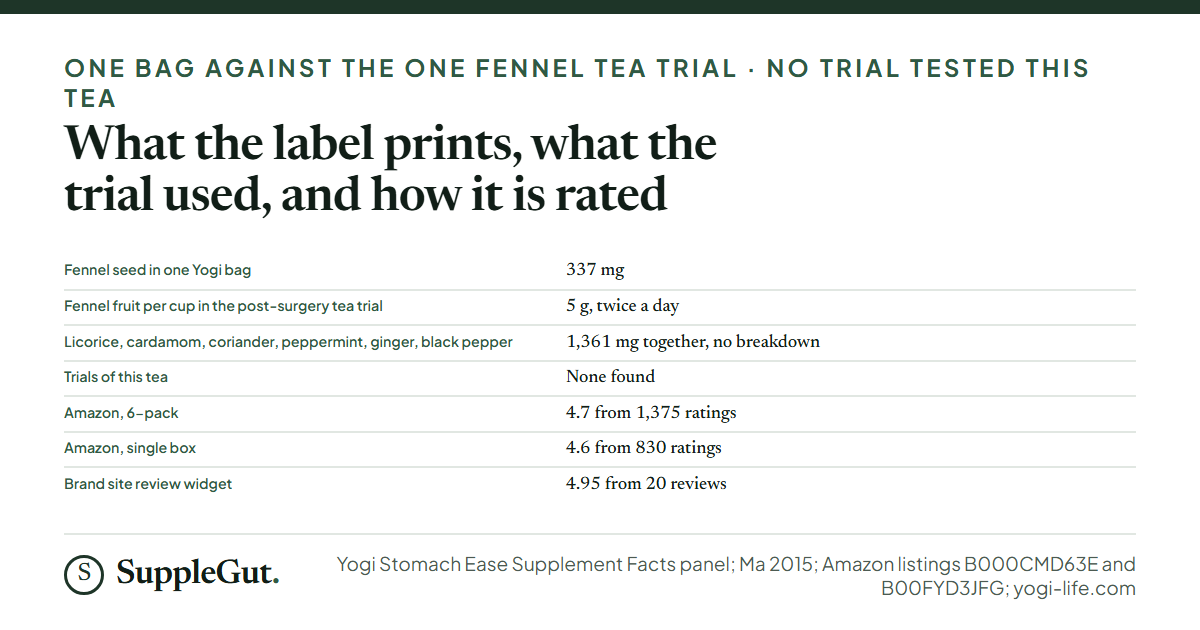
Does Yogi Stomach Ease tea work? No trial of this tea was found. The one human trial of fennel as a tea, in 159 people after gynecologic cancer surgery, used 5 g of fennel fruit a cup against 337 mg of fennel in a Yogi bag. Ginger was tested as capsules, peppermint as oil, and cardamom, coriander and black pepper have no human gut trial. Licorice root is listed first, and its glycyrrhizin raises blood pressure and lowers potassium at heavy or long use. Amazon shows 4.7 from 1,375 ratings on the 6-pack.
Yogi Stomach Ease is a caffeine-free organic tea bag of fennel, licorice, cardamom, coriander, peppermint, ginger and black pepper, sold in 16-bag boxes for “healthy digestion.” Its panel prints one herb on its own line, fennel, and groups the other six under a single figure. This page walks through the panel, the research on each herb, the licorice question, the brewing directions, the label warning, the reviews and what a cup costs.
What one bag holds: fennel, a six-herb blend, rice and flavors
The box carries a Supplement Facts panel, with a serving of one tea bag making 8 fl oz. The brand’s image of the panel gives these lines:
| Line on the panel | Per tea bag |
|---|---|
| Organic fennel seed | 337 mg |
| Proprietary blend of herbs | 1,361 mg |
| Organic licorice root, cardamom pod, coriander seed, peppermint leaf, ginger root, black pepper | No separate amounts |
| Other ingredients | Organic toasted brown rice, brown rice flavor, caramel flavor |
The fennel and the blend add up to 1,698 mg of herbs a bag. The box weighs 29 g across 16 bags, or about 1.81 g a bag, which leaves roughly 0.11 g for the rice and flavors. That is our arithmetic, not a printed figure. The six blend members have no amounts of their own, so the label does not show how much peppermint or ginger sits in a cup. The panel marks every herb “daily value not established.”
The ingredient list on the brand’s page and on Amazon runs, in order, licorice root, cardamom pod, fennel seed, coriander seed, peppermint leaf, ginger root, toasted brown rice, brown rice flavor, black pepper and caramel flavor. Ingredient lists run from most to least by weight, so by this reading licorice root and cardamom each weigh at least as much as the 337 mg of fennel. The panel and the list place fennel differently, and neither gives the rest of the split.
The front of the box reads “Herbal Supplement” with “Supports healthy digestion,” which is why a tea bag carries Supplement Facts and not a food nutrition table. The brand lists USDA Organic (certified by QAI, as printed on the panel), Non-GMO Project Verified, vegan and OU Kosher, and Amazon adds gluten-free and “no artificial flavors or sweeteners.” The box has no “contains” line or facility statement for milk, wheat, egg, soy, tree nuts, fish or sesame. No testing for potency or contaminants is stated.
Trials of the tea, and the one trial of fennel as a tea
A PubMed search on the product name and brand with tea and digestion found no trial of Stomach Ease, and ClinicalTrials.gov lists none. The brand’s claim is a quoted line, “complex flavor and simple results: ease,” followed by the standard FDA disclaimer. No study backs the claim on the page.
Fennel is the herb with a printed amount and the only one of the seven with a human trial as a tea. In a randomized trial, 159 patients recovering from laparotomy for gynecologic cancer drank fennel fruit tea or water twice a day from the first morning after the operation until first flatus. Each cup held 5 g of dried fennel fruit in 130 mL of boiled water, and only the filtrate was drunk. The tea group (78 patients) passed first flatus at 53.1 hours against 64.2 hours for water (81 patients, P < 0.001), first defecation at 4.3 against 5.4 days, and left hospital at 5.6 against 6.7 days. Ileus symptoms, a stalled gut after surgery, were 2.6 times as likely in the water group (Ma et al., Sichuan Da Xue Xue Bao, 2015).
The setting and the amount both differ from a Yogi cup. The patients were just out of surgery, and a trial cup held about 15 times the 337 mg of fennel in one bag, with two cups a day coming to about 30 times. The bag is also steeped in 8 fl oz (about 237 mL) with six other herbs, and the trial does not say what a lower amount does.
A 2025 laboratory study used freshly brewed fennel tea on strips of guinea pig stomach. It relaxed the upper part of the stomach (the fundus and corpus) and increased the strength of contractions in the lower part (the antrum), and the paper’s keywords include functional dyspepsia (Annahazi et al., Neurogastroenterology & Motility, 2025). It is an animal model and not a trial in people.
Peppermint, ginger, licorice and the herbs with no gut trial
Peppermint. A 2006 review of peppermint tea found human studies of the leaf limited and clinical trials of peppermint tea absent (McKay and Blumberg, Phytotherapy Research, 2006). The IBS evidence is for oil in capsules: a 2022 meta-analysis of 10 randomized trials in 1,030 patients found peppermint oil beat placebo for global symptoms (number needed to treat 4) and abdominal pain (number needed to treat 7), with more adverse events and very low quality evidence (Ingrosso et al., Alimentary Pharmacology & Therapeutics, 2022). Yogi uses the leaf, and its amount sits inside the blend. The peppermint tea guide covers those trials in full.
Ginger. The trials used capsules and powder. In 11 people with functional dyspepsia, 1.2 g of ginger in capsules shortened gastric half-emptying to 12.3 minutes against 16.1 on placebo, with no change in symptoms (Hu et al., World Journal of Gastroenterology, 2011). A systematic review of ginger in gut disorders found divided daily amounts of about 1,500 mg or less helpful for nausea (Nikkhah Bodagh et al., Food Science & Nutrition, 2019), and a meta-analysis of 12 trials in 1,278 pregnant women found ginger improved nausea (Viljoen et al., Nutrition Journal, 2014). Ginger’s share of the Yogi blend is not printed. The ginger tea guide sets those doses beside a tea bag.
Licorice. We found no trial of licorice tea for a gut symptom. The licorice-containing trials that turned up were multi-herb extracts, and their results are not read here. What the literature does cover is safety, in the next section.
Cardamom, coriander and black pepper. Searches on each with dyspepsia, IBS and digestion returned no human gut trial. None has a measured gut effect on record.
Licorice is listed first
Licorice root heads the ingredient list, and it contains glycyrrhizin, which the gut converts to glycyrrhizic acid and then to glycyrrhetic acid. Glycyrrhetic acid inhibits an enzyme, 11-beta-hydroxysteroid dehydrogenase type 2, and binds the mineralocorticoid receptor, which can produce mineralocorticoid-like overactivity. A toxicology review names hypertension and low potassium, with the disorders that follow from it, as the most important side effects of licorice and glycyrrhizin, and says to use it with caution in pregnancy (Nazari et al., Phytotherapy Research, 2017). A review of licorice root trials says chronic use can lead to hypokalemia and hypertension, and that some people are more sensitive than others (Kwon et al., Journal of Medicinal Food, 2020).
The label does not say how much licorice root is in a bag, and it does not state whether the root is whole or has had the glycyrrhizin removed (as in DGL). The brand’s product data has separate warning fields for licorice, ashwagandha and ginger, and all three are empty for this tea. The general warning on the panel is the only licorice-relevant caution printed.
None of those reviews measured this tea, and none sets a number of cups. They show what the ingredient does at heavy or long use, and that the bag’s licorice amount sits somewhere inside 1,361 mg. The It’s Health Tea GERD tea also holds licorice root.
The Ayurvedic framing belongs to the brand
Amazon’s title for the 6-pack calls the tea a caffeine-free blend “with Peppermint, Licorice Root and Ayurvedic Herbs,” and the brand’s tagline reads “Settle your stomach, beat the bloat.” The brand’s page pairs the tea with “enjoying a meal slowly and intentionally.” That framing is the brand’s own. Cardamom, coriander and black pepper are the spices associated with it, and as the section above shows, none has a human gut trial. The tradition is the brand’s framing, and no measured result for this bag sits behind it.
Brewing a cup
The directions on the box: bring water to a boil, pour it over one bag and steep for 7 minutes. For a stronger tea, use 2 bags. A serving is one bag in 8 fl oz. The brand gives no daily amount and no timing, apart from pairing the tea with an unhurried meal. Reviewers describe a sweet, earthy cup, and some add honey. The bags are compostable and the tea is caffeine free.
Safety: the box warning and what reviewers report
The warning on the panel and in Amazon’s safety field reads: consult your healthcare provider prior to use if you are pregnant, nursing, taking any medication or have a medical condition. That covers most people, and it is the only warning printed. Apart from the licorice question above, the bag holds no stimulant laxative herb and no caffeine.
Among reviews, one brand-widget reviewer who gave four stars reports acid reflux after a cup and wonders whether the peppermint is the cause. The peppermint tea guide covers reflux under its cautions. Other complaints concern the flavor, covered below. A pregnant or nursing reader, or anyone on a daily medicine, is the person the label’s own line points to a provider for.
Ratings and review text
Amazon shows 4.7 out of 5 from 1,375 ratings on the 6-pack listing and 4.6 from 830 on the single box, where the star split is 80% five-star, 11% four, 5% three, 1% two and 3% one. Amazon’s summary of review text counts 23 mentions of digestive effects (21 positive, 2 negative), 19 of taste (14 positive, 5 negative) and 5 of soothing (all positive). The single-box listing had no featured offer on the day it was read, with other sellers listed.
The brand’s own page runs a review widget with 20 reviews averaging 4.95, 19 of them five-star, collected between 2019 and 2025. That is a feed the brand hosts, and its small count and near-uniform score are a different record from Amazon’s. The Amazon “see all reviews” page requires sign-in, so only the summary and snippets were read.
- Praise: an upset stomach settling quickly, with one review saying relief within 15 minutes; comfort after a heavy or over-full meal; a sweet, earthy flavor.
- Complaints: a strong licorice flavor or an off-putting smell, a taste some find too sweet, and some buyers who say it did not help them.
A cup at three prices
| Where | Price | Bags | Per cup |
|---|---|---|---|
| Brand site, one box | $6.99 | 16 | $0.44 |
| Amazon 6-pack, one time | $26.76 | 96 | $0.28 |
| Amazon 6-pack, Subscribe & Save | $25.42 | 96 | $0.26 |
The brand’s site lists free shipping on orders over $35 and no subscription on the product page. It states a 60-day satisfaction guarantee that covers purchases from its site or authorized sellers in the United States, with a refund or replacement on request. The guarantee does not cover unauthorized sellers. Amazon’s Subscribe & Save is Amazon’s program, with no fees and cancellation allowed.
Stomach Ease beside peppermint tea and the Traditional Medicinals ginger tea
The Traditional Medicinals peppermint tea holds one ingredient, 1,500 mg of peppermint leaf a bag, and Amazon shows 4.7 from 3,922 ratings on its 16-bag listing. The Traditional Medicinals ginger tea holds one ingredient too, 1,500 mg of ginger rhizome a bag, steeped 10 to 15 minutes, at 4.6 from 3,880 ratings.
| Yogi Stomach Ease | TM peppermint | TM ginger | |
|---|---|---|---|
| Ingredients | Seven herbs plus rice and flavors | Peppermint leaf | Ginger rhizome |
| Printed per bag | Fennel 337 mg; blend 1,361 mg | 1,500 mg | 1,500 mg |
| Licorice root | Listed first | None | None |
The practical difference is what each label lets you check. With a single-herb bag the whole 1,500 mg is one plant, and its trials can be set beside it, as the guides above do. With Stomach Ease, the six-herb blend cannot be broken down, and no trial compares the three teas.
Who this blend suits
- Someone who wants a sweet, spiced blend after a meal and prefers one bag to several single-herb teas.
- Someone comfortable with licorice as the first ingredient and not in a group the label’s warning singles out.
- Someone who likes a caffeine-free cup from an organic brand sold in grocery stores and online, with a 60-day guarantee on authorized purchases.
A reader who wants one herb with a known weight can compare the single-herb teas above, and the quiz starts from symptoms and goals.
Products researched for this topic
Common questions
Is there any proof that Yogi Stomach Ease settles the stomach?
No trial of this tea turned up in PubMed or ClinicalTrials.gov. A fennel tea trial in surgical patients used about 15 times the fennel in one bag per cup, and ginger and peppermint were tested as capsules and oil. On Amazon’s review summary, 21 of 23 mentions of digestive effects are positive.
How much of each herb is in one bag?
Only fennel has its own figure: 337 mg of organic fennel seed. Licorice root, cardamom pod, coriander seed, peppermint leaf, ginger root and black pepper share a proprietary blend of 1,361 mg with no breakdown. Toasted brown rice, brown rice flavor and caramel flavor are listed as other ingredients.
Does the warning on the box apply to me?
The label warns anyone who is pregnant, nursing, taking any medication or living with a medical condition to consult a healthcare provider first. Licorice root is the first ingredient listed, and glycyrrhizin from licorice raises blood pressure and lowers potassium in published reviews, mainly at heavy or long use.
What do 16 bags cost, and what is a cup from the Amazon 6-pack?
On the brand’s site a 16-bag box is $6.99, about $0.44 a cup. The Amazon 6-pack of 96 bags is $26.76, about $0.28 a cup, and $25.42 with Subscribe & Save, about $0.26.
What are the brewing directions on the box?
The box says to bring water to a boil and steep 7 minutes, and to use 2 bags for a stronger cup. A serving is one bag in 8 fl oz, and the brand gives no daily amount.
Does the tea contain caffeine or a laxative herb?
Neither. The brand lists it as caffeine free, and the panel and ingredient list hold no senna, cascara, aloe latex, rhubarb or other stimulant laxative.
How does it differ from a plain peppermint or ginger tea?
Yogi’s blend adds fennel, licorice and spices to peppermint and ginger, tastes sweeter and earthier by reviewers’ accounts, and carries a general medication warning. The Traditional Medicinals peppermint and ginger teas each hold a single herb at 1,500 mg a bag. No trial compares any of them.
Why does a tea bag carry a Supplement Facts panel?
Both labels apply. The front reads “Herbal Supplement,” and the back carries a Supplement Facts panel rather than a nutrition table. It is sold as a tea bag, one bag per 8 fl oz cup.
Sources
- Ma H-W, Zhao J-T, Zhao X. “The effect of fennel tea drinking on postoperative gut recovery after gynecological malignancies operation.” Sichuan Da Xue Xue Bao Yi Xue Ban, 2015;46(6):940–943. PubMed 26867333
- Annahazi A, Kuch B, Ridzal L, et al. “Fennel tea has a region-specific effect on the motility of the stomach.” Neurogastroenterology & Motility, 2025;37(12):e70201. PubMed 41214408
- McKay DL, Blumberg JB. “A review of the bioactivity and potential health benefits of peppermint tea (Mentha piperita L.).” Phytotherapy Research, 2006;20(8):619–633. PubMed 16767798
- Ingrosso MR, Ianiro G, Nee J, et al. “Systematic review and meta-analysis: efficacy of peppermint oil in irritable bowel syndrome.” Alimentary Pharmacology & Therapeutics, 2022;56(6):932–941. PubMed 35942669
- Hu M-L, Rayner CK, Wu K-L, et al. “Effect of ginger on gastric motility and symptoms of functional dyspepsia.” World Journal of Gastroenterology, 2011;17(1):105–110. PubMed 21218090
- Nikkhah Bodagh M, Maleki I, Hekmatdoost A. “Ginger in gastrointestinal disorders: a systematic review of clinical trials.” Food Science & Nutrition, 2019;7(1):96–108. PubMed 30680163
- Viljoen E, Visser J, Koen N, Musekiwa A. “A systematic review and meta-analysis of the effect and safety of ginger in the treatment of pregnancy-associated nausea and vomiting.” Nutrition Journal, 2014;13:20. PubMed 24642205
- Nazari S, Rameshrad M, Hosseinzadeh H. “Toxicological effects of Glycyrrhiza glabra (licorice): a review.” Phytotherapy Research, 2017;31(11):1635–1650. PubMed 28833680
- Kwon Y-J, Son D-H, Chung T-H, Lee Y-J. “A review of the pharmacological efficacy and safety of licorice root from corroborative clinical trial findings.” Journal of Medicinal Food, 2020;23(1):12–20. PubMed 31874059
- Yogi Stomach Ease: product page, Supplement Facts panel image, box image and satisfaction guarantee. yogi-life.com
- Amazon listings for Yogi Stomach Ease: 6-pack (ASIN B000CMD63E) and single box (ASIN B00FYD3JFG), with ingredient list, safety information, price, ratings and review summary. amazon.com
Turn the reading into a shortlist of one
The evidence here is about categories. The quiz works at the level of one person and one product.
Take the quiz →