Guide
Qi, the spleen and food stagnation: the TCM ideas behind gut products, explained
Quick answer
What do qi, spleen qi deficiency and dampness mean? In traditional Chinese medicine qi is the activity that moves and warms the body, the spleen is a set of functions that transform and transport food and fluid, and dampness is a heavy, sticky influence the tradition says follows a weak spleen. They are the tradition’s concepts and not laboratory measures. A label can be checked for herb names, amounts and heavy-metal testing, but not for whether a pattern such as spleen qi deficiency fits the buyer.
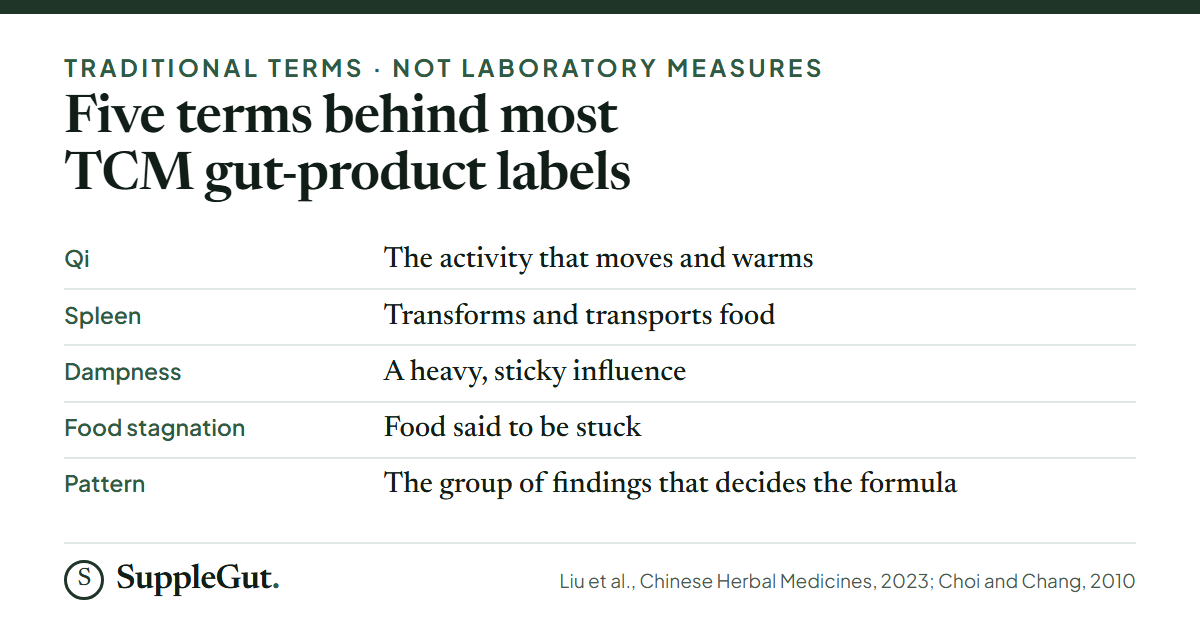
Words from traditional Chinese medicine (TCM) now sit on supplement labels in the United States: “tonifies spleen qi,” “resolves dampness,” “harmonizes the stomach,” “Six Gentlemen.” This guide defines the terms the way the tradition uses them, gives the nearest modern idea where one exists without treating the two as the same thing, names the classical digestive formulas and the pattern each is aimed at, and sets out what a buyer can and cannot check about a label that uses these words. The wider background is in What is traditional Chinese medicine?, and the full set of guides is in the TCM section.
The terms, one by one
The middle column is the tradition’s own account. The right-hand column is the closest idea in modern physiology or pharmacy, offered as a loose comparison and not as a translation. The WHO’s standard terminology for traditional medicine runs to 3,259 terms, and its authors note that formula titles are not standardized across romanizations, so one formula can appear under several spellings (Choi and Chang, 2010).
| Term | In the tradition | Nearest modern idea (not an equivalent) |
|---|---|---|
| Qi | The activity that moves, warms and transforms in the body; in digestion, the force that moves food and fluid along. | Loosely, physiological function. No measurement corresponds. |
| Yin | The cool, moist, quiet and nourishing side of any pairing. | None. A descriptive pole. |
| Yang | The warm, active, moving side of any pairing. | None. A descriptive pole. |
| Spleen (pi) | The organ system said to transform food and fluid into qi and blood and transport them. One of five zang. | Not the anatomical spleen. Loosely, digestion, absorption and nutrient handling. |
| Stomach (wei) | The organ system said to receive and ripen food and send it downward. Paired with the spleen. | Loosely, the stomach and upper-gut motility and secretion. |
| Dampness (shi) | A heavy, sticky influence from outside (damp weather) or inside (a weak spleen): fullness, heaviness, loose stool, a thick tongue coating. | Loosely, fluid retention and mucus. No marker. |
| Phlegm (tan) | Dampness that has thickened; the texts include visible mucus and also lumps and a sense of fullness. | Loosely, abnormal mucus or fluid accumulation. |
| Food stagnation | Food said to be stuck in the stomach and intestines: fullness, sour belching, no wish to eat. | Loosely, slow emptying or dyspepsia after meals. A comparison only. |
| Qi stagnation | Qi that fails to move: distension, cramping and pain that shifts and worsens with stress. | Loosely, functional gut symptoms linked with stress. A comparison only. |
| Damp-heat | Dampness combined with heat: burning, foul loose stool, thirst, a sticky yellow tongue coating. | None. |
| Cold | A pattern of chilled limbs, pain eased by warmth and thin clear stool or fluid. A description of the pattern, not a temperature. | None. |
| Deficiency (xu) | An under-supply or under-function, such as weak spleen qi: tiredness, poor appetite. | Loosely, under-function. No marker. |
| Excess (shi) | An accumulation or blockage, such as food stagnation. | Loosely, accumulation or over-activity. |
| Middle burner (zhong jiao) | The upper abdomen, the middle of the three burners, where the spleen and stomach do their work. | The upper abdomen. The three burners together have no anatomical counterpart. |
| Pattern differentiation (bian zheng) | Sorting a person’s findings into a pattern (zheng) to choose a formula. | Loosely, diagnostic subgrouping. ICD-11’s traditional medicine chapter lists 196 patterns. |
| Chief herb (jun) | The herb in a formula aimed at the main pattern. | Loosely, the main active ingredient. The scientific basis of the compatibility theory has not been clarified. |
| Deputy herb (chen) | An herb that reinforces the chief or covers a second aspect. Assistants (zuo) moderate side effects; envoys (shi) direct and harmonize. | Loosely, supporting ingredients. |
| Decoction (tang) | Raw herbs simmered in water and drunk. The original form. | An herbal tea. |
| Granule | A dried, concentrated extract that dissolves in hot water. | A spray-dried extract. |
| Teapill (wan) | A small pill of herb powder or extract, taken by the handful. A Plum Flower label lists 8 pills as one serving. | A small tablet, dosed by count. |
| Patent medicine | A ready-made formula in pill, tablet or capsule form, sold under its formula name. | In the United States, a dietary supplement. |
| Pinyin name | The Chinese name in Roman letters: Bai Zhu, Fu Ling, Chen Pi. The same herb also has a Latin and an English name. | Bai Zhu is atractylodes (Atractylodes macrocephala) and Fu Ling is poria (Poria cocos). |
Formula names end in the form: tang is a decoction, wan a pill and san a powder. The same formula is often sold in a different form from its name, so “Ping Wei San” may be a powder, a tablet or a teapill.
The classical digestive formulas
Ten classical formulas recur in trials and on labels. The herbs are those usually given by reference and supplier sites, and versions vary; the pattern is what the tradition says the formula is for, not a diagnosis.
| Formula | Usual herbs | Pattern the texts address |
|---|---|---|
| Si Jun Zi Tang (Four Gentlemen) | Ginseng or codonopsis, atractylodes, poria, licorice | Spleen qi deficiency: poor appetite, tiredness, loose stool. |
| Liu Jun Zi Tang (Six Gentlemen) | Si Jun Zi plus pinellia and tangerine peel | Spleen qi deficiency with phlegm-dampness: nausea, fullness. |
| Xiang Sha Liu Jun Zi Tang | Liu Jun Zi plus costus root and amomum | Spleen qi deficiency with qi stagnation: distension, belching, pain. |
| Shen Ling Bai Zhu San | Si Jun Zi plus yam, lotus seed, coix, hyacinth bean, amomum, platycodon | Spleen qi deficiency with dampness: loose stool, poor appetite. |
| Bao He Wan (Preserve Harmony) | Hawthorn, massa fermentata, radish seed, pinellia, poria, tangerine peel, forsythia | Food stagnation: fullness, sour belching. A reference entry cautions against it in spleen and stomach deficiency. |
| Ping Wei San (Calm the Stomach) | Atractylodes (cang zhu), magnolia bark, tangerine peel, licorice, ginger, jujube | Dampness obstructing the spleen and stomach: heavy fullness, nausea, thick white tongue coating. |
| Huo Xiang Zheng Qi San | Agastache, perilla, angelica dahurica, areca peel, atractylodes, poria, pinellia, magnolia bark, platycodon, tangerine peel, licorice, ginger, jujube | Outer cold with inner dampness: nausea, vomiting, diarrhea with chills. |
| Tong Xie Yao Fang (Important Formula for Painful Diarrhea) | Atractylodes, white peony, tangerine peel, saposhnikovia | Liver qi overacting on the spleen: pain, then diarrhea. |
| Ban Xia Xie Xin Tang | Pinellia, scutellaria, dried ginger, ginseng, licorice, coptis, jujube | Mixed cold and heat in the middle burner: epigastric fullness, nausea, rumbling, loose stool. |
| Xiao Yao San (Free and Easy Wanderer) | Bupleurum, dang gui, white peony, atractylodes, poria, licorice, ginger, mint | Liver qi stagnation with spleen deficiency: flank distension, irritability, poor appetite. |
Where trials exist they are of the standard formula: eight herbs for Xiang Sha Liu Jun Zi Tang in a 2024 meta-analysis of 23 trials (Wang et al., 2024), four herbs for Tong Xie Yao Fang in a 2022 meta-analysis of 11 trials with 985 adults (Liang et al., 2022). Both sets of authors called the evidence limited by trial design; the tables are in TCM formulas for digestion: what the trials show.
How labels use these words
A label that says “tonifies spleen qi,” “resolves dampness,” “dispels food stagnation” or “harmonizes the stomach” is using the tradition’s vocabulary to state the purpose of a formula. It is a statement of what the tradition says, in terms a laboratory cannot test. The FDA treats the line between that and a disease claim seriously: its warning letter to ActiveHerb found that website and label claims made several of its products unapproved drugs, and the products it named included Stomacare, a Huo Xiang Zheng Qi formula (FDA, 2019).
What a buyer can check, and what not
- Can check: the herb names. Latin names and the plant part, not only pinyin. The FDA says aristolochic acid entered products in past outbreaks because of mislabeled plants or because Chinese names were misinterpreted or similar, which is why the alert covers look-alike genera.
- Can check: amounts. Several labels we read give a blend total with the herbs in order and no amount per herb: 1,360 mg for eight Plum Flower Calm Stomach teapills, 1,435 mg of herbal blend for two capsules of Health Concerns Quiet Digestion, 1.0 g for two capsules of Snap Dynasty Stomach Chi.
- Can check: “modified.” Quiet Digestion is labeled a modified Bao He Wan. A modified formula has different herbs from the classical one, so trials of the classical version do not carry over.
- Can check: testing claims. Snap Dynasty states that each formula is batch-tested for heavy metals, pesticides and microbes. That is a brand claim; the buyer can ask for the certificate.
- Cannot check: whether the pattern fits the buyer. A pattern comes from a practitioner’s questions, tongue and pulse. A label cannot establish it.
Trials test one formula at one dose in one form. The rikkunshito trial in Japan gave 2.5 g three times a day for 8 weeks to 247 patients with functional dyspepsia, and 33.6% were responders against 23.8% on placebo (P=0.09) (Suzuki et al., 2014). A modified formula, another dose or another form is not covered by that result. Are Chinese herbal supplements safe? covers heavy metals, aristolochic acid and undeclared drugs.
Products this guide draws on
Common questions
What is qi?
Qi is the TCM term for the activity that moves, warms and transforms in the body, and in digestion for the force that moves food and fluid along. It is the tradition’s concept and not a quantity that an instrument measures. The nearest modern ideas, such as physiological function or energy metabolism, are loose comparisons.
Does “spleen” in TCM mean the organ in the abdomen?
No. The TCM spleen is a set of functions, chiefly transforming and transporting food and fluid, and it is paired with the stomach. “Spleen qi deficiency” is a pattern the tradition describes with tiredness, poor appetite and loose stool; it is not a statement about the anatomical organ.
What is dampness in TCM?
Dampness is a heavy, sticky influence that the tradition says can come from outside, as in damp weather, or from inside when the spleen is weak. A 2023 review links it to a weak spleen combined with fatty, sweet and rich food. It is described by its signs, such as fullness, heaviness and loose stool, and has no laboratory marker.
What is food stagnation?
Food stagnation is the tradition’s name for food that is stuck, with fullness, sour belching and no wish to eat. Bao He Wan, built around hawthorn and massa fermentata, is the classical formula for it. A modern comparison would be dyspepsia after meals, but the two are not equated.
What does “tonifies spleen qi” on a label mean?
It is the tradition’s statement that the formula is for the pattern called spleen qi deficiency, as with Si Jun Zi Tang or Liu Jun Zi Tang. It describes purpose in TCM terms and is not a measurable effect. A buyer can check the herb names and amounts on the label, not whether the pattern applies.
What do tang, wan and san mean in formula names?
They name the original form: tang is a decoction, wan a pill and san a powder. A formula called a San may now be sold as a tablet or teapill, and the same formula can appear under several spellings, since the WHO terminology notes that formula titles are not standardized across romanizations.
Can a quiz or a label tell me my TCM pattern?
In the tradition a pattern is reached by a practitioner through questions, the tongue and the pulse, and the same Western diagnosis can fall under several patterns. A label cannot establish one, and the pattern is a category of the tradition and not a laboratory value.
Sources
- Choi S-H, Chang I-M. “A Milestone in Codifying the Wisdom of Traditional Oriental Medicine: TCM, Kampo, TKM, TVM: WHO International Standard Terminologies on Traditional Medicine in the Western Pacific Region.” Evidence-Based Complementary and Alternative Medicine, 2010;7(3):303–305. 3,259 terms; romanization of formula titles. pmc.ncbi.nlm.nih.gov/articles/PMC2887335
- Liu B, Kou Z, Chen B. “Effects and mechanisms of traditional Chinese medicines on functional dyspepsia: A review.” Chinese Herbal Medicines, 2023;15(4):516–525. Spleen, stomach, spleen qi deficiency, dampness. pmc.ncbi.nlm.nih.gov/articles/PMC10715891
- Reddy B, Fan AY. “Incorporation of complementary and traditional medicine in ICD-11.” BMC Medical Informatics and Decision Making, 2022. 150 disorders and 196 patterns. pmc.ncbi.nlm.nih.gov/articles/PMC9248085
- “Compound-based Chinese medicine formula: from discovery to compatibility mechanism.” Liverpool John Moores University repository. Chief, deputy, assistant and envoy. researchonline.ljmu.ac.uk/id/eprint/12359
- Wang L, et al. “Efficacy and safety of Xiangsha liujunzi decoction for functional dyspepsia: a systematic review and meta-analysis.” Frontiers in Pharmacology, 2024. Composition, 23 trials. frontiersin.org
- Liang S-B, et al. “Systematic review and meta-analysis of Chinese herbal formula Tongxie Yaofang for diarrhea-predominant irritable bowel syndrome: Evidence for clinical practice and future trials.” Frontiers in Pharmacology, 2022. Composition, 11 trials, 985 adults. frontiersin.org
- Suzuki H, et al. “Randomized clinical trial: rikkunshito in the treatment of functional dyspepsia: a multicenter, double-blind, randomized, placebo-controlled study.” Neurogastroenterology and Motility, 2014;26(7):950–961. PMID 24766295. pubmed.ncbi.nlm.nih.gov/24766295
- Formula compositions and indications as given by suppliers and reference sites: Blue Poppy Si Jun Zi Tang, Shen Ling Bai Zhu San, Huo Xiang Zheng Qi San and Xiao Yao San; Asante Academy: Bao He Wan; D’Alberto: Ban Xia Xie Xin Tang; ActiveHerb and Mayway ingredient lists.
- FDA. Warning letter to ActiveHerb Technology, Inc., WL 574615. fda.gov
- FDA. Import Alert 54-10, Aristolochia species and look-alike genera. accessdata.fda.gov/cms_ia/importalert_141.html
- Brand pages for label amounts: Plum Flower Calm Stomach Teapills at mayway.com; Health Concerns Quiet Digestion at healthconcerns.com; Snap Dynasty at snapdynasty.com.
Not sure which product fits your situation?
This guide covers the mechanics. The quiz takes your specific symptoms, routine and preferences and matches you to one product from the catalog.
Take the quiz →