Guide
Classic Chinese digestive formulas: what the human trials show, formula by formula
Quick answer
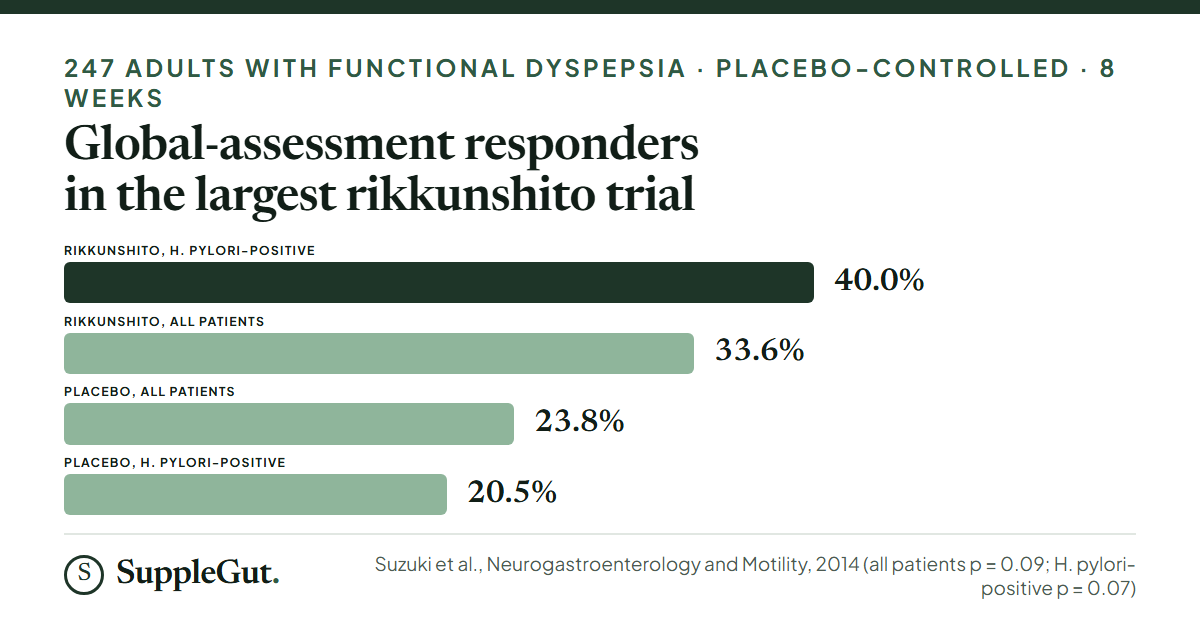
What do the human trials show for classic Chinese digestive formulas? Most formulas have many trials and few placebo-controlled ones. Rikkunshito (Liu Jun Zi Tang) has the largest placebo trial: 247 adults with functional dyspepsia, 33.6% responders on the formula against 23.8% on placebo (p = 0.09). Tong Xie Yao Fang has two placebo trials in IBS-D that disagree, 57.5% against 37.5% in 160 people and 79.2% against 70.8% in 96. For the rest, the bulk is Chinese trials against a drug, rated at high risk of bias by the reviews that pooled them.
Chinese digestive formulas reach the shelf under a Chinese name (Liu Jun Zi Tang) or a Japanese one (rikkunshito), and the trials behind them are less uniform than the labels suggest. This guide takes eleven classic formulas one at a time: the herbs, the pattern the tradition says each addresses, the human trials with PubMed numbers, and whether the evidence is placebo-controlled, open-label or made of Chinese-language trials that the pooling reviews rated low quality. The background is in What is traditional Chinese medicine? and the glossary of key concepts for the gut; the TCM section lists every guide in the series.
How the evidence is sorted here
A placebo-controlled trial compares the formula with a look-alike dummy. An open-label or usual-care trial compares it with a drug or ordinary care and nobody is blinded. Between them sits the large group of single-center Chinese trials against a prokinetic drug such as domperidone, which the reviews describe as having unclear randomization, no allocation concealment and almost no blinding.
| Formula | Strongest design found | Key number | PMID |
|---|---|---|---|
| Liu Jun Zi Tang / rikkunshito | Placebo-controlled, 247 adults | 33.6% against 23.8% responders (p = 0.09) | 24766295 |
| Xiang Sha Liu Jun Zi Tang | 9 Chinese trials against drugs | Odds ratio 2.63 | 23304226 |
| Si Jun Zi Tang | 12 trials, all high risk of bias | Response ratio 1.23 | 33407405 |
| Shen Ling Bai Zhu San | 13 IBS trials against or added to conventional care | Cure-rate ratio 2.38 | 33258340 |
| Bao He Wan | No human trial of the pill found | Mouse studies only | 37228379 |
| Ping Wei San | Assessor-blind against usual care, 140 adults | Symptom score 1.55 points lower | 42637062 |
| Tong Xie Yao Fang | Two placebo trials, 160 and 96 adults | 57.5% against 37.5%; 79.2% against 70.8% | 29856472, 39870499 |
| Ban Xia Xie Xin Tang | 57 trials, 5 placebo-controlled | Response ratio 1.19 against drugs | 37274096 |
| Xiao Yao San | 6 open-label trials; 1 placebo trial of a modified pill | Ratio 1.15; score 3.8 against 5.3 | 37124216, 33108123 |
| Huo Xiang Zheng Qi San | 1 placebo trial, 212 adults | Responders 29 points above placebo | 41297321 |
| Da Cheng Qi Tang | 60 trials added to hospital care | Response ratio 1.25 | 25392589 |
Liu Jun Zi Tang (rikkunshito)
The “Six Gentlemen” formula combines ginseng, atractylodes, poria, licorice, pinellia, orange peel, ginger and jujube. The tradition uses it for what the texts call spleen deficiency, and Chinese reviewers pair functional dyspepsia with the traditional category of stuffiness and fullness. Rikkunshito, the Japanese version, lists the same eight herbs with a different atractylodes species and the peel of Citrus unshiu.
The largest placebo-controlled trial is Japanese and multicenter (PMID 24766295). A total of 247 adults with functional dyspepsia took 2.5 g of rikkunshito or placebo three times a day for eight weeks. Global-assessment responders were 33.6% against 23.8% (p = 0.09), epigastric pain improved more on the formula (p = 0.04), and among H. pylori-positive patients the figures were 40.0% against 20.5% (p = 0.07). Smaller placebo trials were mixed: 23 Belgian patients improved on both rikkunshito and placebo (PMID 31608532), and complete response in 180 cisplatin patients was 50.6% against 58.9% (PMID 40156342). A meta-analysis of 52 mostly Chinese trials in 5,475 patients gave a response ratio of 1.21 (95% CI 1.17 to 1.25) against drugs such as domperidone, and only 5 of the 59 trials it identified were double-blinded (PMID 32767596).
Xiang Sha Liu Jun Zi Tang
This adds amomum and aucklandia to Liu Jun Zi Tang. Chinese reviewers describe its target as spleen deficiency with qi stagnation, which in plain terms is fullness and distension on top of weak digestion. A meta-analysis of 15 single-center Chinese trials with 1,149 participants compared the two formulas with domperidone, cisapride or mosapride, mostly over four weeks (PMID 23304226). The odds of symptom improvement were 1.96 (95% CI 1.15 to 3.36) for Liu Jun Zi Tang and 2.63 (95% CI 1.72 to 4.03) with the added herbs. Only two trials scored 3 or more on the five-point Jadad scale and none described allocation concealment.
Si Jun Zi Tang
The “Four Gentlemen” formula is the base Liu Jun Zi Tang builds on: ginseng (often replaced by codonopsis in practice), atractylodes, poria and licorice. A meta-analysis of 12 randomized trials reported a response ratio of 1.23 (95% CI 1.17 to 1.30) in functional dyspepsia and rated every trial at high risk of bias (PMID 33407405). The benefit was limited to modified versions: 1.24 across eight trials, against 1.21 (95% CI 0.99 to 1.49) for the plain formula in one trial. Two placebo-controlled trials gave a ratio of 1.74 (95% CI 1.30 to 2.34).
Shen Ling Bai Zhu San
This is Si Jun Zi Tang plus lablab seed, Chinese yam, lotus seed, platycodon, amomum and coix, and the tradition uses it for spleen weakness with dampness, which the reviews frame as spleen-deficiency diarrhea. In IBS, 13 trials with 868 patients found a cure-rate ratio of 2.38 (95% CI 1.43 to 3.95; 8 trials) against conventional treatment alone, with risk of bias rated moderate (PMID 33258340). In chronic diarrhea, 14 trials with 1,158 participants found patient-reported satisfaction higher against conventional medicine (relative risk 2.34, 95% CI 1.84 to 2.97), an outcome rated at high risk of bias; the one trial reporting stool frequency against placebo found no significant change (PMID 35635135). In ulcerative colitis, network meta-analyses of 70 and 34 trials included it as an add-on to mesalazine (PMID 38813206, PMID 41635924).
Bao He Wan
The pill combines hawthorn, massa fermentata, radish seed, pinellia, poria, orange peel and forsythia. The tradition uses it for dietary stagnation, which corresponds roughly to indigestion after food that has not moved on. We could find no randomized trial of the pill itself in PubMed. The published work is on mice, where a decoction raised intestinal lactase activity in diarrhea induced by a high-fat, high-protein diet (PMID 37228379, PMID 36093186, PMID 35620223). In people, the closest is a trial of 55 gastric cancer patients after gastrectomy in which a modified Pingwei Baohe decoction, borrowing from this pill and from Ping Wei San, was added to chemotherapy and first flatus and bowel sounds returned sooner (PMID 41479727).
Ping Wei San
“Balance the Stomach Powder” contains atractylodes, magnolia bark, orange peel and licorice. The tradition describes damp-cold stagnation in the spleen and stomach and credits the formula with drying dampness, moving qi and harmonizing the stomach. The one controlled trial we found used the Korean name, Pyeongwi-san: 140 adults with functional dyspepsia were assigned to it (56), to Yukgunja-tang (56) or to usual care (28) for six weeks, with assessors blinded but not patients (PMID 42637062). The dyspepsia score fell 1.55 points more than with usual care (95% CI 0.12 to 2.98), and the two formulas did not differ. The comparator was usual care, not a placebo.
Tong Xie Yao Fang
“Important Formula for Painful Diarrhea” contains atractylodes, white peony, orange peel and saposhnikovia. It was first recorded in the Yuan dynasty, and trials describe the target as liver depression with spleen deficiency, which the tradition pictures as liver qi constraint overrunning a weak spleen, with pain followed by loose stools. It has the clearest placebo record of any formula here, and the two trials disagree. In 160 adults with IBS-D, adequate relief over four weeks was 57.5% against 37.5% (odds ratio 2.2, 95% CI 1.2 to 4.4; PMID 29856472). In 96 adults over eight weeks, response was 79.2% against 70.8% (ratio 1.12, 95% CI 0.89 to 1.41; PMID 39870499). A review of 11 trials in 985 adults found a ratio of 1.53 for its single placebo trial and 1.12 against drugs in ten others, which it rated at high risk of bias (PMID 36091782). The pooled IBS evidence is in Does Chinese herbal medicine work for IBS?
Ban Xia Xie Xin Tang
The formula is pinellia, ginseng, dried ginger, coptis, scutellaria, licorice and jujube, and the tradition treats it as a formula for mixed cold and heat in the stomach, with epigastric stuffiness. A meta-analysis of 57 trials with 5,525 people found a response ratio of 1.19 (95% CI 1.15 to 1.23) against Western medicine in 43 trials; only five trials were placebo-controlled, three of them found no significant difference on a symptom scale, and 54 of the 57 were rated high risk of bias (PMID 37274096). For chemotherapy diarrhea, the Japanese form (Hangeshashinto) was tested in 44 randomized lung cancer patients on irinotecan, 41 evaluable: grade 3 or 4 diarrhea occurred in 1 of 18 on the formula and 10 of 23 controls, and the trial stopped at an interim analysis (PMID 12687289). Pooling three trials gave a risk ratio for severe diarrhea of 0.40 (95% CI 0.11 to 1.41), and the authors judged the evidence insufficient (PMID 38213366).
Xiao Yao San
“Free and Easy Wanderer” combines bupleurum, dang gui, white peony, atractylodes, poria, licorice, mint and fresh ginger, and the tradition describes disharmony of the liver and spleen, with liver qi stagnation at its core. A review of six Chinese trials with 707 people found a response ratio of 1.15 (95% CI 1.05 to 1.26) against Western drugs, with no placebo trial and no blinding of participants (PMID 37124216). The placebo-controlled trial is of a modified pill: 144 adults with functional dyspepsia took it for four weeks, and the symptom score went from 9.3 to 3.8 against 9.5 to 5.3 on placebo (p = 0.013; PMID 33108123). For IBS we found only a protocol for a review (PMID 33725813).
Huo Xiang Zheng Qi San
The oral liquid used in the trials lists agastache, atractylodes, magnolia bark, pinellia, perilla, angelica dahurica, orange peel, poria, areca peel, licorice and ginger. The tradition uses it for what the texts call gastrointestinal cold, with nausea, diarrhea and summer heatstroke. In a double-blind trial in 212 adults with IBS-D, 20 mL twice a day for four weeks put responders 29 points above placebo (95% CI 14 to 43), and the symptom severity score fell 10.9 points more; the maker supplied the product and had no role in the analysis (PMID 41297321). For acute gastroenteritis, a Chinese-language meta-analysis of 44 trials with 4,153 patients found the pills added to Western medicine ahead on total effective rate, and rated overall quality low (PMID 31602833).
Da Cheng Qi Tang
The “Major Order the Qi” decoction pairs rhubarb root, magnolia bark, immature bitter orange and mirabilite, a sodium sulfate salt. The tradition uses it for yangming bowel excess, meaning constipation with abdominal fullness, and it is a strong purgative that the trials gave in hospital settings. A meta-analysis of 60 trials with 6,095 patients found the decoction alone not clearly different from conservative therapy in intestinal obstruction (6 trials, response ratio 1.13, 95% CI 0.97 to 1.31) and ahead when added to it (48 trials, 1.25, 95% CI 1.20 to 1.30). Time to first flatus after surgery was shorter (11 trials), and the trials did not report blinding or allocation concealment (PMID 25392589). In severe acute pancreatitis, 23 trials of chengqi-series decoctions with 1,865 patients found lower mortality (risk ratio 0.41, 95% CI 0.32 to 0.53), with certainty rated low to moderate (PMID 36913877).
What the trials have in common
Where a formula has more than one placebo trial, the results diverge: Tong Xie Yao Fang went from 57.5% against 37.5% to 79.2% against 70.8%, and rikkunshito’s largest trial did not reach significance on its primary measure. The pooled figures come mostly from Chinese trials of a formula against a drug. And a trial formula is a specific preparation at a specific dose, while a retail product with the same name can differ in herbs, ratios and amounts.
The herbs in these formulas have their own safety records. Raw pinellia irritates the mouth and throat, licorice raised blood pressure in trials at 100 mg a day of glycyrrhizic acid or more, American ginseng lowered warfarin’s effect in a 20-person trial, and the European monograph limits rhubarb root to one week of use. Are Chinese herbal supplements safe? sets out the sources, and TCM in the United States and Europe covers regulation.
Products researched for this topic
Common questions
Which Chinese digestive formula has the most trial evidence?
By count, Liu Jun Zi Tang (rikkunshito), Ban Xia Xie Xin Tang and Shen Ling Bai Zhu San each have dozens of trials. By design, Tong Xie Yao Fang and rikkunshito have placebo-controlled ones. Rikkunshito’s largest, in 247 adults, found 33.6% responders against 23.8% on placebo, which did not reach significance (p = 0.09).
Is rikkunshito the same as Liu Jun Zi Tang?
It is the Japanese version of the same eight-herb formula, with a different atractylodes species and the peel of Citrus unshiu. Trials of the two are reported separately, and the placebo-controlled trials are of rikkunshito.
Do these formulas beat placebo?
Where placebo trials exist the answer varies. Tong Xie Yao Fang gave 57.5% against 37.5% in 160 people and 79.2% against 70.8% in 96, and the second difference was not significant. Huo Xiang Zheng Qi oral liquid and a modified Xiao Yao pill each had one positive placebo-controlled trial. Most other evidence compares a formula with a drug.
Why do so many trials compare the formula with a drug?
Most were run in Chinese hospitals as formula-versus-prokinetic trials, with no dummy for the herbs and little blinding. The reviews that pooled them rate most at high risk of bias, which is why the pooled figures are reported with that caveat.
Are the formulas in supplements the same as the ones in the trials?
Not necessarily. Trials used set preparations, such as 2.5 g of rikkunshito three times a day or 20 mL of Huo Xiang Zheng Qi liquid twice a day. A retail product with the same name can use different herb ratios, species or amounts, so the label’s Latin names and amounts per serving are the thing to compare.
Is there a Chinese formula with an IBS placebo trial?
Yes: Tong Xie Yao Fang for IBS-D, Huo Xiang Zheng Qi oral liquid for IBS-D, and a standard formula in the 1998 JAMA trial. Does Chinese herbal medicine work for IBS? has the numbers and the Cochrane review.
Do these formulas interact with medicines?
Several of their herbs have documented interactions: ginseng lowered the effect of warfarin in a 20-person trial, licorice raised blood pressure in pooled trials, and rhubarb adds to potassium loss from diuretics. Are Chinese herbal supplements safe? goes through the sources.
Sources
- Suzuki H, et al. “Randomized clinical trial: rikkunshito in the treatment of functional dyspepsia.” Neurogastroenterology and Motility, 2014;26(7):950–961. pubmed.ncbi.nlm.nih.gov/24766295
- Masuy I, et al. “The effect of rikkunshito on gastrointestinal symptoms and gastric motor function: the first study in a Belgian functional dyspepsia population.” Neurogastroenterology and Motility, 2020;32(2):e13739. pubmed.ncbi.nlm.nih.gov/31608532
- Konno Y, et al. “Efficacy of rikkunshito on chemotherapy-induced nausea and vomiting in patients with uterine corpus or cervical cancer treated with cisplatin-based regimen (JORTC-KMP03).” Integrative Cancer Therapies, 2025;24. pubmed.ncbi.nlm.nih.gov/40156342
- Ko SJ, et al. “Effects of the herbal medicine Rikkunshito, for functional dyspepsia: a systematic review and meta-analysis.” Journal of Gastroenterology and Hepatology, 2021;36(1):64–74. pubmed.ncbi.nlm.nih.gov/32767596
- Lee B, et al. “Yukgunja-tang and Pyeongwi-san improve functional dyspepsia and modulate ghrelin dynamics: a multicenter randomized controlled trial.” Journal of Ethnopharmacology, 2026;373:122335. pubmed.ncbi.nlm.nih.gov/42637062
- Xiao Y, et al. “Chinese herbal medicine liu jun zi tang and xiang sha liu jun zi tang for functional dyspepsia: meta-analysis of randomized controlled trials.” Evidence-Based Complementary and Alternative Medicine, 2012;2012:936459. pubmed.ncbi.nlm.nih.gov/23304226
- Wang Y, et al. “Efficacy and safety of Si-Jun-Zi-Tang-based therapies for functional (non-ulcer) dyspepsia: a meta-analysis of randomized controlled trials.” BMC Complementary Medicine and Therapies, 2021;21:11. pubmed.ncbi.nlm.nih.gov/33407405
- Wang Y, et al. “Efficacy of Shenlingbaizhu formula on irritable bowel syndrome: a systematic review.” Journal of Traditional Chinese Medicine, 2020;40(6):897–907. pubmed.ncbi.nlm.nih.gov/33258340
- Wang H, et al. “Herbal formula Shenling Baizhu San for chronic diarrhea in adults: a systematic review and meta-analysis.” Integrative Cancer Therapies, 2022;21. Herb list from Table 1. pubmed.ncbi.nlm.nih.gov/35635135
- Zhang M, et al. “Efficacy and safety of Chinese patent medicine combined with 5-aminosalicylic acid for patients with ulcerative colitis: a network meta-analysis of randomized controlled trials.” Heliyon, 2024;10(10):e31182. pubmed.ncbi.nlm.nih.gov/38813206
- Huang B, et al. “Comparative efficacy and safety of mesalazine-based regimens with traditional Chinese medicines in mild-to-moderate ulcerative colitis.” Frontiers in Pharmacology, 2026;16:1691460. pubmed.ncbi.nlm.nih.gov/41635924
- Zhou et al. “Baohe pill decoction treats diarrhea induced by high-fat and high-protein diet by regulating lactase-producing bacteria in intestinal mucosa.” Frontiers in Microbiology, 2023;14:1157475. pubmed.ncbi.nlm.nih.gov/37228379; companion papers 36093186 and 35620223
- Ma HY, et al. “Modified Pingwei Baohe decoction improves postoperative recovery in gastric cancer patients.” World Journal of Gastrointestinal Surgery, 2025;17(12):113364. pubmed.ncbi.nlm.nih.gov/41479727
- Chen M, et al. “Randomised clinical trial: Tong-Xie-Yao-Fang granules versus placebo for patients with diarrhoea-predominant irritable bowel syndrome.” Alimentary Pharmacology & Therapeutics, 2018;48(2):160–168. pubmed.ncbi.nlm.nih.gov/29856472
- Liang SB, et al. “Chinese herbal formula Tongxie Yaofang granules for diarrhoea-predominant irritable bowel syndrome: a randomised, double-blind, placebo-controlled, phase II trial.” BMJ Open, 2025;15(1):e088410. pubmed.ncbi.nlm.nih.gov/39870499
- Liang SB, et al. “Systematic review and meta-analysis of Chinese herbal formula Tongxie Yaofang for diarrhea-predominant irritable bowel syndrome.” Frontiers in Pharmacology, 2022;13:904657. pubmed.ncbi.nlm.nih.gov/36091782
- Kim K, et al. “Herbal medicine, Banxia-xiexin tang, for functional dyspepsia: a systematic review and meta-analysis.” Frontiers in Pharmacology, 2023;14:1130257. pubmed.ncbi.nlm.nih.gov/37274096
- Mori K, et al. “Preventive effect of Kampo medicine (Hangeshashin-to) against irinotecan-induced diarrhea in advanced non-small-cell lung cancer.” Cancer Chemotherapy and Pharmacology, 2003;51(5):403–406. pubmed.ncbi.nlm.nih.gov/12687289
- Takahashi T, et al. “Efficacy of Hangeshashinto in the prevention of chemotherapy-induced diarrhea: a systematic review and meta-analysis.” Cureus, 2023;15(12):e50377. pubmed.ncbi.nlm.nih.gov/38213366
- Ha NY, et al. “Safety and efficacy of Xiaoyao-san for the treatment of functional dyspepsia: a systematic review and meta-analysis of randomized controlled trials.” Frontiers in Pharmacology, 2023;14:1114222. pubmed.ncbi.nlm.nih.gov/37124216
- Chen G, et al. “An herbal formulation of Jiawei Xiaoyao for the treatment of functional dyspepsia: a multicenter, randomized, placebo-controlled, clinical trial.” Clinical and Translational Gastroenterology, 2020;11(10):e00241. pubmed.ncbi.nlm.nih.gov/33108123
- Lee J, et al. “Xiaoyao-san, a traditional Chinese herbal formula, for the treatment of irritable bowel syndrome: a protocol for a systematic review and meta-analysis.” Medicine, 2021;100(10):e24019. pubmed.ncbi.nlm.nih.gov/33725813
- Guo X, et al. “Huoxiang Zhengqi oral liquid for irritable bowel syndrome with diarrhea: a multicenter, double-blind, randomized controlled trial.” Phytomedicine, 2025;149:157567. pubmed.ncbi.nlm.nih.gov/41297321
- Yu DD, et al. “Systematic review and meta-analysis of Huoxiang Zhengqi pills combined with Western medicine for acute gastroenteritis” (in Chinese). Zhongguo Zhong Yao Za Zhi, 2019;44(14):2914–2925. pubmed.ncbi.nlm.nih.gov/31602833
- Yang B, et al. “Da-cheng-qi decoction, a traditional Chinese herbal formula, for intestinal obstruction: systematic review and meta-analysis.” African Journal of Traditional, Complementary and Alternative Medicines, 2014;11(4):101–119. pubmed.ncbi.nlm.nih.gov/25392589
- Lin J, et al. “Effectiveness of Chengqi-series decoctions in treating severe acute pancreatitis: a systematic review and meta-analysis.” Phytomedicine, 2023;113:154727. pubmed.ncbi.nlm.nih.gov/36913877
- Penninkilampi R, et al. “The association between consistent licorice ingestion, hypertension and hypokalaemia.” Journal of Human Hypertension, 2017;31(11):699–707. pubmed.ncbi.nlm.nih.gov/28660884
- Yuan CS, et al. “American ginseng reduces warfarin’s effect in healthy patients: a randomized, controlled trial.” Annals of Internal Medicine, 2004;141(1):23–27. pubmed.ncbi.nlm.nih.gov/15238367
- Bai J, et al. “A comprehensive review on ethnopharmacological, phytochemical, pharmacological and toxicological evaluation, and quality control of Pinellia ternata.” Journal of Ethnopharmacology, 2022;298:115650. pubmed.ncbi.nlm.nih.gov/35988838
- European Medicines Agency HMPC. “European Union herbal monograph on Rheum palmatum L. and Rheum officinale Baillon, radix” (EMA/HMPC/113700/2019). ema.europa.eu
- Middlesex University. “Purgative Method in Shang Han Lun”, for the traditional description of Da Cheng Qi Tang. repository.mdx.ac.uk
Still deciding between products?
The guide gives the background. For a single answer, the quiz asks about your symptoms, your routine and what you have tried, then names one product.
Take the quiz →