Guide
What is traditional Chinese medicine, and what does it say about digestion?
Quick answer
What is traditional Chinese medicine? Traditional Chinese medicine (TCM) is the medical system of China, built on classical texts such as the Huangdi Neijing, Shang Han Lun and Shennong Bencao Jing, which scholars date to the Warring States and Han periods, and standardized under that name in the People’s Republic from the 1950s. It describes the body through qi, yin and yang, five phases and organ systems, and approaches a gut complaint by naming a pattern and choosing a formula and diet. The NCCIH says studies of Chinese herbal products have had mixed results and that many are of poor quality.
Traditional Chinese medicine, usually shortened to TCM, is the medical system of China and the source of the words on a growing share of gut-supplement labels: “spleen qi,” “dampness,” “food stagnation,” “Six Gentlemen.” This guide covers its origins, structure, account of digestion, clinical method, users and the trials of its gut formulas. Each term is defined one by one in the glossary guide, and the TCM section lists every guide in the series.
Where TCM comes from
The NCCIH says only that traditional Chinese medicine has evolved over thousands of years. The works practitioners still cite are dated by scholars in ranges, because each was assembled and edited over centuries:
- Huangdi Neijing (Yellow Emperor’s Inner Classic). Two texts of 81 treatises each, written as dialogues between the Yellow Emperor and his ministers: the Suwen (Basic Questions) on theory and diagnosis and the Lingshu (Spiritual Pivot) on acupuncture. Scholars have dated it from the Warring States period to the Han dynasty (206 BCE to 220 CE). Nathan Sivin places the Suwen and Lingshu probably in the first century BCE and calls the work a collection of diverse writings. The standard text goes back to an imperial edition of 1053.
- Shang Han Lun (Treatise on Cold Damage). Compiled by Zhang Zhongjing before 220 CE, near the end of the Eastern Han, as part of a larger Treatise on Cold Damage and Miscellaneous Disorders. Its surviving companion on miscellaneous disorders is the Jin Gui Yao Lue (Essential Prescriptions of the Golden Cabinet). Song-dynasty scholars collated the Shang Han Lun and published it in 1065; it has 398 sections and 113 herbal prescriptions, and it is the earliest public Chinese medical text to group symptoms into clinically useful “patterns.”
- Shennong Bencao Jing (Divine Farmer’s Materia Medica). The oldest herbal in the tradition. The original is lost; it is said to have had 365 entries in three grades, and researchers date its compilation to the first and second centuries CE.
The system in its present form is younger. From the 1950s the People’s Republic standardized its precepts, tried to integrate them with modern anatomy and pathology, and sponsored the combining of Chinese and Western medicine (Taylor, 2005); Chengdu, Guangzhou and Shanghai were among the first four TCM colleges, founded in 1956. The English phrase “traditional Chinese medicine” belongs to the same decade; the writer Ian Johnson credits party propagandists in 1955. “TCM” names the version standardized then; Kampo in Japan and Korean medicine are related traditions with formulas of their own.
How the system is structured
TCM describes the body through a set of categories. They are the tradition’s own vocabulary, and none of them is a measurement in modern physiology.
- Qi. The activity that moves, warms and holds the body together. Popular books render it as “vital energy”; no instrument measures it.
- Yin and yang. Paired opposites, such as cool and warm or rest and activity, used to describe balance and its loss.
- The five phases (wood, fire, earth, metal, water). A scheme that links organs, seasons and tastes. The spleen is assigned to earth and the liver to wood, which is why the texts speak of the liver “overacting on” the spleen.
- Zang-fu, the organ systems. Five zang (liver, heart, spleen, lung, kidney) and six fu (gallbladder, stomach, small intestine, large intestine, bladder and the triple burner). These are functional categories and not the anatomical organs of the same names: the TCM spleen is a set of functions, so “spleen deficiency” is not a statement about the organ in the abdomen.
- Pattern differentiation (bian zheng). The central diagnostic act: sorting a person’s symptoms, tongue and pulse into a pattern (zheng), which decides the formula. A 2012 review describes how modern research uses patterns to stratify patients with a given disease (Jiang et al., 2012), and the WHO’s standard terminology, 3,259 terms from Chinese, Japanese, Korean and Vietnamese usage, opens its basic theory section with qi, yin–yang and five phase theory (Choi and Chang, 2010).
What TCM says about digestion
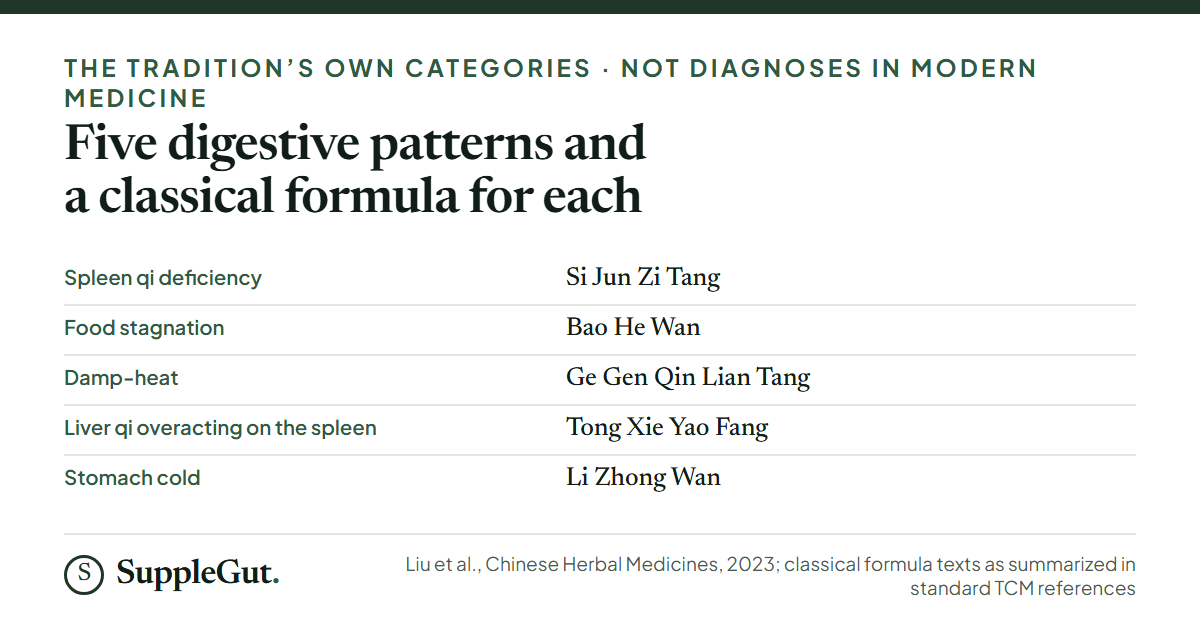
TCM treats digestion as the work of a pair, the spleen and the stomach. A 2023 review of TCM for functional dyspepsia calls them “the hub for the movement of qi in and out of the human body.” In the usual teaching the stomach receives and ripens food while the spleen “transforms and transports” it. When spleen qi is weak, the review says, qi stagnates in the middle of the body, and phlegm, water dampness and blood stasis can follow; dampness is linked to a weak spleen combined with fatty, sweet and rich food (Liu et al., Chinese Herbal Medicines, 2023). These are the tradition’s explanations, not physiology. The patterns that come up most for the gut are:
- Spleen qi deficiency. Poor appetite, tiredness, bloating after eating and loose stool. Classical formulas: Si Jun Zi Tang and Liu Jun Zi Tang, built around ginseng or codonopsis, atractylodes, poria and licorice.
- Food stagnation. Food said to be stuck: fullness, sour belching, no wish to eat. Bao He Wan, built around hawthorn, massa fermentata, radish seed and barley sprout.
- Damp-heat. Dampness with heat: burning, foul-smelling loose stool, thirst, a sticky yellow tongue coating. The texts use coptis-based formulas such as Ge Gen Qin Lian Tang.
- Liver qi overacting on the spleen. Pain followed by diarrhea, relieved after the stool, and worse with stress. Tong Xie Yao Fang and Xiao Yao San, with white peony and, in the second, bupleurum.
- Stomach cold. Pain eased by warmth, nausea and thin clear fluid. Warming formulas such as Li Zhong Wan, with dried ginger.
How a practitioner approaches a gut complaint
In the tradition’s account, the practitioner asks about appetite, stools, pain, thirst, response to heat and cold, sleep and stress, then examines the tongue (its color and coating) and the pulse at the wrist. The findings are sorted into a pattern, and a formula is built for it with the jun chen zuo shi principle: a chief herb aimed at the main pattern, deputies that reinforce it, assistants that moderate side effects or deal with secondary complaints, and an envoy that directs the formula and harmonizes it. In the usual reading of Si Jun Zi Tang, ginseng is the chief, atractylodes the deputy, poria the assistant and honey-fried licorice the envoy. A review notes that the modern scientific basis of this compatibility theory has not been clarified (LJMU repository). Diet advice follows the pattern.
A formula reaches the patient in one of four forms. A decoction is the raw herbs simmered in water and drunk as a tea. A granule is a concentrated dried extract that dissolves in hot water. A teapill is a small pill made from the herbs, taken by the handful. A patent medicine is a ready-made formula sold under its classical name in pill, tablet or capsule form; the labels we read give a blend total and an ordered list of herbs with no amount for each herb.
Who uses TCM
- China. TCM is part of the state system. National statistics counted 72,355 TCM institutions, 1,432,900 TCM beds and 682,770 TCM practitioners (assistants included) in 2020 (Zhou, PLOS ONE, 2023), and Volume I of the 2020 Chinese Pharmacopoeia holds 2,711 monographs on TCM materials and preparations.
- The WHO. The World Health Assembly approved ICD-11 in 2019. Its Chapter 26, a supplementary chapter on traditional medicine conditions, entered into force in 2022 with a first module on East Asian systems; the module lists 150 disorders and 196 patterns, and codes are meant to be paired with a conventional diagnosis (Lee et al., Bulletin of the World Health Organization, 2025; Reddy and Fan, 2022).
- The United States. The NCCIH says most states and the District of Columbia regulate acupuncture practice, and most require NCCAOM certification. Products are sold as dietary supplements; Chinese herbal medicine in the United States and Europe covers the rules.
- Japan. Kampo grew out of Chinese medicine, and 148 Kampo prescriptions are covered by Japan’s national health insurance (Kono et al., Frontiers in Pharmacology, 2015).
What the human evidence looks like
The NCCIH’s summary is that studies of Chinese herbal products have had mixed results and that, because many are of poor quality, no firm conclusions about effectiveness can be drawn. For the gut the evidence is mostly trials of formulas:
- Herbal medicines for IBS. A Cochrane review of 75 randomized trials with 7,957 participants found that only three double-blind, placebo-controlled trials were of high quality. A standard Chinese formula, individualized herbal medicine and Tong Xie Yao Fang each improved global symptoms against placebo; the authors advise caution with the less rigorous trials (Liu et al., Cochrane Database of Systematic Reviews, 2006).
- An Australian IBS trial. 116 people took individualized formulas (38), a standard formula (43) or placebo (35) for 16 weeks. Symptom scores improved on active treatment against placebo (P=.03 by patient rating), and individualized formulas were no more effective than the standard one (Bensoussan et al., JAMA, 1998).
- Xiang Sha Liu Jun Zi Tang for dyspepsia. A 2024 meta-analysis pooled 23 trials, all run in China, with 2,101 patients, and found a risk ratio of 1.27 (95% CI 1.21 to 1.33) for total clinical effectiveness. Its authors rated the evidence low in quality (Wang et al., Frontiers in Pharmacology, 2024).
The trial tables sit in TCM formulas for digestion: what the trials show and Does Chinese herbal medicine work for IBS?.
Safety, and what a buyer can check
The NCCIH lists what Chinese herbal products have contained: heavy metals such as arsenic, lead and cadmium, undeclared drugs including warfarin and diclofenac, pesticides, sulfites and incorrect herbs, some of which caused organ damage. The most thoroughly documented case is Belgian: slimming pills in which Stephania tetrandra had been replaced by Aristolochia fangchi, which contains aristolochic acid. Among 39 patients with end-stage kidney disease who agreed to preventive surgery, 18 (46%) had urothelial carcinoma (Nortier et al., NEJM, 2000). A California survey of 260 Asian patent medicines found that 83, or 32%, held undeclared drugs or heavy metals (Ko, NEJM, 1998). These are findings about the products sampled, not about every product.
What a buyer can check is limited: the Latin names and plant parts on the label, a Supplement Facts panel with amounts, and a third-party heavy-metal test result from the brand. The NCCIH advises asking any practitioner about training and experience. Are Chinese herbal supplements safe? goes through the surveys and case reports.
The catalog entries behind this guide
Common questions
How old is traditional Chinese medicine?
Its classical texts are dated by scholars to the Warring States and Han periods: the Huangdi Neijing from roughly the first centuries BCE, the Shennong Bencao Jing to the first and second centuries CE, and Zhang Zhongjing’s Shang Han Lun to before 220 CE. Each was edited over later centuries, and the Neijing’s standard text goes back to an imperial edition of 1053.
Is “TCM” the same as Chinese medicine in general?
Not exactly. “Traditional Chinese medicine” names the version standardized in the People’s Republic from the 1950s, and the English phrase dates to the same decade. Japanese Kampo and Korean medicine grew from the same classical sources and have their own formulas and rules.
What does TCM say about digestion?
It describes digestion as the work of the spleen and stomach, with the spleen said to transform and transport food and fluids. When spleen qi is weak, the texts say dampness and stagnation follow. Treatment starts from a pattern such as spleen qi deficiency, food stagnation or liver qi overacting on the spleen, and diet and a formula are chosen to fit it.
What is a TCM pattern?
A pattern (zheng) is the group of findings a practitioner reaches from questions, the tongue and the pulse, and it decides the formula. ICD-11’s traditional medicine chapter lists 150 disorders and 196 patterns. A pattern is the tradition’s category and is not a laboratory diagnosis.
Does traditional Chinese medicine help irritable bowel syndrome?
A Cochrane review of 75 trials with 7,957 participants found some formulas improved symptoms against placebo, but only three trials were of high quality. An Australian trial of 116 people found symptom scores better on active Chinese herbal formulas than placebo over 16 weeks, with individualized formulas no better than a standard one. Does Chinese herbal medicine work for IBS? has the detail.
Is TCM licensed in the United States?
Acupuncture is regulated in most states and the District of Columbia, and most require NCCAOM certification, according to the NCCIH. Chinese herbal products are sold as dietary supplements. Chinese herbal medicine in the United States and Europe covers the rules.
Do Chinese herbal products contain heavy metals or undeclared drugs?
Some have. The NCCIH lists arsenic, lead and cadmium, undeclared drugs such as warfarin and diclofenac, and wrong herbs, and a California survey found 83 of 260 patent medicines (32%) with undeclared drugs or heavy metals. The surveys describe the products sampled and do not extend to every product.
Sources
- NCCIH. “Traditional Chinese Medicine: What You Need To Know.” Origins, state regulation, safety and evidence summaries. nccih.nih.gov/health/traditional-chinese-medicine-what-you-need-to-know
- Unschuld PU; Sivin N; Needham J and Lu G-D, as summarized at Huangdi Neijing, Shanghan Lun and Shennong Ben Cao Jing. Dates, structure, editions, 365 entries and three grades.
- Taylor K. Chinese Medicine in Early Communist China, 1945–63. London: RoutledgeCurzon, 2005; Johnson I, 2021, as summarized at Traditional Chinese medicine. Standardization in the 1950s and the origin of the English term. The four TCM colleges of 1956: Chengdu University of Traditional Chinese Medicine.
- Choi S-H, Chang I-M. “A Milestone in Codifying the Wisdom of Traditional Oriental Medicine: TCM, Kampo, TKM, TVM: WHO International Standard Terminologies on Traditional Medicine in the Western Pacific Region.” Evidence-Based Complementary and Alternative Medicine, 2010;7(3):303–305. pmc.ncbi.nlm.nih.gov/articles/PMC2887335
- Jiang M, et al. “Syndrome differentiation in modern research of traditional Chinese medicine.” Journal of Ethnopharmacology, 2012;140(3):634–642. doi.org/10.1016/j.jep.2012.01.033
- Liu B, Kou Z, Chen B. “Effects and mechanisms of traditional Chinese medicines on functional dyspepsia: A review.” Chinese Herbal Medicines, 2023;15(4):516–525. pmc.ncbi.nlm.nih.gov/articles/PMC10715891
- “Compound-based Chinese medicine formula: from discovery to compatibility mechanism.” Liverpool John Moores University repository. The monarch–minister–assistant–guide principle. researchonline.ljmu.ac.uk/id/eprint/12359
- Zhou M. “Equity and prediction of health resource allocation of traditional Chinese medicine in China.” PLOS ONE, 2023. journals.plos.org/plosone
- ChemLinked. “China Issues the 2020 Edition of Chinese Pharmacopoeia.” Volume I, 2,711 monographs. baipharm.chemlinked.com
- Lee Y-S, et al. “International Statistical Classification of Diseases and data gaps in traditional medicine.” Bulletin of the World Health Organization, 2025;103(11):744–746. pmc.ncbi.nlm.nih.gov/articles/PMC12578526
- Reddy B, Fan AY. “Incorporation of complementary and traditional medicine in ICD-11.” BMC Medical Informatics and Decision Making, 2022. 150 disorders and 196 patterns. pmc.ncbi.nlm.nih.gov/articles/PMC9248085
- Kono T, et al. “Complementary and synergistic therapeutic effects of compounds found in Kampo medicine: analysis of daikenchuto.” Frontiers in Pharmacology, 2015;6:159. 148 Kampo prescriptions under national insurance. frontiersin.org
- Liu JP, et al. “Herbal medicines for treatment of irritable bowel syndrome.” Cochrane Database of Systematic Reviews, 2006;(1):CD004116. PMID 16437473. pubmed.ncbi.nlm.nih.gov/16437473
- Bensoussan A, et al. “Treatment of irritable bowel syndrome with Chinese herbal medicine: a randomized controlled trial.” JAMA, 1998;280(18):1585–1589. PMID 9820260. pubmed.ncbi.nlm.nih.gov/9820260
- Wang L, et al. “Efficacy and safety of Xiangsha liujunzi decoction for functional dyspepsia: a systematic review and meta-analysis.” Frontiers in Pharmacology, 2024. frontiersin.org
- Nortier JL, et al. “Urothelial carcinoma associated with the use of a Chinese herb (Aristolochia fangchi).” NEJM, 2000;342:1686–1692. PMID 10841870. pubmed.ncbi.nlm.nih.gov/10841870
- Ko RJ. “Adulterants in Asian patent medicines.” NEJM, 1998;339:847 (letter). PMID 9750079. pubmed.ncbi.nlm.nih.gov/9750079; figures as summarized by Relias Media.
- Brand pages for label format: Mayway (Plum Flower teapills) mayway.com; Health Concerns healthconcerns.com.
Still deciding between products?
The guide gives the background. For a single answer, the quiz asks about your symptoms, your routine and what you have tried, then names one product.
Take the quiz →