Guide
Are Chinese herbal supplements safe? Aristolochic acid, adulteration, heavy metals and what to check on a label
Quick answer
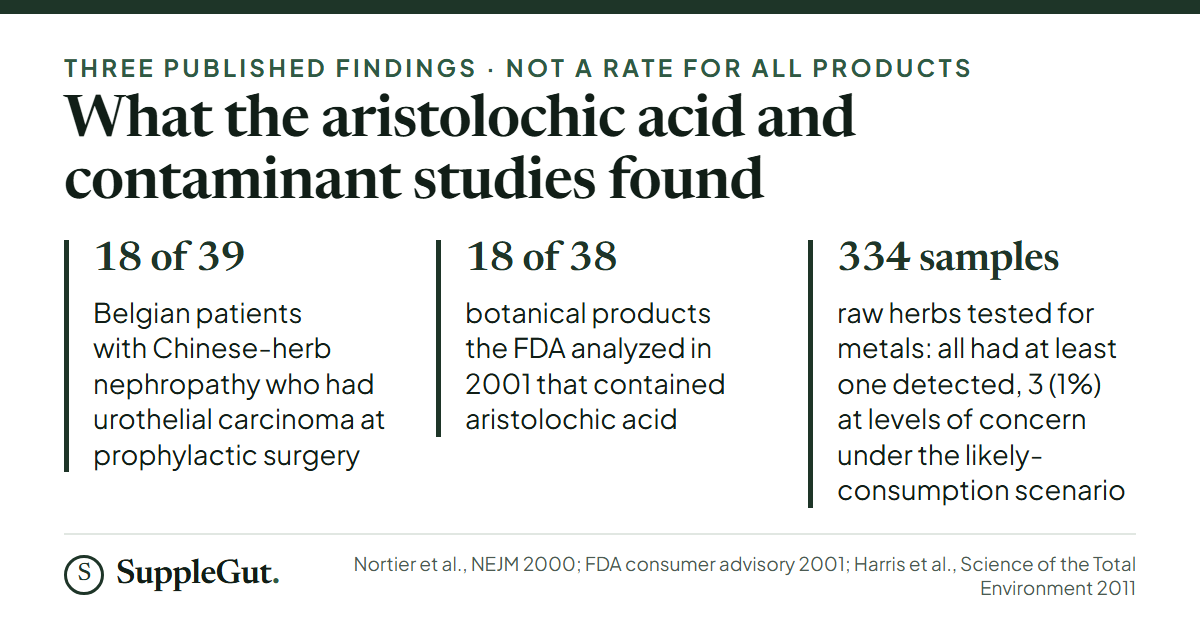
Are Chinese herbal supplements safe? It depends on the herb and the product, and the documented problems are specific. Aristolochia substituted for another herb caused kidney failure in Belgium, where 18 of 39 patients had urothelial cancer. A California survey of 260 patent medicines found at least 83 (32%) with undeclared drugs or heavy metals, and herbs such as licorice and ginseng have documented drug and blood-pressure effects. A label can show Latin names, amounts and a lot-matched test certificate, but cannot show that a bottle is genuine.
Chinese herbal products have a documented safety record with specific problems: aristolochic acid from the wrong plant species, undeclared drugs and heavy metals in patent medicines, counterfeits, and herb-specific effects on blood pressure, warfarin and the liver. This guide sets out each with its source, then what a label can and cannot show. The findings describe the products sampled and the herbs named, and do not extend to every product. For background see What is traditional Chinese medicine? and the glossary of key concepts; the TCM section lists the whole series. The trial record for the formulas is in Classic Chinese digestive formulas, and the IBS evidence is in Does Chinese herbal medicine work for IBS?
Aristolochic acid: the Belgian cases and after
In 1990 a Brussels slimming clinic added two Chinese herbs to its regimen, Stephania tetrandra and Magnolia officinalis (magnolia bark). By 1992 nine young women who had followed it were in terminal or preterminal kidney failure, and 8 of 9 biopsies showed extensive interstitial fibrosis (PMID 8094166). The cause was later traced to a manufacturing error: Aristolochia fangchi, which contains aristolochic acid, had replaced Stephania tetrandra. Among 39 patients with end-stage disease who agreed to prophylactic removal of their kidneys and ureters, 18 had urothelial carcinoma (46%, 95% CI 29% to 62%), 19 had dysplasia, and every tissue sample held aristolochic acid DNA adducts; cumulative doses above 200 g carried the higher risk (PMID 10841870). The European Medicines Agency counted more than 100 Belgian cases of irreversible nephropathy, with a third of patients transplanted (EMA public statement, 2005).
The same statement lists other clusters. In the UK, two women taking unlicensed remedies for eczema reached end-stage kidney failure after Aristolochia manshuriensis was substituted for Mu Tong, and later testing found aristolochic acid in over 40% of UK samples labeled Fang Ji or Mu Tong. China reported 17 kidney-failure cases from A. manshuriensis sold as Mu Tong, with 12 deaths; Japan reported ten cases of nephropathy in 1995 and France seven. The International Agency for Research on Cancer lists aristolochic acid and plants containing it as carcinogenic to humans (Group 1).
In 2001 the FDA advised consumers to stop using botanical products containing aristolochic acid after it analyzed 38 products and found 18 contained it. Import Alert 54-10 now directs detention without examination of dietary supplements containing aristolochic acid, naming Aristolochia, certain Asarum, Cocculus and Thottea species, and describes the compound as a potent carcinogen and nephrotoxin. Taiwan’s national insurance data show how widely exposure occurred: in a random sample of 200,000 insured people, 78,644 were prescribed products that might contain it between 1997 and 2003 (PMID 18945373). In a case-control study of 4,594 people with urinary tract cancer and 174,701 controls, more than 60 g of Mu Tong or an estimated 150 mg of aristolochic acid went with higher risk, rising with dose (Mu Tong 61 to 100 g: odds ratio 1.6; above 200 g: 2.1; aristolochic acid above 500 mg: 2.0), independent of arsenic exposure (PMID 20026811).
Undeclared drugs and heavy metals
In a 1998 New England Journal of Medicine letter, Ko reported the California Department of Health Services analysis of 260 Asian patent medicines bought from retail herbal stores. At least 83 (32%) contained undeclared pharmaceuticals or heavy metals; of the 31 containing pharmaceuticals, only 14 listed them on the label, and the letter counted 24 items with lead, 36 with arsenic and 35 with mercury (letter, summarized in Relias Media, NEJM). A systematic review of adulteration with synthetic drugs found 18 case reports, two case series and four analytical studies, with corticosteroids among the adulterants and one Taiwanese report of at least one conventional drug in 24% of samples (PMID 12190885).
Raw herbs are a different question. A survey of 334 samples of 126 species collected across China found at least one of five metals in every sample and pesticides in 36.7% of 294 samples tested, yet under the authors’ likely consumption scenario only 3 samples (1%) for metals and 14 (5%) for pesticides reached levels of concern, against 231 (69%) and 81 (28%) under the most conservative scenario (PMID 21824641).
Regulators have acted on named products. Health Canada warned in 2006 that certain lots of Emperor’s Tea Pill and Hepatico Extract, both made by Lanzhou Traditional Chinese Herbs, held high levels of lead and mercury, and a later advisory reported that testing of products seized from a Calgary herbal store found prescription drug ingredients. The FDA keeps a list of tainted supplements and publishes notices on pain and arthritis products, Chinese-labeled ones among them, found to contain hidden drugs such as diclofenac and dexamethasone. Counterfeits add a further problem. Mayway, a US importer of Emperor’s Teapills, stated in 2016 that Emperor’s Teapills sold in the New York area with extremely high lead and mercury were not its genuine Min Shan brand. It says its Min Shan products are tested for heavy metals at the factory and by a third-party laboratory, with results furnished on request. That is the brand’s own statement, and we have not seen the test reports.
Herb-specific problems
- Bupleurum formulas. A review of 73 patients in Japan with herbal-medicine pneumonitis found sho-saiko-to (Xiao Chai Hu Tang in Chinese), a bupleurum formula, the most frequent cause (26%); 89% developed it within three months, 36% recovered on stopping, 18% needed mechanical ventilation and 3 (4%) died (PMID 28274529).
- Ginseng and warfarin. A case report described reduced warfarin effect with ginseng (PMID 9075501). In a randomized trial of 20 healthy volunteers, two weeks of American ginseng lowered peak INR by 0.19 compared with placebo (95% CI 0.07 to 0.36; PMID 15238367).
- Licorice and blood pressure. Across 18 studies with 337 people ingesting at least 100 mg a day of glycyrrhizic acid, systolic pressure rose 5.45 mm Hg (95% CI 3.51 to 7.39) and plasma potassium fell 0.33 mmol/L (PMID 28660884).
- Pinellia, raw. The raw tuber irritates the mouth and throat, and processing reduces its toxicity (PMID 35988838); a toxic lectin falls with processing (PMID 39525387).
- Rhubarb root. The European monograph limits use to one week, warns that long-term use may cause water and electrolyte imbalance, notes that diuretics, corticosteroids and licorice add to potassium loss, and contraindicates it in pregnancy and under age 12 (EMA/HMPC/113700/2019).
- Ephedra (ma huang). A review of 140 adverse-event reports found 31% definitely or probably related to ephedra-alkaloid supplements, with 10 deaths and 13 permanent disabilities among the related events (PMID 11117974). The FDA declared such supplements adulterated in a rule published and effective in 2004. DNA sequencing of 15 TCM products found Ephedra and Asarum in some (PMID 22511890).
- He Shou Wu (Polygonum multiflorum). A series of 18 liver-injury cases from 2005 to 2012 had a median onset of 27 days, 14 rated highly probable (PMID 24559819). The HLA-B*35:01 allele was present in 45.4% of 11 patients with the injury against 2.7% of the Han Chinese population, and in a 72-person cohort taking it for four weeks, 37.5% of carriers had a transaminase rise against 4.7% of non-carriers (PMID 30985007).
Species substitution: why Latin names matter
Chinese herbs are traded under pinyin names, and one name can cover several plants. The EMA lists the following:
| Pinyin name | Plants sold under it |
|---|---|
| Fang Ji | Han fang ji, Stephania tetrandra root; Guang fang ji, Aristolochia fangchi root (contains aristolochic acid); Cocculus trilobus and C. orbiculatus roots |
| Mu Tong | Clematis armandii, Clematis montana, Akebia quinata or Akebia trifoliata stems; Guan Mu Tong, Aristolochia manshuriensis stem (contains aristolochic acid) |
The Belgian cases involved the Fang Ji swap and the British ones the Mu Tong swap. A review of aristolochic acid nephropathy noted that in Asian countries substitution of botanical products by aristolochic-acid herbs is frequent (PMID 18418355), and DNA sequencing of 15 TCM products found animal DNA, including from the Asiatic black bear and saiga antelope, with several animal families rarely declared on the packaging (PMID 22511890). A label that gives only a pinyin name cannot settle which plant is inside.
What a label can show, and what it cannot
- Pinyin and Latin names together, with the plant part (root, stem, fruit), so that Fang Ji can be told from Aristolochia.
- Amounts per serving in a Supplement Facts panel, with the extract ratio where it is an extract.
- Processing where it matters, such as processed rather than raw pinellia.
- Good manufacturing practice. US supplement makers must follow the FDA rule at 21 CFR Part 111. Australia’s TGA licenses local sites and clears overseas ones, and some makers state TGA GMP status.
- Third-party heavy-metal testing: a certificate naming the laboratory, the lot and the metals (arsenic, cadmium, lead, mercury).
A label cannot show that the bottle is genuine rather than a counterfeit, that the species is right, or that no undeclared drug is present, and a test certificate is the seller’s statement about a lot, which is worth matching to the lot number on the bottle.
The NCCIH notes that some Chinese herbal products have been contaminated with toxic compounds, heavy metals, pesticides and microorganisms, and that products have contained drugs such as warfarin and diclofenac; it advises talking with a health care provider before using TCM herbal products if you have a health condition.
Regulation in the US, EU and China
In the US these are dietary supplements under the Dietary Supplement Health and Education Act of 1994: manufacturers carry the first responsibility for safety and labeling, the FDA does not approve supplements before sale, and its role is mostly enforcement afterward. Most states and the District of Columbia regulate acupuncture practice. In the EU, Directive 2004/24/EC created a registration route for traditional herbal medicinal products with at least 30 years of use, 15 of them in the EU, with no clinical trials required, and the EMA reports that most member states acted against Aristolochia products and many also restrict Stephania. In China, TCM sits within the state health system and a Law on Traditional Chinese Medicine adopted in 2016 has been in force since 2017. TCM in the United States and Europe covers practice and regulation in more detail.
The entries this page refers to
Common questions
Are Chinese herbal supplements safe?
It depends on the herb and the product, and the documented problems are specific. They include aristolochic acid from the wrong plant species, undeclared drugs and heavy metals in patent medicines, counterfeits, and herb effects such as licorice raising blood pressure. The sources are in the sections above, and they describe the products sampled, not every product.
What is aristolochic acid and why is it a concern?
It is a compound in Aristolochia plants that damages the kidneys and causes urothelial cancer. In Belgium, 18 of 39 patients with the resulting kidney disease who had prophylactic surgery had urothelial carcinoma. The FDA warns against products containing it, and the IARC lists it as carcinogenic to humans.
Do Chinese herbal products contain heavy metals or drugs?
Some do. A California survey of 260 Asian patent medicines found at least 83 (32%) with undeclared pharmaceuticals or heavy metals, and a survey of 334 raw herbs found a metal in every sample, though only 1% at levels of concern under the likely-consumption scenario. These describe the samples tested.
What should a Chinese herbal supplement label show?
Pinyin and Latin names together with the plant part, amounts per serving in a Supplement Facts panel, processing where it matters, a statement of good manufacturing practice, and a third-party heavy-metal certificate that matches the lot number. A label cannot show that a bottle is genuine or free of undeclared drugs.
Can Chinese herbs interact with medicines?
Some can. American ginseng lowered the effect of warfarin in a 20-person trial, licorice raised blood pressure and lowered potassium across 18 studies, and rhubarb root adds to potassium loss from diuretics and corticosteroids according to the European monograph.
What is the difference between Fang Ji and Mu Tong?
Both are pinyin names that cover several plants. Fang Ji can be Stephania tetrandra, Cocculus species or Aristolochia fangchi; Mu Tong can be Clematis or Akebia stems or Aristolochia manshuriensis. The Aristolochia plants contain aristolochic acid, which is why Latin names matter.
Is ephedra (ma huang) banned?
In the US, the FDA declared dietary supplements containing ephedrine alkaloids adulterated in a rule published and effective in 2004. A review of 140 adverse-event reports had found 10 deaths and 13 permanent disabilities among those related to ephedra supplements.
Sources
- Vanherweghem JL, et al. “Rapidly progressive interstitial renal fibrosis in young women: association with slimming regimen including Chinese herbs.” Lancet, 1993;341(8842):387–391. pubmed.ncbi.nlm.nih.gov/8094166
- Nortier JL, et al. “Urothelial carcinoma associated with the use of a Chinese herb (Aristolochia fangchi).” New England Journal of Medicine, 2000;342(23):1686–1692. pubmed.ncbi.nlm.nih.gov/10841870
- European Medicines Agency, Committee on Herbal Medicinal Products. “Public statement on the risks associated with the use of herbal products containing Aristolochia species.” 2005. Case counts, Fang Ji and Mu Tong species. ema.europa.eu
- FDA. Import Alert 54-10, “Detention without physical examination of bulk/finished dietary supplements products containing aristolochic acid.” accessdata.fda.gov
- FDA. Consumer advisory on botanical products containing aristolochic acid, 2001 (38 products analyzed, 18 containing aristolochic acid), reproduced at medicinenet.com and reported at foodnavigator.com.
- IARC Monographs. List of classifications: aristolochic acid and plants containing aristolochic acid, Group 1. monographs.iarc.who.int
- Hsieh SC, et al. “Prescription profile of potentially aristolochic acid containing Chinese herbal products: an analysis of National Health Insurance data in Taiwan between 1997 and 2003.” Chinese Medicine, 2008;3:13. pubmed.ncbi.nlm.nih.gov/18945373
- Lai MN, et al. “Population-based case-control study of Chinese herbal products containing aristolochic acid and urinary tract cancer risk.” Journal of the National Cancer Institute, 2010;102(3):179–186. pubmed.ncbi.nlm.nih.gov/20026811
- Debelle FD, Vanherweghem JL, Nortier JL. “Aristolochic acid nephropathy: a worldwide problem.” Kidney International, 2008;74(2):158–169. pubmed.ncbi.nlm.nih.gov/18418355
- Ko RJ. “Adulterants in Asian patent medicines.” New England Journal of Medicine, 1998;339(12):847. pubmed.ncbi.nlm.nih.gov/9750079; summary of the figures at reliasmedia.com
- Ernst E. “Adulteration of Chinese herbal medicines with synthetic drugs: a systematic review.” Journal of Internal Medicine, 2002;252(2):107–113. pubmed.ncbi.nlm.nih.gov/12190885
- Harris ES, et al. “Heavy metal and pesticide content in commonly prescribed individual raw Chinese herbal medicines.” Science of the Total Environment, 2011;409(20):4297–4305. pubmed.ncbi.nlm.nih.gov/21824641
- Health Canada. “Health Canada advises consumers not to use two unauthorized natural health products due to heavy metal contamination” (Emperor’s Tea Pill and Hepatico Extract), 2006. canada.ca; and the testing advisory on products from a Calgary herbal store, recalls-rappels.canada.ca
- FDA. “Avoiding products contaminated with hidden ingredients” and “Pain and arthritis products containing hidden ingredients.” fda.gov; fda.gov
- Mayway. “Mayway’s response to ‘Dietary supplement sold in city found to have high levels of lead and mercury’ article” (2016). Manufacturer’s own statement. mayway.com; mayway.com/news-archive
- Enomoto Y, et al. “Japanese herbal medicine-induced pneumonitis: a review of 73 patients.” Respiratory Investigation, 2017;55(2):138–144. pubmed.ncbi.nlm.nih.gov/28274529
- Janetzky K, Morreale AP. “Probable interaction between warfarin and ginseng.” American Journal of Health-System Pharmacy, 1997;54(6):692–693. pubmed.ncbi.nlm.nih.gov/9075501
- Yuan CS, et al. “American ginseng reduces warfarin’s effect in healthy patients: a randomized, controlled trial.” Annals of Internal Medicine, 2004;141(1):23–27. pubmed.ncbi.nlm.nih.gov/15238367
- Penninkilampi R, et al. “The association between consistent licorice ingestion, hypertension and hypokalaemia: a systematic review and meta-analysis.” Journal of Human Hypertension, 2017;31(11):699–707. pubmed.ncbi.nlm.nih.gov/28660884
- Bai J, et al. “A comprehensive review on ethnopharmacological, phytochemical, pharmacological and toxicological evaluation, and quality control of Pinellia ternata.” Journal of Ethnopharmacology, 2022;298:115650. pubmed.ncbi.nlm.nih.gov/35988838
- Wang X, et al. “Food processing drives the toxic lectin reduction and bioactive peptide enhancement in Pinellia ternata.” Current Research in Food Science, 2024;9:100895. pubmed.ncbi.nlm.nih.gov/39525387
- EMA HMPC. “European Union herbal monograph on Rheum palmatum L. and Rheum officinale Baillon, radix” (EMA/HMPC/113700/2019). ema.europa.eu
- Haller CA, Benowitz NL. “Adverse cardiovascular and central nervous system events associated with dietary supplements containing ephedra alkaloids.” New England Journal of Medicine, 2000;343(25):1833–1838. pubmed.ncbi.nlm.nih.gov/11117974
- FDA. “Final rule declaring dietary supplements containing ephedrine alkaloids adulterated because they present an unreasonable risk”, 69 FR 6788, 2004. federalregister.gov; fda.gov
- Coghlan ML, et al. “Deep sequencing of plant and animal DNA contained within traditional Chinese medicines reveals legality issues and health safety concerns.” PLoS Genetics, 2012;8(4):e1002657. pubmed.ncbi.nlm.nih.gov/22511890
- Dong H, et al. “Eighteen cases of liver injury following ingestion of Polygonum multiflorum.” Complementary Therapies in Medicine, 2014;22(1):70–74. pubmed.ncbi.nlm.nih.gov/24559819
- Li C, et al. “HLA-B*35:01 allele is a potential biomarker for predicting Polygonum multiflorum-induced liver injury in humans.” Hepatology, 2019;70(1):346–357. pubmed.ncbi.nlm.nih.gov/30985007
- NCCIH. “Traditional Chinese medicine: what you need to know.” Contaminants, undeclared drugs, acupuncture licensing. nccih.nih.gov
- FDA. “Questions and answers on dietary supplements” and the current good manufacturing practice rule for dietary supplements (21 CFR Part 111). fda.gov
- Therapeutic Goods Administration. “Overseas manufacturers” (GMP clearance). tga.gov.au
- European Commission. “Herbal medicinal products” (Directive 2004/24/EC, traditional use registration). health.ec.europa.eu
- Law of the People’s Republic of China on Traditional Chinese Medicine, adopted 2016, in force 2017. caixinglobal.com
Which of these fits you?
Three minutes with the quiz turns this background into one named product, with the reasons shown.
Take the quiz →