
Stool form and regularity
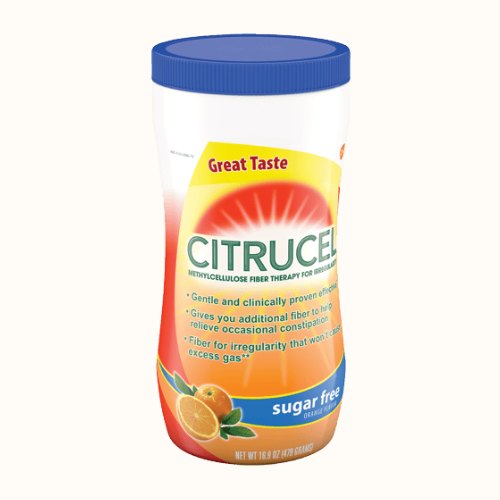
Citrucel Sugar Free Orange Fiber Powder
A methylcellulose powder with an over-the-counter laxative label, sold as the fiber that will not ferment.
- Format
- Powder
- Type
- Fiber
- Cost
- $0.44 a day
- Customer rating
- 4.7 out of 5 from 1,563 ratings from Amazon
What customers consistently report
- Regularity without the cramping or gas some get from psyllium
- A large tub that lasts months
- Dissolving cleanly when stirred straight away
Those are the themes that recur across the reviews. High review confidence — 4.7 from 1,563 Amazon ratings on the 32 oz listing.
Why it might work
Methylcellulose is a chemically modified plant cellulose that absorbs water and adds soft bulk to stool, which is the bulk-laxative mechanism. Unlike inulin or wheat dextrin it is not fermented by colonic bacteria, so it does not feed gas, and Citrucel is marketed on that. It is classed in the fiber literature as viscous but non-gel-forming, which is the likeliest reason it lacks psyllium’s cholesterol effect. Like every bulk fiber it needs a full glass of liquid and 12 to 72 hours to act.
What the research supports
Ingredient-level evidence, and not much of it. A 1988 study gave 59 chronically constipated people 1, 2 or 4 g of methylcellulose a day or 3.4 g of psyllium; every arm increased stool frequency and water content, but there was no placebo group. A 2017 review states there are no well-controlled clinical studies in constipated patients supporting methylcellulose against placebo, and a 1991 trial found it did not lower cholesterol where psyllium did. The 2023 AGA/ACG constipation guideline does not address it. No trial of the branded powder was found.
What the label discloses
The OTC drug label states 2 g of methylcellulose per rounded tablespoon with maltodextrin, aspartame, citric and malic acid, flavor and potassium citrate; 30 calories from maltodextrin per dose. The "won’t cause excess gas" claim is footnoted to laboratory testing. Sold as an OTC bulk laxative with a filed Drug Facts panel. No third-party testing is stated.
Who this tends to suit
We match this product to people reporting constipation, irregular bowel habits and a feeling of incomplete emptying. It fits someone whose priority is regularity or a steady daily routine. Whether it is the best fit for you depends on the rest of your answers — what you have already tried, what format you will take, and anything that has to be ruled out.
Where it may not fit
The label supports gluten-free. A powder only works if you will take it as often as the label directs.
Side effects and what to be aware of
The evidence is thin: one 1988 study with no placebo arm. Each rounded tablespoon is 2 g of fiber against 7 g in a serving of plain psyllium, and the label caps you at three a day. It is sweetened with aspartame (48.6 mg phenylalanine per dose) and needs a full glass of liquid or it can swell and block the throat. Some find the taste sour and the powder slow to dissolve.
Is this the right one for you?
The quiz works out which of the products we have researched fits your symptoms, your routine and what you have already tried — and tells you plainly if none of them do.
Take the quiz →Free. Private. Nothing to sign up for.
Others we researched for the same job
These sit in the same role as Citrucel Sugar Free Orange Fiber Powder — stool form and regularity — so they are the sensible things to weigh it against.
See all the products we have researched →
Related reading
Background on how this type of product works, read from the trial evidence.