
Comparison
Metamucil vs Citrucel: which fiber powder actually works?
They sit next to each other on every pharmacy shelf, both orange, both sugar-free, both sold for occasional constipation. They are not the same fiber. Metamucil is psyllium husk; Citrucel is methylcellulose, a chemically modified plant cellulose. That one difference decides the evidence, the dose and what each is good for.
Quick answer
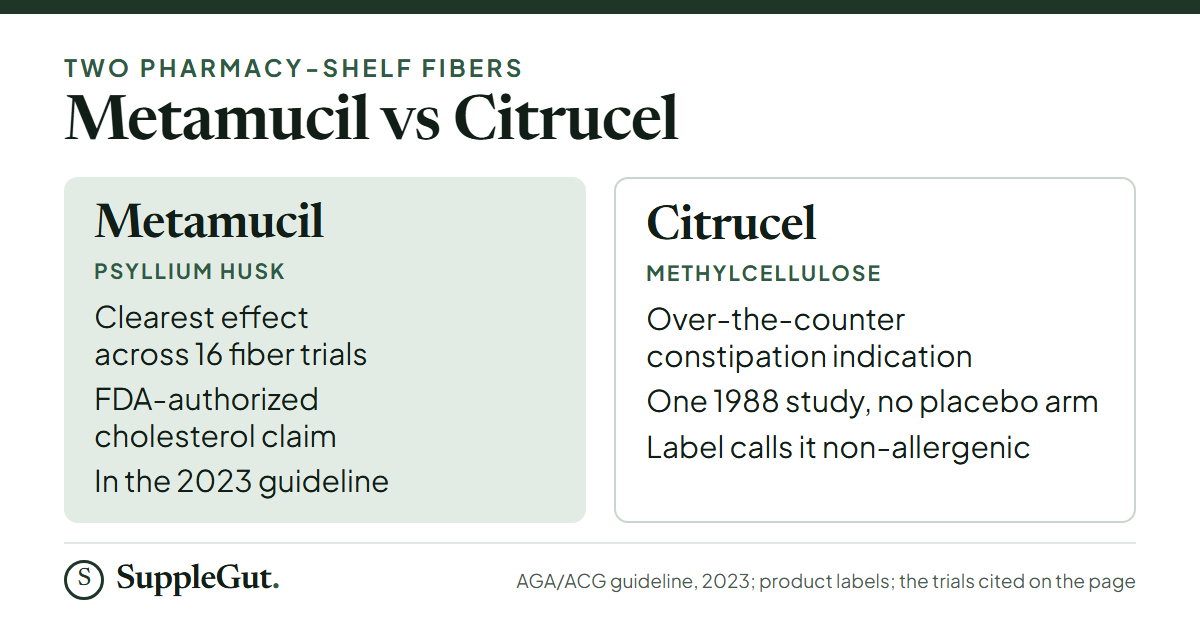
Metamucil, on the evidence. Psyllium has the clearest effect in a meta-analysis of sixteen randomized fiber trials, an FDA-authorized cholesterol claim and the 2023 gastroenterology guideline behind it. Methylcellulose has an over-the-counter indication and a single 1988 study without a placebo arm.
Citrucel, if Metamucil did not agree with you. It is the standard second try when psyllium causes bloating you cannot get past, and its label calls methylcellulose a non-allergenic fiber. Either way, plain psyllium husk powder gives more fiber per dose than both, at a lower cost per gram of fiber.
The short answer
Metamucil 4-in-1 Fiber Powder, Sugar-Free Orange
$0.22–0.25 a dose · 4.6★ from 7,984 ratings at Walmart Business
Psyllium husk with an OTC drug label. The meta-analysis of 16 randomized fiber trials in 1,251 people with chronic constipation found 66% responded to fiber against 41% on placebo, with psyllium the clearest performer, and the 2023 AGA/ACG guideline names psyllium as the one fiber supplement that appears to work. Roughly 3.4 g of psyllium per teaspoon or packet; three a day reaches the 7 g behind the cholesterol claim.
- Hard, dry or infrequent stools
- You also want the cholesterol effect
- You want the fiber with the trial record
Citrucel Sugar Free Orange Powder
$39.30 for 32 oz · 4.7★ from 1,563 ratings at Amazon
Methylcellulose, 2 g per rounded tablespoon, with an OTC label and a “won’t cause excess gas” claim footnoted to laboratory testing. The one clinical study (1988, 59 constipated people) found it increased stool frequency and water at 1 to 4 g a day — measured against psyllium, not placebo.
- Metamucil left you bloated even after a slow start
- You react to psyllium itself
- You want the higher customer rating and do not mind the thinner evidence
Not sure which of the two fits you? The quiz asks about your symptoms before it names one.
The cheaper answer to both. Plain psyllium husk powder is the same fiber as Metamucil with nothing added: 7 g of fiber per serving at $0.31 a day, no aspartame, no Yellow 6. Both branded powders are paying for flavor, portioning and a drug label. See psyllium husk vs Metamucil for that comparison.
Side by side
✓ marks the product with the advantage on that row. Rows with no mark are a genuine tie or a matter of preference.
Where they differ
1. Different fibers, so different evidence
Psyllium’s record is long: the 16-trial fiber meta-analysis for constipation, in which psyllium did best, more than twenty controlled cholesterol trials behind the FDA claim, and the guideline sentence quoted above. Methylcellulose’s record is one study from 1988 in which 59 chronically constipated people took 1, 2 or 4 g a day or 3.4 g of psyllium; all arms improved, and there was no placebo group to show how much was the fiber. A 2017 review by two fiber researchers puts it plainly: methylcellulose “has an over-the-counter indication for relief of constipation, but there are no well-controlled clinical studies in constipated patients to support efficacy versus placebo.”
2. Gel or no gel
Psyllium forms a viscous gel that keeps holding water through the colon; that is the laxative mechanism and, in the small intestine, the cholesterol mechanism. Methylcellulose is viscous but non-gel-forming in that literature, and the one trial that tested the difference — 105 people with high cholesterol, eight weeks — found LDL fell 8.8% on psyllium and not at all on methylcellulose.
3. Gas
Both are largely non-fermentable, which is what separates them from inulin and wheat dextrin. Citrucel’s gas claim rests on laboratory testing. The only head-to-head human data, a 2026 trial in 30 volunteers, found psyllium blunted the early fermentation of a 15 g inulin dose significantly (p = 0.033 against placebo) while methylcellulose did not reach significance (p = 0.49). People who bloat on Metamucil and settle on Citrucel exist; that experience is a fair reason to switch, not evidence that methylcellulose is gentler in general.
4. Where Citrucel wins
Allergy and preference. Its label calls methylcellulose “a non-allergenic fiber,” and psyllium is a recognized allergen for a small number of people. It carries no artificial color where Metamucil uses Yellow 6, and it has the higher customer rating of the two, though from a smaller pool.
Where they are the same
- Both need a full glass of liquid, and both labels carry the same choking warning. Neither is for anyone with difficulty swallowing.
- Both take 12 to 72 hours to a first bowel movement, and both say stop after seven days without result or if there is rectal bleeding.
- Both should be spaced from medicines by about two hours.
- Both sugar-free versions use aspartame and carry a phenylalanine warning.
- Both cost more per gram of fiber than plain psyllium.
Read the full research
Common questions
Which is better, Metamucil or Citrucel?
On evidence, Metamucil. Its fiber, psyllium, had the clearest effect in a meta-analysis of 16 randomized fiber trials in 1,251 people with constipation, has an FDA-authorized cholesterol claim, and is the one fiber the 2023 AGA/ACG guideline says appears to be effective. Citrucel’s methylcellulose has an over-the-counter indication and one 1988 study with no placebo arm. Citrucel is the sensible second choice if Metamucil left you bloated.
Is Citrucel gentler than Metamucil?
Citrucel is marketed as fiber that “won’t cause excess gas,” footnoted to laboratory testing. Psyllium is also largely non-fermentable, and the only head-to-head data, a 2026 trial in 30 volunteers, favored psyllium for blunting fermentation. Some people do tolerate methylcellulose better; that is a reason to try it, not proof it is gentler.
Does Citrucel lower cholesterol like Metamucil?
No. In an 8-week trial in 105 people with high cholesterol, psyllium lowered LDL by 8.8% against placebo and methylcellulose did not. Metamucil prints the FDA-authorized claim on its pack; Citrucel makes no cholesterol claim.
Can I switch from Metamucil to Citrucel?
Yes, and it is the usual move when psyllium causes bloating that does not settle after the first couple of weeks. Start Citrucel at one rounded tablespoon a day with a full glass of water and build up. The fiber per dose is lower (2 g against Metamucil’s roughly 3.4 g of psyllium), so do not expect a stronger effect.
Do Metamucil and Citrucel contain aspartame?
The sugar-free orange versions of both do. Metamucil’s label states 25 mg of phenylalanine per teaspoon; Citrucel’s states 48.6 mg per adult dose. Plain psyllium husk powder contains no sweetener at all.
In one line: Metamucil 4-in-1 Fiber Powder, Sugar-Free Orange — best evidence of the two.
Which fiber for constipation, on one page
Which fibers have the trials, the dose that worked, and how to take it without the gas. Sent by email, then two short follow-ups over ten days. Unsubscribe any time.
Your address is used for these three emails and nothing else. How we handle it.
Speak to a doctor first if you are pregnant, breastfeeding, trying to conceive, immune-suppressed, or taking prescription medication — and before starting anything if you have blood in your stool, unexplained weight loss, persistent vomiting, or pain severe enough to wake you at night. Those are signs to get looked at, not to try a supplement.
Is a fiber powder the right first step for you?
Bulk fiber suits hard or infrequent stools and does little for bloating that follows particular foods. Our quiz sorts that out before it names a product.
Find your match →Free · Private · No sign-up · 1–3 minutes
Related guides
Other comparisons
Where these numbers come from
- Metamucil OTC drug label; approximately 3.4 g psyllium per packet; phenylalanine — dailymed.nlm.nih.gov/dailymed/drugInfo.cfm?setid=a9824f73-5ea2
- Metamucil supplement facts, other ingredients and per-dose price — www.heb.com/product-detail/metamucil-4-in-1-psyllium-husk-fibe
- Metamucil rating, 4.6 from 7,984 — business.walmart.com/ip/Metamucil-Fiber-Supplement-Sugar-Free-
- Citrucel OTC drug label: 2 g methylcellulose per rounded tablespoon, warnings, 48.6 mg phenylalanine — dailymed.nlm.nih.gov/dailymed/drugInfo.cfm?setid=9d5f2244-a610
- Citrucel Sugar Free Orange: the non-fermentable claim and its laboratory-testing footnote — www.citrucel.com/products/sugar-free-orange-mix
- Citrucel 32 oz price and rating, 4.7 from 1,563 — www.amazon.com/dp/B010SI4TCI?tag=supplegut-20
- Fiber constipation meta-analysis, 16 trials, 1,251 people — pubmed.ncbi.nlm.nih.gov/35816465
- Chang L et al. AGA-ACG guideline on chronic idiopathic constipation, 2023 — pubmed.ncbi.nlm.nih.gov/37211380
- Hamilton JW et al. Clinical evaluation of methylcellulose as a bulk laxative. Dig Dis Sci 1988 — pubmed.ncbi.nlm.nih.gov/2839321
- Lambeau KV, McRorie JW. Fiber supplements and clinically proven health benefits. 2017 (methylcellulose statement; Anderson 1991 cholesterol trial) — pmc.ncbi.nlm.nih.gov/articles/PMC5413815
- Reid et al. Modified cellulose or psyllium and colonic gas production: randomized trial in 30 volunteers. Food Funct 2026 — pmc.ncbi.nlm.nih.gov/articles/PMC12869852
- FDA authorized health claim, 7 g/day soluble psyllium, 21 CFR 101.81 — www.law.cornell.edu/cfr/text/21/101.81
Prices and star ratings are point-in-time snapshots and move around. Where a figure could not be confirmed from a manufacturer label or retailer listing, this page says so rather than estimating.