Discomfort and cramping
Jupi Debloat & Hydration Powder
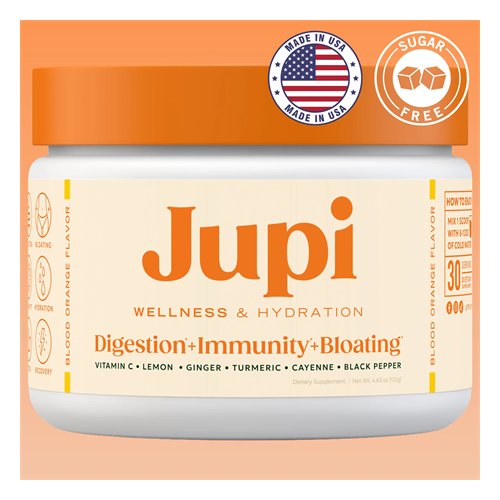
A blood orange powder with ginger, turmeric, electrolytes and vitamins C and D, stirred into water once a day.
- Format
- Powder, once a day
- Type
- Herbal
- Cost
- See the price on Amazon
- Customer rating
- See the reviews on Amazon
Not sure it suits your symptoms? The quiz matches one product to you in one to three minutes.
The mechanism, as the brand describes it
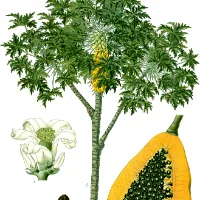
Ginger is thought to speed gastric emptying and stimulate stomach contractions, which one small trial measured in dyspepsia patients without a change in symptoms. Turmeric contains curcuminoids that are poorly absorbed on their own, and piperine from black pepper raised curcumin absorption in a human study at 20 mg with 2 g of curcumin. The brand lists kiwi and papaya as sources of natural digestive enzymes (amounts are small and no enzyme activity is printed), apple cider vinegar and lemon add acid and flavor, and the electrolytes (sodium, potassium, magnesium, chloride) and vitamins C and D are there for hydration and immune claims, not bloating. The label amounts are lower than the trial amounts for ginger, turmeric, cayenne, kiwi and papaya, and the powder is not a delayed-release or enzyme product.
What has actually been tested
We found no trial of Jupi Debloat & Hydration Powder. The label carries 250 mg of ginger root and 500 mg of turmeric root, below the doses in dyspepsia trials: a ginger extract at 480 mg a day improved symptom scores in an 80-person trial and a single 1.2 g dose sped gastric emptying in 11 patients, but ginger at 1 and 2 g a day did not beat placebo in a 45-person irritable bowel trial, and turmeric at 750 mg to 2 g a day gave dyspepsia scores comparable to omeprazole or simethicone in trials of 78 to 206 patients. Those trials measured dyspepsia, not bloating alone, and a 2024 review of turmeric in digestive disorders rated most studies at high risk of bias.
What the panel prints, and what it leaves out
Every ingredient has its own printed amount and there is no proprietary blend, but the turmeric and ginger are listed as root, with no curcuminoid or gingerol content, and the black pepper extract is 5 mg against 20 mg in the widely cited absorption study. The brand names no manufacturer, laboratory or certification, and the Amazon listing’s shorter ingredient line and “Orange” flavor differ from the brand panel. The panel net weight (189 g) and the jar graphic (132 g) disagree.
Herb entries for what is in it.




When it makes sense
Its symptom profile covers bloating and general abdominal discomfort. It fits someone whose priority is day-to-day comfort or a steady daily routine. Debloat & Hydration Powder can match on symptoms and still lose to something else once your history, your format and your medicines are in.
Where it falls short of the brief
The dietary claims the label makes are gluten-free and vegan. If you are pregnant or breastfeeding or taking prescription medication, the quiz leaves this product out of your results. The flag is about who should make that decision, not about the product itself. A powder only works if you will take it once a day, every day.
Side effects and what to be aware of
The brand’s typed rating is 4.8. The brand’s FAQ advises checking with a healthcare provider if pregnant, nursing, taking medication or having a medical condition, and says to start with half a scoop if the stomach is sensitive. One scoop has 400 mg of sodium and 50 mcg of vitamin D (250% of the Daily Value).
Questions people ask
Does Jupi Debloat & Hydration work for bloating?
No trial of Jupi was found. Ginger at 250 mg and turmeric at 500 mg per scoop are below the 480 mg to 1.2 g ginger and 750 mg to 2 g turmeric doses used in dyspepsia trials, and those trials measured dyspepsia symptoms rather than bloating alone. The brand’s own survey claim (87% less discomfort in 7 days) gives no number of respondents.
What is in a scoop of Jupi?
One 6.3 g scoop lists 500 mg turmeric root, 300 mg kiwi, 250 mg ginger root, 200 mg baobab, 150 mg papaya, 125 mg apple cider vinegar, 100 mg coconut water powder, 100 mg lemon balm extract, 25 mg lemon, 10 mg cayenne and 5 mg BioPerine, plus vitamin C 100 mg, vitamin D 50 mcg, magnesium 100 mg, zinc 2 mg, sodium 400 mg, chloride 610 mg and potassium 150 mg. It is sweetened with stevia leaf extract.
Is Jupi safe, and what are the side effects?
The label panel shows no warning, but the brand’s FAQ says to check with a healthcare provider if pregnant, nursing, taking medication or having a medical condition, and to start with half a scoop if the stomach is sensitive. In an open-label trial of 1,080 mg of ginger a day, 14.9% reported bloating and 12.8% heartburn as mild effects. One scoop has 400 mg of sodium and vitamin D at 250% of the Daily Value.
How much does Jupi cost, and is there a subscription?
A jar of about 30 servings is $47.99 on the brand site ($1.60 a day). The brand’s multi-jar bundles are $95.98 for 3 and $143.96 for 5. The store pages read show no recurring plan; the refund page gives a 60-day return window and the FAQ also offers a 30-day guarantee, and Amazon marks it non-returnable.
Jupi vs a ginger or turmeric supplement: what is different?
Jupi combines ginger, turmeric, electrolytes and vitamins in one powder at modest amounts; single-ingredient ginger and turmeric products can carry the higher doses used in the trials. No trial compares them, and the label here gives root amounts rather than extract strengths.
A word before buying. Anyone pregnant or breastfeeding, or taking prescription medication should run Debloat & Hydration Powder past a doctor or pharmacist. What is written here is research, not medical advice.
Would it come out on top for you?
Answer the quiz to see whether Debloat & Hydration Powder fits your case or whether a product in the same role fits better.
Take the quiz →Free. Private. Nothing to sign up for.
Its peers in the catalog
These sit in the same role as Jupi Debloat & Hydration Powder — discomfort and cramping — so they are the sensible things to weigh it against.
See all the products we have researched →
Further reading
The guides behind the category, written from the trials rather than the labels.